I had the incredible opportunity to visit NVIDIA HQ alongside a small but mighty group of Mayfield AI founders, going behind the scenes of one of the most transformative companies of our time.
I held in my hands the Blackwell B200 GPU—the world’s most powerful AI chip, the engine fueling this new industrial revolution.
And then, I met Jensen Huang, the man in the driver’s seat. What a mind-blowing vision of the future! We’re not just building new technology—we’re unlocking entirely new realities and industries.
But what struck me most was his raw honesty about entrepreneurship:
“If it’s not hard, you’re not moving fast enough.”
Being a successful founder isn’t just about scoring wins —it’s about enduring the pain, failures, and challenges to build something great.
Channeling that wisdom as I push forward on my own startup journey. More soon on that.
#AI #Entrepreneurship #Startups #NVIDIA
“Oh my god… I have no words.”
Listen to the emotional moment this year’s laureate Maria Corina Machado finds out she has been awarded the Nobel Peace Prize.
Kristian Berg Harpviken, Director of the Norwegian Nobel Institute, shared the news with her directly before it was announced to the world.
#NobelPrize #NobelPeacePrize
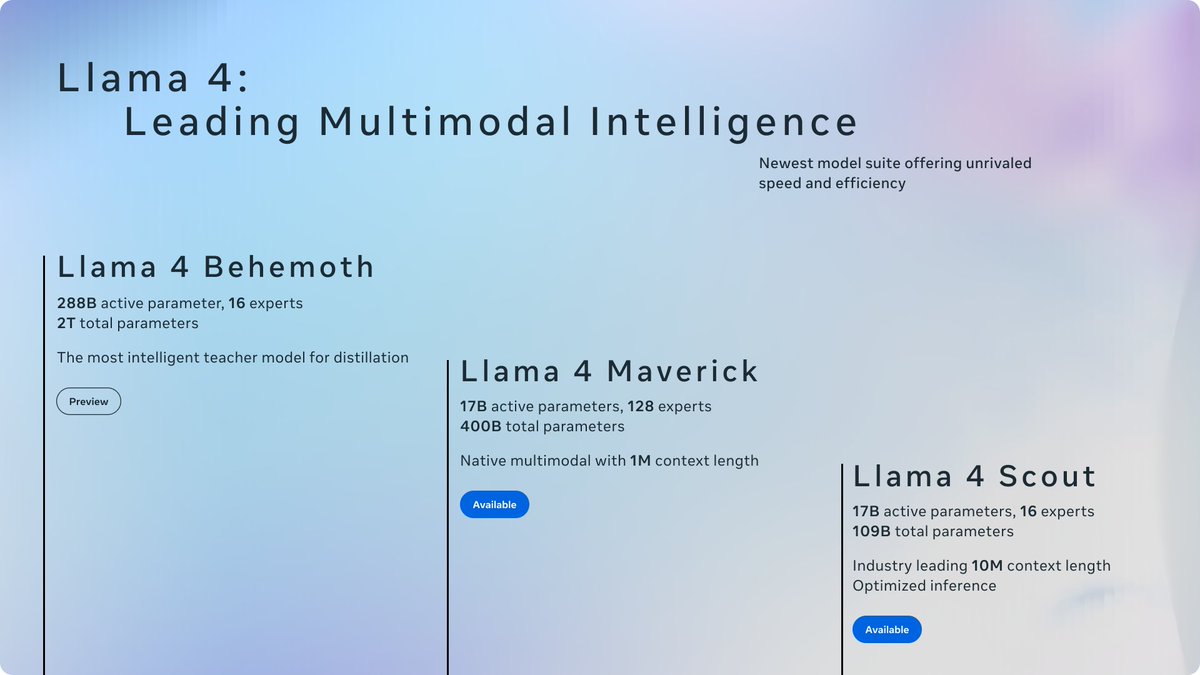
Today is the start of a new era of natively multimodal AI innovation.
Today, we’re introducing the first Llama 4 models: Llama 4 Scout and Llama 4 Maverick — our most advanced models yet and the best in their class for multimodality.
Llama 4 Scout
• 17B-active-parameter model with 16 experts.
• Industry-leading context window of 10M tokens.
• Outperforms Gemma 3, Gemini 2.0 Flash-Lite and Mistral 3.1 across a broad range of widely accepted benchmarks.
Llama 4 Maverick
• 17B-active-parameter model with 128 experts.
• Best-in-class image grounding with the ability to align user prompts with relevant visual concepts and anchor model responses to regions in the image.
• Outperforms GPT-4o and Gemini 2.0 Flash across a broad range of widely accepted benchmarks.
• Achieves comparable results to DeepSeek v3 on reasoning and coding — at half the active parameters.
• Unparalleled performance-to-cost ratio with a chat version scoring ELO of 1417 on LMArena.
These models are our best yet thanks to distillation from Llama 4 Behemoth, our most powerful model yet. Llama 4 Behemoth is still in training and is currently seeing results that outperform GPT-4.5, Claude Sonnet 3.7, and Gemini 2.0 Pro on STEM-focused benchmarks. We’re excited to share more details about it even while it’s still in flight.
Read more about the first Llama 4 models, including training and benchmarks ➡️ https://t.co/9G3QgVdCkB
Download Llama 4 ➡️ https://t.co/eVomRvEr0w
✈️ HouseWhisper is heading to Nashville!
AI is transforming real estate, and we’re discussing it at @InmanConnect On Tour Nashville. Our CEO, Luis Poggi, joins top AI leaders to share how tech is reshaping agent workflows & client communication.
Will you be there?
Still riding the high from launch week 🎢🔥 HouseWhisper is out in the world, and none of it would’ve happened without this absolute dream team. 😍🙌
If you know AI (and you’re fantastic too) join us! Send your resume to [email protected]
I’ve been working on something amazing, and today, I finally get to share it: we’re officially launching HouseWhisper AI! 🎉🎉🎉
@housewhisperai is an AI teammate for real estate that handles lead management tasks and remembers every little detail so agents don’t have to. It’s our dream to give every agent a personal assistant who’s always got their back, and is just a call or text away anytime.
Check out a real call with one of our 4000+ agent customers here 🔊:
We’ve raised almost 10M in total funding from @MayfieldFund , @psl , @IntegraGroupe , and @75SunnyVentures , and we have huge plans for HouseWhisper in 2025. So proud of this team and excited for what’s ahead! 🚀
Check out https://t.co/rfbIUdmGbC to learn more and get HouseWhisper.
#realestate #AI #startup #Innovation #entrepreneur
For a long time, I’ve been fascinated by the idea of AI as a teammate. At face value, it can sound scary, but the nuance is critical. AI is not replacing your job: it’s the teammate your boss could never hire to help you with your job. It can take the intermittent, humdrum tasks off your plate entirely, clearing your head (and schedule) for the things you’re great at.
For so long, software has given us the ability to do more, but it hasn’t truly done the work for us. I’m excited to chip away at that paradigm with a new project launching soon - stay tuned.
In the meantime, I’ve written about some interesting thinking on this shift from some of the top VC minds. If you’re as excited as I am, read more on my substack:
https://t.co/knxzGdHbCr
#AI #Entrepreneurship #Startups
I think AI agentic workflows will drive massive AI progress this year — perhaps even more than the next generation of foundation models. This is an important trend, and I urge everyone who works in AI to pay attention to it.
Today, we mostly use LLMs in zero-shot mode, prompting a model to generate final output token by token without revising its work. This is akin to asking someone to compose an essay from start to finish, typing straight through with no backspacing allowed, and expecting a high-quality result. Despite the difficulty, LLMs do amazingly well at this task!
With an agentic workflow, however, we can ask the LLM to iterate over a document many times. For example, it might take a sequence of steps such as:
- Plan an outline.
- Decide what, if any, web searches are needed to gather more information.
- Write a first draft.
- Read over the first draft to spot unjustified arguments or extraneous information.
- Revise the draft taking into account any weaknesses spotted.
- And so on.
This iterative process is critical for most human writers to write good text. With AI, such an iterative workflow yields much better results than writing in a single pass.
Devin’s splashy demo recently received a lot of social media buzz. My team has been closely following the evolution of AI that writes code. We analyzed results from a number of research teams, focusing on an algorithm’s ability to do well on the widely used HumanEval coding benchmark. You can see our findings in the diagram below.
GPT-3.5 (zero shot) was 48.1% correct. GPT-4 (zero shot) does better at 67.0%. However, the improvement from GPT-3.5 to GPT-4 is dwarfed by incorporating an iterative agent workflow. Indeed, wrapped in an agent loop, GPT-3.5 achieves up to 95.1%.
Open source agent tools and the academic literature on agents are proliferating, making this an exciting time but also a confusing one. To help put this work into perspective, I’d like to share a framework for categorizing design patterns for building agents. My team AI Fund is successfully using these patterns in many applications, and I hope you find them useful.
- Reflection: The LLM examines its own work to come up with ways to improve it.
- Tool use: The LLM is given tools such as web search, code execution, or any other function to help it gather information, take action, or process data.
- Planning: The LLM comes up with, and executes, a multistep plan to achieve a goal (for example, writing an outline for an essay, then doing online research, then writing a draft, and so on).
- Multi-agent collaboration: More than one AI agent work together, splitting up tasks and discussing and debating ideas, to come up with better solutions than a single agent would.
I’ll elaborate on these design patterns and offer suggested readings for each next week.
[Original text: https://t.co/y4McIAjD2m]
Foundation model pricing update - big price cuts from @GoogleAI and @OpenAI are changing the frontier
@GoogleAI has cut the prices on Gemini Flash by ~70%, now charging just $0.075/$0.3 per 1M input/output tokens.
Last week, @OpenAI reduced GPT-4o prices by ~40% with the release of gpt-4o-2024-08-06.
Both of these models are now in highly attractive parts of the chart - see the big purple arrows below!
Developers wanting to leverage Gemini Flash's 1M token context window should continue to note that Google charges higher prices for both input and output tokens for prompts with >128K tokens. These tokens are now priced at $0.15/$0.6 per 1M input/output tokens.
by my calculations, the gpt4o price cut and the gemini 1.5 pro august result are "true ups" vs the Price-Intelligence Frontier of Q2 2024.
But we're now in Q3... and it's been nonstop price cuts the last 3 months since @deepseek_ai started charging $0.14/mtok for a frontier model
4o-mini and today's Gemini 1.5 Flash price cut are another order of magnitude new frontier in efficiency.
more details in @smol_ai news
La democracia es el respeto irreductible de la voluntad popular.
Hoy, nuestros hermanos venezolanos, están sufriendo el quebrantamiento del mandato de cambio expresado en las urnas el pasado domingo.
No se construye democracia sobre los cimientos del fraude. #VenezuelaLibreYa
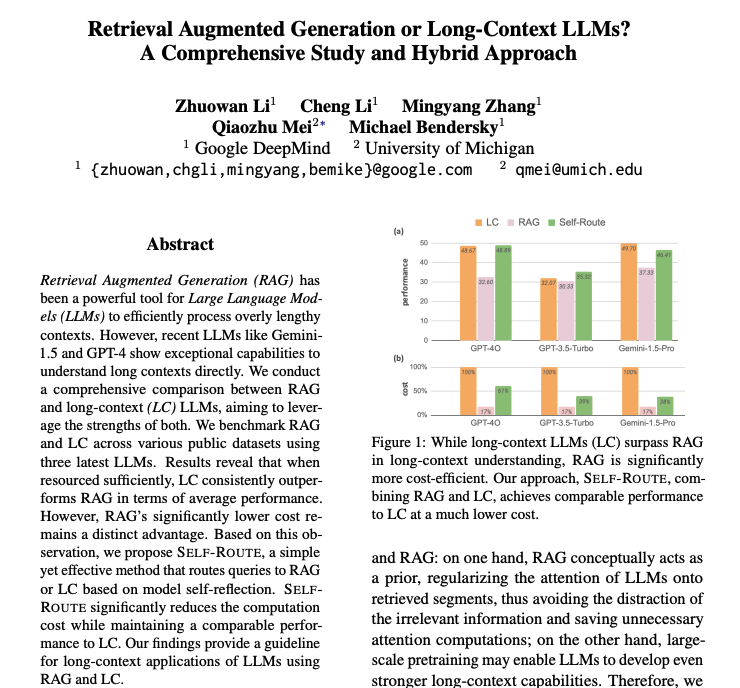
Very interesting study on comparing RAG and long-context LLMs.
Main findings:
- long-context LLMs outperform RAG on average performance
- RAG is significantly less expensive
On top of this, they also propose Self-Route, leveraging self-reflection to route queries to RAG or LC.
Report that Self-Route significantly reduces computational cost while maintaining comparable performance to LC.
Interesting result: "On average, LC surpasses RAG by 7.6% for Gemini-1.5-Pro, 13.1% for GPT-4O, and 3.6% for GPT-3.5-Turbo. Noticeably, the performance gap is more significant for the more recent models (GPT-4O and Gemini-1.5-Pro) compared to GPT-3.5-Turbo, highlighting the exceptional long-context understanding capacity of the latest LLMs."
Again, not sure why Claude was left out of the analysis. I would love to see that including other custom LLMs trained to perform better at RAG.
I am not entirely convinced that long-context LLMs generally can outdo RAG systems today. But I think it's interesting to see a combination of the approaches which is something I've been advocating for recently.
Each of the 5 penalty shootouts in the 2022 World Cup was won by teams whose managers spent the shortest time communicating their tactical/logistical instructions after extra time.
To be brief under pressure could indicate that important decisions were made in advance.
3/8







![AndrewYNg's tweet photo. I think AI agentic workflows will drive massive AI progress this year — perhaps even more than the next generation of foundation models. This is an important trend, and I urge everyone who works in AI to pay attention to it.
Today, we mostly use LLMs in zero-shot mode, prompting a model to generate final output token by token without revising its work. This is akin to asking someone to compose an essay from start to finish, typing straight through with no backspacing allowed, and expecting a high-quality result. Despite the difficulty, LLMs do amazingly well at this task!
With an agentic workflow, however, we can ask the LLM to iterate over a document many times. For example, it might take a sequence of steps such as:
- Plan an outline.
- Decide what, if any, web searches are needed to gather more information.
- Write a first draft.
- Read over the first draft to spot unjustified arguments or extraneous information.
- Revise the draft taking into account any weaknesses spotted.
- And so on.
This iterative process is critical for most human writers to write good text. With AI, such an iterative workflow yields much better results than writing in a single pass.
Devin’s splashy demo recently received a lot of social media buzz. My team has been closely following the evolution of AI that writes code. We analyzed results from a number of research teams, focusing on an algorithm’s ability to do well on the widely used HumanEval coding benchmark. You can see our findings in the diagram below.
GPT-3.5 (zero shot) was 48.1% correct. GPT-4 (zero shot) does better at 67.0%. However, the improvement from GPT-3.5 to GPT-4 is dwarfed by incorporating an iterative agent workflow. Indeed, wrapped in an agent loop, GPT-3.5 achieves up to 95.1%.
Open source agent tools and the academic literature on agents are proliferating, making this an exciting time but also a confusing one. To help put this work into perspective, I’d like to share a framework for categorizing design patterns for building agents. My team AI Fund is successfully using these patterns in many applications, and I hope you find them useful.
- Reflection: The LLM examines its own work to come up with ways to improve it.
- Tool use: The LLM is given tools such as web search, code execution, or any other function to help it gather information, take action, or process data.
- Planning: The LLM comes up with, and executes, a multistep plan to achieve a goal (for example, writing an outline for an essay, then doing online research, then writing a draft, and so on).
- Multi-agent collaboration: More than one AI agent work together, splitting up tasks and discussing and debating ideas, to come up with better solutions than a single agent would.
I’ll elaborate on these design patterns and offer suggested readings for each next week.
[Original text: https://t.co/y4McIAjD2m]](https://pbs.twimg.com/media/GJN6yJRaIAExh4D.jpg)