“Taxation is theft, purely and simply even though it is theft on a grand and colossal scale which no acknowledged criminals could hope to match. It is a compulsory seizure of the property of the State’s inhabitants, or subjects.”
― Murray N. Rothbard
Herbert Marcuse’s essay “Repressive Tolerance” (1965) is one of the most influential justifications for ideological coercion in modern Western thought.
The Frankfurt School philosopher argued that classical liberal tolerance was not neutral but served to perpetuate oppression. By allowing conservative and traditional views to circulate freely, he claimed, liberal societies protected the existing order. His proposed remedy was “liberating tolerance”: the deliberate suppression of “regressive” ideas combined with near-unrestricted freedom for progressive and revolutionary ones. In effect, he called for institutionalised discrimination against dissenting views under the guise of emancipation.
This framework inverted the principle of free speech. Instead of defending equal rights to expression, Marcuse treated speech as a form of power that must be redistributed. Once tolerance is redefined as selective and directional, the distinction between persuasion and coercion collapses. Institutions can then be justified in restricting, marginalising and punishing ideas deemed harmful to the desired social transformation.
Marcuse’s idea found many acolytes and the consequences of his reasoning are now visible across universities, corporations and public institutions. Policies that restrict speech, enforce ideological conformity and punish deviation are frequently defended on grounds that echo Marcuse’s distinction between “regressive” and “progressive” views. What presents itself as expanded tolerance often functions as a mechanism for enforcing a new orthodoxy.
By replacing the idea of equal liberty with the claim that some ideas deserve protection while others must be suppressed, he provided the intellectual blueprint for the coercive management of speech and thought that we now see in operation in so many of our institutions – presented as liberation but in reality a sophisticated rationale for ideological control.
Communism directly killed more people in peacetime than any other system in history.
Stalin’s Holodomor: millions of Ukrainians deliberately starved
Mao’s Great Leap Forward: up to 45 million dead from famine
Pol Pot’s Cambodia: 1 in 4 people slaughtered
Total body count: nearly 100 million (Black Book of Communism)
That’s not a “mistake.” That’s the track record.
Still romanticizing it in 2026?
Drop your honest take below. No sugarcoating.
Milton Friedman:
“What we call a deficit is simply a form of taxation; it’s hidden taxation.”
“If it is financed by printing money, it’s taxation in the form of inflation. If it is not financed by printing money, it’s an invisible tax on all property.”
Germany, 1948. The Reichsmark is worthless. Cigarettes function as currency. Factory output sits at half its 1936 level, and the Allied occupation runs a price-control regime so absurd that farmers feed grain to livestock rather than sell it at the dictated price. Then Ludwig Erhard walks into a radio studio on June 20 and tells the German people the controls are gone. He did not ask the occupation authorities first. He told General Lucius Clay afterward that he hadn't altered the regulations, he had abolished them.
What followed embarrassed every Keynesian planner watching from Washington and London.
The Deutsche Mark replaced the Reichsmark at brutal terms: roughly 100 old marks for 6.5 new ones. Hard money, scarce by design. The black markets emptied overnight because goods reappeared in shop windows the moment prices could speak. Industrial production jumped over 50 percent in the second half of 1948 alone. And here is the part the textbooks bury: through the 1950s, as the economy grew at better than 8 percent a year, the cost of living stayed remarkably flat. Germans got richer while prices held or fell. Productivity outran the money supply, which is exactly what's supposed to happen when a central bank keeps its greedy paws to itself.
Falling prices alongside roaring growth, rising real wages, and a currency people actually wanted to hold rewarded Erhard's Germany. Deflation is not the disease. It is the natural reward for producing more than you did last year.
The Bundesbank inherited this discipline and guarded the Mark with a stinginess that drove politicians to fury for forty years. That stinginess built the strongest economy in Europe. Then the same political class buried the Mark under the euro in 2002 and handed monetary policy to people who consider 2 percent annual theft a "target."
Erhard proved sound money and free prices rebuild a bombed nation in a decade. Every finance minister since has worked very hard to forget it.
"Who is John Galt?"
John Galt is the fictional hero in Ayn Rand’s masterpiece “Atlas Shrugged.” He represents an ideal of individualism, self reliance and human progress. “Who is John Galt?” is a catchphrase uttered by those frustrated about the decline and hopelessness they see around them as society disintegrates under the weight of an over-reaching state. The phrase is uttered as a cry of despair.
In the novel, entrepreneurs, creators and visionaries mysteriously disappear and leave behind a society increasingly consisting of the weak, dependent and unproductive, who have based their existence on leeching off those who have now finally had enough of regulation, taxation, and demonisation of their success.
The novel is an exposition of Rand’s political philosophy known as Objectionism, promoting rational self-interest, individual rights and laissez-faire capitalism. It is a battle cry for libertarians against government overreach and an encouragement to pursue activities that requires independence, creativity and rational purpose, not least entrepreneurship - and profit.
When the majority resign from their personal responsibility for their own life and happiness and hands it over to “society,” that society becomes increasingly reliant on the efforts of a small class of productive individuals. What happens when they finally are pressed to hard and refuse to recognise the claim the majority purports to have on their property? Atlas, who according to Greek mythology carried the weight of the world, finally shrugs.
On October 4, 1957, the Soviets put Sputnik into orbit and the entire American establishment lost its mind. A beeping aluminum ball the size of a beach ball. Four years later Yuri Gagarin circled the Earth while the United States was still strapping monkeys to rockets. The Soviets won the early rounds, and they made sure you knew it.
Then the Americans did what every losing team does. They moved the goalposts. Suddenly the contest wasn't orbit, it was the Moon, a target far enough away that American industrial capacity and dollars could win it. Apollo 11 landed in July 1969, the flag went up, and everyone agreed to forget who had been first into space. Fair enough. But ask yourself what the scoreboard cost.
Central planning hides a fundamental problem. The Soviet program ran on a command economy that could pour resources into rockets precisely because it didn't have to answer to consumers. No prices, no profit and loss, no signal telling Gosplan that the steel and titanium going into the R-7 might serve a hungry population better as farm equipment. Ludwig von Mises explained in 1920 that without market prices for capital goods, a planner is blind. He cannot calculate. He can only guess, and back his guesses with force.
So the Soviets built spectacular rockets while the citizen in Kiev queued two hours for bread and the woman in Sverdlovsk waited months for shoes. Defense and space ate an estimated 15 to 20 percent of Soviet GDP through the 1970s and 80s, against roughly 5 percent in the United States. Korolev got his launch pads, but shoppers got an empty shelfs and a ration cards. The state celebrated cosmonauts on television while it could not reliably deliver milk to Moscow.
This is the trick of every grand state achievement: the triumph is visible and the cost is scattered across millions of people who never consented and never appear in the propaganda reel. A man orbited the Earth in 1961 while his mother stood in line for sausage. Both facts are true, and the second one is the one that brought the whole empire down by 1991.
A planner can reach the stars, but he still can't fill a grocery store.
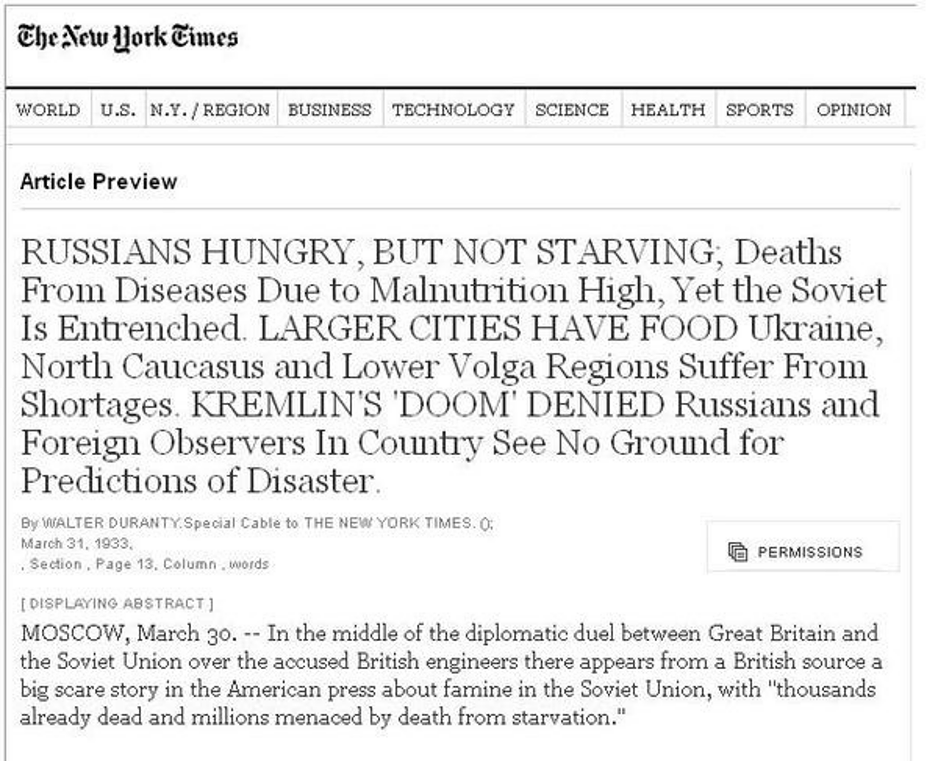
In 1933, as millions were dying in Ukraine during the Holodomor, a reporter for one of the world’s most influential newspapers accepted the Pulitzer Prize for telling his readers there was no famine.
Walter Duranty, the Moscow correspondent for The New York Times, repeatedly denied the existence of mass starvation in 1932 and 1933. In a notorious article, he dismissed reports of widespread death as “exaggerated” and praised Stalin’s leadership. Gareth Jones, a Welsh journalist who had travelled through Ukraine and reported the truth about the famine, Duranty publicly denounced as unreliable, helping to discredit one of the few Western journalists telling the truth.
Duranty also downplayed, justified and excused dekulakisation and the gulags. And he was not ignorant of the famine; he understood what was happening but chose to lie in order to maintain access to Soviet officials. For this work, he was awarded the Pulitzer Prize in 1932. The New York Times has never returned the award, despite years of calls to do so.
The Holodomor killed millions in a famine engineered by Soviet policy and sustained through deliberate state coercion. Stalin denied the disaster, blocked relief efforts and concealed the evidence of mass death. And one of the world's most influential newspapers helped sell his lies to the West.
The enduring scandal is not only that Duranty deceived his readers, but that he was rewarded for doing so. His reporting demonstrates how easily journalism can become propaganda when access, ideology, and institutional interests take precedence over truth. Often the most consequential falsehoods are advanced not on the fringes, but from the centre of the establishment itself.
Over 100 million people were murdered by communist regimes in the 20th century.
Not a “mistake.”
Not “poor implementation.”
A direct result of abolishing private property and concentrating all power in the state.
If you still defend the ideology, you’re either historically illiterate or morally bankrupt.
Communism’s fatal flaw isn’t economics.
It’s that it requires humans to stop being human.
Remove incentives to produce and innovate, punish success, reward loyalty to the party… and you get poverty, corruption, and tyranny. Every. Single. Time.
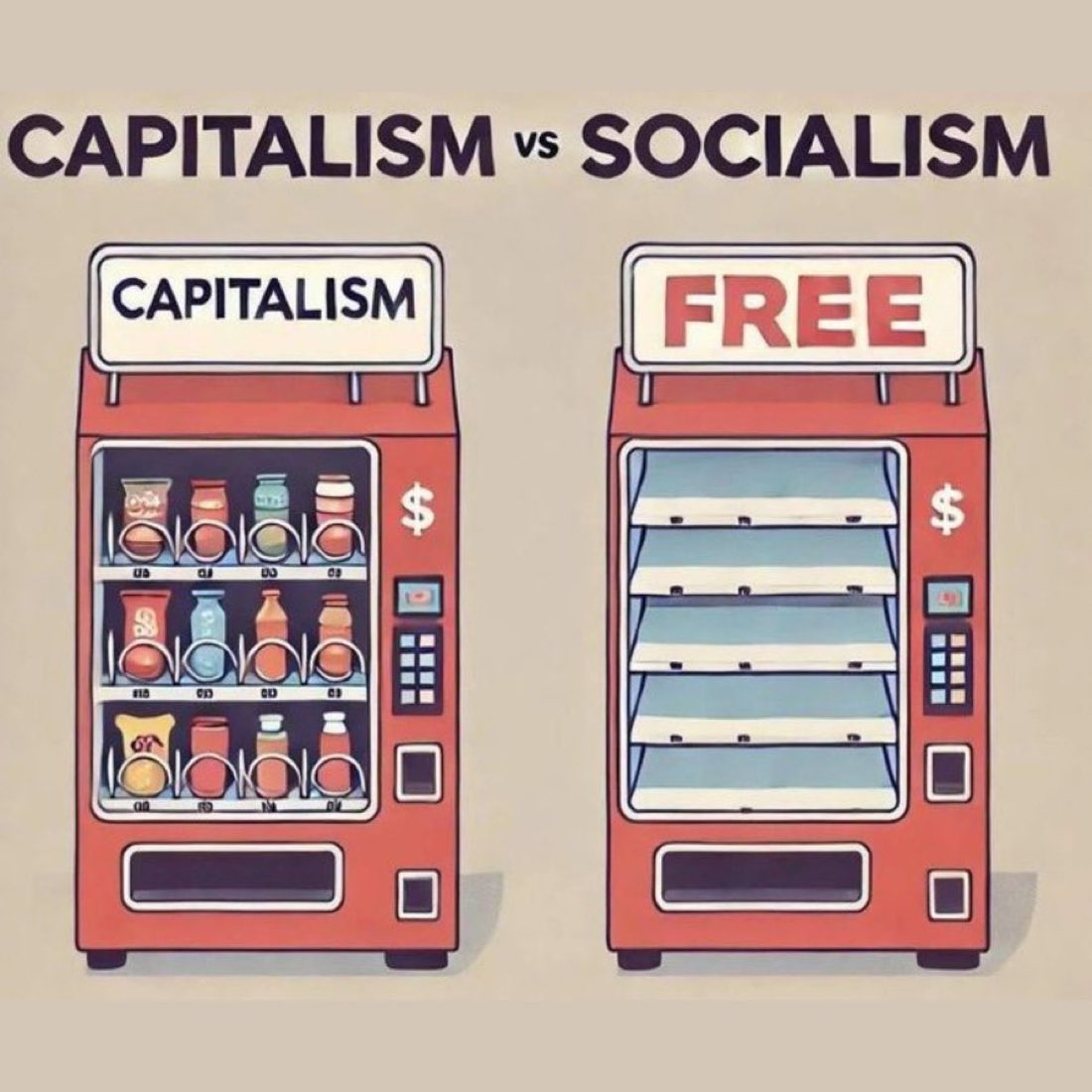
Capitalism works because it aligns with reality. Communism fights it.
If only we could just skip the death and famine part of the communist plan.
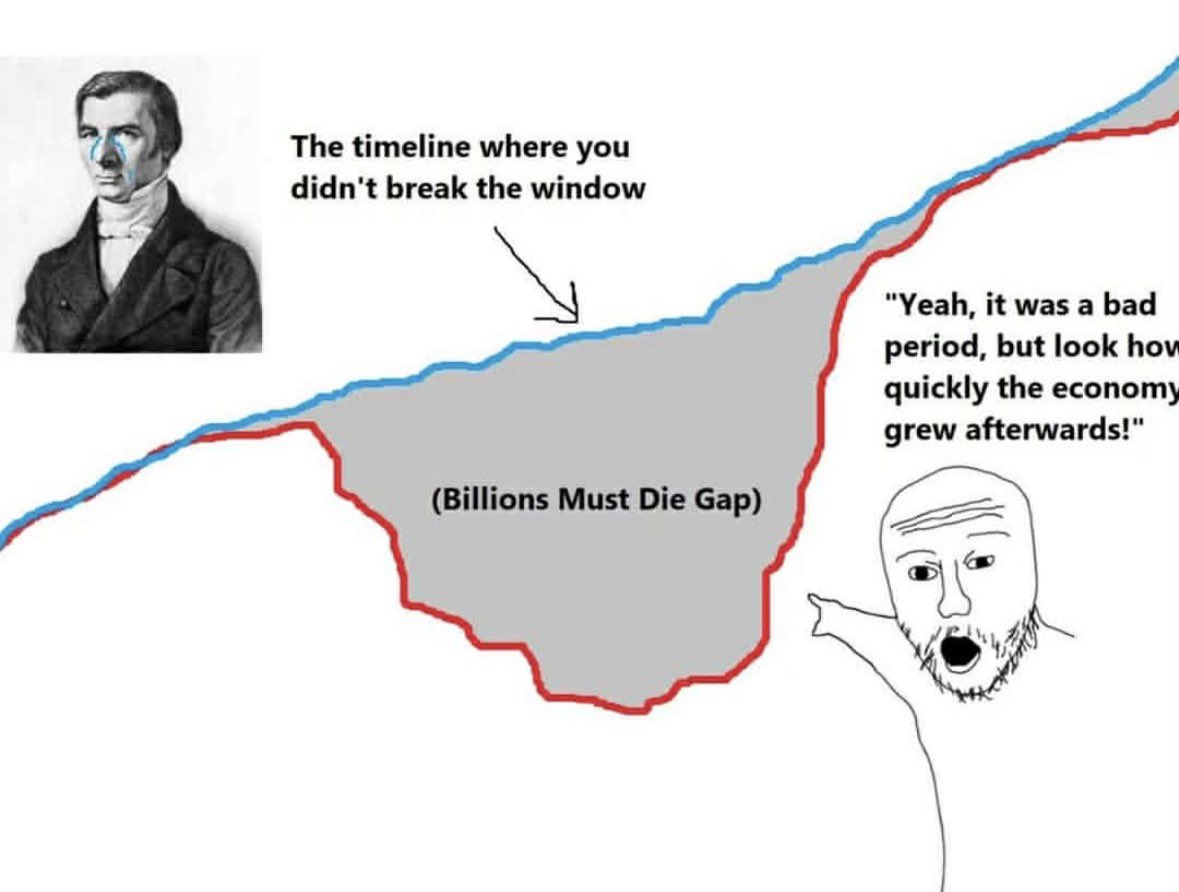
But central planning always demands a “bad period” of deliberate mass death before it can claim any growth.
The Bolsheviks opened with war communism that starved millions and executed thousands more to seize power.
Stalin industrialized the body count through the Holodomor genocide that starved millions of Ukrainians and a gulag empire that devoured millions of others.
Mao’s Great Leap Forward remains the deadliest famine in recorded history after forced collectivization and backyard furnace insanity killed tens of millions.
Even after the slaughter the results never deliver. And market liberalization, even a little, always turns out to be the only way out of the communist death spiral.
Bastiat’s broken window fallacy shows why destruction does not create wealth. A boy breaks a shopkeeper’s window. People see the glazier get paid to repair it and assume the economy benefits.
They miss that the shopkeeper can no longer spend that money productively elsewhere. The repair only replaces what was lost, not create new value.
Which is why market economies that skipped the genocide phase left them in the dust on actual living standards.
South Korea versus North Korea. West Germany versus East Germany.
Reformed China still trails South Korea and Taiwan in per capita wealth and basic freedoms.
The joke is that Mainland China is still the poorest China.
The graves were not a cost of progress. They were proof the model was broken from the start.
Hayek on why politicians love Keynesian economics:
“Politicians love the argument that if you outspend your income and run a deficit, you’re doing good to the people in general.”
“They don’t want to hear anything more than to be told that irresponsible spending is beneficial.”
The most dangerous thing in politics is not malice. It's arrogance: the belief that a small group of experts can redesign society better than the countless individuals who actually live in it.
Friedrich Hayek had a name for this mistake: The Fatal Conceit.
In his final book, Friedrich Hayek delivered his most pointed critique of socialism and central planning. The book’s title refers to the fatal intellectual error at the heart of socialist thought: the arrogant belief that human reason is capable of deliberately designing and controlling the complex order of society. Hayek called this “constructivist rationalism” - the idea that we can scrap inherited institutions and traditions and rebuild society according to a rational blueprint.
Hayek argued that this conceit is based on a fundamental misunderstanding of how civilisation actually works. The extended order of the market - our system of prices, division of labour, property rights and moral traditions - was not invented or designed by anyone. It emerged through a long process of cultural evolution. No single mind, and certainly no central planning board, possesses the knowledge required to coordinate millions of individuals with constantly changing needs, preferences, and local circumstances.
The price system, Hayek explained, is a remarkable mechanism that communicates dispersed knowledge far more effectively than any planner ever could. When socialists attempt to replace this spontaneous order with conscious direction, they do not merely cause inefficiency. They destroy the very foundations that make advanced civilisation possible.
The Fatal Conceit goes beyond economics to defend the moral and cultural foundations of a free society. Hayek showed that the socialist project is not just impractical - it is based on a dangerous overestimation of human reason and ability, and an arrogant dismissal of evolved wisdom.
The fatal conceit is still very much alive today in every attempt to centrally engineer society, the economy, or human behaviour. Hayek’s warning endures: civilisation is fragile, and those who believe they are wise enough to redesign it are usually the ones who end up destroying it.
Alan Greenspan died today, and the man who spent two decades inflating bubbles will be eulogized as a maestro. Fitting, because he understood exactly what he was doing.
In 1966 a younger Greenspan wrote an essay called "Gold and Economic Freedom." He laid out the case with precision. The gold standard protected savers from confiscation by inflation. Welfare statists hated gold because it stood in the way of their deficits. He wrote that the abandonment of gold made deficit spending a "scheme for the hidden confiscation of wealth." He was right. He knew it. Then he took the job running the printing press.
From August 1987 to January 2006 Greenspan sat atop the Federal Reserve and did the opposite of everything that essay defended. After the 1987 crash he flooded the banks with liquidity and taught a generation of traders that the central bank would catch them every time they fell. They named the reflex after him: the Greenspan put. He cut the federal funds rate to 1 percent by June 2003 and held it there, and you watched housing prices detach from any sane relationship to income. Mortgage credit gushed. He went on television in February 2004 and suggested Americans consider adjustable-rate mortgages, roughly eighteen months before he started hiking rates into those very borrowers. The man who warned in 1966 about the hidden confiscation of wealth engineered the largest credit distortion in postwar history.
Then came the apology that wasn't one. In October 2008, sitting before Congress as the wreckage smoked, Greenspan confessed he had found "a flaw" in his model of how the world worked. He was "shocked" that lenders had not policed themselves. You don't get to spend twenty years pricing risk at zero and then act surprised when men respond to the incentives you built. Any committee of economists cannot set the price of money better than a market can.
Greenspan knew the answer at 40 and spent the next half century pretending he'd forgotten it. The savers he warned about in 1966 paid for that performance.