We built Mach7 on one idea: your medical images shouldn't be locked inside any single vendor's system.
Vendor-neutral archiving. Universal viewing. True data independence.
New here on X — follow along for what's next in enterprise imaging.
Average turnaround time is not what customers remember. The slowest exam of the night is. Where overnight reading delays hide, and how to find them:
https://t.co/k48lJVX9sB
#Teleradiology#Radiology
Build for year six, not just year one. Mitchell Fong's advice for anyone spending rural health transformation money on imaging:
https://t.co/we1KqwOzpJ
"I think CT and POCUS will grow exponentially."
Zac Hines of NC State's veterinary college on the next five years. One CT there already handles seven to ten cases a day, most under sedation or anesthesia. On Flight Path:
https://t.co/SuImGQbOrz
AI readiness is one of six decisions in an enterprise imaging strategy, alongside downtime viewing, ransomware resilience and backup. Build for what comes next:
https://t.co/xh6nBz0SEi
"It's still a liability if you don't have it."
Zac Hines of NC State's veterinary college on why a bedside scan that informs a decision gets saved, and why the saved images help with teaching too. On Flight Path:
https://t.co/SuImGQbOrz
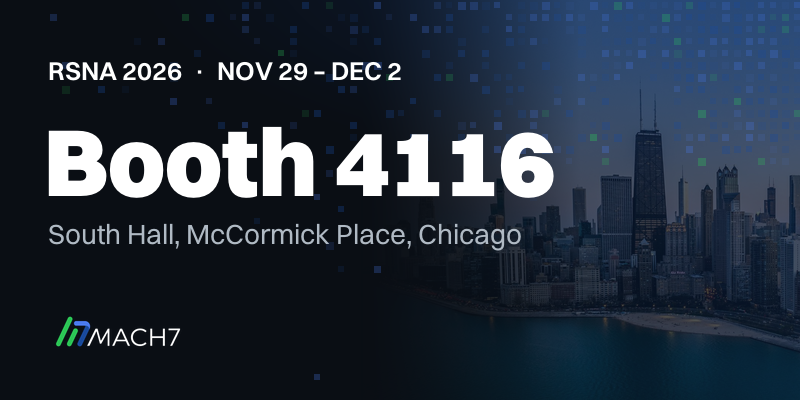
RSNA is two weeks out. Booth 4116, South Hall, open 10 a.m. to 5 p.m. CT, Nov. 29 to Dec. 2. Book a time with our team. #RSNA26
https://t.co/1yQJbvZAlW
New Flight Path: Zac Hines, PACS Administrator at NC State's College of Veterinary Medicine, on the point-of-care ultrasound surge, why a bedside scan that drives a decision gets saved, and what two decades of images are for.
https://t.co/SuImGQbOrz
The question is not whether individual imaging systems work. It is whether they work together. The patterns most health systems will recognize:
https://t.co/8rNOZMusJI
At #RSNA26, we'll show how health systems can choose AI tools and manage imaging data as separate decisions. Five new Flamingo modules shown for the first time. Booth 4116, South Hall, Nov 29 to Dec 2.
https://t.co/MCJnLAOpVK
When does a bedside scan become part of the record? Point-of-care ultrasound is everywhere now, and someone has to decide which images to keep.
New Flight Path tomorrow.
https://t.co/r7dDiSA54t
A POCUS exam with no order and no accession number has nowhere reliable to file itself. At worst it becomes what a POCUS consensus paper calls a phantom scan: on audit, it is in neither the record nor the archive. Where do yours live?
https://t.co/x0sWtq18GJ
If an AI vendor disappears, stroke detection shouldn't go with it. Have a backup for critical algorithms: one of the plainest lessons from the KLAS Enterprise Imaging Summit.
https://t.co/PUgm42fSYH
You do not have to replace your archive to automate DICOM routing. The Communication Workflow Engine also runs stand-alone and drops into the environment you already have.
https://t.co/nm0zmAFH0y
"That train has left the station."
Dr. Liron Pantanowitz on digital and AI adoption in pathology, and why labs that resist risk going the way of Kodak. On Flight Path:
https://t.co/l2oFqxgO3o
"I don't want AI to build a faster treadmill." Teri Thomas on using AI to improve the time clinicians spend with patients, not just to save time. https://t.co/ZpKvZpndCt
Better healthcare technology makes human judgment more valuable, not less. Our CEO Teri Thomas on the Healthcare Success podcast with Stewart Gandolf: https://t.co/ZpKvZpndCt
How do you migrate an imaging archive while radiologists keep reading? One of four questions Teri Thomas and Barinder Dhillon take on with The Imaging Wire's Brian Casey:
https://t.co/QvjJxEu3Ls
UCSF Health's Marc Kohli on the DICOM router his team put in almost ten years ago, an insight he credits to colleague John Mongan: "We basically use it as our AI orchestrator." The plumbing decides who your imaging AI works for:
https://t.co/019Dm1w75R
You don't throw away your shoes because there's a knot in the laces.
Teri Thomas on The Imaging Wire Show, on modernizing imaging one piece at a time and keeping what works:
https://t.co/5gfZ0MFv1h