A half century of economics in a nutshell, this is essential reading for anyone who wants to understand why the dismal science has become esoteric and uninformative. But @BrianCAlbrecht also previews a renaissance. It’s happening in antitrust. I can’t wait to see it spread.
Is price theory dead?
Part of @tylercowen's new book argues basically yes. I don't dispute his evidence.
But the broader picture highlights the continued relevance of price theory. Not dead yet https://t.co/KjeaAOSQei
We missed @MeadorFTC at Spring Meeting. His GW speech would have earned an ovation from the worldwide competition bar.
@abaantitrust and @FTC have been allies for decades, to the benefit of both.
Spring Meeting is the World Cup of competition & consumer expertise. It’s best when all the stars take the field.
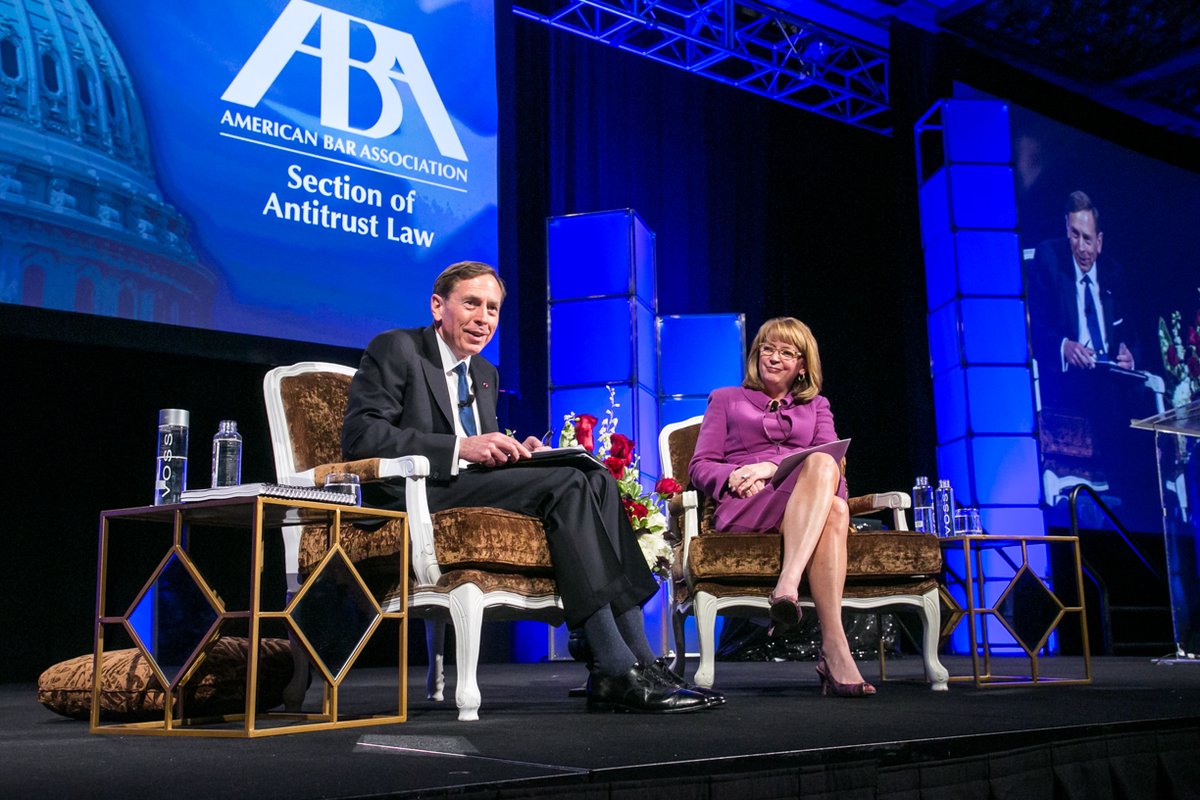
With everyone in town for the #ATSpring Meeting, now seems like a good time to point out that the best thing @abaantitrust could do would be some structural separation from @ABAesq. The antitrust bar shouldn’t be subsidizing far left political advocacy.
With everyone in town for the #ATSpring Meeting, now seems like a good time to point out that the best thing @abaantitrust could do would be some structural separation from @ABAesq. The antitrust bar shouldn’t be subsidizing far left political advocacy.
Visitors to my fireside chat heard that Ireland and Portugal are leading adopters of AI to detect anticompetitive conduct. New merger regs and guidelines are also on tap. I noted the HSR updates @FTC and @JusticeATR and endorsed the 2008 (not 2023) Merger Guides.
Antitrust enforcers from around the world stress objectivity and economics as key to pro-growth competition policy. Welcome news to the largest audience of antitrust practitioners on earth.
A wonderful tribute to Jodie Bernstein, a giant of the FTC and a pathbreaker in the bar.
(Fine print - the release doesn’t mention Jodie’s hilarioussense of humor. She still delivers!)
Thanks, @chris_mufarrige and @FTC! https://t.co/AdcgwyMwfR
Playwright Wallace Shawn and director André Gregory (of “My Dinner With” fame) answer the ancient question: how long are parents responsible for their children? I love it but won’t reveal it. https://t.co/Zcw6uB40yi
Has a more important book appeared in the last 250 years? Wealth of Nations, 3/9/1776, still resonates. Review in WAPO:
A Smithian focus therefore broadens the AI debate. The question is not merely how many jobs will be displaced, or how to regulate data. It is whether commercial society can integrate powerful new technologies without hollowing out the moral capacities on which it rests….
Perhaps Smith’s deepest insight is that a commercial society is a moral achievement. It channels self-interest into productive activity through competition under the rule of law. It lifts living standards by expanding exchange. But it is fragile. It depends on justice, on open rivalry and on citizens capable of judgment.
https://t.co/X0oUMfg4b6
I was using ChatGPT for legal advice and it decided to completely hallucinate some preposterous nonsense about how growing wheat to use on my own farm somehow constitutes interstate commerce
I was using ChatGPT for legal advice and it decided to completely hallucinate some preposterous nonsense about how growing wheat to use on my own farm somehow constitutes interstate commerce
En 1881, un grand magasin de Chicago a fait quelque chose qui allait tranquillement changer le monde pour toujours.
Ils ont regardé leurs clients - des femmes en jupes longues qui naviguaient dans les rues boueuses, des hommes d'affaires sans temps à perdre - et ont fait une promesse que personne n'avait jamais faite auparavant :
"Achetez-le ici. Ce sera à ta porte avant que tu rentres à la maison. "
Pas en deux jours. Pas demain.
Aujourd'hui. Gratuit. Garantie.
Marshall Field's n'a pas seulement vendu de la marchandise. Ils ont construit une machine.
À son apogée, leur opération de livraison a fait traverser 400 wagons et des centaines de chevaux à travers 350 miles carrés de Chicago - chaque wagon a peint sa signature en vert, chaque conducteur en uniforme pressé, chaque itinéraire mémorisé comme un soldat connaît un champ de bataille.
Pas les ordinateurs. Pas de GPS. Sur les applis.
Juste des chevaux, des cartes et un engagement obsessionnel, presque irrationnel à tenir une promesse.
Une histoire - transmise à travers l'histoire de Chicago - raconte un homme d'affaires qui a commandé un grand bureau en acajou sur approbation. Cet après-midi-là, appelé à l'improviste hors de la ville, il a lancé ce qui semblait être un défi impossible
« Apportez-le chez moi à Rogers Park avant 16 h - ou ne vous dérangez pas. "
Il est monté dans un train. Arrivée à la maison à 3h30.
Le bureau était déjà à l'intérieur.
Les gens ont plaisanté en disant que les livraisons de Marshall Field sont arrivées avant vous.
Au milieu du 20e siècle, en passant aux camions motorisés, l'opération traitait jusqu'à 95 000 colis par jour - à partir d'un seul magasin.
Un magasin.
Quatre-vingt-quinze mille paquets
Tous les jours.
Le système qu'ils ont inventé - entrepôts hubs, points de distribution de district, malles organisés par route - est le plan exact que FedEx, UPS et Amazon utiliseraient plus tard pour construire des empires de billions de dollars.
Amazon n'a pas inventé la livraison le jour même.
Ils viennent de remplacer les chevaux par des camionnettes et les livres de registres par des algorithmes.
Les chariots verts sont partis maintenant. Marshall Field's lui-même a été absorbé par Macy's en 2006, effaçant un nom vieux de 150 ans de l'horizon de Chicago.
Mais l'attente qu'ils ont planté dans l'esprit américain - que ce que vous achetez devrait arriver rapidement, fiablement et sans frais supplémentaires - n'a jamais quitté.
La prochaine fois qu'une notification apparaît disant « Votre colis a été livré », rappelez-vous :
Un cheval est arrivé le premier.
Et personne n'avait même de téléphone pour le tracer.
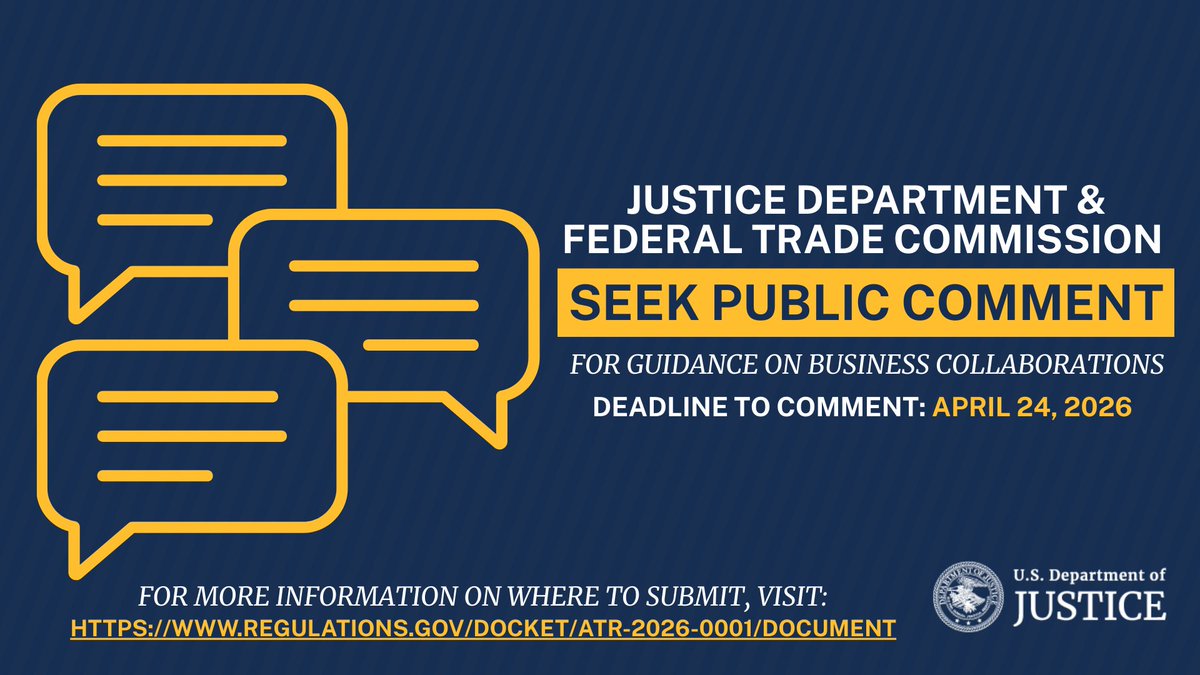
Justice Department and @FTC Seek Public Comment for Guidance on Business Collaborations
Agencies Launch Joint Public Inquiry for Consideration of Guidance on Collaborations Among Competitors to Promote Certainty and Competition
🔗: https://t.co/VjyJlK55kx
Last Chance for Arbitrary and Capricious HSR Rules? Fifth Circuit allows @FTC to round up the usual suspects (for a little while longer). https://t.co/wlLlZRPMAw
Not at all. Chicago is exhibit A in the kids’ predicament. Voters elected a teachers’ union rep over a Duncan-like board leader. Now the mayor is trying to borrow money to fund the union pension.
We don’t need to bust the union to save the kids. They are mobile (tho parents pay twice when kids go private without tax credits). Kids don’t all need to move. A marginal defection could force the bureaucracy to fight or fold.
I’ll take the contra (hopeful) view.
The clip is provocative nihilism. Saying economics ignores the poor has been wrong since Smith’s Theory of Moral Sentiments through Friedman’s negative income tax.
I hope the nonsense was debunked in good old Chicago style at the event.
That’s a good way to teach and learn economics.
@Rock5491 My White Sox have been dwelling in the cellar, but MLB, LA, Toronto, and the Cubs are holding their own. We’re seeing similar evidence in K-12. Latest summary is here: https://t.co/NitpjUmTkg
@Rock5491 Depends your measure. I don’t measure competition by the fortunes of the Ivies. Rather than the incumbents, I look for dynamics like entry and repositioning. That’s happening: https://t.co/wrXT8h3chK, https://t.co/n6ujpSerZA