Institutional-grade macro research and execution frameworks built on a consistent, evidence-based methodology and supported by integrated analytical tools.
The market has been working through and digesting the nuances from Chairman Warsh’s FOMC meeting on 29 July, with a directive from Warsh to consider a broader set of inflation measures than PCE alone. The Dallas Fed’s 12-month trimmed-mean PCE measure printed at 2.2% the following day, quite close to the Fed’s 2% target.
If the FOMC is going to place greater weight on lower measures of underlying inflation, such as the trimmed-mean PCE measure, which has been running well below headline and core PCE, then the logical market response is a weaker dollar and lower front-end rates relative to what had been positioned. This has become a focus for the market and helped spark a wave of dollar weakness into the Bank of Japan intervention. The renewed and potentially increasing use of the FIMA facility allows foreign governments to raise dollars against their Treasury holdings rather than sell them, cushioning the impact that intervention could otherwise have on US bond yields, an obvious choice for Bessent.
The Treasury secretary has encouraged the Federal Reserve to consider increasing the size of the FIMA facility, while Finance Minister Katayama has indicated that Japan intends to use it again in the future. This, combined with one of the steepest curves in the world now beginning to flatten from the front end, as hedge funds and speculators are historically short the yen, is material for prolonged strength in Japan’s currency.
Scott Bessent said at the beginning of the week that policy will need to follow the intervention and that the United States would not have joined the intervention if it were not optimistic about Japan’s policies.
Provided the curve in Japan continues to flatten from the front end, the FIMA facility is used more frequently by foreign monetary authorities and the Bank of Japan continues raising its policy rate, which we believe may be increasingly likely following Bessent’s commentary, the jig could be up for the Yen shorts in the medium term.
The above must then be combined with last night’s Quarterly Refunding Announcement. There was no change to nominal coupon or FRN auction sizes, consistent with expectations that any meaningful increases have been pushed further out.
In fact, the key change was that Treasury adjusted its language from evaluating potential future increases in coupon and FRN auction sizes to evaluating potential future changes.
That may be deliberate at this current juncture and could place further pressure on the dollar. It also leaves open the option of shortening duration rather than simply increasing coupons, while Treasury continues to fund seasonal requirements through bills and cash-management bills. Treasury maintained coupon sizes for at least the next several quarters and indicated that bill issuance will increase again across the curve in October.
As critical as Scott Bessent was of previous Treasury secretaries before his appointment, it now appears that he is doubling down on the Yellen experiment. Increasing coupons would place additional pressure on the long end, and that is clearly something Bessent does not want. At some point, however, he will need to move towards coupons due to the sheer size of the maturity wall and the government’s funding requirements. He cannot continue funding everything through the front end indefinitely without increasing refinancing risk.
Scott Bessent and Chairman Warsh are clearly working broadly in unison and, from our current read, appear even more dovish than the previous administration. The purpose, into the midterms, appears to be to keep the market afloat. Liquidity has been tightening; however, due to the fall in the MOVE Index this week, conditions have eased over the course of the week, with our liquidity measure incorporating MOVE now sitting at positive 13%.
As we head into Friday night’s payrolls, Bessent has kept the funding concentrated in the shorter end, which is liquidity-positive relative to the alternative. Since Warsh spoke, the market rushed into a bear-steepener trade and may now be caught off guard if issuance continues to be concentrated towards the shorter end and the MOVE Index continues to fall.
Chart - Japanese 30s-2s Yield Curve - Bear Flattener
The new Fed Chair was royally rebuked for his evasiveness in answering questions, although he did make it clear to play the ball, not the man.
The Chairman was asked after his prepared remarks: Is your inflation target 2%? He was steadfast and, on at least three occasions, stated that it is 2%, including in his first remarks on 17/6: The markets sold off hard on both occasions, short-lived on 29/7, but extremely hard on 17/6, leading to 40% in Korea.
On further examination of his reply to whether he is committed to 2%, and we believe this has not been discussed enough by the market or commentators, the Chairman repeatedly dodged the question. If he is committed to no forward guidance, the market is trying to understand his reaction function. The Fed has missed its inflation target for 60 months, so why not hike? Is your target 2%, Mr Chairman?
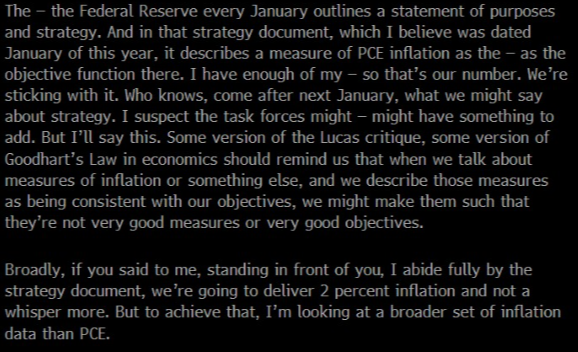
The Chairman’s reply is the image below, verbatim.
Warsh's statement on 2% seems firm enough until you look at the last paragraph...
He was firm on the 2%; however, he referred to his task force and a statement of purpose from the Fed each January that will be tabled with the task force’s input this coming January. This has now got our attention:
“BUT TO ACHIEVE THAT, I’M LOOKING AT A BROADER SET OF INFLATION NUMBERS THAN PCE.”
The market sold off hard, and the next night PCE was announced, with the Dallas Fed reporting that PCE ex Food and Energy, the preferred measure for the previous Fed under Powell, was slightly lower at 3.3%; however, the trimmed mean, taking out volatile items, dropped to 2.2%, essentially at target. The market has ripped since, benefiting from lower oil prices and mixed jobs reports.
So what is the broader set, Mr Chairman? Is it a combination of PPI, Core CPI, released next week, Core PCE (previous preferred measure) or trimmed mean? The market loves the juice, and we think this is one element in the current rally most have missed, due to the trimmed mean being close to the 2% target.
The new Fed Chair was royally rebuked for his evasiveness in answering questions, although he did make it clear to play the ball, not the man.
The Chairman was asked after his prepared remarks: Is your inflation target 2%? He was steadfast and, on at least three occasions, stated that it is 2%, including in his first remarks on 17/6: The markets sold off hard on both occasions, short-lived on 29/7, but extremely hard on 17/6, leading to 40% in Korea.
On further examination of his reply to whether he is committed to 2%, and we believe this has not been discussed enough by the market or commentators, the Chairman repeatedly dodged the question. If he is committed to no forward guidance, the market is trying to understand his reaction function. The Fed has missed its inflation target for 60 months, so why not hike? Is your target 2%, Mr Chairman?
The Chairman’s reply is the image below, verbatim.
Warsh's statement on 2% seems firm enough until you look at the last paragraph...
He was firm on the 2%; however, he referred to his task force and a statement of purpose from the Fed each January that will be tabled with the task force’s input this coming January. This has now got our attention:
“BUT TO ACHIEVE THAT, I’M LOOKING AT A BROADER SET OF INFLATION NUMBERS THAN PCE.”
The market sold off hard, and the next night PCE was announced, with the Dallas Fed reporting that PCE ex Food and Energy, the preferred measure for the previous Fed under Powell, was slightly lower at 3.3%; however, the trimmed mean, taking out volatile items, dropped to 2.2%, essentially at target. The market has ripped since, benefiting from lower oil prices and mixed jobs reports.
So what is the broader set, Mr Chairman? Is it a combination of PPI, Core CPI, released next week, Core PCE (previous preferred measure) or trimmed mean? The market loves the juice, and we think this is one element in the current rally most have missed, due to the trimmed mean being close to the 2% target.
An excerpt from today's Pillars to Post update; view the whole note below:
"The criticism of the Fed was less about forward guidance and more about what the reaction function is. And there you have it: the reaction function.
We all know that Warsh is a balance-sheet and inflation hawk, but he is also a believer in AI productivity assisting inflation. In saying that, he said, “Play the ball, not the man,” which is why we must be laser-focused on critical data and the price response.
Yes, you can be critical and ask why they did not hike after years of missing inflation targets. Let us see what the data brings. The long end will do it for them, and the short end will also reprice if the data continues to come in hot in the US."
https://t.co/MT9LmdBsac
The market has responded to Warsh’s evasiveness, with stocks lower, the curve steepening through the back end and the dollar weakening. We are now back to where we were last year (long gold, short stocks). The Chairman was too cute by half and not stoic enough in his delivery. The credibility established on 17 June and1 July is now being given up.
As Yra Harris said yesterday in his Pillars to Post:
https://t.co/PNyQM8EHoX
“Warsh appears to be more interested in shrinking liquidity through the balance sheet. He will not want to make the double-shotgun mistake Powell made in 2018.”"For now, I am still saying zero for the reasons discussed in my response to Harley."
That mistake, raising rates while simultaneously draining liquidity through quantitative tightening, was heavily criticised by Stanley Druckenmiller and ultimately forced the Powell pivot. For that reason, Yra’s base case was that the Fed would make no move.
Macro Pillars stated in this week’s report: https://t.co/6TW2e7mVie
“Critically, next week the FOMC meets for the Chairman’s second meeting. With elevated oil prices and, as a result, higher inflation expectations, we expect the market to test the Chairman. If the FOMC is not serious and does not respond by hiking or signalling that it will, then the long end will do it for them. This is a very dangerous juncture for long-end yields.”
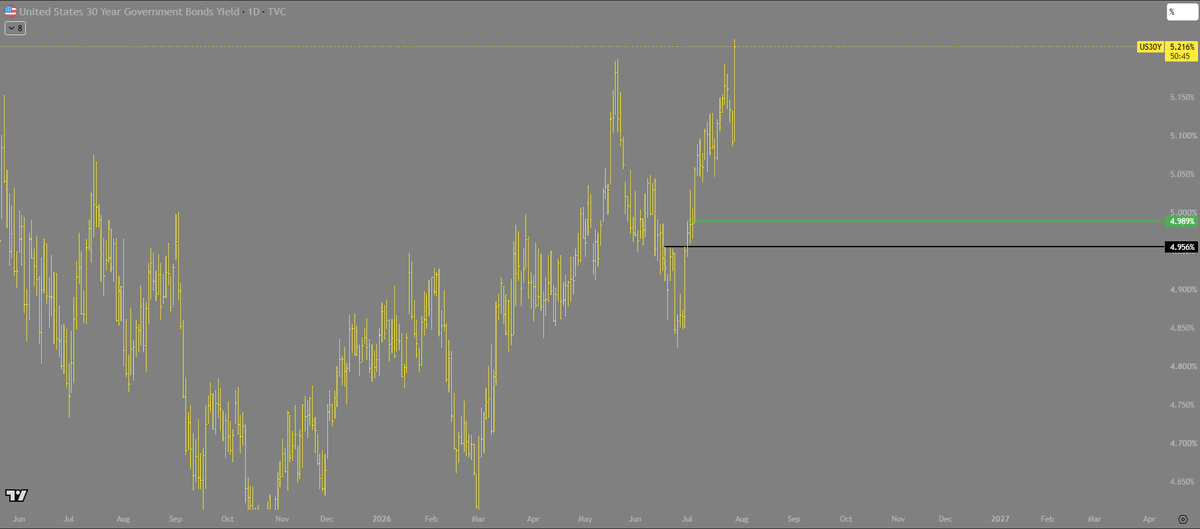
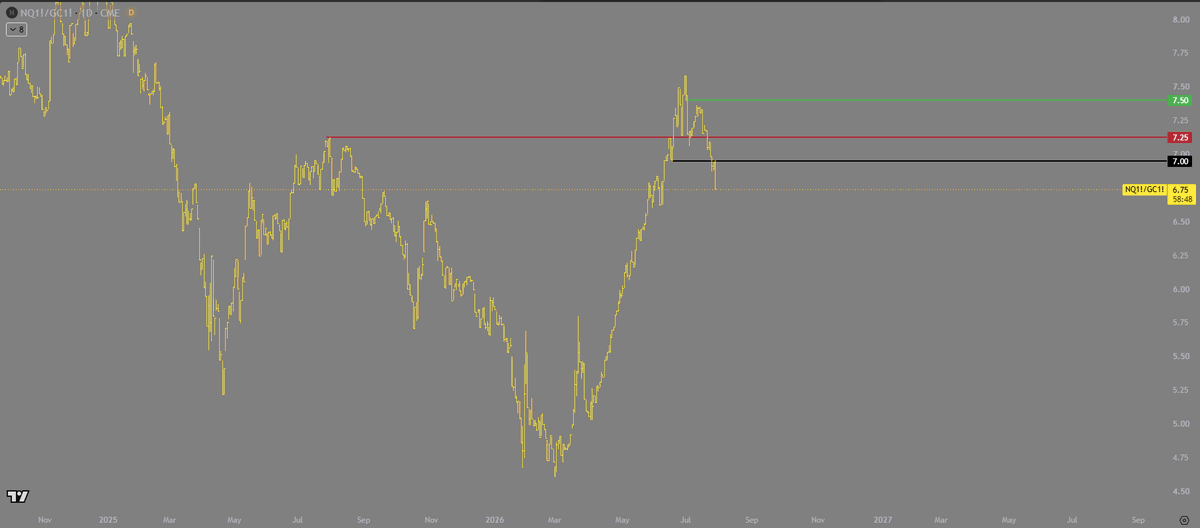
The Fed did not hike and Warsh failed to provide the firm and unequivocal guidance required to anchor the market. The long end is now doing the tightening for him (see Chart 1), with a market caught badly off guard. We maintain our long-gold, short-stocks position and have increased our exposure to gold. We are focused on the Nasdaq/Gold chart for further instruction (see Chart 2).
28 June https://t.co/gpqY59JVR5
5 July https://t.co/LGOWg6Lonp
Grains trade update https://t.co/yxdwfXDN5m
12 July https://t.co/KgbEGpmB5B
19 July https://t.co/IGiNOAakRM
26 July https://t.co/4Qx30z71Wn
Everybody is posting the #KOSPI chart on the day of capitulation, shocked by the sell-off and providing little value after the fact.
Macro Pillars was actively trading the deleveraging across the Asian AI sector and accountably writing to and updating our clients throughout the entire move, as shown in the chart below and the attached reports in the comments.
If you want to understand why #TAIWAN #EWT #EWY #KOSPI #NASDAQ are so heavy, have a read for yourselves.
Andrew Perry and Macro Pillars have been short Taiwan, Asian AI and the Nasdaq ahead of July’s sell-off, while long agricultural commodities and positioned for several other major market moves.
The calls were published in real time. The research is there to verify it. See for yourself.
Below are our weekly reports from the period, plus one mid-week update on the grains trade:
28 June https://t.co/9whexvBVKC
5 July https://t.co/OFehagyS3r
Grains trade update https://t.co/wBIMZwbNBF
12 July https://t.co/B7A1Iq59ra
19 July https://t.co/dh3Fcc0iRO
26 July https://t.co/6TW2e7mVie
Andrew Perry and Macro Pillars have been short Taiwan, Asian AI and the Nasdaq ahead of July’s sell-off, while long agricultural commodities and positioned for several other major market moves.
The calls were published in real time. The research is there to verify it. See for yourself.
Below are our weekly reports from the period, plus one mid-week update on the grains trade:
28 June https://t.co/9whexvBVKC
5 July https://t.co/OFehagyS3r
Grains trade update https://t.co/wBIMZwbNBF
12 July https://t.co/B7A1Iq59ra
19 July https://t.co/dh3Fcc0iRO
26 July https://t.co/6TW2e7mVie
Andrew Perry and Macro Pillars have been short Taiwan, Asian AI and the Nasdaq ahead of July’s sell-off, while long agricultural commodities and positioned for several other major market moves.
The calls were published in real time. The research is there to verify it. See for yourself.
Below are our weekly reports from the period, plus one mid-week update on the grains trade:
28 June https://t.co/9whexvBVKC
5 July https://t.co/OFehagyS3r
Grains trade update https://t.co/wBIMZwbNBF
12 July https://t.co/B7A1Iq59ra
19 July https://t.co/dh3Fcc0iRO
26 July https://t.co/6TW2e7mVie
Andrew Perry and Macro Pillars have been short Taiwan, Asian AI and the Nasdaq ahead of July’s sell-off, while long agricultural commodities and positioned for several other major market moves.
The calls were published in real time. The research is there to verify it. See for yourself.
Below are our weekly reports from the period, plus one mid-week update on the grains trade:
28 June https://t.co/9whexvBVKC
5 July https://t.co/OFehagyS3r
Grains trade update https://t.co/wBIMZwbNBF
12 July https://t.co/B7A1Iq59ra
19 July https://t.co/dh3Fcc0iRO
26 July https://t.co/6TW2e7mVie
Andrew Perry and Macro Pillars have been short Taiwan, Asian AI and the Nasdaq ahead of July’s sell-off, while long agricultural commodities and positioned for several other major market moves.
The calls were published in real time. The research is there to verify it. See for yourself.
Below are our weekly reports from the period, plus one mid-week update on the grains trade:
28 June https://t.co/9whexvBVKC
5 July https://t.co/OFehagyS3r
Grains trade update https://t.co/wBIMZwbNBF
12 July https://t.co/B7A1Iq59ra
19 July https://t.co/dh3Fcc0iRO
26 July https://t.co/6TW2e7mVie
Andrew Perry and Macro Pillars have been short Taiwan, Asian AI and the Nasdaq ahead of July’s sell-off, while long agricultural commodities and positioned for several other major market moves.
The calls were published in real time. The research is there to verify it. See for yourself.
Below are our weekly reports from the period, plus one mid-week update on the grains trade:
28 June https://t.co/9whexvBVKC
5 July https://t.co/OFehagyS3r
Grains trade update https://t.co/wBIMZwbNBF
12 July https://t.co/B7A1Iq59ra
19 July https://t.co/dh3Fcc0iRO
26 July https://t.co/6TW2e7mVie
Andrew Perry and Macro Pillars have been short Taiwan, Asian AI and the Nasdaq ahead of July’s sell-off, while long agricultural commodities and positioned for several other major market moves.
The calls were published in real time. The research is there to verify it. See for yourself.
Below are our weekly reports from the period, plus one mid-week update on the grains trade:
28 June https://t.co/9whexvBVKC
5 July https://t.co/OFehagyS3r
Grains trade update https://t.co/wBIMZwbNBF
12 July https://t.co/B7A1Iq59ra
19 July https://t.co/dh3Fcc0iRO
26 July https://t.co/6TW2e7mVie
Andrew Perry and Macro Pillars have been short Taiwan, Asian AI and the Nasdaq ahead of July’s sell-off, while long agricultural commodities and positioned for several other major market moves.
The calls were published in real time. The research is there to verify it. See for yourself.
Below are our weekly reports from the period, plus one mid-week update on the grains trade:
28 June https://t.co/9whexvBVKC
5 July https://t.co/OFehagyS3r
Grains trade update https://t.co/wBIMZwbNBF
12 July https://t.co/B7A1Iq59ra
19 July https://t.co/dh3Fcc0iRO
26 July https://t.co/6TW2e7mVie
Macro Pillars have been short Taiwan, Asian AI and the Nasdaq ahead of July’s sell-off, while long agricultural commodities and positioned for several other major market moves.
The calls were published in real time. The research is there to verify it. See for yourself.
Below are our weekly reports from the period, plus one mid-week update on the grains trade:
28 June https://t.co/9whexvBVKC
5 July https://t.co/OFehagyS3r
Grains trade update https://t.co/wBIMZwbNBF
12 July https://t.co/B7A1Iq59ra
19 July https://t.co/dh3Fcc0iRO
26 July https://t.co/6TW2e7mVie
Andrew Perry and Macro Pillars have been short Taiwan, Asian AI and the Nasdaq ahead of July’s sell-off, while long agricultural commodities and positioned for several other major market moves.
The calls were published in real time. The research is there to verify it. See for yourself.
Below are our weekly reports from the period, plus one mid-week update on the grains trade:
28 June https://t.co/9whexvBVKC
5 July https://t.co/OFehagyS3r
Grains trade update https://t.co/wBIMZwbNBF
12 July https://t.co/B7A1Iq59ra
19 July https://t.co/dh3Fcc0iRO
26 July https://t.co/6TW2e7mVie
Andrew Perry and Macro Pillars have been short Taiwan, Asian AI and the Nasdaq ahead of July’s sell-off, while long agricultural commodities and positioned for several other major market moves.
The calls were published in real time. The research is there to verify it. See for yourself.
Below are our weekly reports from the period, plus one mid-week update on the grains trade:
28 June https://t.co/9whexvBVKC
5 July https://t.co/OFehagyS3r
Grains trade update https://t.co/wBIMZwbNBF
12 July https://t.co/B7A1Iq59ra
19 July https://t.co/dh3Fcc0iRO
26 July https://t.co/6TW2e7mVie
Andrew Perry and Macro Pillars have been short Taiwan, Asian AI and the Nasdaq ahead of July’s sell-off, while long agricultural commodities and positioned for several other major market moves.
The calls were published in real time. The research is there to verify it. See for yourself.
Below are our weekly reports from the period, plus one mid-week update on the grains trade:
28 June https://t.co/9whexvBVKC
5 July https://t.co/OFehagyS3r
Grains trade update https://t.co/wBIMZwbNBF
12 July https://t.co/B7A1Iq59ra
19 July https://t.co/dh3Fcc0iRO
26 July https://t.co/6TW2e7mVie
Andrew Perry and Macro Pillars have been short Taiwan, Asian AI and the Nasdaq ahead of July’s sell-off, while long agricultural commodities and positioned for several other major market moves.
The calls were published in real time. The research is there to verify it. See for yourself.
Below are our weekly reports from the period, plus one mid-week update on the grains trade:
28 June https://t.co/9whexvBVKC
5 July https://t.co/OFehagyS3r
Grains trade update https://t.co/wBIMZwbNBF
12 July https://t.co/B7A1Iq59ra
19 July https://t.co/dh3Fcc0iRO
26 July https://t.co/6TW2e7mVie