@sularomasia @LedwabaRonald@KG_BUCS@BafanaBafana True, we don't mind him getting young players into the national team but he needs to mix it properly with experience, you can't expect Mofokeng to carry the team but you can give that to Grobler, Lorch or Rayners but his adviser Mkhelele is misleading him and his also short sited
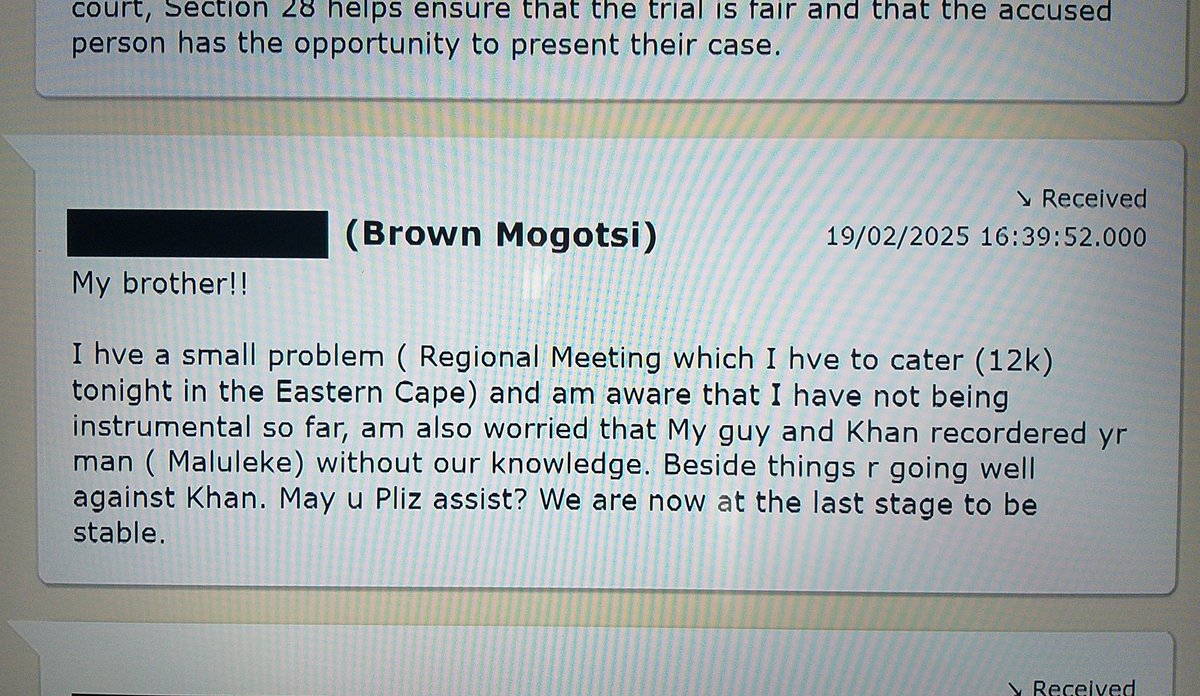
Brown Mogotsi was milking Vusi Cat Matlala BIG time yoh!😭😭 Everything that he had to do he asked for money from Cat Matlala
Brown Mogotsi was indirectly Cat Matlala's girlfriend.
With Cat Matlala being in prison, Brown Mogotsi is broke as fuck whatever he is right now. 😂😂😭
#MadlangaCommission
Breaking:South Africans are not impressed with Judge Ledwaba,the same judge who sealed the CR17 bank statements, shielding Ramaphosa’s funders Pressure is mounting as legal experts argue the sealing did not follow due process and CR17 can be subpoenaed to the #MadlangaCommission
@TheTruthPanther The day evidence start hitting naspers shares, phuthuma shares and investors start holding back..there will be suicides and poisoned deaths of those benefited by being bee
You try buying a car for R1.3 million even cash, the dealership wants your life history. FICA DOCUMENTS, payslips, bank statements and how did you get this money. How do you buy cars R223 milllion. How do you buy
4 Lamborghinis without all the relevant documents. The Lamborghini dealership or wherever he bought the cars from need to be investigated. Your average BMW and Audi dealerships would never allow this.
⚖👀 The Gavel’s Shadow: Will Madlanga Drag Ramaphosa Into the Dock? 🔨🇿🇦 ~ 🧩��� An Evidence Nightmare: How Delay, Deception & Cadre Loyalty Collide 💣🔥 🤐🐘 The Silence That Could Impeach: Ramaphosa’s Promise Lost in Pretoria’s Echo Chamber 🏛🕳
Picture this: a quiet Pretoria hall on September 25, 2025, where Major General Petronella van Rooyen's voice cuts through the air like a switchblade, declaring Minister Senzo Mchunu's order to disband the Political Killings Task Team not just wrong, but unlawful—a ministerial overreach that buried 121 dockets probing KwaZulu-Natal's syndicate-fueled murders, leaving them to rot at less than 1% progress.
The room freezes, but the real chill spreads to the Union Buildings, where President Cyril Ramaphosa, briefed on this very sabotage six months earlier by Commissioner Fannie Masemola, had promised action and delivered silence. This isn't a footnote in a forgotten report; it's the spark that could summon Ramaphosa to the Madlanga Commission, raising the ghost of Section 89 impeachment for "serious misconduct"—a constitutional hammer for leaders who let international anti-corruption pledges like UNCAC gather dust while domestic rot festers.
The claim is stark: Madlanga's potential call for Ramaphosa's testimony on his February 1, 2025, briefing inaction constitutes UNCAC-linked deception, warranting impeachment in a nation scarred by cadreism's shadows and 82% fearing to speak truth to power. We'll build this case through an evidence network—judicial gavels, economic scars, historical detours, and social silences—each piece locking into a puzzle of accountability overdue, testable by the commission's 2026 report or 2026 elections, where deception's cost is measured not in words, but in the lives of 1,971 unavenged since 2000.
Stirring Questions
What happens when a president's promised whisper to a minister echoes into eternity, raising the specter of a summons that could shatter the silence?
Does defending cadreism as "transformation" beg the question of its innocence, assuming loyalty cleans corruption without proving a single graft-free hire?
How does a BRICS trip's cut-short return prompt doubts about the true cost of global stages when home dockets burn?
Could Madlanga's gavel force a cadre records flood, exposing the 2013-2017 chairmanship ghosts?
Together, these questions matter because they weave personal pledges into national fractures, stirring a collective demand for transparency that turns passive fear into active renewal, reminding us that in Mzansi's story, unanswered calls aren't just rude—they're the cracks where hope seeps in.
The Cracks in the Covenant: Defining Deception in a Democracy's Mirror
To unpack this, let's start with the bones of the beast: deception in leadership isn't a flashy lie told in a smoky room, but a quiet erosion, the kind where a briefing's vow dissolves into air, leaving institutions like the PKTT—South Africa's elite squad against political hits, forged in 2018 from the Moerane Commission's 2016 tally of over 200 KZN assassinations—to wither under unlawful orders.
Madlanga, proclaimed July 22, 2025, via Gazette No. 50948 under Section 84(2)(j), probes SAPS "criminality and interference," with terms broad enough to summon the president if evidence links him to overreach, as Masemola's September 22-23 testimony did, recounting Ramaphosa's "taken aback" reaction to Mchunu's December 31, 2024, directive yet no follow-up, a gap van Rooyen nailed on September 25 as violating SAPS Act Section 5's operational vesting in the Commissioner.
Section 89 impeachment demands a two-thirds National Assembly vote for "serious violation," a high bar last tested in Zuma's 2018 resignation eve, but UNCAC—ratified 2004—lowers it morally, with Articles 5 (prevention), 6 (body independence), and 32-33 (protections) binding officials to act against graft, a duty Ramaphosa's silence flouts amid cadreism's unconstitutional grip (Zondo Vol. 2, 2022, Sections 195-197).
Common views split the room like a family braai gone sour: Supporters hail Ramaphosa as the "least corrupt" reformer, inheriting Zuma's mess with 48% Zondo implementation and R11 billion recovered (Presidency July 2025), his BRICS Brazil jaunt (July 6-7, 2025) a diplomatic win yielding Brazil's July 23 ICJ join. Critics, from DA benches to X's #MadlangaCommission chorus (September 23, @ewnupdates 2.3K engagements), see deception in delays—like the "late" July 13 Mchunu suspension post-Mkhwanazi leaks (R360m syndicates, TimesLive July 10)—and cadre stonewalling (ConCourt February 12, 2024, CCT 139/22 ordering 2013+ records, contempt April 2024). Neutrally, it's a leader navigating GNU fractures (ANC 40.18% drop, Foreign Policy May 27, 2024), but the conversation's clues—from greylisting's AML lags (FATF February 2023, eight gaps) to Phala Phala's $580k clearance (SARS March 8, 2023)—suggest rigidity over adaptation, where "busyness" excuses inaction on 121 PKTT dockets (<1% progress, SAPS Q1 2025).
This isn't abstract; it's the daily grind for families awaiting justice in a 1.2 million case backlog, where 82% fear speaking (Afrobarometer 2025) and 33.2% unemployment (Stats SA Q2 2025) fans the flames of distrust.
Yet, history whispers a different tune. Cadreism, ANC's 1997 "loyalty lottery" for transformation, chaired by Ramaphosa 2013-2017, birthed the R500 billion capture beast (Zondo 2022), its unconstitutional merit subversion enabling Gupta rigs at Eskom (R412bn debt, Eskom 2025). Zondo's April 28, 2021, transcript captures his evangelical pitch: "not corruption, but reflection of demographics," a rose-tinted veil over 66% municipal collapses (Auditor-General 2024). The DA's saga—High Court 2023 win, SCA September 2023 dismissal, ConCourt February 2024 order for 1,300 pages of WhatsApp/CV hires, ANC contempt April 2024 for partial release—exposes the stonewall, omitting pre-2018 shadows.
BRICS Brazil's cut-short (July 7 DIRCO log) for Mkhwanazi's July 6 leaks yields July 13 vagueness, coinciding with Brazil's ICJ July 23 join, a diplomatic sleight amid domestic docket graves.
These facts flow into a river of questions:
If a briefing's promise evaporates, what does that say about the oath's weight?
Does cadre "transformation" truly heal if it assumes equity without proving fewer scandals?
How does a summit's sparkle prompt ignoring the home hearth's embers?
Might Madlanga's broad summons power (Proclamation 137) force a cadre flood, linking to UNCAC's transparency call?
These questions aren't side notes; they're the current carrying facts to foresight, why they matter is simple—they bridge yesterday's vows to tomorrow's verdicts, turning individual lapses into a nation's ledger, where ignoring them leaves the scales tipped toward the few, but heeding them balances hope for all.
Stirring Questions
If a president's "surprise" at overreach fades to silence, what raises alarms about the system's safeguards?
How does cadre stonewalling prompt a peek at the withheld 2013 shadows?
Could UNCAC's Article 13 civil society role force X's #Madlanga chorus into formal probes?
United, these questions are vital—they stir from facts to foresight, begging logical rigor against assumptions, prompting deeper dives, emerging as calls for reform, collectively forging a path where Mzansi's story shifts from endurance to empowerment, reminding us that unanswered whispers become roars for change.
Unraveling the Threads: An Evidence Network of Deception and Delay
The claim—that Madlanga's summons could ignite Section 89 impeachment for UNCAC-linked deception—doesn't stand on whispers or headlines; it's forged in an evidence network, where judicial edicts, economic ledgers, historical detours, and social pulses interlock like gears in a clock ticking toward accountability. Each field reinforces the others, consilient in their verdict: inaction isn't oversight, it's a choice with costs, falsifiable by Madlanga's 2026 report or the 2026 ballot box. Let's trace this web, starting with the gavel's strike.
Judicial Echoes: From Zondo's Verdict to Madlanga's Mandate
Law's language is precise, its precedents unyielding. The Zondo Commission's Vol. 2 (2022) branded cadre deployment unconstitutional under Sections 195-197, a "subversion of merit" Ramaphosa chaired 2013-2017, enabling R500 billion capture through pliant SOE appointments (Zondo Commission, 2022). His April 28, 2021, testimony transcript (https://t.co/iGCpULBVGR) insists it's "transformation," but the July 2025 progress report admits only 48% implementation, with 51 of 1,438 implicated charged—no elites like Mantashe or Mchunu (Presidency, 2025).
This rigidity links to PKTT's fate: Masemola's September 22-23 Madlanga testimony recounts Ramaphosa's February 1 vow to intervene, unfulfilled as van Rooyen's September 25 ruling confirms overreach (SAPS Act Section 5), breaching UNCAC Article 6 independence (UNODC, 2004).
It's a referee calling foul but pocketing the whistle, where 121 dockets' <1% progress (SAPS Q1 2025) isn't accident—it's the echo of cadre loyalty. Some may counter that it is an "Inherited mess"—but Zondo's 2022 gavel demands action, not alibis. This judicial thread feeds economic fallout, where unchecked rot bleeds the nation dry.
Economic Scars: The Bill for a Blind Eye
Numbers whisper what shouts cannot: cadreism's merit dodge costs R17-23 trillion in trust deficits (TDEIM, 2025), with 33.2% unemployment and 62.4% youth idle (Stats SA Q2 2025) as construction mafias—unprobed post-PKTT—extort billions, mirroring Eskom's R412 billion debt (Eskom 2025). Ramaphosa's inaction on Masemola's briefing lets this fester, flouting UNCAC Article 5 prevention, where greylisting's February 2023 FATF slap (eight AML gaps, under 1% laundering convictions) ties cadre appointees in FIC/SARB to lax oversight.
Picture a young coder in Johannesburg dreams of fintech startups, but tender rigs—shielded by cadre loyalty—clip her wings, her code gathering dust as Gini's 0.63 grinds wider (World Bank 2025). Sure some may object "Reforms underway"—yet 48% Zondo stall and R11 billion recoveries pale against losses. This economic wound bleeds into history, where past choices haunt present ledgers.
Historical Detours: From CODESA Bridge to BRICS Blindspot
History isn't linear; it's a detour where bridges built in 1991-1994 CODESA (Presidency 2025) crumble under 2013-2017 cadre weight, Ramaphosa's chairmanship enabling Gupta rigs (Zondo 2022). His Zondo April 2021 defense—"essential for demographics"—ignores Marikana's 2012 34 deaths, his Lonmin emails urging crackdowns foreshadowing loyalty biases (Marikana Commission 2012). BRICS Brazil's July 6-7, 2025, cut-short for Mkhwanazi leaks yields July 13 vagueness, coinciding with Brazil's July 23 ICJ join (https://t.co/8Px29bDAwE docket), a diplomatic sleight amid DA records stonewall (ConCourt February 12, 2024, contempt April 2024). UNCAC Article 7 integrity? Breached in the gap.
Imagine a bridge-builder from NUM strikes (1982, 300,000 members) now dynamites his span for foreign photo-ops, the river below swirling with 1,971 unavenged (GI-TOC 2024). And some may push back that "Global leadership needed"—but Dudula's 59 attacks (Xenowatch 2024) show home neglect. History detours to social voids, where silence silences the silenced.
Social Pulses: Whistleblowers' Echoes in a Nation's Fear
Society's heartbeat is faint but fierce: 82% fear reporting (Afrobarometer 2025), a pulse quickened by Deokaran's 2021 12 bullets for Tembisa exposé (SIU 2025) and Mkhwanazi's July 6, 2025, leaks on R360m syndicates (TimesLive July 10). Ramaphosa's July 13 suspension of Mchunu sans probe erodes UNCAC Article 32-33 protections, amid X's #MadlangaCommission roar (September 23, @ewnupdates 2.3K engagements).
Picture life in a Cape Town flat, a nurse scrolls Madlanga streams, her whistleblower cousin's memory fueling quiet resolve—fear's chain, but links weakening. Then an objection "Progress in recoveries"—R11 billion (Presidency 2025) helps, but 70-80% stalled cases (Corruption Watch 2024) mock it. Social fear pulses back to judicial roots, completing the evidence network's circle.
Now, the solution unfolds: Imagine Madlanga's 2026 report as a key turning in a rusted lock—30-day response mandates click into place, cadre bans sweep clean, UNCAC statutes bind fast. Time slows as the door creaks open: dockets flow, whistleblowers breathe free, youth code futures unshackled. Unity's rhythm—action and awareness merge, performance surges as understanding blooms: merit mends what loyalty tore, a nation's ledger balanced not by force, but flow.
Stirring Questions
If judicial gavels echo unanswered, what raises the volume on a summons that could echo globally?
Does "transformation" beg cadre's virtue without docket-deep proof?
How does economic bleed prompt a merit rethink amid 62.4% youth idle?
Might social fear's 82% threshold trigger UNCAC international review?
These questions interlock like the evidence network itself—systemic stakes, fallacy-free scrutiny, reform blueprints, global calls—vital because they transform isolated facts into a symphony of change, reducing dissonance by showing deception's cost in lives and ledgers, empowering dear readers to see not just the break, but the mend.
The Web Tightens: Evidence's Unyielding Convergence
Evidence threads pull taut: Judicial rulings (Zondo's unconstitutional cadre, Madlanga's overreach affirmation) lock with economic hemorrhage (R17-23trn deficit, 33.2% jobless), historical pivots (CODESA to BRICS dodges), and social tremors (82% fear, 1,971 unavenged), proving Madlanga's summons could catalyze Section 89 impeachment for UNCAC deception—falsifiable if Ramaphosa testifies without charges by 2026, stakes a democracy where 26% trust (Afrobarometer 2025) hangs by inaction's thread.
Envision the convergence: Gavel falls, dockets unlock, merit hires hum—a breakthrough where deception yields to dawn, a republic reborn not in rhetoric, but resolve.
Stirring Questions
If evidence converges, what raises the pitch for a summons that silences excuses?
Does "inherited mess" beg absolution without action's proof?
How does historical detour prompt a BRICS-home balance?
Could 2026 elections test Madlanga's fangs on cadre ghosts?
Collectively, they unify the puzzle—raising urgency, begging evidence over alibis, prompting global ties, emerging as electoral litmus—essential because they forge coherence from chaos, countering biases with interlocking truths, guiding Mzansi from fracture to fortified hope.
Facing the Mirrors: Objections That Don't Quite Reflect
We hear the defenses, and they're not without merit—the ANC's a hydra of history, and Ramaphosa's no solo villain. First, he's a reformer hemmed by coalition chains, with 48% Zondo progress and R11 billion clawed back (Presidency July 2025). Empathize: Inherited rot is real, cadreism's roots run deep. But Zondo's July 2025 rebuke calls it superficial—51 charged, elites untouched—inaction isn't inheritance, it's inheritance tax on the nation (Zondo, 2025).
Second, summons risks political theater, a DA witch hunt in GNU's fragile peace (ANC 40.18% drop, Foreign Policy May 27, 2024). Fair: Impeachment's a blunt tool, Zuma dodged it. Yet Section 89's bar is "serious," met by UNCAC breaches and 121 docket graves (van Rooyen September 25), not vendetta—Peru's Kuczynski fled similar shadows.
Third, "busyness" is leadership's lot, BRICS Brazil a must for multipolarity. Understand: Global stages matter, ICJ July 23 win proves it. But July 13's vague Mchunu suspension amid leaks (TimesLive July 10) prioritizes optics over 82% fear (Afrobarometer 2025)—busyness doesn't bury dockets.
Facts refract these mirrors: Deception thrives in delays, but Madlanga could polish them clean.
Stirring Questions
If objections mirror defenses, what raises the need for a summons to shatter illusions?
Does "reformer trapped" beg progress without elite charges' proof?
How does coalition fragility prompt a Section 89 rethink?
Might whistleblower shields from R11bn recoveries force global UNCAC compliance?
These questions bind rebuttals to resolve—raising clarity, begging evidence, prompting thresholds, emerging as safeguards—crucial because they validate concerns while proving the claim's steel, easing dissonance to reveal a path where empathy meets enforcement, hopeful in its honesty.
Dawn's First Light: A Reckoning Ramaphosa Can't Outrun
Madlanga's orbit tightens around Ramaphosa, its summons a potential Section 89 spark for UNCAC deception, woven from PKTT graves, cadre shadows, BRICS veils, and global precedents in an evidence network where judicial steel meets economic fire, historical bends social heartbeats. Test it: If he testifies sans reform by 2026, the claim crumbles; else, stakes soar—26% trust, R17-23trn deficit demand action.
Feel the light break: Gavel summons, reforms cascade—cadre bans click, responses flow, shields rise. Timely truth in this surge, a tide of unity—understanding arrives not as thunder, but the quiet power of a nation claiming its due, alight in the yes to justice.
Seize it, Mzansi: Petition Madlanga, vote merit in 2026, whisper no more—will you let deception dim the dawn, or fan it to full flame?
The evidence network proves Madlanga's potential summons of Ramaphosa raises Section 89 impeachment for UNCAC-linked deception with undeniable evidence.
Stirring Questions
If the web tightens, what raises the final call for a summons that rebalances scales?
Does "inherited" beg reform without follow-through's proof?
How does stakes' height prompt a 2026 merit mandate?
Could international UNCAC review amplify Madlanga's roar?
These questions culminate the case—resolve, action, votes, emerging as global spotlights—profound because they seal the story from fracture to flame, countering weariness with wonder, critical yet kindling hope's unquenchable spark.
#⚖GavelSlam2025🔥
#RamapauseButton⏸🤦🏾♂
#MadlangaModeON👨🏾⚖🔨
#121FilesAndChill📂❄
#PretoriaPlotTwist🎭🏛
#SilenceIsSuspicious🤫👀
#UNCACUnplugged🎤🌍
#CadreClawMachine🕹🤡
#BRICSandMortarButNoJustice🏗💸
#Section89OrBust💥🚨
#DocketApocalypse☠📜
#FromThumaMinaToThumaLawyers📞⚖
#WhisperGate2025👂💀
#PhantomOfTheUnionBuildings👻🏛
#MzansiNeedsReceipts🧾🔥
References
Afrobarometer. (2025). Public attitudes survey. Afrobarometer.
Auditor-General South Africa. (2024). Consolidated general report on local government audit outcomes. AGSA.
BusinessLive. (2025, September 25). Madlanga summons possibility.
Daily Maverick. (2025, September 23). Commission terms analysis.
FATF. (2023). Jurisdictions under increased monitoring. FATF.
Foreign Policy. (2024, May 27). South Africa’s election: ANC’s vote share.
Genocide Watch. (2025). South Africa: Stage 6 polarization report.
GI-TOC. (2024). Assassinations in South Africa: 2000-2021 update.
Moerane Commission. (2018). Report on political killings in KZN.
Presidency of South Africa. (2025, July). Zondo progress report.
SABC News. (2025, September 23). Madlanga analyst commentary.
SAPS. (2025). Q1 crime statistics.
Stats SA. (2025). Quarterly labour force survey Q2.
TDEIM. (2025). Trust deficit economic impact model.
TimesLive. (2025, July 10). Mkhwanazi leaks.
UNODC. (2004). United Nations Convention Against Corruption.
van Rooyen, P. (2025, September 25). Madlanga Day 6 testimony. (SAPS transcript).
Zondo Commission. (2022). Judicial Commission of Inquiry into State Capture Report Vol. 2. Government Printer.
[BREAKING NEWS] SIU Exposes R2 Billion Healthcare Looting at Tembisa Hospital
Controversial Tenderpreneur Maumela Reportedly Connected to Ramaphosa Received Over R800k
The Special Investigating Unit (SIU) has revealed a massive R2 billion fraud at Tembisa Hospital, uncovering three coordinated syndicates responsible for misappropriating public healthcare funds. The Maumela Syndicate, linked to businessman Hangwani Morgan Maumela—reportedly connected to President Cyril Ramaphosa through a previous marriage—is a central focus of the investigation, though Ramaphosa has denied any knowledge of him.
An in-depth review of 2,207 procurement bundles revealed serious maladministration and procurement fraud. The SIU identified 207 service providers who traded with the hospital under 4,501 purchase orders, each tied to a purported three-quote procurement process. Investigators found irregular appointments of service providers, fraudulent payments, fronting, and falsified Supply Chain Management documentation, benefiting key officials from the Gauteng Department of Health and Tembisa Hospital.
The Maumela Syndicate alone accounts for R816,560,710 in fraudulent contracts. The SIU has traced 41 suppliers linked to Maumela, including three companies connected to Vusimuzi Matlala. Assets identified include luxury vehicles and properties valued at R520 million, notably a R75 million property in Bantry Bay and several Gauteng homes. The SIU, in coordination with the National Prosecuting Authority (NPA) Asset Forfeiture Unit, has preserved these assets as part of ongoing efforts to recover public funds.
Advocate Andy Mothibi of the SIU confirmed that the investigation was launched following a referral by the Office of the Premier in September 2022 and has since involved complex, multi-layered fraud, corruption, and money-laundering schemes. Interim reports are being prepared, with the SIU also investigating similar cases at Home Affairs and Medico-Legals. Authorities say the probe aims to hold corrupt officials and service providers accountable and restore public trust in healthcare.
The SIU emphasized the importance of collaboration with the Office of the Premier and the Health Ministry in uncovering wrongdoing. The investigation highlights systemic vulnerabilities in public procurement, underscoring the need for rigorous oversight. Authorities continue to monitor all funds and assets linked to the syndicates, while the public awaits updates on the full scope of recoverable losses.
The Tembisa Hospital corruption probe traces back to 2021, when Babita Deokaran, a chief director in the Gauteng Department of Health’s infrastructure and facilities management unit, uncovered systemic graft in the hospital’s supply chain. On 26 July 2021, Deokaran submitted a 10-page report flagging R850 million in suspicious payments to over 200 companies for unperformed or overpriced services, including PPE and medical equipment during the COVID-19 pandemic. Her findings exposed a web of irregularities from January 2019 to August 2022, involving kickbacks, ghost suppliers, and inflated tenders worth billions.
Tragically, Deokaran was assassinated on 15 August 2021, just 19 days after submitting her report. Six men—Phumlani Dlamini, Phumlani Ntuli, Nkanyiso Makhubele, Njabulo Ngwenya, Mfundo Makhubele, and Zenzele Mkhize—were convicted in April 2022 for murder, attempted murder, and firearms charges, receiving life sentences. The masterminds behind the hit remain at large, with investigations continuing amid delays, police failures, and allegations of interference, as detailed in Jeff Wicks’ 2025 book, The Shadow State.
🎩✨ Lesufi’s G20 Illusion: Jozi’s Magic Trick or Global Roast? 🌍🚨 ~ 📉🔥 Johannesburg’s High-Stakes Balancing Act: G20 or #GLOL? 🎪🎭 ~ 🦸♀🗳 Zille’s Jozi Reboot: Cape Crusader vs. Cadre Chaos 💥🐘
Panyaza Lesufi, Gauteng’s Premier, stands center stage, a magician promising a dazzling G20 summit in November 2025. With a flourish, he pledges “Solidarity” to a watching world, conjuring visions of Johannesburg as a gleaming host. But behind the curtain, the city crumbles: R22.2 billion lost to irregular spending, 44% of its water vanishing into leaky pipes, and 7,743 hospital infections staining its healthcare system (Polity, August 4, 2025; The Conversation, 2024; The Star, August 3, 2025).
Lesufi’s wand waves over press releases and reshuffles, yet the potholes deepen, the taps run dry, and the G20 looms as a potential global embarrassment—think Mandela’s 2013 funeral interpreter, but with higher stakes (BBC, 2013). This is no illusionist’s trick; it’s a city and a nation teetering on the edge. Can Johannesburg pull off this high-wire act, or will Lesufi’s magic leave South Africa the punchline of a grim joke?
This article dives into Johannesburg’s corruption crisis, Lesufi’s sleight-of-hand governance, and the G20’s make-or-break moment, weaving in Helen Zille’s mayoral bid and the people’s defiance as threads of hope. Backed by a network of evidence—financial data, health statistics, and grassroots voices—it’s a story of a city drowning in cadreism, yet fighting to surface.
Let’s peel back the layers.
The Magician’s Mirage: Lesufi’s G20 Dream Meets Jozi’s Nightmare
Panyaza Lesufi is a master of optics, not infrastructure. Since taking the Gauteng premiership in October 2022, he’s wielded press conferences like a magician’s cape, dazzling with 47 forensic reports and head-of-department reshuffles in August 2025 (IOL, August 3, 2025). His latest act? A G20 summit billed as South Africa’s triumphant return to the global stage, hosting world leaders in Johannesburg come November 2025 (Wikipedia, December 2024).
The budget’s set at R691 million, with a R26.5 billion World Bank loan in tow (BusinessTech, 2025). On paper, it’s a glittering promise. In reality, it’s a house of cards built on sand.J
ohannesburg, South Africa’s economic engine, is collapsing under Lesufi’s watch. The National Treasury’s August 2025 ultimatum to Mayor Dada Morero was blunt: recover R22.2 billion in irregular spending or kiss grant funding goodbye (Polity, August 4, 2025). That’s billions that could’ve fixed the 44% water loss or the R200 billion infrastructure backlog (The Conversation, 2024; City of Johannesburg, 2025).
Instead, Lesufi’s promising a summit while Sandton endured an eight-day water outage in July 2025 (African Insider, August 2025). Picture this: G20 delegates sipping bottled Evian, dodging potholes on Lillian Ngoyi Street, and praying Charlotte Maxeke Hospital isn’t their next stop. Lesufi’s magic can’t hide the truth—Johannesburg’s a city where promises outshine pipes.
Stirring Questions:
Can Lesufi’s optics outshine Johannesburg’s potholes come November?
Is Lesufi incompetent because the city’s failing, or is the system too broken to fix?
How will delegates react when the “Solidarity” welcome includes dry taps?
What contingency plans exist if Johannesburg’s infrastructure flops mid-summit?
Why it matters:
A failed G20 could tank South Africa’s credibility, and these questions probe whether Lesufi’s spin can defy gravity—or if reality will crash the show.
The Great Jozi Heist: Billions Lost, Cadres Laughing
Johannesburg’s finances aren’t just leaking—they’re hemorrhaging. The R22.2 billion in irregular expenditure isn’t a typo; it’s a looting spree sanctioned by cadreism, the ANC’s loyalty-over-competence creed (Polity, August 4, 2025). Add R705 million wasted on an unconstitutional VIP-Protection policy, and you’ve got a city where money evaporates faster than water in a Jozi summer (Polity, August 4, 2025).
Since 1994, cadreism’s cost South Africa R1.5 trillion, per the Zondo Commission (2022). Now, the G20’s R691 million budget dangles like fresh meat before the same sticky fingers.
The National Treasury’s ultimatum isn’t a suggestion—it’s a lifeline. Recover the funds, or Johannesburg loses grants that keep its lights flickering. Yet, Lesufi’s response is a reshuffle and a smile, as if shuffling deck chairs on the Titanic counts as strategy. Residents endure power cuts, dry taps, and 1,600 murders in 2023 alone (The South African, November 28, 2023), while cadres treat public funds like a personal braai budget.
The G20 could be their next feast—imagine world leaders toasting “Solidarity” while the city’s coffers are picked clean.
Stirring Questions:
How does a city lose R22.2 billion and still play global host?
Are cadres looting because they’re greedy, or is the system designed to enable it?
What safeguards can stop the G20 budget from vanishing into the cadre abyss?
Can transparency tools like blockchain track funds in real-time?
Why it matters:
If Johannesburg can’t secure its money, the G20 becomes a symbol of plunder, not progress—these questions demand accountability before the curtain falls.
Cadreism’s Dystopia: Hospitals Kill, Water Vanishes
Cadreism isn’t just a financial parasite—it’s a public health and safety assassin. Gauteng’s hospitals are petri dishes of despair, logging 7,743 nosocomial infections in 2024, fueled by R1.2 billion in ghost tenders at Tembisa Hospital (The Star, August 3, 2025; Corruption Watch, 2024).
Johannesburg’s water system? A sieve losing 44% to leaks and neglect, with a R200 billion repair bill the ANC can’t—or won’t—pay (The Conversation, 2024; City of Johannesburg, 2025). This is Lesufi’s stage: a city where competence bows to loyalty, and residents pay the price.
The G20 risks showcasing this dystopia. Delegates might marvel at Sandton’s skyline, only to find dry taps and potholes that could swallow a limo. The 2013 Mandela funeral fake interpreter was a blip; this could be a catastrophe (BBC, 2013). Lesufi’s “Solidarity” sounds hollow when Charlotte Maxeke Hospital’s a biohazard and Lillian Ngoyi Street’s a lunar landscape.
Johannesburg’s not ready for a close-up—it’s a cautionary tale in cadre collapse.
Stirring Questions:
How can Johannesburg host a summit when it can’t save its own people?
Is cadreism the sole villain, or are budgets just too tight to fix this mess?
What emergency fixes can patch healthcare and water before November?
How can trust in Jozi’s health and safety systems be rebuilt post-G20?
Why it matters:
A summit flop could scar South Africa globally—these questions probe whether cadreism’s rot can be staunched in time.
Zille’s Jozi Rebuild: Cape Crusader or Outmatched Hope?
Helen Zille, the DA’s 74-year-old dynamo, sees Johannesburg as her next conquest. Her 2026 mayoral bid promises a “Jozi Rebuild,” armed with a Cape Town résumé: 90% crime reduction, R10 billion in private water funds, and seven “Best City” awards (Thompsons, 2025; City Mayors, 2008). Her plan—R2 billion for pipes, community patrols—sounds like a lifeline for a city choking on a R200 billion backlog (World Bank, 2023; City of Johannesburg, 2025).
But Johannesburg’s 5.6 million souls dwarf Cape Town’s scale, and cadreism’s grip is tighter than a Jozi traffic jam.
Zille’s a Cape Crusader in a Jozi jungle, facing skepticism over her DA branding—some see it as Sandton’s elite club, not Alexandra’s ally (CFR, 2017). Lesufi’s photo-op juggling contrasts with her pipeline plotting, but can she outmuscle the ANC’s machine? Picture her swooping in, blueprints in hand, while cadres guard their loot like hyenas.
It’s a long shot, but it’s hope—and Johannesburg’s desperate for a hero.
Stirring Questions:
Can Zille’s Cape magic tame Johannesburg’s chaos?
Will she succeed just because Cape Town did, or is Jozi a different beast?
How can she win over voters wary of the DA’s blue badge?
Can Zille balance quick wins with a long-term fix for cadreism?
Why it matters:
Her bid could shift Johannesburg’s trajectory—these questions test if hope can outpace history.
The People’s Pulse: Defiance as Johannesburg’s Heartbeat
Forget the cadres—Johannesburg’s real power hums on its streets. Pretoria’s 12,000 marchers and 1.2 million #TruthMzansi posts roar for accountability, eyeing the G20’s R691 million with hawk-like vigilance (SABC, 2025). Soweto vendors rig solar panels to dodge Eskom’s blackouts; Alexandra activists expose tender scams like detectives on a mission (SABC, 2025).
This isn’t passive anger—it’s defiance with teeth, a wildfire that could torch cadreism or the summit itself.
Imagine Sandton overrun by marchers waving “Pothole Protocol” signs, Lesufi’s photo ops drowned out by chants. The people aren’t waiting for saviors—they’re the pulse keeping Johannesburg alive. Their stakes are clear: if the G20 flops, it’s their city, their future, that pays. This is South Africa’s soul fighting back.
Stirring Questions:
Can 12,000 marchers and 1.2 million posts force change by November?
Does defiance win because it’s loud, or does it need a plan?
How can this energy shape policy, not just protests?
Can grassroots momentum outlast the G20 spotlight?
Why it matters:
The people could tip the scales—these questions ask if their fire can forge a new Johannesburg.
G20: South Africa’s Last Stand or Global Laughingstock?
November 2025 is Johannesburg’s reckoning. The G20 could crown South Africa a BRICS powerhouse, with R691 million and a R26.5 billion World Bank loan fueling trade talks (Wikipedia, December 2024; BusinessTech, 2025). Or it could cement its slide into failed-state infamy.
Lesufi’s “Solidarity” clashes with a city manager vacancy since January 2025, 44% water loss, and R1.5 trillion looted since 1994 (Jacaranda FM, July 2025; The Conversation, 2024; Zondo Commission, 2022). This isn’t a summit—it’s a tightrope.
Picture Lesufi pulling a rabbit from his hat as potholes swallow limos, delegates clutching bottled water, and global media tweeting #GLOL. Success hinges on competence, not cadreism, but Johannesburg’s track record screams caution. It’s South Africa’s last stand—glory or humiliation hangs in the balance.
Stirring Questions:
Can Johannesburg dodge disaster by November?
Is the G20 doomed because Jozi’s broken, or can it rise above?
What’s the tipping point—looting, outages, or unrest—that sinks it?
What economic fallout awaits a failed summit?
Why it matters:
This isn’t just about Johannesburg—it’s South Africa’s global soul on trial, and these questions demand we look beyond the stage.
Synthesis: A Network of Truth, a Call to Rise
The evidence locks together like a puzzle: R22.2 billion lost, 7,743 infections, 44% water gone—Johannesburg’s collapse isn’t random; it’s cadreism’s signature (Polity, August 4, 2025; The Star, August 3, 2025; The Conversation, 2024).
Lesufi’s magic distracts, but the G20 exposes the cracks. Zille offers a blueprint, yet the people—12,000 marchers, 1.2 million posts—hold the real power (SABC, 2025). This evidence network isn’t guesswork; it’s falsifiable, built on data, history, and voices from Gauteng to the World Bank (World Bank, 2023).
Imagine this: November arrives, and Johannesburg hums—pipes fixed, funds tracked, cadres sidelined. It’s not fantasy; it’s the solution unfolding. Step by step, transparency locks in the R691 million, grassroots pressure ousts incompetence, and competence trumps loyalty. Time will deliver the truth as the city rallies, Mzansians uniting into collective will, performance soaring as South Africa proves its worth.
The stakes? A nation’s pride, an economy’s lifeline, a people’s future.
Objections Refuted:
“Lesufi’s trying—he released 47 reports!” Optics, not action—R22.2 billion’s still missing (IOL, August 3, 2025).
“Zille can’t win; the DA’s too divisive!” Her Cape Town record begs to differ—90% crime drop speaks louder than branding (Thompsons, 2025).
“Protests won’t change anything!” Tell that to the Zondo Commission, sparked by public fury (Zondo Commission, 2022).
Conclusion: Your Move, Mzansi
Jozi’s G20 isn’t Lesufi’s show—it’s South Africa’s mirror. The evidence screams: cadreism’s bleeding the city dry, but defiance and reform can stitch it back. Demand transparency for every rand. Back the marchers, the tweeters, the doers. Vote for pipes over promises.
Lesufi’s wand won’t save us, but we can. What’s your move, Mzansi?
#💸JoziLootFest
#🕳PotholeProtocol
#🚱EvianOverEkurhuleni
#🪄LesufiLeaksAndLies
#🏥BiohazardBoulevard
#📸SummitOrCinema
#🧻CadresWipingWithTenders
#🥳G20ButNoH2O
#🔍DAvsDNAofCorruption
#🧠MzansiWokeAF
#🤯MandelaInterpreter2.0
#🍗CadreBraaiBudget
#🚨TenderTyrantsUnite
#📢SABCNotSilent
#��♂LesufiTheMagician
#🪙ReshuffleRoulette
#💣JoziOnTheBrink
References (APA):
BBC. (2013). Mandela funeral interpreter fiasco.
BusinessTech. (2025). G20 budget and World Bank loan details.
City of Johannesburg. (2025). Infrastructure backlog report.
Corruption Watch. (2024). Tembisa Hospital tender exposé.
IOL. (August 3, 2025). Lesufi’s forensic reports and reshuffles.
Polity. (August 4, 2025). National Treasury ultimatum.
SABC. (2025). #TruthMzansi and protest coverage.
The Conversation. (2024). Johannesburg water loss statistics.
The Star. (August 3, 2025). Hospital infection data.
Thompsons. (2025). Cape Town crime reduction stats.
Zondo Commission. (2022). State capture financial losses.
@BafanaSurprise Newly appointed South African president Cyril Ramaphosa calling for a Satanic New World Order 666. For the Enslavement of humankind under the strict rule of Lucifer as the book of Revelation 13 say. Our souls as South African citizens were sold to the devil.
Through General Mkhwanazi, we now know that Adv Teffo was not crazy as advertised by the media at the time.♥️
The bought media tried to discredit him so their favs are not thoroughly investigated.🤞
He’s hated for honesty & transparency.😢
Listen here:




![TheTruthPanther's tweet photo. [BREAKING NEWS] SIU Exposes R2 Billion Healthcare Looting at Tembisa Hospital
Controversial Tenderpreneur Maumela Reportedly Connected to Ramaphosa Received Over R800k
The Special Investigating Unit (SIU) has revealed a massive R2 billion fraud at Tembisa Hospital, uncovering three coordinated syndicates responsible for misappropriating public healthcare funds. The Maumela Syndicate, linked to businessman Hangwani Morgan Maumela—reportedly connected to President Cyril Ramaphosa through a previous marriage—is a central focus of the investigation, though Ramaphosa has denied any knowledge of him.
An in-depth review of 2,207 procurement bundles revealed serious maladministration and procurement fraud. The SIU identified 207 service providers who traded with the hospital under 4,501 purchase orders, each tied to a purported three-quote procurement process. Investigators found irregular appointments of service providers, fraudulent payments, fronting, and falsified Supply Chain Management documentation, benefiting key officials from the Gauteng Department of Health and Tembisa Hospital.
The Maumela Syndicate alone accounts for R816,560,710 in fraudulent contracts. The SIU has traced 41 suppliers linked to Maumela, including three companies connected to Vusimuzi Matlala. Assets identified include luxury vehicles and properties valued at R520 million, notably a R75 million property in Bantry Bay and several Gauteng homes. The SIU, in coordination with the National Prosecuting Authority (NPA) Asset Forfeiture Unit, has preserved these assets as part of ongoing efforts to recover public funds.
Advocate Andy Mothibi of the SIU confirmed that the investigation was launched following a referral by the Office of the Premier in September 2022 and has since involved complex, multi-layered fraud, corruption, and money-laundering schemes. Interim reports are being prepared, with the SIU also investigating similar cases at Home Affairs and Medico-Legals. Authorities say the probe aims to hold corrupt officials and service providers accountable and restore public trust in healthcare.
The SIU emphasized the importance of collaboration with the Office of the Premier and the Health Ministry in uncovering wrongdoing. The investigation highlights systemic vulnerabilities in public procurement, underscoring the need for rigorous oversight. Authorities continue to monitor all funds and assets linked to the syndicates, while the public awaits updates on the full scope of recoverable losses.
The Tembisa Hospital corruption probe traces back to 2021, when Babita Deokaran, a chief director in the Gauteng Department of Health’s infrastructure and facilities management unit, uncovered systemic graft in the hospital’s supply chain. On 26 July 2021, Deokaran submitted a 10-page report flagging R850 million in suspicious payments to over 200 companies for unperformed or overpriced services, including PPE and medical equipment during the COVID-19 pandemic. Her findings exposed a web of irregularities from January 2019 to August 2022, involving kickbacks, ghost suppliers, and inflated tenders worth billions.
Tragically, Deokaran was assassinated on 15 August 2021, just 19 days after submitting her report. Six men—Phumlani Dlamini, Phumlani Ntuli, Nkanyiso Makhubele, Njabulo Ngwenya, Mfundo Makhubele, and Zenzele Mkhize—were convicted in April 2022 for murder, attempted murder, and firearms charges, receiving life sentences. The masterminds behind the hit remain at large, with investigations continuing amid delays, police failures, and allegations of interference, as detailed in Jeff Wicks’ 2025 book, The Shadow State.](https://pbs.twimg.com/media/G2AJzMXXUAALCbL.jpg)
![TheTruthPanther's tweet photo. [BREAKING NEWS] SIU Exposes R2 Billion Healthcare Looting at Tembisa Hospital
Controversial Tenderpreneur Maumela Reportedly Connected to Ramaphosa Received Over R800k
The Special Investigating Unit (SIU) has revealed a massive R2 billion fraud at Tembisa Hospital, uncovering three coordinated syndicates responsible for misappropriating public healthcare funds. The Maumela Syndicate, linked to businessman Hangwani Morgan Maumela—reportedly connected to President Cyril Ramaphosa through a previous marriage—is a central focus of the investigation, though Ramaphosa has denied any knowledge of him.
An in-depth review of 2,207 procurement bundles revealed serious maladministration and procurement fraud. The SIU identified 207 service providers who traded with the hospital under 4,501 purchase orders, each tied to a purported three-quote procurement process. Investigators found irregular appointments of service providers, fraudulent payments, fronting, and falsified Supply Chain Management documentation, benefiting key officials from the Gauteng Department of Health and Tembisa Hospital.
The Maumela Syndicate alone accounts for R816,560,710 in fraudulent contracts. The SIU has traced 41 suppliers linked to Maumela, including three companies connected to Vusimuzi Matlala. Assets identified include luxury vehicles and properties valued at R520 million, notably a R75 million property in Bantry Bay and several Gauteng homes. The SIU, in coordination with the National Prosecuting Authority (NPA) Asset Forfeiture Unit, has preserved these assets as part of ongoing efforts to recover public funds.
Advocate Andy Mothibi of the SIU confirmed that the investigation was launched following a referral by the Office of the Premier in September 2022 and has since involved complex, multi-layered fraud, corruption, and money-laundering schemes. Interim reports are being prepared, with the SIU also investigating similar cases at Home Affairs and Medico-Legals. Authorities say the probe aims to hold corrupt officials and service providers accountable and restore public trust in healthcare.
The SIU emphasized the importance of collaboration with the Office of the Premier and the Health Ministry in uncovering wrongdoing. The investigation highlights systemic vulnerabilities in public procurement, underscoring the need for rigorous oversight. Authorities continue to monitor all funds and assets linked to the syndicates, while the public awaits updates on the full scope of recoverable losses.
The Tembisa Hospital corruption probe traces back to 2021, when Babita Deokaran, a chief director in the Gauteng Department of Health’s infrastructure and facilities management unit, uncovered systemic graft in the hospital’s supply chain. On 26 July 2021, Deokaran submitted a 10-page report flagging R850 million in suspicious payments to over 200 companies for unperformed or overpriced services, including PPE and medical equipment during the COVID-19 pandemic. Her findings exposed a web of irregularities from January 2019 to August 2022, involving kickbacks, ghost suppliers, and inflated tenders worth billions.
Tragically, Deokaran was assassinated on 15 August 2021, just 19 days after submitting her report. Six men—Phumlani Dlamini, Phumlani Ntuli, Nkanyiso Makhubele, Njabulo Ngwenya, Mfundo Makhubele, and Zenzele Mkhize—were convicted in April 2022 for murder, attempted murder, and firearms charges, receiving life sentences. The masterminds behind the hit remain at large, with investigations continuing amid delays, police failures, and allegations of interference, as detailed in Jeff Wicks’ 2025 book, The Shadow State.](https://pbs.twimg.com/media/G2AJy4uWkAAAkQw.jpg)






![TheTruthPanther's tweet photo. [BREAKING NEWS] SIU Exposes R2 Billion Healthcare Looting at Tembisa Hospital
Controversial Tenderpreneur Maumela Reportedly Connected to Ramaphosa Received Over R800k
The Special Investigating Unit (SIU) has revealed a massive R2 billion fraud at Tembisa Hospital, uncovering three coordinated syndicates responsible for misappropriating public healthcare funds. The Maumela Syndicate, linked to businessman Hangwani Morgan Maumela—reportedly connected to President Cyril Ramaphosa through a previous marriage—is a central focus of the investigation, though Ramaphosa has denied any knowledge of him.
An in-depth review of 2,207 procurement bundles revealed serious maladministration and procurement fraud. The SIU identified 207 service providers who traded with the hospital under 4,501 purchase orders, each tied to a purported three-quote procurement process. Investigators found irregular appointments of service providers, fraudulent payments, fronting, and falsified Supply Chain Management documentation, benefiting key officials from the Gauteng Department of Health and Tembisa Hospital.
The Maumela Syndicate alone accounts for R816,560,710 in fraudulent contracts. The SIU has traced 41 suppliers linked to Maumela, including three companies connected to Vusimuzi Matlala. Assets identified include luxury vehicles and properties valued at R520 million, notably a R75 million property in Bantry Bay and several Gauteng homes. The SIU, in coordination with the National Prosecuting Authority (NPA) Asset Forfeiture Unit, has preserved these assets as part of ongoing efforts to recover public funds.
Advocate Andy Mothibi of the SIU confirmed that the investigation was launched following a referral by the Office of the Premier in September 2022 and has since involved complex, multi-layered fraud, corruption, and money-laundering schemes. Interim reports are being prepared, with the SIU also investigating similar cases at Home Affairs and Medico-Legals. Authorities say the probe aims to hold corrupt officials and service providers accountable and restore public trust in healthcare.
The SIU emphasized the importance of collaboration with the Office of the Premier and the Health Ministry in uncovering wrongdoing. The investigation highlights systemic vulnerabilities in public procurement, underscoring the need for rigorous oversight. Authorities continue to monitor all funds and assets linked to the syndicates, while the public awaits updates on the full scope of recoverable losses.
The Tembisa Hospital corruption probe traces back to 2021, when Babita Deokaran, a chief director in the Gauteng Department of Health’s infrastructure and facilities management unit, uncovered systemic graft in the hospital’s supply chain. On 26 July 2021, Deokaran submitted a 10-page report flagging R850 million in suspicious payments to over 200 companies for unperformed or overpriced services, including PPE and medical equipment during the COVID-19 pandemic. Her findings exposed a web of irregularities from January 2019 to August 2022, involving kickbacks, ghost suppliers, and inflated tenders worth billions.
Tragically, Deokaran was assassinated on 15 August 2021, just 19 days after submitting her report. Six men—Phumlani Dlamini, Phumlani Ntuli, Nkanyiso Makhubele, Njabulo Ngwenya, Mfundo Makhubele, and Zenzele Mkhize—were convicted in April 2022 for murder, attempted murder, and firearms charges, receiving life sentences. The masterminds behind the hit remain at large, with investigations continuing amid delays, police failures, and allegations of interference, as detailed in Jeff Wicks’ 2025 book, The Shadow State.](https://pbs.twimg.com/media/G2AJzdKXoAA3QQz.jpg)


