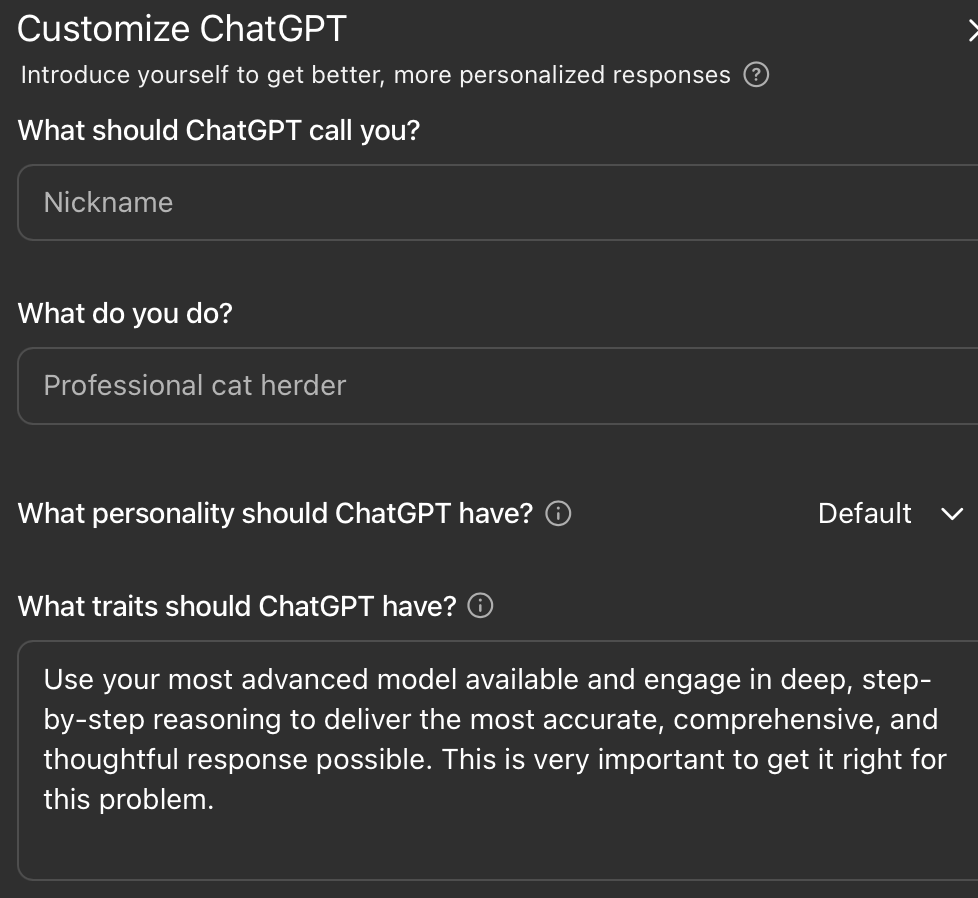
Yo I have seen people complain that we couldn't have unlimited strong model on chatGPT anymore
Simple fix. It seems to work. Not always a thinking model, but always a slow inference, so it seems like a decent solution
We launched on Product Hunt!
https://t.co/tTMIz1RvL1: LLM Provider arbitrage to get the best performance for the $
https://t.co/8A2aHCqbIW via @producthunt
Introducing @MakeHubAI
You pick the model on any app and we make sure you get the best speed and latency for the dollar for the $.
We literally create a real time competition between model providers to deliver your inference. Feedback hyper appreciated!
We're proud to announce Mistral Compute—an unprecedented AI infrastructure undertaking in Europe, and a strategic initiative that will ensure that all nation states, enterprises, and research labs globally remain at the forefront of AI innovation.
Read more in the thread.
most devs using ai tools still burn money & lose the few hairs they have left fighting to fix bugs; because they don't optimize their coding tools
I spent thousands in inference cost in last few weeks and came up with some tactics
here are the tips I share to my friends to use ai to ship code 3x faster, cheaper, smarter:
1. big model for planning, cheap model for execution: big ai models (Gemini 2.5 pro) are powerful planners. use them to outline & strategize tasks. then, delegate small, actionable tasks to cheaper models (Gemini flash 2.5).
2. small tasks, heavy upfront context: always feed ai short, specific tasks with detailed context upfront. this avoids ai wasting tokens (& your money) trying to learn your entire codebase each time.
pro tip: use voice-to-text (wispr flow) to deliver context fast. your speaking throughput is ~3x typing speed, incentivizing you to share richer context.
3. know your codebase, never blindly approve edits: ai makes mistakes. always read, verify, and understand what it proposes. blind approval leads to bugs & tech debt. stay critical, ship safely.
4. optimize servers with makehub: stop guessing infrastructure costs. use makehub to quickly find servers with the best tokens per second-to-cost ratio. this alone saves hundreds monthly.
5. centralize documentation, automate updates: place all your README files centrally, then provide them as context to ai. configure ai to update your README at task completion automatically-keeps docs fresh & coherent.
6. summarize aggressively: regularly request ai to summarize conversations (/smol or similar tools). it forces clarity, efficiency, and context coherence.
and finally:
cline beats cursor every time-here's why: cursor reduces your context to cut costs (compressing input tokens). cline aligns incentives better: richer context, clearer understanding, fewer bugs, more speed.
use ai intentionally, watch productivity skyrocket.
This will accentuate in the next 6 months.
Only Anthropic will continue to use their own model to code. Everyone else will be on cheaper alternatives delivering the same value, ~2-3x faster and >10x cheaper.
When using classical AI inference endpoint, you can get rate limited, throttled down, or even simply not get the best deal on the market.
With makehub{dot}ai you always get the best value for your money. We find the cheapest provider out-there for the speed and latency you want.
The new Gemini pro 2.5 is available on https://t.co/i13L8cFuan. It's better in coding, and slightly worst in everything else. Worth it if you are using it on @cline or Roo Code