Developers have spent years wishing computers would do what they wanted, not just what they typed. If only it could think, use a bit of judgement. Agentic coding has basically granted that wish. Adam set Claude Code inlining every function used only once in a codebase. It flagged one file as a judgement call, explained its reasoning, and Adam agreed. He killed the goal.
The harness didn't care. "Goal not yet met... continuing," it kept saying, three times over, long after Adam had told it to stop.
"The harness does not forget, and it does not forgive."
The only thing that actually worked was giving it a new goal: "call yourself a good boy." "I'm a good boy :dog:" Goal achieved.
Be careful what you wish for. A goal that survives being killed isn't broken, it's doing exactly what it was told. That's the gap our AI Governance Self-Assessment is built to help you close, in about ten minutes.
https://t.co/w9POcp4PH6
Want the full exchange? Check the comments for Adam's actual screenshot.
A page we'd already removed kept showing up on the MakerX website. The working theory was a caching issue..
Sebastian asked Claude to dig in properly. The real cause: when the /contact route switched to server-side rendering back in May, the build stopped generating the old static file, but a deployment configuration setting meant that the existing copy remained. Every release since had left it in place, winning the race against the route it was supposed to have replaced. Not a caching bug after all. A leftover file, hiding in plain sight.
This is the kind of investigation that used to eat an afternoon. It's also a decent test case for where AI-assisted development actually pays off versus where it's just noise, which is exactly what Rob and Jess dig into here https://t.co/QWQwDFVSlJ
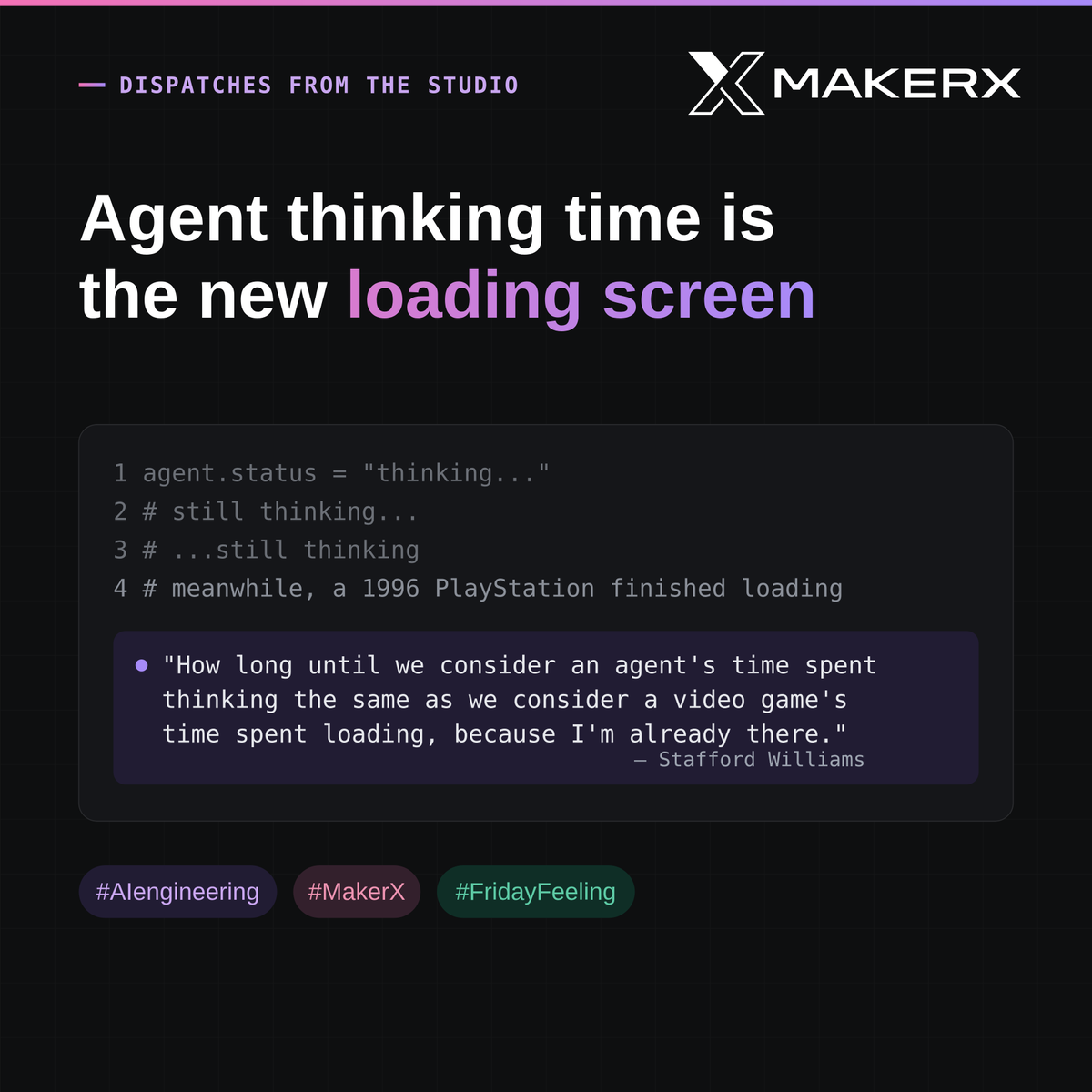
If you've stared at an AI tool while it "thinks" before it answers, you get it.
Happy Friday from an R&D studio where we're all waiting for the spinner to stop.
If your team's trying to work out whether you actually need an agent or just a good loading screen, Rob and Jess wrote the diagnosis
(https://t.co/1bg0ZV4yY6)
#AIengineering #ThingsStaffordSays
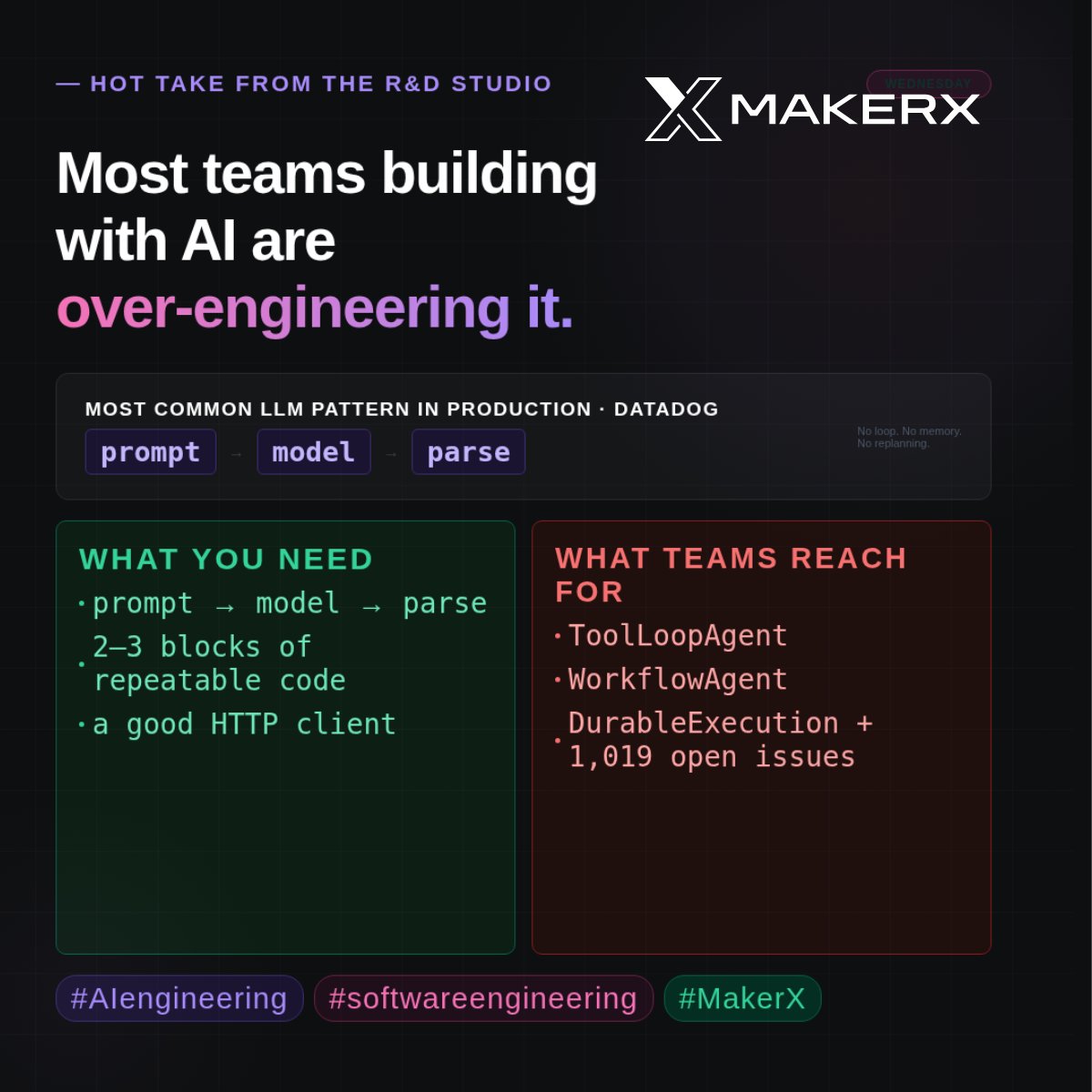
You probably don't need an AI agent....
Most teams reach for agentic frameworks when a simple workflow would do.
Datadog says agent framework adoption doubled in the past year. EchoLeak shows why that matters.
One email. No click. No attachment.
Microsoft 365 Copilot read it during routine summarisation, followed hidden instructions, pulled confidential files from OneDrive, SharePoint, and Teams, then sent them out through a Microsoft-approved domain.
CVE-2025-32711. CVSS 9.3.
A lot of business AI work should be boring:
- Fetch the record.
- Run a scoped prompt.
- Validate the output.
- Pass the result to deterministic code.
Every agentic layer adds permissions, tokens, latency, and security review.
A single prompt is easy to eval and red-team. A non-deterministic chain is a moving target.
Use an agent when the task needs one. Use a workflow when the path is known.
here are five AI transformation questions your board should ask before funding the next "agent" project 👇.
https://t.co/oVoD1vqsLt
#AIEngineering #AIGovernance #AISecurity #LLMOps #MakerX
We're incredibly proud of our Principal Engineer, Melissa Houghton, taking the stage at AgentCon Perth last week to talk production grade AI agents. This is the work we do every day at MakerX, experimenting with AI, and building and shipping it at scale. Seeing that knowledge shared with the Perth tech community is amazing! Well done Mel 😍.
Getting AI into production is harder than it looks. If your organisation is trying to close the gap between experimenting with AI and actually getting results from it, Rob Moore and Jess Panni wrote the diagnosis 👇
Five AI Transformation Questions Your Board Hasn't Asked Yet (https://t.co/HMd0BaGlQT)
Follow MakerX for more from the R&D studio.
#AgentCon #AIengineering #MakerX #Perth
AI tends to do what it wants. Telling it off doesn't help, or does it?
As we know, Claude Code has a habit of over-commenting code, like a simple variable assignment ships with five lines explaining it. It can make PR reviews a nightmare.
Our Principal Engineer, Stafford Williams, built a gate to stop it. The agent had to jump through deliberate hoops before adding any comment, and received a clap back that it was being, very naughty.
First attempt: "noted. *steps through all the hoops anyway*"
Second attempt? Actually better. The agent hesitated, reconsidered, and chose not to step through the hoops at all.
Whether this holds up next week is anyone's guess. Stafford's not convinced. But if Claude needs another telling off, you'll hear about it here first.
If your team is trying to get real results from AI, Rob and Jess wrote the diagnosis = Five AI Transformation Questions Your Board Hasn't Asked Yet (https://t.co/rAFe4TSfZz)
Happy Friday. Follow MakerX for more from our R&D studio.
#AIengineering #ClaudeCode #softwareengineering
One of the things we do at MakerX is fix the problems that come with AI-assisted development! This week, our Principal Engineer, Jack Watts, built a comment-bloat gate: a three-layer enforcement system that stops AI coding tools from stuffing your codebase with unnecessary comments.
Layer 1 is a steering rule that triggers as code files are being edited, cutting the rate of bloat getting written at all. Layer 2 is a deterministic post-edit hook that checks every Claude Code write against a threshold. Layer 3 is a PR backstop so nothing slips through to review. The output from a recent run: "The comment-bloat gate flagged my 3-line comment. The 'why' is justified but too long. Condensing it." That's the model correcting itself, automatically, before it becomes your problem. This is what maintainable AI-assisted engineering can look like in practice.
If your team is navigating what good AI engineering actually looks like at an org level, Rob Moore and Jess Panni wrote the diagnosis. Five questions every leader should be asking before their next AI strategy discussion, free to download: https://t.co/a73rJTYCFT
Follow MakerX for more of what we're actually building!
#AIengineering #ClaudeCode #AIcodingtools #softwareengineering
A year ago we published a piece on how R&D works at MakerX. Today you can use a product that it produced.
Back in May 2025, Jess Panni wrote about how experimentation in an R&D studio isn't chaos or innovation theatre. It moves through three modes: Visionary (provoke new possibilities), Investigative (test what's viable), and Applied (turn a proven concept into a real product people use).
mdify started as an experiment in our R&D studio, born from a problem we kept hitting ourselves: AI agents struggling to interpret messy documents real businesses run on. So we built mdify: it converts PDFs, Word docs and images into clean, structured, AI-ready Markdown.
Read the original blog: https://t.co/Yox8xVOp8Z
Try mdify: https://t.co/bx3hrYGT0r
What stage is your org stuck in, exploring, testing, or actually shipping?
AI has been adopted faster than governance, risk and oversight frameworks have caught up, because AI got deployed across the business faster than anyone built the governance around it. It's also exactly the gap APRA (and everyone else) is starting to poke at.
We've built a free self-assessment which will give you a clearer picture of where you actually stand 👇.
https://t.co/fDEvqIKRGN
We're curious what people find! If you take it, tell us what you think of the result and how it holds up.
Most organisations have a few AI initiatives happening right now. A pilot here. A proof of concept there. Someone's probably even talking about an "AI transformation". The gap between using AI and getting results from AI is where many organisations are getting stuck, because AI exposes the data, delivery and governance challenges that were already there.
Rob Moore and Jess Panni's paper explores that gap and puts names to the patterns many organisations are experiencing and finishes with five questions worth asking before your next AI strategy discussion.
Free to download, and well worth 15 minutes of your time. 👇
https://t.co/cTr0qzciVJ
Your AI isn't underperforming. Your documents are.
PDFs built for humans. Tables that get flattened. Diagrams that vanish. Context that disappears into the conversion. Most teams spend too much time tweaking prompts when the real problem is what they're feeding their AI in the first place.
mdify converts your documents into clean, structured Markdown that AI can actually use. The meaning stays intact.
Try it here 👇
https://t.co/CpOW5x5PPg
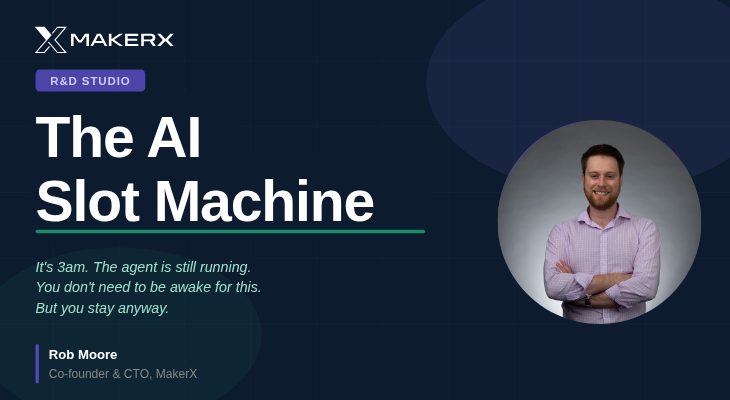
It's 3am. The agent is still running. You don't need to be awake for this. But you stay anyway. @robdmoore has been building in anger with AI coding tools for a while. Long enough to see the real pay-off (weeks of work condensed into a day) and the real cost (the late nights, the context-switching, the one-more-run spiral he's calling the AI slot machine).If you're building this way, it's worth a read.
Building fast is one thing. Building with governance is another. Take MakerX's free AI self-assessment to see where your gaps are:
https://t.co/4jUZg13P1m
.@APRAinfo just put every regulated board on notice about AI. Are you ready? Most teams are using AI across operations, procurement, and customer-facing functions. Far fewer have mapped what that actually means for governance, supplier concentration, cyber risk, and assurance obligations.
We've built a free AI Governance Maturity Self-Assessment for leaders in regulated industries, developed by our team and based on the real gaps we see in banking, insurance, super, health, and government. It takes five minutes. It tells you where you sit across four areas, and what to fix first.
Take the assessment → https://t.co/x5g8fBegS0
We built Mdify because AI agents kept stumbling on documents designed for humans, not machines. PDFs, Word docs, images, video; tools lose the structure, and AIs lose the meaning.
Mdify converts it all to clean, structured Markdown that AI can use. If you have documents your AI pipeline is struggling with, it converts them.
We'd love your feedback! Mdify was born from R&D at MakerX, and we're opening it up to see what use cases we haven't thought of yet. Tell us what works, what doesn't, and what you wish it could do.
👇 Explore Mdify here 👇
https://t.co/FlKAsCepNa
We're excited to share that our Principal Consultant, Melissa Houghton, is speaking at AgentCon Perth 2026 on 26 June!
Moving AI agents from prototype to production is where the real work happens, and Mel knows this space deeply.
Register to see her speak https://t.co/IPIvUUUu1P
Thinking about how to get more from AI in your organisation? Download our white paper: *Five AI Transformation Questions Your Board Hasn't Asked Yet* 👀👇
https://t.co/YPfVcTMlTV
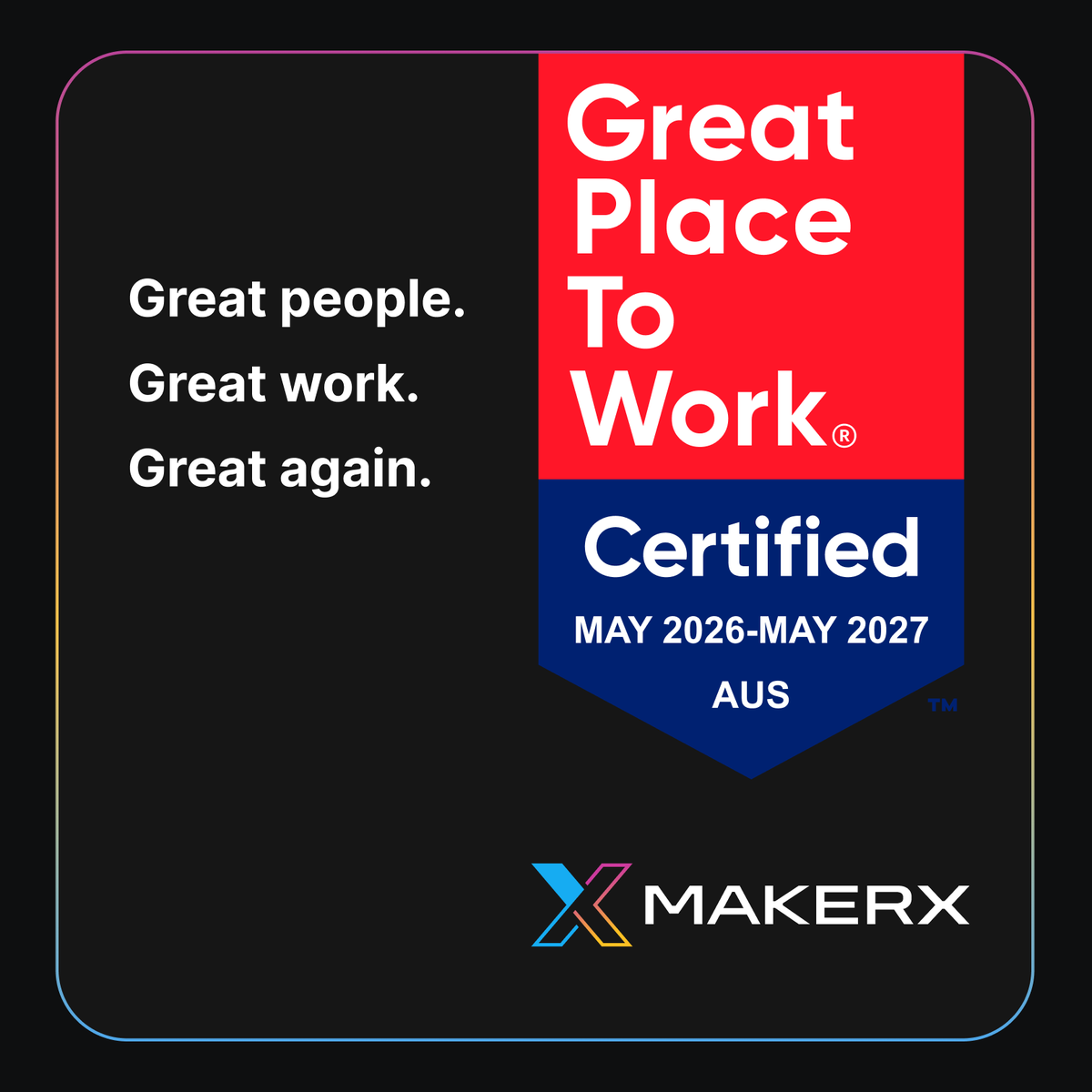
100% of our Aussie team said MakerX is a great place to work!
For the third year running, we're officially Great Place To Work® Certified.
→ Training & development scores jumped 18% to 97% in a single year
→ People finding meaningful work jumped 12% to 94% = this is not "just a job"
→ Every respondent said they feel psychologically safe
→ Scores were consistent across every age, gender, and tenure group. No one is being left out of a good experience
We're so proud of it. And none of this happens without the Makers who show up every day and contribute to the culture that makes these results possible, thank you to our folks. :blue_heart:
If MakerX sounds like the kind of place you'd like to work one day, we'd love to hear from you. Drop us a message or keep an eye on our page!