Community Strategist. Worked with @Structure_fi @Cardano @Spiceworks @Toyota @Google @Zynga @Wowhead He/him, married to @FromArnorWLove. Bi-wife energy.
We no longer have to write the software by hand. We write the test that we expect to pass and the computer generates. Well actually we don't write the test by hand. We write the spec and the computer generates the tests from that. Well actually we don't write the spec by hand. We write the design brief and the computer generates the spec based on the constraints. Well actually we don't write the design brief by hand, we just figure out what the next feature should be and the computer generates the brief. Well actually we don't figure out what the next feature should be manually, we observe desire paths from the users and the computer generates the feature request. Well actually the computer observes the users and detects their desire paths. Well actually the user is also a computer. Well actually the the computer is detecting the desire paths of the computer and building the software for the computer. Well actually we're not sure where the software is, we can't see it being built anymore. We can just tell because the machines are all working really really hard.
@brubinow This was always true. I remember seeing a magician with my family when I was a child in the early 90’s and I pointed out that the pamphlet mentioned that of the two of them, the “assistant” had received a bunch of awards from The Magic Castle, and the other hadn’t.
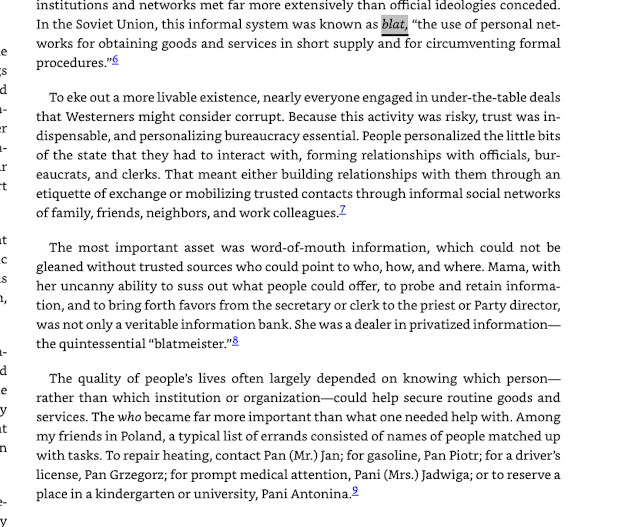
The Jeff Epstein saga isn't a scandal about pedophilia, it's about a Russian word called 'blat,' a Soviet-era word meaning 'the use of personal networks for obtaining goods and services in short supply and for circumventing formal procedures.' It's about a kind of government.
As with the large number of 'blatniks' in the Soviet era who made sure their factories got what they needed outside the formal state procurement process, Epstein greased the wheels for the neoliberal state. His job was governance.
What does that mean? Well it's clear that Epstein was an entrepreneurial broker across multiple public and private bureaucracies, helping organize 'under-the-table' deals among the legal, business, intelligence, and political elites to allow them to escape the rule of law and traditional conflict of interest restrictions. It's statecraft to allow a superclass to systemically escape the formalized rules.
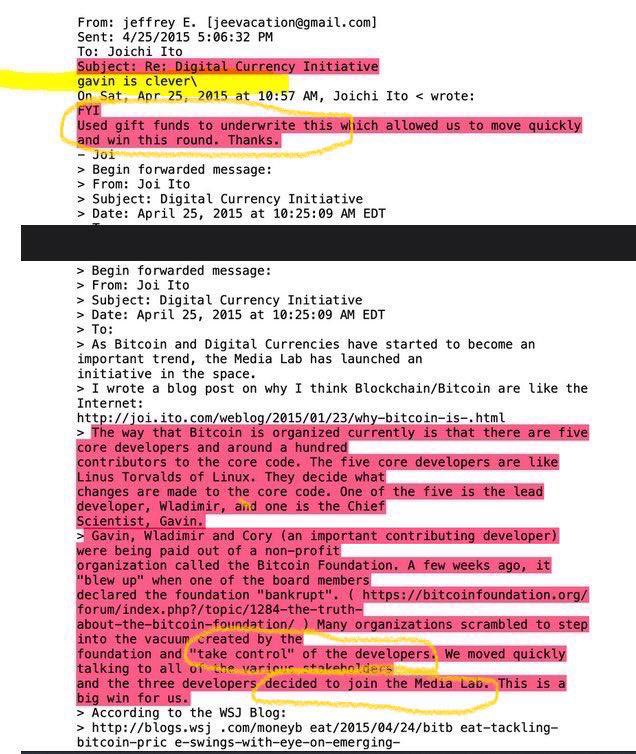
The pedophilia and prostitution were part of it - that is obviously violating the rule of law - but so are the random favors Epstein bestowed. Like Epstein sending Senator Joe Manchin's request for a yacht, a request which came from the First lady of the Virginia Islands, to a random NY financier who might have one. Or working with Joi Ito at MIT and billionaire Reid Hoffman to restructure the Bitcoin Foundation. It's all about matching capital and talent and inputs outside of the restrictions ordinary people are subject to.
This kind of governance is particularly important in Soviet-style states, where everyone knows the rules are fake, where skirting the system IS the system. Epstein and his affiliates thrived because of the weakened institutions of the United States, institutions enfeebled in many cases by the men in his network, like Larry Summers. These men adopted multiple roles - advisor, businessman, academic, board member, regulator - and put on the hat that best maximized their self-interest and the self-interest of their narrow network at that moment.
The old world, where handing someone your business card meant you represented that institution, disappeared in the 1980s. Over the course of the 1990s, neoconservatives, neoliberals, bankers - ultimately Epstein's network - built this new social order. It was one where you couldn't succeed through the formal rules, but if you were let into the networks of trust by blatniks, you could do anything you wanted.
While all the specifics of Epstein's network are not known, and while conspiracy theorists often have crazy views, they have correctly fingered that the world of meritocracy and formalized systems is increasingly a fraud. And that the real government lies elsewhere.
In short, when formal democratic institutions like Congress stop governing, the networks of men like Epstein fill the power vacuum. Epstein built what Roy Cohn always wanted to have, but never achieved, because the then-institutions were too strong for him to break.
Here's a passage from sociologist Janine Wedel's Shadow Elite on how this form of governance works.
The Epstein files reveal that Israel hijacked control of the Bitcoin network over a decade ago.
Israel was paying the salaries of 60% of Bitcoin’s core developers and offered highly elusive gifts behind the scenes. This is very suspicious.
Epstein and Israel were also major investors in Blockstream, a company that works with Tether and exerts significant influence over Bitcoin. They can manipulate the price by issuing unbacked Tether, control the network’s code because they hired most of the developers, and own a majority of the nodes.
This suggests Israel likely has direct access to and influence over Bitcoin. The idea of “decentralization” is clearly illusory, and it is deeply concerning that the network could be manipulated by a single state operating behind the scenes.
good afternoon. the CEO of Tumblr and Wordpress is being sued on allegations of wage theft and human trafficking
https://t.co/DCe88b6orr
https://t.co/D0HZfzrHVF
Fill up a @CountingCrows song with saxophones, cellos and weird samples. Fill up a @bleachersmusic song with piano, accordion and mandolin. Sprinkle the whole thing with telecasters and see what happens.
Maybe I’m crazy but I would love to hear a collab between @jackantonoff and @duritz. Let them bond over their mutual love of sprawling, yearning, Springsteen-style epics and see what kind of strange alchemy results.
Toxic fandoms have grown so powerful that while talent, executives and publicists privately bemoan the issue, fear of triggering another backlash kept several studios from speaking for this story. https://t.co/2TJGqgQzC8
Does anyone know a good way to reach a human being at @ORemployment ? I’m rapidly approaching 3 hours on hold and I’m worried they’re going to close for the day before they pick up my call.
Learning Nate Silver works for Peter Thiel is one of those things that would have shocked me in 2016 and made me wonder why I hadn't already been assuming it in 2024.
I cannot begin to describe how profound the introduction of X-Wing in 1993 was for gaming and Star Wars in general. It was the dream come true: piloting a starfighter from Star Wars. And it would have been easy to put anything out with the label Star Wars on the side of it, but Lucasarts was not that kind of company.
The single most important thing is the gameplay. Lawrence Holland and the other creators studied the films and notice that all of the fighters and ships didn't simply turn left or right, they slid along a curve as if they were moving on the circumference of a circle. They noticed that there were shields and that they could be reconfigured from one place to another. They noticed the different kinds of weapons, from torpedo's to lasers, to ion canons to concussion missiles. Each had different purposes. They noticed the differences between ship speeds, armament and handling.
The galaxy these ships flew in was robust with Imperial capital ships like Star Destroyers, frigates, corvettes, boarding craft, shuttles, Calamari cruisers, cargo ships, cargo pods, tugs. TIE fighters, interceptors, bombers, Vader's TIE. This was a huge number of assets in 1993. I remember upgrading my 486 25MHz to a 33Mhz motherboard to see this at its top setting.
But what was it's charm? It felt real. You started as a pilot cadet and if you went through the flight school training until you got your fighter qualification patch on your uniform, you would be able to handle your own through the rest of the game. You start on the Mon Cal cruiser independence. If you go to training you are transferred to a frigate that will allow you to run the obstacle course in different fighters. It is a timed course and there is not enough time to complete it. You add two seconds of time for each turret you shoot and there is no targeting computer to aid you. The early levels there is enough time. Later levels you have to shoot targets to get time. After a while the turrets shoot back. Finally, turrets hidden by the terrain shoot after you pass. If you succeed, the rest of the game becomes no issue.
The music was a character in itself. Using the iMuse system, the midi music would change based on the action in the game. The results would be a unique composition with every mission and how you played.
Another frigate gives you training by performing historical missions. Here you learn the fundamentals of starfighter combat AND you get to learn some of the Star Wars lore up to that point. My favorite was recreating the heist of the Incom T-65 X-wing prototypes as well as helping the engineering team defect.
You can study the different ships shown in the game, learn their weak points and strengths. Much of this conforms to the info that came from LFL in the early 1980s and the West End Games RPGs that named ship builders and weapons companies. The attention to detail to at that time was existing lore was staggering. It also codified what had been talked about in the 10 years after Return of the Jedi.
This all leads us to the campaigns. You are transferred to Home One where you begin missions against the empire in a series of campaigns. And here it should be noted... the stakes are real. You could be shotdown and recovered. You can get killed. Or you could be caught by the empire, tortured by Vader himself for information. You could continue playing, but any and all rank would be lost with you starting over as a new person.
In the first campaign you are desperately outnumbered and chased. The empire finds one of your bases and you do your best to limit losses. You still take losses, but you don't want to lose everything. One of the missions defending a medical frigate offloading injured soldiers later went into one of the first X-wing novels. The rest of the first campaign is set on putting together a plan to capture a shuttle and smuggle a bomb onto the lead star destroyer in the sector. The second campaign is leading a direct assault on a Star Destroyer after its hyperdrive breaks down. It is a series of missions including peeling away the support ships and fighter defense until the final assault can happen. Its defenses conformed around the lore for what was in a task force's armament. The end of the campaign is assisting Princess Leia's Tantive IV get the Death Star plans. The last campaign are the events of A New Hope with the search for the Death Star leading up to the assault on the station. The last mission of the original game is the trench run.
All historical missions are briefed by General Dodonna. All campaign missions are briefed by Admiral Ackbar. But after you do a campaign mission, it falls into Dodonna's inventory of historical missions and you can replay it with him giving the briefing this time. The briefings are worth the listen in themselves: what is planned and what is a surprise.
Two other expansions were sold the following year. Imperial Pursuit showed the empire's reaction to the loss of the Death Star with the rebels abandoning Yavin and trying to lose the empire. B-wing was the introduction of the B-wing fighter as the search for a new rebel base continues. The end is the establishment of the Hoth base.
When you watch Andor, this is its spiritual ancestor. When you wonder about how all the lore in the early 1990s became interconnected, this was the first LFL direct property that tied it all (all others were vendors or licensees before). It was the best space simulator of the 1990s, racing often times neck and neck with Origin's Wing Commander series. By the end of the 1998, the technology and story telling was perfected.
By 1999, it was all gone. Episode 1's starfighter game was a cash in that lost all of the flight mechanics that were meticulously researched and replicated. We never got it back. Parts of it emerged in Star Wars Galaxies MMO, but it was not the same. Star Wars squadrons brought back some of it, but its campaign story was so rigid and its characters so bland it was practically stillborn. But if you are able to and have a proper flightstick.... it is worth going back to the story telling of this space simulator.
https://t.co/zOZqNMx5hs
It was one of the first games with cutscenes. I near lept out of my seat watching the imperial invasion.
https://t.co/TnFEACYUQH
Gameplay can be seen here as well as the intros to the game and the menus.
Edit: I should note that while not in the game itself, the game came with something called "the Farlander Papers". The protagonist of the game is a force sensitive pilot named Keyan Farlander who eventually becomes the one Y-wing pilot to survive the attack on the death star. He captures much of the data on the imperial forces that becomes the database you can reference. His story was told more extensively in the strategy guide that was published at the time.
One of the most interesting metrics of company culture is what I call the "work to do the work." How much time is spent on information gathering, stakeholder alignment and decision making, and how much is spent on actually doing the thing. An early startup's biggest advantage is that alignment tends be easy, since you have a small team all working on the same product, a founder who is the ultimate decision maker, and a necessary bias to action (maybe a 1:10 WTDTW:W ratio). As you scale, this ratio invariably shifts: bigger teams, more hierarchy, more complexity, more feedback to inform future decisions. Good processes should be in service of helping teams make and communicate well-informed decisions so they can still spend the bulk of their time actually moving things forward.
The problem with a high WTDTW ratio isn't just that it slows teams and companies way down, but that it changes the incentives of an organization. In a company with a 10:1 ratio, for example, employees are rewarded for their ability to navigate and influence the organization, rather than producing results. I distinctly remember a moment in my career when I realized, with horror, that I was pouring the vast majority of my creative energy into solving problems in the WTDTW realm (and getting real personal satisfaction from playing that role well)...but I was exhausted by the time we actually got to execute. And it's a dangerous trap, especially for executives, to think that all the "strategy" is in the WTDTW bucket, because the creativity, iteration and debate that goes into actually bringing something to life is where the magic happens, whatever your company's size. 🪄
Okay so I’m not saying you should be inappropriate with your kids.
But I’m starting to think that this idea that kids seeing their parents be physical is somehow traumatizing may be partially responsible for this weird cultural idea we have that old people aren’t attractive.
AI is completely unsustainable due to the amount of resources it uses
It’s not capable of operating without human labor & input
It doesn’t do half the things they claim, it’s mostly theoretical
It’s the latest scam from SiliCon Valley but w/ $$$ at stake, they won’t admit it
I think we’re going to see a lot more companies shed small-to-medium sized games they don’t know how to promote while concentrating on blockbusters that take 10 years and underperform, particularly against well-promoted small to medium sized games.
@thcscus The best part is that you never see it coming, despite the fact that 5 seconds of thinking about who Cerberus would have warned you it was coming.