@BrianLeeTrades Hi Brian. Trading low win rate strategy how do you take care of long losing streaks? Do you size down and keep taking every setup or you also trade less? My problem is if I start taking less trades I skip on winners because I can't really tell which one will take off. Thanks :)
@CFlanders7 Hi Chris. When you get in long losing streaks, do you just reduce your risk or you also stop trading? Because with low win rate strategy it's hard to know which setup will take off and then when filtering out you can miss on a winner. Thanks a lot :)
@mmonis I see that you recommend to narrow your focus on couple of names. Do you think that's also the best advice to grow small account? And how excatly do you build your TopD list? Thanks :)
@TheOneLanceB Do you have any content/videos about profit taking? How do you decide if you want to sell everything into strength or you always trim small chunks and move your trailing stop?
“Don't talk about your stocks! Don't brag about how much you're up! Don't worry about what other people own, worry about what you own! Keep a low profile!” - William J. O’Neil
The market provides 2 or 3 periods of strong follow-through per year (obviously not always) when hitting the gas is warranted. Follow through is THE MAIN INGREDIENT for swing and position trading.
What do traders do during the rest of the time, when follow-through is missing?
Unprofitable traders will not adjust, they will convince themselves to take trades constantly. They won't listen to their account feedback. They'll focus on 'setups' in a poor environment. They'll ingest constant noise from social media. They'll overtrade and perpetuate the boom and bust cycle.
Profitable traders wait - they trade less, much less. They understand their simple strategy; when the environment is conducive to that strategy and when it's not.
Make no mistake, this discipline IS what separates successful traders that can achieve longevity and compound their accounts from those that come and go.
@Mo_U_Gad How do you decide when to stop trading and wait and then what makes you jump in again? If breakouts mostly come in clusters aren't you afraid of missing the best ones?
@vaggelis_plytas Hey, what's your stock selection process? Do you like to see good theme/industry move or you also want to see good earnings/revenue numbers? What gives you conviction? Nice work :)
YTD WIn Rate 24.8%, (Lowest in my 15 years)
YTD Performance: +49% realized (+54.5% unrealized)
Over a month ago, I posted a poll asking whether, with a win rate below 40%, it would be more effective and lead to greater improvement to focus on adjusting your winning trades or your losing trades. The results leaned toward losing trades, and I agree—if you've accepted that your strategy has a win rate under 40%, the priority should be addressing your losing trades. I have one of my lowest annual (YTD) win rate % in my 15 years but I definitely felt I have improved so much more significantly. You can't control the outcome, but you can control your sizing, your risk, your loss.
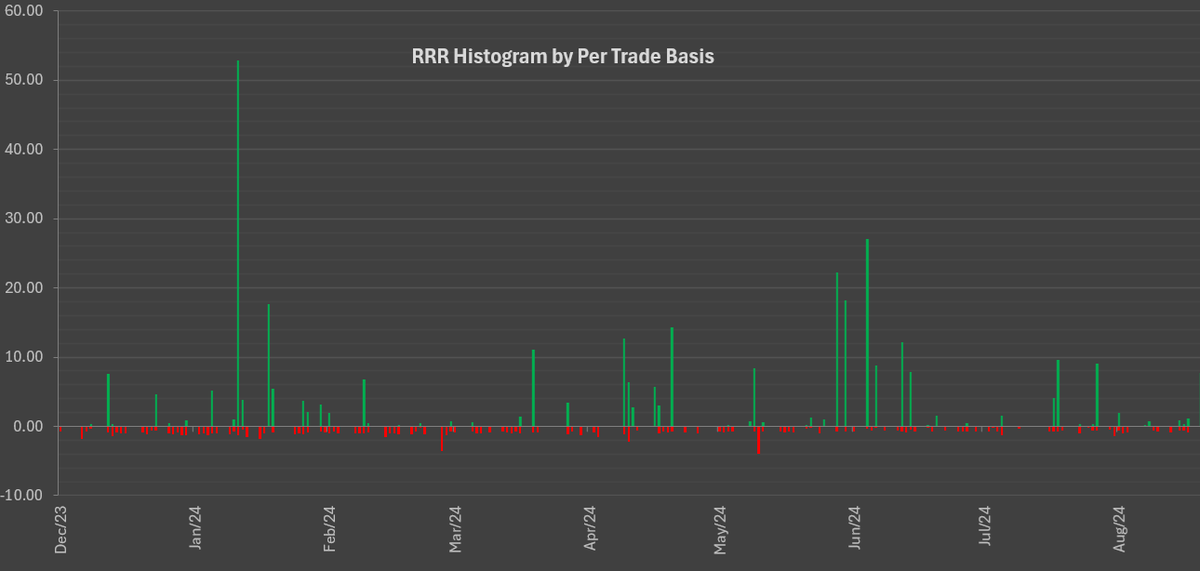
If you're struggling to gain traction in your trading, I recommend building an RRR (Risk-Reward Ratio) histogram graph on per trade basis. This will help you analyze how well your losses are controlled from a broader perspective, rather than focusing on the disappointment of your equity curve which does not present you any perspective to improve.
Total Trades: 371 (Max Month: 64, Min Month: 29)
Trade Type: 64% ETF (Leveraged, Non-leveraged & Inverse), 36% Equities (Mostly long including inverse mega $GGLS and $TSLQ, less than 4 parabolic short)
Win Rate: 24.8% (Max Month: 31.6%, Min Month: 14.5%)
Avg R Gain: 3.7 (Max Month: 6.4, Min Month: 1.4)
Avg R Loss: 0.78 (Max Month: 0.89, Min Month: 0.69)
Avg R Gain/Loss: 4.7 (Max Month: 7.26, Min Month: 1.61)
Consecutive Winning Months: 4 (May to August)
Consecutive Losing Months: 2 (Mar to Apr)
Biggest Winning Month: February (+18.8%, Win Rate: 25%)
Biggest Losing Month: (-7.6%, Win Rate: 14.5%)
Biggest Winner: 7th February $GBTC 53R. (I attempted 26/1 and 7/2 on full losses)
Biggest Loser: $GLD -3.92R (executed 6/6, gap down open 7/6)
Avg Holding Days (Winners): 15 Days (Max Month: 22.4, Min Month: 9.6)
Avg Holding Days (Losers): 2 Days (Max Month: 4.3, Min Month: 1.2)
Longest Consecutive Losing Trades: 17 8th March to 15th March (Min Month: 5)
Longest Consecutive Winning Trades: 4
A few key takeaways I hope you can learn from.
1. Trading is not easy because you are on drawdown and facing consecutive losing streaks most of the time. You face bad days more than good days, this is a fact and you need to accept it. My longest consecutive losing streak of 17 in 6 trading days is not easy to stomach for someone without risk management and emotional control.
2. Don’t fixate on the performance of your last 10 trades, the performance this week or this month —focus on the performance of your last 500 trades. Embrace the big picture, the law of large numbers, and a long-term perspective in trading.
3. Be highly selective to reduce subpar trade frequency and improve the quality of both trade selection and execution. At times I favor high ADR% stock not because they move fast, but because they may give you the tightest entry based on LoD to ATR and it could just explode to 5-6R winner in a single day when it trades to its mean ADR%, its implied volatility. It's about quality of entry opportunity much more than selection quality alot of times.
4. I won’t be a profitable trader without RVOL-based entries. This year there's alot of false breakout, false gap up movers. I have big winners in $KOSS and $MGOL because they open as much as +1000% Rvol and trades to +4500% in under 15mins. Volume are strong clues for trading breakouts in equities and intraday follow through.
5. High-quality entries is way more important than stock selection imho. I can bet you not many swing traders can profit from high quality IPO names trading at ATH $CAVA $BTSG $NU until you can get a quality entry eg. $CAVA 9th August high rvol below 60% LoD.
5. Learn to size down losses before your trade hit the eventual stops. I spoke alot about selling partial in sequential manner of 33% size out from 33% below entry, and further 33% size out from 33% to stop loss. I can control my average losses within 0.8R because of this even with slippages and spread. This is a metrics anyone can improve and I largely focus to improve on.
6. Learn to hold trades if it is working. I am still holding $XLU and $SCHH with 70 days calendar days holding period. Non-leveraged ETFs may be slow on ADR% perspective, but they present the best trend to 10/20-MA without overshoots as much as equities. This 2 are +25R trades.
7. Don't kick yourself for missing major trade of the year that are being hyped up on social media eg. $SMCI or $ASTS. I did not even capture that.
Trading becomes challenging if you let daily price action affect you emotionally. However, it becomes more manageable and straightforward when you focus on the bigger picture, address your weaknesses and learn to improve them on MoM basis. You need to give yourself time and avoid the mentality that you can rush towards success.