Nigeria, man. There's no escaping the rot, insecurity and dysfunction, no matter how rich you get.
1. Buy an SUV because the roads are bad, and you become a prime target for kidnapping, extortion, and inflated prices
2. Live in an estate for quiet and security but the moment you drive out the gate, you're back in the same poverty, crime, chaos and insecurity everyone else suffers. Your safety exists only within the walls of your expensive prison
3. Spend millions on solar so you don't have to suffer generator noise but your neighbours still use generators. You stop hearing yours, not theirs.
4. Make money and the women will come but the women who come are poor. You work hard to escape poverty, only to give your money to women who are hoping to escape their own poverty by 'working' you
5. Buy Starlink to escape MTN and Airtel, and now the whole compound wants your password.
"But it's unlimited now?"
Decline and you're a bad neighbour
The tragedy of trying to buy your way out systemic dysfunction is that you never truly solve the underlying problem. You just spend money trying to insulate yourself from it, and in that process, create new problems for yourself.
But you interprete it as progress because you no longer have the exact same probems as the next Nigerian.
Because progress here is less about better roads, reliable power and security for all.
Progress here is more about owning an SUV while everyone else dodges potholes in their Camry, having steady power and uninterrupted airconditioning whilst everyone else sweats through the heat, and living behind the 'security' of estate gates while everyone else lives with insecurity.
It is that contrast that gives me fulfilment. It is what makes you stand out, and provides both of us something to brag about. So the benchmark is not whether the system works; It is whether I am better than others in a system that does not work.
And I say "I", because I, also find myself thinking that way sometimes.
I also want to brag about paying 8 million for rent, rather than demand afforable housing for all or protest against the fraud of agents and the greed of landlords.
Afterall, I am also a product of the system.
As a result, most of what I, and by extension, Nigerians broadly speaking, consider progress, is a maladaptation to systemic failure.
It is, to condense it, progress measured against dysfunction, rather than freedom from it.
And 'Maladaptation' because the actions we have adapted to help us cope with the dysfunction, ultimately does more harm than good.
So for example, rather than protest insecurity, bad roads or unreliable power, we maladapt by travelling by air, buying SUVs and installing solar.
We spend money to work around failing institutions while the institutions themselves continue to decay.
But the problem with our "I better pass my neighbour' cope is that it will eventually reach its limit. Because as the rot and decay deepens and spreads, even our workarounds will fail, our estates will no longer keep the criminals and the abokis that surround us out (Abuja residents beware), the kidnappers will come to our doorsteps, like they're doing in Ekpoma, and our roads will get so bad even our four-wheelers will no longer be able to handle them, leading to accidents that will land us in hospitals with no doctors and nurses because our best health workers have japa'd.
Checkmate
Dear beloved sports-loving Nigerian youths,
After watching the performances of Davido, Burna Boy, and Rema at the opening of the 2026 World Cup—at a time when Nigeria, the giant of Africa, is absent—I felt a measure of consolation. This was reinforced by the fact that many Nigerians playing for clubs worldwide are representing other countries. Felix Nmecha, for instance, set a record by scoring the fastest goal at six minutes for Germany. I write to you therefore, knowing that this country belongs to you, the youth.
You are more of stakeholders in Nigeria’s future than I am. I am 64 years old; by God’s grace, much of my journey is behind me, while yours lies ahead.
It is therefore imperative that you rise to the challenge by obtaining your PVC, your most powerful tool for driving the change you desire.
In the last three years alone, over 15 million Nigerians have turned 18—enough to decide who becomes President, Governor, Senator, Member of the House, or Local Government Chairman. Indeed, enough to shape the nation’s future.
I know many of you are sceptical about politics and political parties. I understand why, but scepticism must not become surrender.
You do not need to belong to any party or wait for anyone to organise you. Organise yourselves in your streets, campuses, communities, workplaces, churches, mosques, and social groups. Mobilise, debate, demand accountability, and take part in choosing those you wish to entrust with leadership.
If you are organised and wish to hear directly from me, invite me. I will come and share my plans for you and our nation.
Do not sit on the sidelines while others decide your future.
I appeal to you to register and vote. Your vote can shape who becomes the next President of our country.
My young friends, this is your country. Take it back.
A New Nigeria is POssible. -PO
Building a Healthier Nigeria Through Stronger Healthcare Systems
As part of our desire and commitment to building a healthier Nigeria, I met with some healthcare professionals and experts in the United States on Friday, June 5, 2026. The meeting was essentially to deepen my understanding of how successful health insurance systems deliver improved healthcare, especially in the areas of primary and emergency care.
One of our key health objectives remains unchanged: to expand health insurance coverage, strengthen primary healthcare across our electoral wards, train more healthcare workers, and make quality healthcare accessible and affordable for all Nigerians.
A New Nigeria must be a healthier Nigeria.
A New Nigeria is possible. -PO
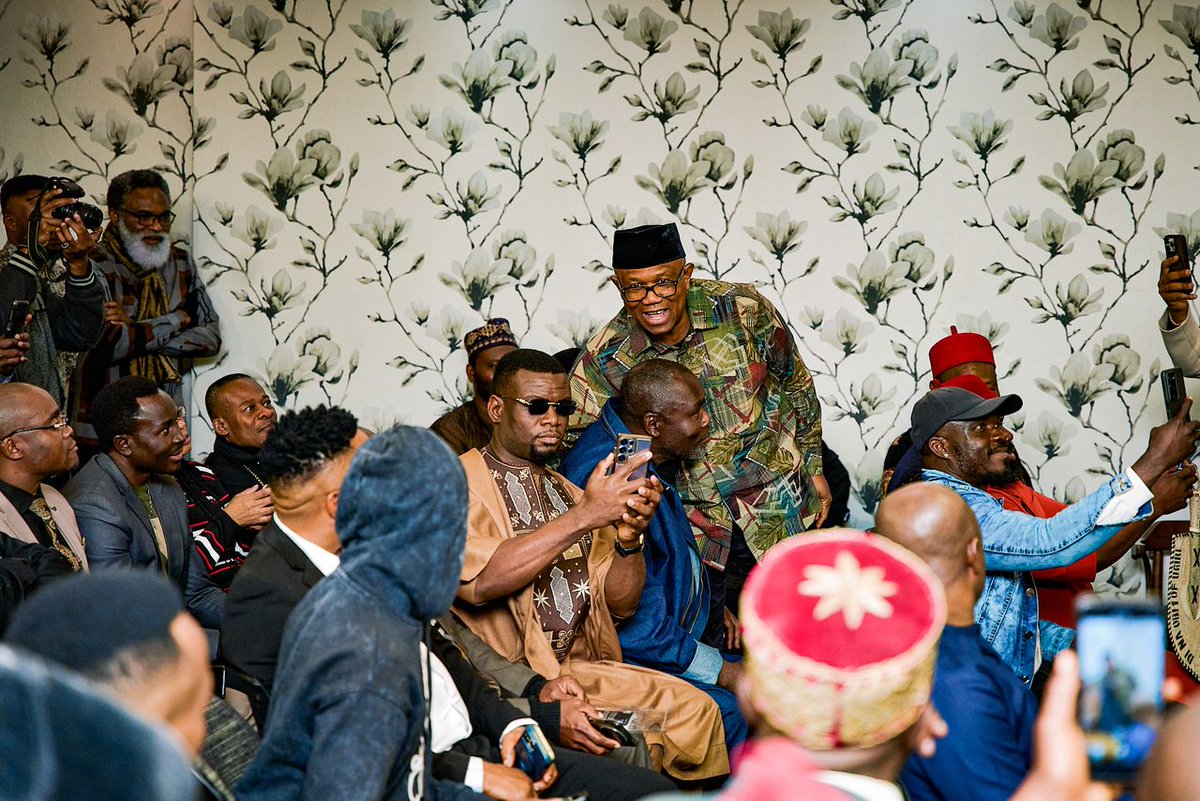
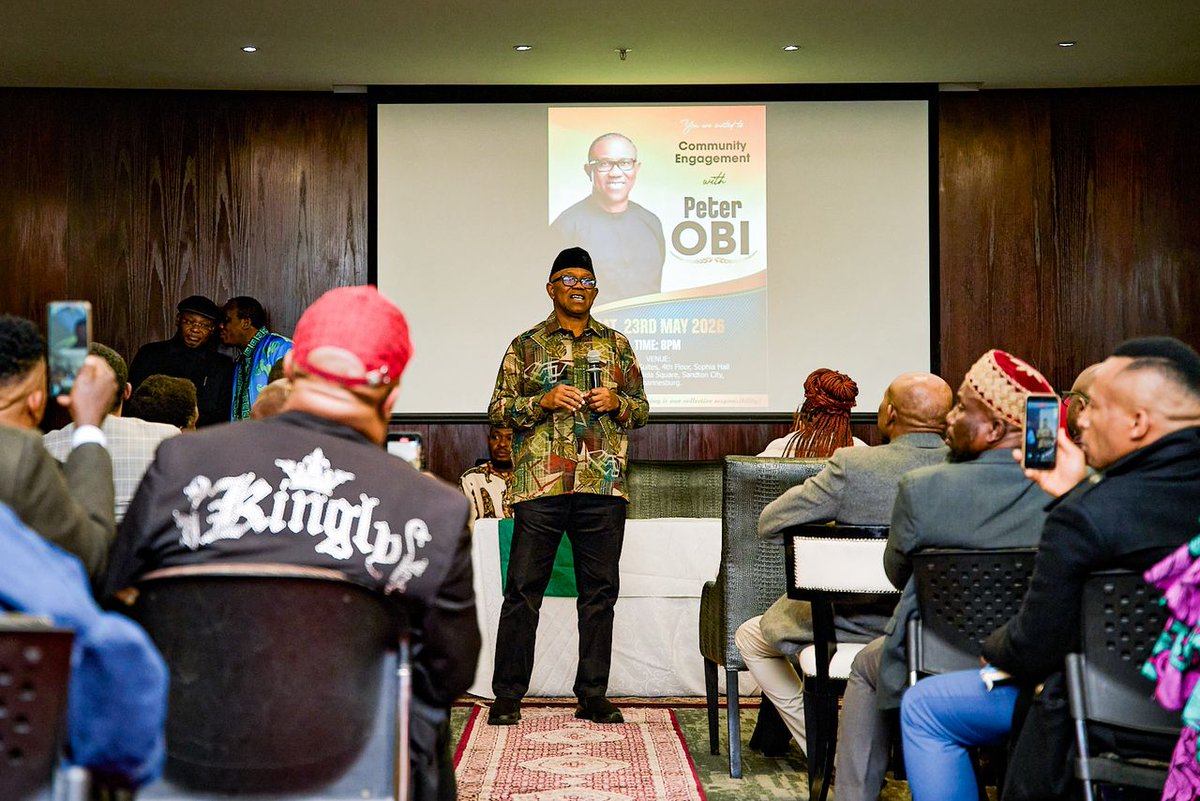
My final engagement in South Africa was yesterday in Johannesburg with my interaction with Nigerians in the diaspora. The discussions were frank, emotional, and deeply reflective of the realities confronting our people both at home and abroad.
The conversation was interrupted several times by passionate questions bordering on diplomacy, the treatment of Nigerians in foreign countries, the political situation back home, and the growing desire of many young Nigerians abroad to return home and contribute meaningfully to nation-building, if only the environment becomes conducive.
I also reminded our people that the respect any citizen receives abroad is often tied to how respected their nation is at home. A country that works, protects its institutions, upholds justice, and cares for its people naturally commands global respect. This is why leadership and governance must remain people-oriented, accountable, and rooted in competence and integrity.
While acknowledging the frustrations and pains many expressed, I emphasized the need for all of us to continue to conduct ourselves within the ambit of the law, irrespective of the provocation or difficulties we face. Nation-building demands discipline, civic responsibility, and the willingness to pursue change through constructive engagement.
The interaction further reinforced my belief that Nigerians across the world remain hopeful about the future of our nation despite the present challenges. Our task as leaders is to inspire that hope with sincerity, measurable action, and a commitment to building a secure, productive, and inclusive Nigeria.
A new Nigeria is POssible. -PO