Could the Universe Be Gently Spinning? 🌀
A groundbreaking new study proposes that the universe might be rotating extremely slowly, completing one revolution every 500 billion years. While imperceptible on human timescales, this subtle cosmic spin could hold the key to resolving the long-standing Hubble tension—a major discrepancy in measurements of the universe's expansion rate.
The Hubble tension stems from conflicting values of the Hubble constant, with nearby supernovae and Cepheid star observations suggesting a faster expansion than estimates derived from the cosmic microwave background (CMB). This conflict challenges the standard cosmological model and has inspired numerous alternative explanations.
Led by astrophysicist István Szapudi from the University of Hawaiʻi at Mānoa, researchers suggest that a rotating universe could influence how space expands, subtly altering measurements and potentially reconciling the conflicting data. The team’s model, initially based on Newtonian mechanics, will soon be refined using general relativity for greater accuracy.
If proven, the idea introduces the concept of a preferred cosmic direction or anisotropy, upending the long-held assumption that the universe is isotropic on large scales. Future research will focus on detailed simulations and sensitive observations to test for signs of this elusive rotation, potentially reshaping our understanding of the cosmos itself.
RESEARCH PAPER 📄
Balázs Endre Szigeti et al., "Can rotation solve the Hubble Puzzle?" MNRAS (2025)
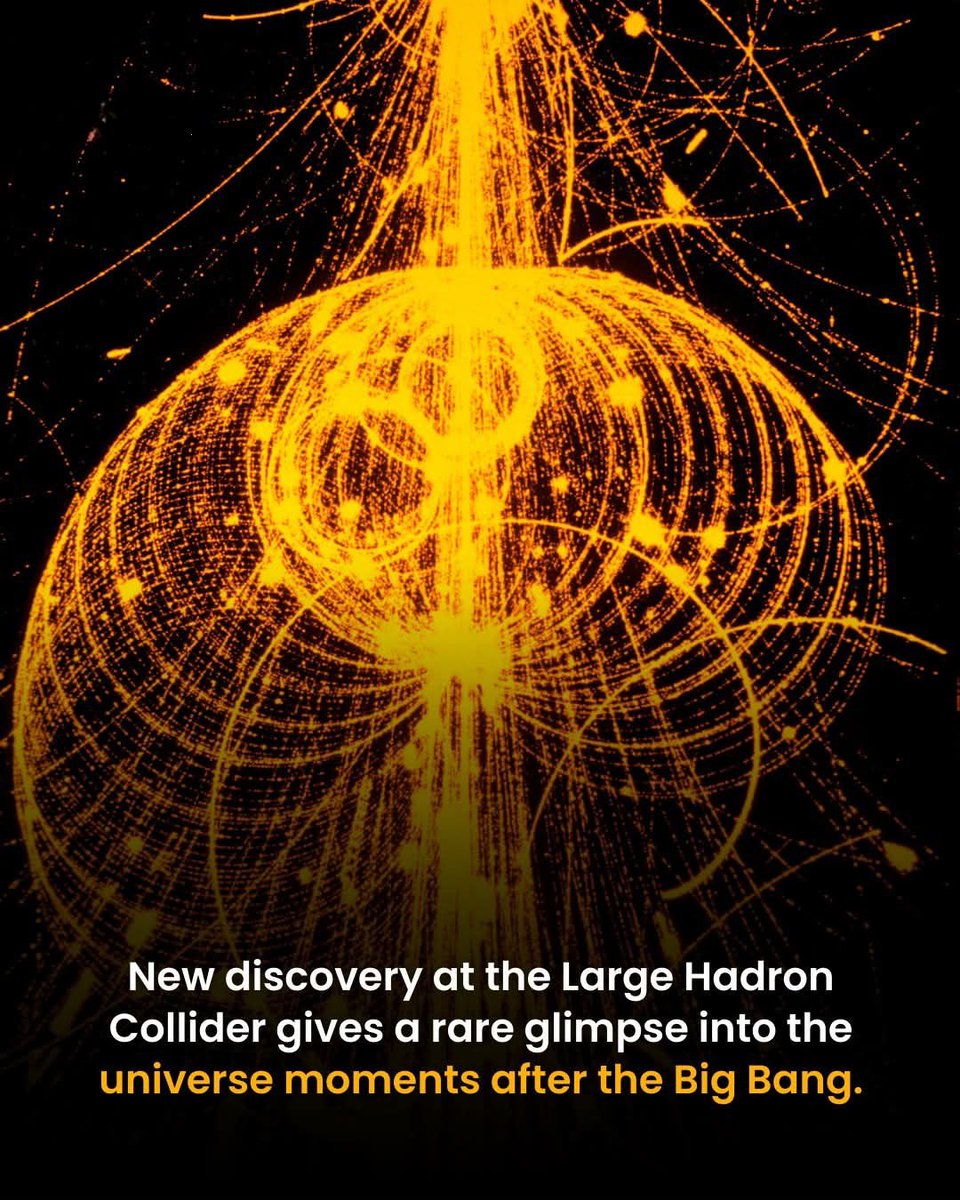
In a breakthrough, researchers at CERN's Large Hadron Collider (LHC) have successfully observed top quark pairs produced during lead-lead (Pb-Pb) collisions—marking the first time these heaviest elementary particles have been detected in such high-energy nuclear interactions.
The discovery opens a new frontier for studying the quark-gluon plasma (QGP), a primordial state of matter that existed microseconds after the Big Bang.
The top quark, due to its enormous mass, decays almost instantaneously—within 10⁻²⁵ seconds. In contrast, the QGP lasts about 10⁻²³ seconds, allowing the decay products of the top quark to interact with the plasma. This interaction provides physicists with a unique tool to probe the evolving properties of the QGP in real time, acting as “time markers” of early-universe physics.
This is the first observation of top quark production in heavy-ion collisions, validating theoretical predictions and demonstrating a powerful new method to explore the strong nuclear force described by quantum chromodynamics (QCD).
Moving forward, scientists aim to study how the top quark's decay products are modified by the QGP. This research could dramatically enhance our understanding of matter under extreme conditions—bringing us closer to understanding the earliest moments of the universe.
@avaricum777@Anc_Aesthetics Well.......I mean, you said "whites can't keep living around blacks". You don't think there's any irony in the fact that at least she's not afraid to show her name and face? Like you are..........