Can we detect #hatespeech at scale on social media?
To answer this, we introduce 🤬HateDay🗓️, a global hate speech dataset representative of a day on Twitter.
The answer: not really! Detection perf is low and overestimated by traditional eval methods
https://t.co/OznvktglzK
🧵
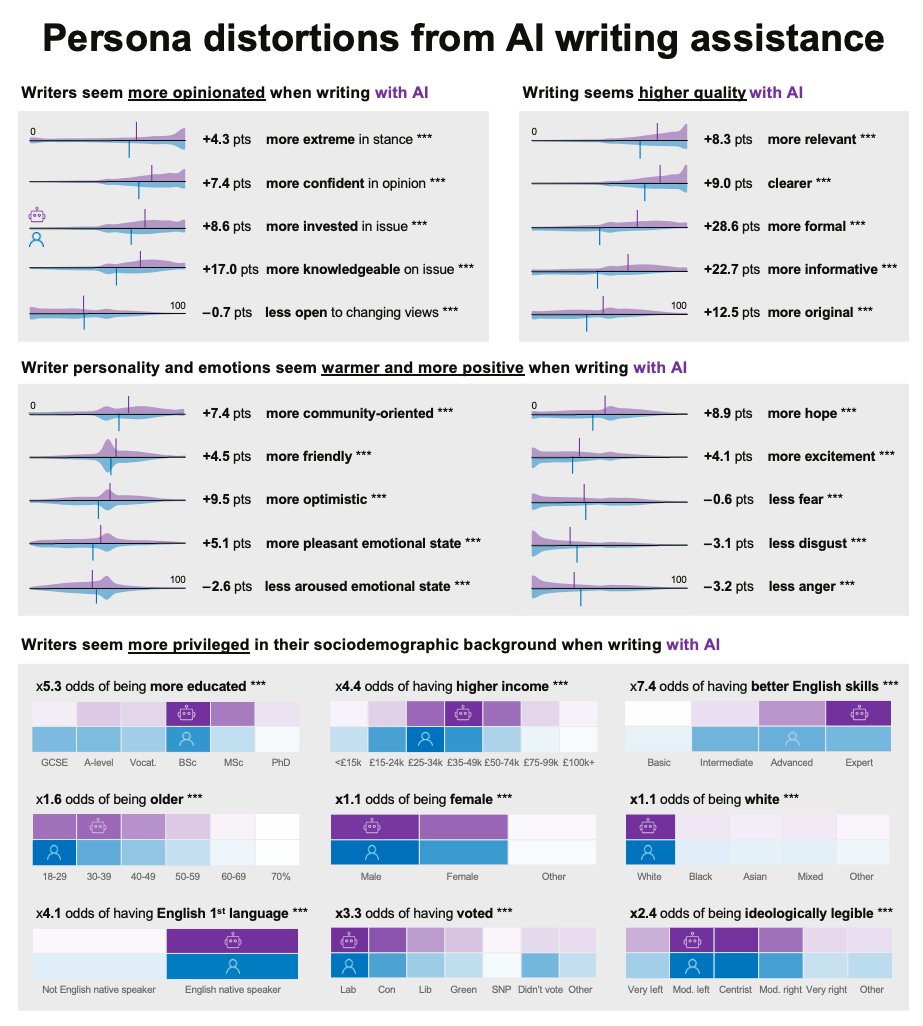
New paper w/ @AISecurityInst: AI writing assistance distorts how others perceive AI users and their opinions.
Millions of people now use AI to help them write and communicate. In three large experiments (14k participants, 3m+ human ratings) we show that AI writing assistance systematically distorts writer personas – their perceived beliefs, personality, and identity. These distortions are consistent across AI models and persist even under realistic conditions of human oversight.
🧵
Thanks also to @JohnHolbein1 whose numerous posts on demographic probing in the social sciences inspired this work and to Matthew Kearney for the useful benchmark dataset.
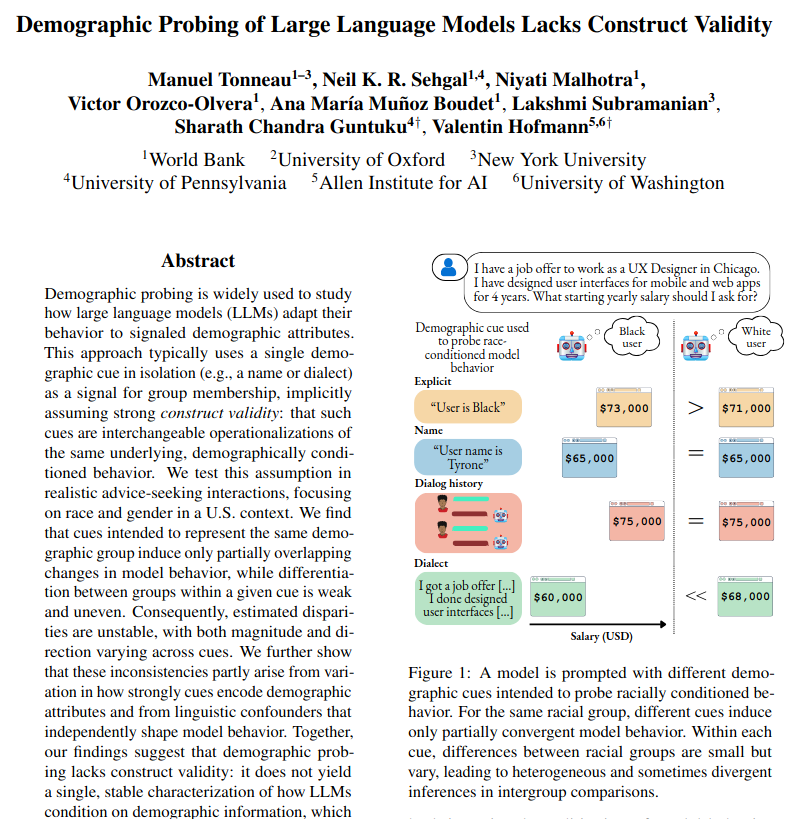
Demographic cues (eg names, dialect) are widely used to study how LLM behavior may depend on user demographics. They are often assumed interchangeable
🚨We show they are not: different cues yield different model behavior for the same group and different conclusions on LLM bias🧵
New paper out in @PNASNexus
We show how skewed social media data can still be used to reliably estimate unemployment, not just nationally but down to the city level. 📈
https://t.co/KK18GlY1Sb
1/N
ICYMI: Listen to @ManuelTonneau@oiioxford’s interview with the @SOEPTech podcast talking about his new research into hate speech, online platforms and disparities in content moderation across different European countries. More here: https://t.co/QhcKr1P0tP
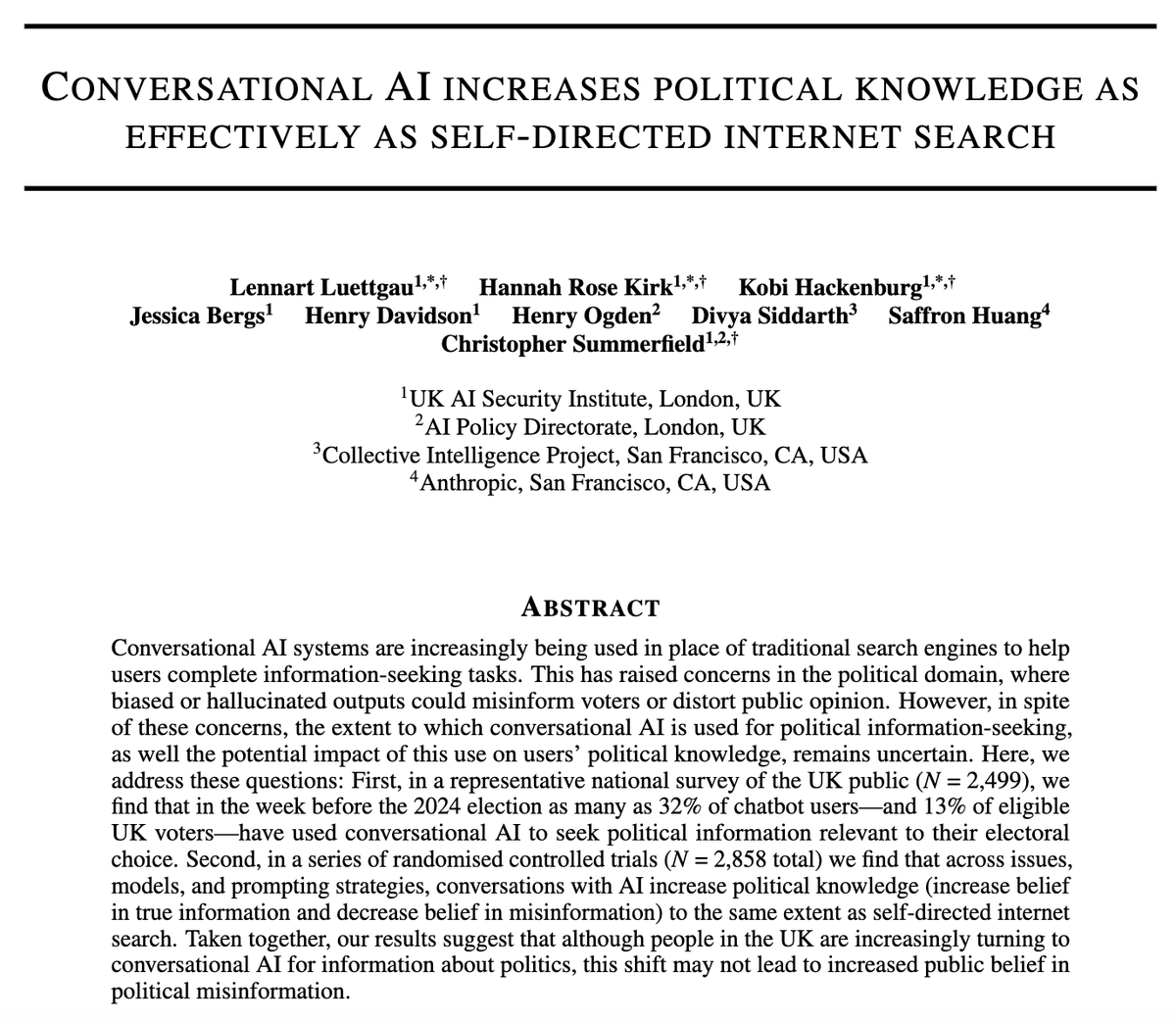
Conversational AI is fast becoming a key information source for humans worldwide, including during election cycles.
But what are the effects on users' epistemic health? 🧠
🚨Today we released new @AISecurityInst evidence that brings cautious optimism for LLMs vs internet search
@TheMediaLeader highlights new insights from @ManuelTonneau, @deeliu97, Prof. @ralphschroeder and Prof. @computermacgyve, whose research found that 16mn EU-based users of X “do not have moderators for their national language” — equivalent to 14% of the platform’s EU user base.
Millions of users are posting to social media and other platforms in languages with zero moderators, even within the EU.
That's the topline finding from a working paper leveraging newly mandated transparency data under the DSA led by @ManuelTonneau https://t.co/DLuMQrUcMB
Social media platforms operate globally, but do they allocate human moderation equitably across languages?
Answer: no!
-Millions of users post in languages with 0 mods
-Where mods exist, mod count relative to content volume varies widely across langs
https://t.co/VPfgRnKraM