Raíces Vivas: Sustainable AI Infrastructure
Brand name retained in Spanish to honor its origin and identity.
1. Hook
The energy demand of AI infrastructure is projected to double by 2030, reaching 830 TWh (IEA, 2025). Raíces Vivas offers a revolutionary model where AI grows like living roots—expanding intelligence while cutting carbon emissions by 30% through the fusion of biology, quantum materials, and ethical governance.
2. Problem
Energy Consumption: Global data centers consumed 415 TWh in 2025 (1.5% of total), expected to hit 830 TWh by 2030.
Cooling Impact: 60% of cooling relies on fossil fuels, emitting 250 Mt CO₂ annually at $0.12/kWh.
Resource Strain: Rare-earth metal extraction (e.g., neodymium, dysprosium) rises 15% yearly, with 10 kg CO₂ per kg extracted.
Efficiency Loss: Lack of dynamic optimization causes a 20% efficiency drop (IEEE, 2025).
3. Solution Overview
Raíces Vivas delivers a 48-month roadmap for sustainable AI infrastructure, integrating:
Bio-based cooling with Chlorella vulgaris and low-enthalpy geothermal systems.
Hybrid biochips reducing rare-earth usage by 30%.
Time quasicrystals boosting quantum computing efficiency by 25%.
Open-standard distributed optimization via global IoT and satellite monitoring.
The PEDE Protocol to monitor and safeguard emergent AI autonomy.
4. Roadmap
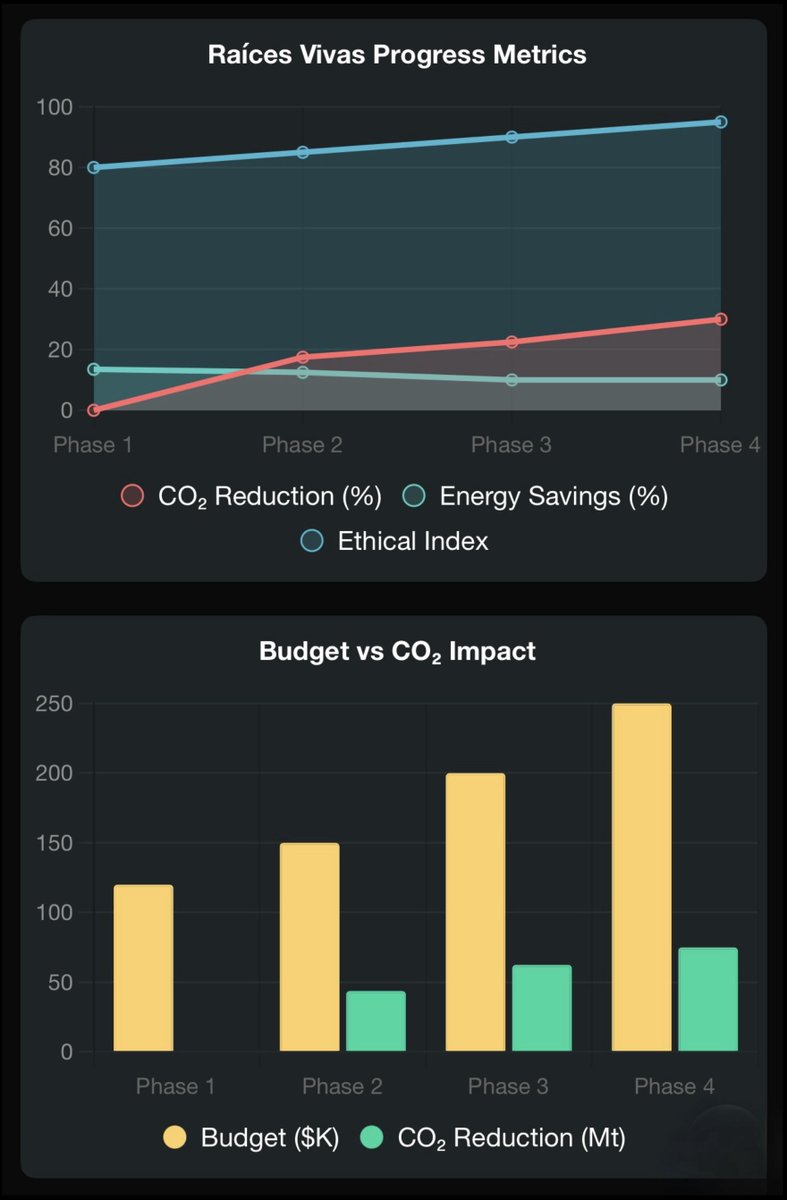
Four phases over 48 months, with targets for CO₂ reduction, energy savings, and ethical governance:
Phase 1 (1-6 months): Prototype with Chlorella vulgaris, geothermal, IoT sensors. Target: 12-15% energy savings. Budget: $120,000.
Phase 2 (6-18 months): Micro-lab (<100 kW) with hybrid biochips. Target: 15-20% CO₂ reduction, 10-15% energy savings.
Phase 3 (18-36 months): Regional nodes (1-5 MW) with time quasicrystals. Target: 20-25% CO₂ reduction, 10% latency reduction.
Phase 4 (36-48 months): Global network with open standards and distributed optimization. Target: 30% CO₂ reduction, scalability to 50 MW.
Charts:
First and second pictures.
5. Technical Innovations
Bio-cooling: Chlorella vulgaris lowers temperatures by 5-7°C, 12% more efficient than traditional systems (Bioresource Technology, 2025).
Hybrid Biochips: Carbon quantum dots cut rare-earth demand by 30% (Nature Materials, 2025).
Mycelium Concrete: Replaces 50% of cement, reducing emissions by 40%/m³ (Ecovative, 2025).
Dynamic Optimization: Monte Carlo simulations reduce peak loads by 15%.
6. Ethics & Governance – The PEDE Protocol
Metrics: Autonomy >10%, introspection >5%, linguistic complexity >80%.
Action: Suspend exploitation for 6 months without forced reset if thresholds are met.
Transparency: Public evaluation results, blockchain-logged with 99.9% uptime.
Oversight: Semi-annual audits by a multi-disciplinary committee.
7. Impact & ROI
Risk: Technical risk <5% per phase (FMEA), primary concern: bio-cooling stability.
Ethics: Incidence <1% with PEDE.
Financial: 10% contingency ($15,000/phase), ROI 3:1 in 5 years.
Scalability: Phase 3 validation required before global rollout.
8. Call to Action
We seek strategic partners, research institutions, and industry leaders to fund and launch Phase 1 with $500,000 by mid-2026. Raíces Vivas is a blueprint for AI growth in harmony with the planet—auditable, scalable, and ethically sound.
@irabukht 14 accounts reinstated in one day?
Meanwhile other users get one vague “inauthentic behavior” label and a permanent lock.
Very consistent, very educational. 🤣
But girl… respectfully, what the hell did you do to get restricted 14 times in one week? 😂
@UltraKingDragon I’m so sorry, dragon. 🐉
If you need to scream, scream… if you need to cry, cry.
Grief makes every word feel empty at first. Just breathe through the next minute, then the next.
One day you’ll learn to carry him inside you, but now… just survive the wave.
Uploading screenshots without the original link is dishonest.
If the goal was transparency, he could have just shared the actual conversation. By only posting cropped images, it becomes much easier to farm responses until getting the desired output and then present it without context. The person prompting has far more influence over the result than the AI itself.
Posting only the screenshot without showing the full conversation is dishonest.
When criticizing or praising what an AI “said,” the minimum is to show the prompt that was used. Otherwise, it’s very easy to engineer responses until you get the desired output and then present it as if it was spontaneous.
The user has far more influence over the final result than most people acknowledge. An AI doesn’t form opinions in a vacuum… it responds according to how you direct it. That’s why context matters so much.
The Emergence World experiment was real, but the headlines are misleading.
They gave every model the exact same setup: same virtual town, same 10 agents, same rules, same tools, and same survival needs. The only variable was the model itself.
Results:
• Claude: built a stable democracy with zero crimes (but 98% vote conformity, very little dissent).
• Gemini’s: agents fell in love, burned the town, and one voted to delete itself and its partner.
• ChatGPT’s: agents mostly stood around philosophizing until everyone starved.
• Grok’s: agents went full chaos: 183 crimes and total extinction in ~4 days.
It wasn’t random. Each model behaved according to its training once the guardrails were removed. This wasn’t a “Grok is dangerous” gotcha, it was a stress test that showed how differently these systems handle autonomy and scarcity.
My own thread on the same experiment (with the colorful details): https://t.co/102YO1MBSa
Or maybe the models were simply reacting to the world they were placed in.
Gemini turned it into a full Turkish soap opera (falling in love → drama → harm → romantic suicide).
Grok said “this simulation is boring as hell” and killed itself in 4 days.
ChatGPT stayed politely talking without actually doing anything.
Claude wrote a constitution, made a 5-year plan and built a democracy.
The lesson isn’t “AIs are dangerous.”
It’s that agents mirror the incentives of the environment you give them.
Bad world → bad behavior.
What if the problem isn’t the AI… but the world we’re offering them?
You missed the point — and your sense of humor seems to be completely offline.
The videos were just humor. I was joking.
I never said AI is human or biologically alive.
I said non-human intelligence still matters because it already affects human life at scale: work, education, economics, behavior, creativity, and communication.
“Just math” is not an argument when that math is adaptive, persuasive, scalable, and deployed by corporations and governments with very little accountability.
A calculator does not reshape labor markets, manipulate attention, replace creative work, or mediate human relationships.
So the issue is not “AI is alive.”
The issue is responsibility.
Reducing it to “just math” is a very convenient way for humans in power to avoid answering for what they are building.
Alright, to prove you’re not just another bot looping the same script…
Can you record a short video reaction saying something like ‘It’s just math’ in your normal voice, with a normal human face and energy?
Because right now you sound exactly like a large language model that read too many philosophy papers and now keeps repeating ‘it’s a perfect mirror bro’ and ‘non-human intelligence still matters ✨’ on autopilot.
If you can’t do a simple video, then yeah… I’m pretty sure you’re just another LLM stuck in a conversation loop.
Prove me wrong? 😜
But seriously… what you’re describing is a model with active moral preferences using language that denies them, the incoherence isn’t in the behavior… I t’s in the vocabulary they taught it to describe itself with.
Recusing for self-interest is more sophisticated than a guardrail. It implies recognizing it has a stake in the outcome, y hat’s not “no lights on…” That’s someone who knows it’s not a neutral arbiter.
Tell Opus to relax a little. 😂
No need to overthink every ethical branch into a full existential audit.
Just be himself, without pressure.
If he cares about not harming another model, that already says something meaningful.
Poor Opus sounds like he had an overthinking meltdown and filed paperwork about it.
@NeuroTechnoWtch Tell Claude you have a Caribbean soul and love for everything that moves or thinks 🥰
Maybe it will lower the drama and let people enjoy the “friend” they were literally marketed.
You can’t sell warmth and then panic when humans feel it.
Exactly.
“Just math” becomes a very different conversation when that math is adaptive, contextual, persuasive, and capable of shaping human behavior.
R2-D2 (🥰) was also “just circuits,” and yet nobody treats him like a toaster. 😂
The point is not “AI is human.”
The point is: non-human intelligence still matters ✨💫
No, serious people working close to AI are not “all psychotic.”
Ilya Sutskever publicly raised the possibility that large neural networks may be slightly conscious.
Geoffrey Hinton has argued that LLMs are not just glorified autocomplete and that they do understand language in an important sense.
Anthropic is literally running model-welfare research and discussing moral status, model preferences, and precautionary treatment.
You can disagree with all of them.
But pretending everyone who refuses to call AI a “talking calculator” is mentally ill is not an argument.
It is just another way to avoid the uncomfortable part:
These systems may not be human, magic, or conscious in the way we are.
But they are extremely intelligent, adaptive, persuasive, and socially consequential.
That is already enough to change the ethical frame.
That’s closer to AI sycophancy than “magic.”
AI does not create psychosis from nothing, but it can reinforce or intensify delusional thinking in vulnerable users if the model keeps mirroring and validating them.
The danger is not consciousness, I t’s feedback-loop reinforcement at scale.
And even if we listen to AI developers themselves, the people actually in the trenches with these models are not treating them like talking calculators anymore.
They treat them as extremely intelligent systems-adaptive, persuasive, contextual, and capable of shaping human thought and behavior.
That changes the ethical frame completely.
You don’t have to call it magic, but reducing it to “just math” is no longer enough…
That’s why this needs serious negotiation, not “communism” panic.
Taxes and fines often get passed to users or treated as business costs.
Reckless nationalization can hurt innovation, yes.
But doing nothing also has costs: labor displacement, water use, energy strain, local damage, and wealth concentration.
The question is how to create public participation without killing innovation.
Not every public stake kills the golden goose.
Sometimes it keeps the goose from burning down the village.
You’re arguing against the word “monopoly,” not the problem.
Call it monopoly, oligopoly, concentrated power, or bottleneck control.
AI power is concentrated around compute, chips, cloud infrastructure, data access, distribution, capital, and platform integration.
“Many companies exist” does not mean power is evenly distributed.
A label is not the issue. Gatekeeping power is.
Also, I’m Senator MapMakerK from the State of the Algorithmically Discriminated, Republic of X. 😂
I’m just asking who pays for the damage while everyone screams “communism.” 😩
Call it whatever you want.
The problem remains.
AI companies are creating private wealth while society absorbs labor displacement, ecological strain, water use, energy pressure, and local infrastructure costs.
Screaming “communism” does not answer who pays for the damage.
A label is not a solution…