The $JESUS Coin Ultimate FAQ (part 2)
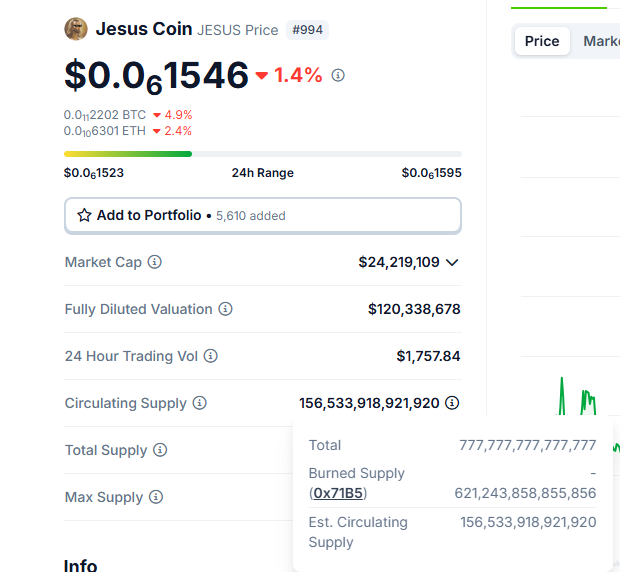
✨Why is the FDV different than the market cap?
✨Can you verify the burn on chain?
✨What’s with the #1 wallet on Solana?
#1 Why does the #1 wallet hold 80% of the supply on Ethereum?
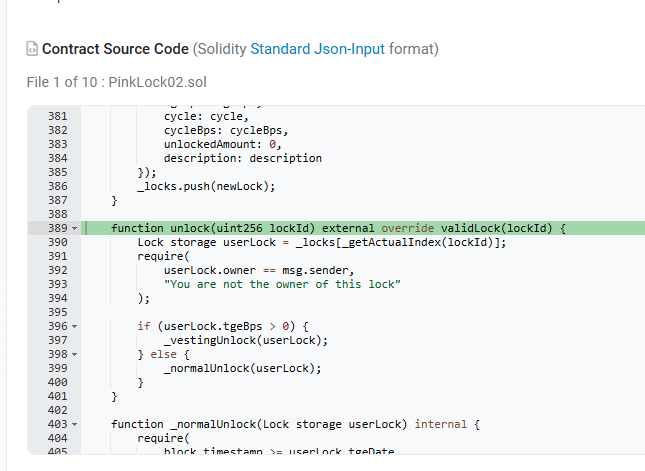
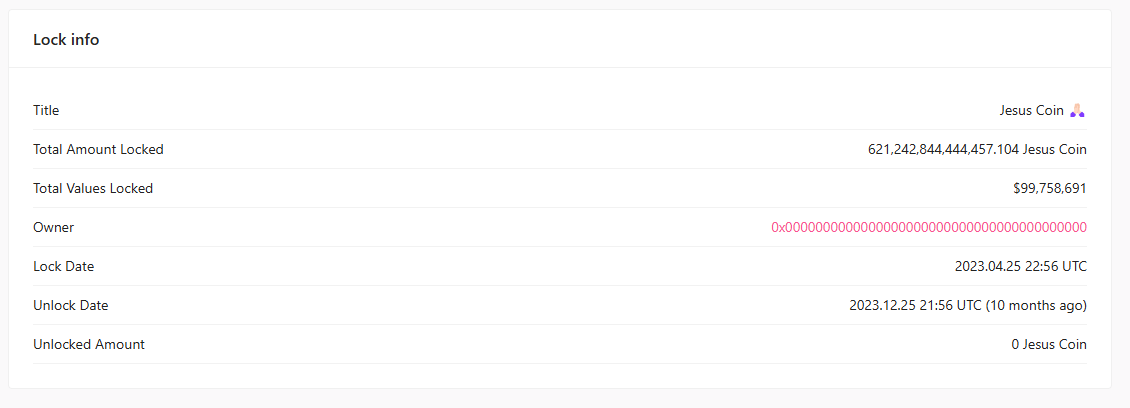
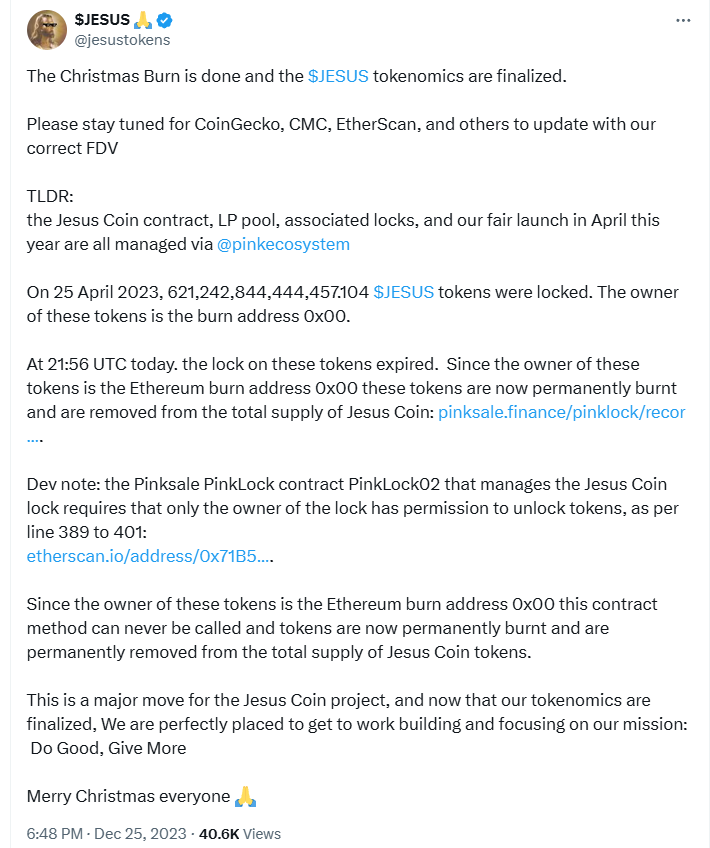
The #1 Wallet is the Burned Supply. It is in a locked smart contract, owned by the burn address (0x0000)
#2 Can you verify the 80% Token Burn?
The 80% Supply Burn is verifiable on chain:
The Safe: 0x71B5759d73262FBb223956913ecF4ecC51057641
The Lock: 0x20a058326b2ebf96dad8f2d30f0682566fbd6d5ab5245f7394272f384f340baf
The Burn: 0x961de8ee1b7a97bfb355c2aad52c2cf6f1179d72246063be94aa979647b249d1
@coingecko has also independently verified our Supply Burn. The burned tokens are stuck in a smart contract called PinkLock 02 (Lock ID 1004705). All tokens launched on the @pinkecosystem launch pad also use this contract for locking/unlocking.
Here’s the best way to explain it:
- PinkLock 02 is a bank.
- The tokens are locked in a Safe within the bank.
- The key to the locked Safe was thrown into a volcano.
- The PinkLock contract is immutable (meaning, it can’t be changed).
- No one can ever open the Safe or change the lock unless they have the key
- But, the key is in a volcano (ie the burn address 0x0000)
- And the Bank is still used by other happy “customers” with completely different Safes
#3 What’s with the #1 wallet on Solana?
The #1 wallet is the $JESUS Bridge smart contract.
Solana Bridge: jkwgDqMBMYH2FP5LmTDGxEFVRKfQrpn1eeN7Q1Zk8yp
All of the available JESUS/SOL tokens that can be bridged from ETH are locked in that contract. It is impossible to redeem (or unlock) more tokens than are locked in the bridge (on either side).
#4 Why is there a discrepancy between market cap and FDV?
79.87% of the supply of $JESUS was burned on 12/25/23. Those tokens are forever burned and can never be unlocked or released. The FDV includes those tokens. (Coins that have done major burns have the same issue)
#5 What’s the difference between JESUS/ETH and JESUS/SOL?
There is no difference. They are the same token, just on two different blockchains. Tokens can be bridged back and forth between the chains without restriction and liquidity is locked on both chains.
- JESUS/SOL trades out of @RaydiumProtocol
- JESUS/ETH trades out of @Uniswap V2
#6 How does the Bridge work?
Blockchain bridges work in two ways:
A) Mint & Burn
B) Unlock & Lock
The JESUS Bridge utilizes the Unlock & Lock functions for bridging JESUS between @ethereum and @solana .
All of the available @jesustokens on Sol are locked in a contract. When JESUS/ETH tokens are bridged over to Solana, those tokens are locked in a contract on the ETH side and the equivalent number of tokens are unlocked on the Sol side. Security wise this means, it is impossible to redeem (or unlock) more tokens than are locked in the bridge (on either side).
ETH bridge: 0x8BCCfed5d847087426cBCC787dAbA655DEe0D9A2
SOL bridge: jkwgDqMBMYH2FP5LmTDGxEFVRKfQrpn1eeN7Q1Zk8yp
#7 Is it better to buy $JESUS on Ethereum or Solana?
Because the Solana liquidity pool has 99% less liquidity, slippage will be much higher there. While the JESUS/ETH LP can easily handle 5–7 figure buys/sells.
If gwei is high, buying on Solana might make more sense.
#8 Why is the JESUS/SOL liquidity so different than the JESUS/ETH liquidity?
$JESUS launched on Ethereum on 4/25/23. At launch, 9 ETH + 1% of the supply was locked in liquidity. The UniSwap LP has accumulated over $1,000,000 in LP fees (from over $400,000,000 in total trading volume).
The JESUS/SOL Raydium liquidity pool was launched on 5/1/24, with ~$40,000 in JESUS and SOL (donations from the community). Both positions are locked and renounced and will continue to earn fees for perpetuity.
#9 What’s the trading volume of $JESUS?
Since fees are less on Solana, SOL memecoins typically have much more volume than coins on Ethereum. $JESUS is an ETH native memecoin.
From 4/25/23 to 11/2/24, the average daily volume of $JESUS is: ~$1,000,000
#10 What are the tokenomics?
Original 👇
Total Supply: 777.777 trillion $JESUS
Liquidity locked: 9 ETH + 1%
Team/marketing/CEX: 0%
Public Presale: 19%
Burned Supply: 621.24 trillion $JESUS (79.87%)
Current 👇
Circulating: 156.5 trillion $JESUS
Liquidity locked: ~ 7 trillion $JESUS (4.7%)
Over 95% of the circulating supply is owned by the community.
#11 Will JESUS ever be on other blockchains? (@base , BTC, XRP, etc)
Since JESUS is a decentralized ERC-20 token, it can be bridged to any chain, at any time, by anyone. However, To be traded on those chains, a new liquidity pool must be launched on the desired chain. Again, anyone can launch an LP on any chain.
#12 Will Jesus Coin ever be on any exchanges or futures platforms?
The listing process for major exchanges varies, most require a 5–6 figure listing fee, Market Maker, Liquidity, marketing costs, and minimum volume requirements.
$JESUS is available to trade on any decentralized exchange (UniSwap, Raydium, @JupiterExchange@CoinbaseWallet @okxweb3 @SlingshotCrypto@usemoonshot
#13 Why isn’t $JESUS verified on everywhere? (Jupiter, Phantom, Moonshot, etc)
Wallets and exchanges all have different verification requirements. Typically, volume and community interest are the aspects they factor in most. As $JESUS continues to grow, more platforms will verify the coin.
#14 Is the $JESUS contract verified and audited?
Yes, the Jesus Coin contract is verified on Etherscan and was audited by @mythx_platform
#15 Why are there security warnings on the contract?
JESUS launched with an antiwhale contract to help protect against bots/snipers. This is standard for most hyped contracts & was turned off before the contract was renounced.
Any “external call risks” and “anti-bot functions” are irrelevant after a contract is renounced because no internal/external functions can be called since the contract is owned by the burn address (0x0000).