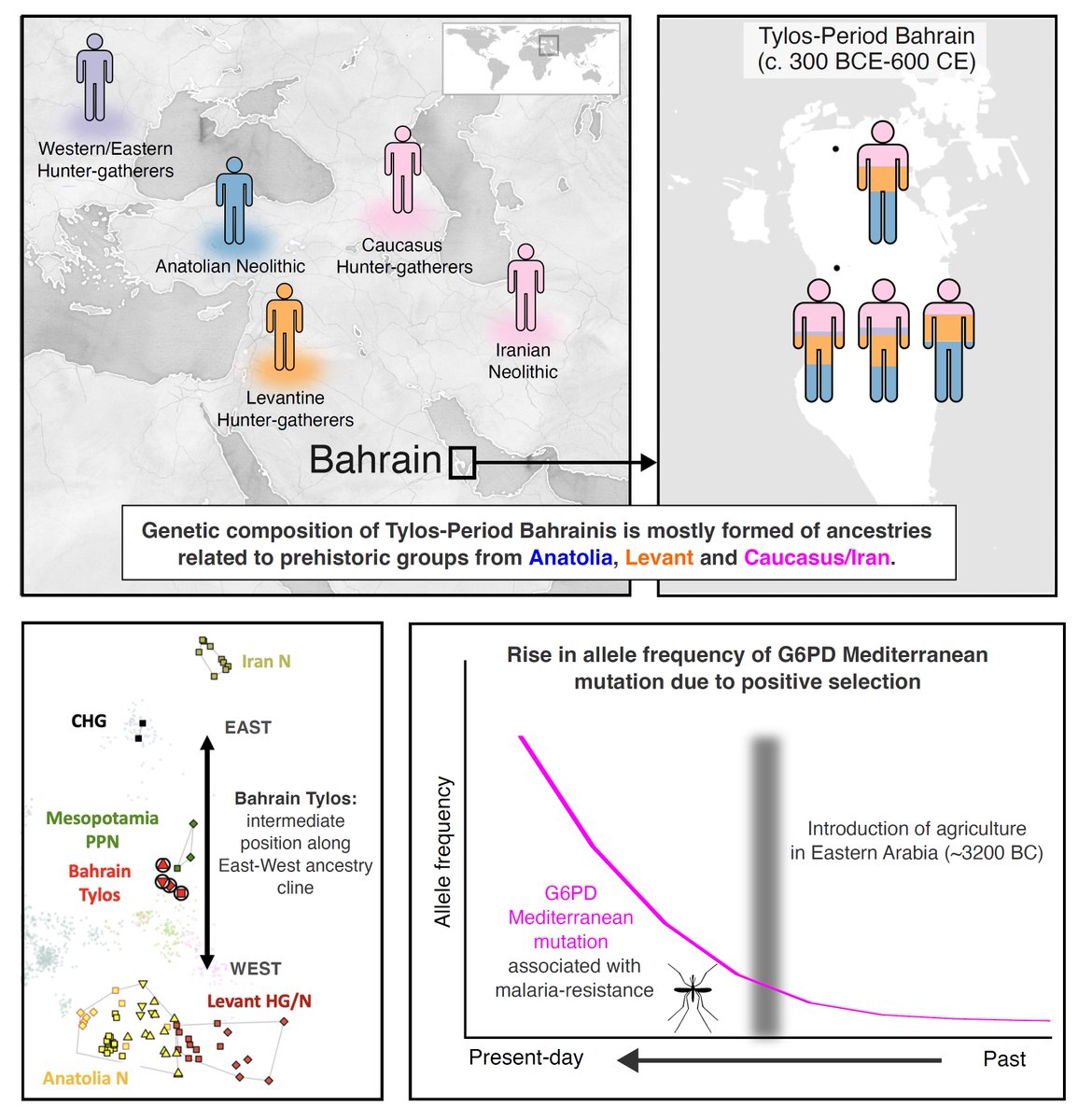
We publish today the first ancient whole-genome sequences from Arabia and show how they inform on ancestry and disease in the Middle East 🧬☠️ #aDNA#MiddleEast#Bahrain https://t.co/HjZQnMW1a1
We are looking for an enthusiast & motivated postdoc to join the Paleogenomics and Evolutionary Biology group at @LIIGH_UNAM, to lead a project working with human pre-hispanic samples. Interested candidates send a CV and letter of intent to [email protected]. Please #RT.
Last chance to apply for postdoctoral positions at the Center for the Human Past/Uppsala University.
Application deadline: Monday, 15 December 2025.
https://t.co/WrKWsAqEqm
Thrilled to share our study sequencing genetic data from tropical mammoths 🏝️🦣. First DNA recovered from Columbian mammoths southern than USA https://t.co/sIGSyuTP65. Thanks to all collaborators, you were key to this success! Below a fantastic note covering the paper ����
Large pedigrees are all the rage in ancient dna these days but thus far they’ve been manually reconstructed. @edwardhuangc from my group built an automated reconstruction tool, please try it out!
https://t.co/KeS7Hti0UX
Analysis of fats and oils on pottery has suggested that Bronze Age communities in eastern Arabia consumed more plants than indicated by the archaeological record.
https://t.co/WDA5g9weSG
Thrilled to announce that our book chapter was published by @routledgebooks in #OpenAccess. This chapter is part of an outstanding 740-page book that examines the early events of the Bantu expansion in Central Africa from multidisciplinary perspectives. 🧵https://t.co/d61h0svkc2
Postdoc position opening in my group! Research projects: pangenomes for diverse organisms, genome evolution, biocomputing, language models. Please reach out if interested!
Our genomics experts have worked with partners from Europe, Asia, and the Middle East to uncover how human populations adapted, survived, and diversified in the Himalayas - one of the most extreme and challenging environments on Earth https://t.co/3inSrtr1SM
Our new paper on genetic diversity in the Himalayas, when it began and how it may have supported survival in extreme environments
https://t.co/th2V0cxYiH
Our new paper on ancient DNA to address the spread of Uralic languages now out in @nature (we started working on this in 2018). Many interesting results, including a sample from ~16k years ago Yakutia that can be modeled as an unadmixed Native American.
https://t.co/8kj9Kynv8a
A 4-year postdoc position in population genomics is available in my group at the University of East Anglia, to work on a project sequencing a thousand fox genomes across rural and urban environments in the UK.
https://t.co/QYebOIS3VS
"We added previously published sequences for 20 indivdiuals [sic] confidently classified as Phoenician or Punic (7 from 2 Sardinian sites, 1 from Ibiza and 12 from Beirut)"
But 2 of those in Beirut were an Egyptian mom and her admixed son
https://t.co/5Armf3cP8V
How the Emirati Genome Project could lead to advances in personalised medicine.
Thanks to @MarcHaber of @birminghamdubai and Prof Habiba Al Safar of @KhalifaUni for the comments.
https://t.co/Qujaq2fzxj
Our papers, out today in @nature, show how ancient DNA from the Eneolithic and Bronze Age steppe points to a North Pontic origin of the Indo-European language family and a Caucasus-Lower Volga (CLV) origin of Indo-Anatolian (inclusive of the now extinct Anatolian languages). 1/
We're looking for two people to join our Research Data Science Service in the @uob_bear team at @unibirmingham, funded by our Institute for Data and AI. Come and work on innovative research projects all across our world-class university: https://t.co/gejAMZcFwe