@mckaywrigley Im trying to figure out how to get that reach responses on Vercel demo but only get standard ChatGPT text responses… anyone could point me to the right direction (don’t want to learn how to build an own app yet)
@CryptoCandyy
Hi,
A colleague of mine showed me your work - CANDYs suite - Core and Valkyrie - Oscillator... sit there a chance to get an access to those custom charts/indicators on TradingView?
IMO, a Sprint review is a conversation, not a presentation. I don't give presentations except in special circumstances. In general, you don't learn much if an engineer is sitting at the computer. Instead, have the outsiders use what you just built, then talk about that.
The reason for low-quality software products?
Developers don't care.
They can easily get away with murder. There are no consequences if they produce badly designed code.
They get their high salary and keep producing sloppy code as if nothing happened.
But the damage is real.
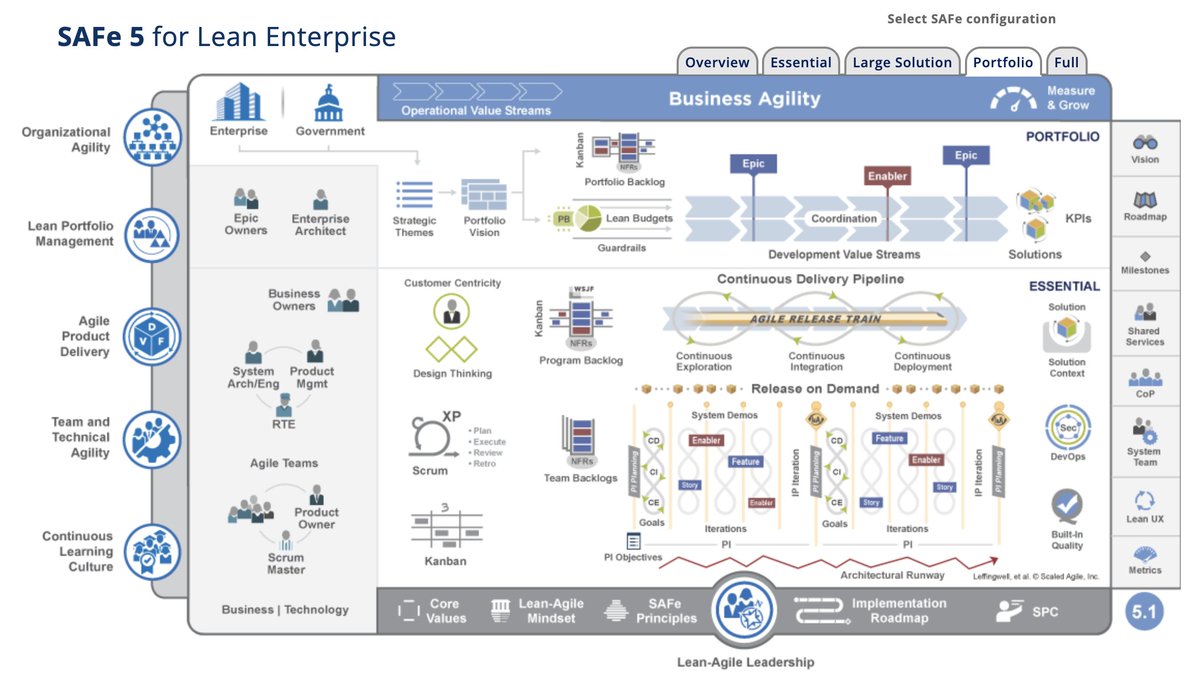
Why is SAFe so bad? It's a huge in-agile bureaucratic morass. Just look at 👇. Where are the people doing the work? Where's the customer? It's entirely about big centralized control-based management getting bigger. It violates every Lean and every Agile principle.
“Our job is not to address every customer opportunity. Our job is to address customer opportunities that drive our desired outcome.” - @ttorres
https://t.co/NeZFL4pjpt
#prodmgmt#ux
You will note that the words "Project Manager" do not appear in either the Agile Manifesto or the Scrum Guide. They did not inadvertently forget to mention them. It's not "of course you have Project Managers, that's a given." It's not a given. There's no place for them.
ISTM, the word "stakeholder" is too broad to be useful. I'd rather split ppl into finer categories. E.g. there are customers, users, builders, budgeters, thugs-who-pay-your-salary-and-use-that-leverage-to-dominate-decision-making, &c. It's useful to distinguish.
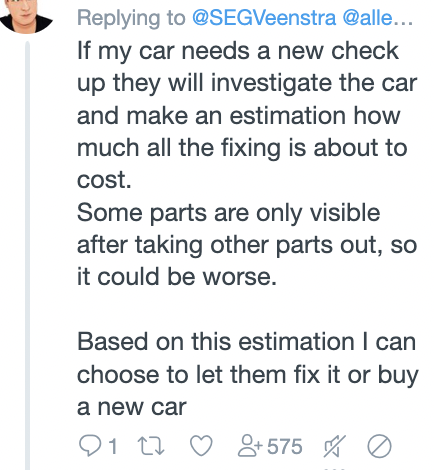
Lord save us from bad metaphors! We do NOT work on cars. We do NOT build houses. We do NOT repair appliances. Where does this thinking even come from? Most of the people who use these metaphors know better. They are actively misleading.
If you find a bug, the very first step is to write a test that fails because of the bug. Check it in. There, you no longer need a bug-tracking database.
I've turned down Agile-adoption jobs where they want a roadmap with benchmarks and metrics and estimates and a finish date. It just doesn't work that way. Sorry. You cannot become agile using a rigid plan. You have to approach the problem in an agile way. 1/3
Working on and delivering entire features in one chunk (as compared to continuously delivering very small stories) is just waterfall dev. I wonder how anybody who stakes a claim to agility can think that's an even remotely reasonable way to work. Am I missing something?