Every single candidate that President Barack Obama campaigned for won including Jon Ossoff and Abdul El-Sayed. He was like a good luck charm for them. He will always be my favorite President.
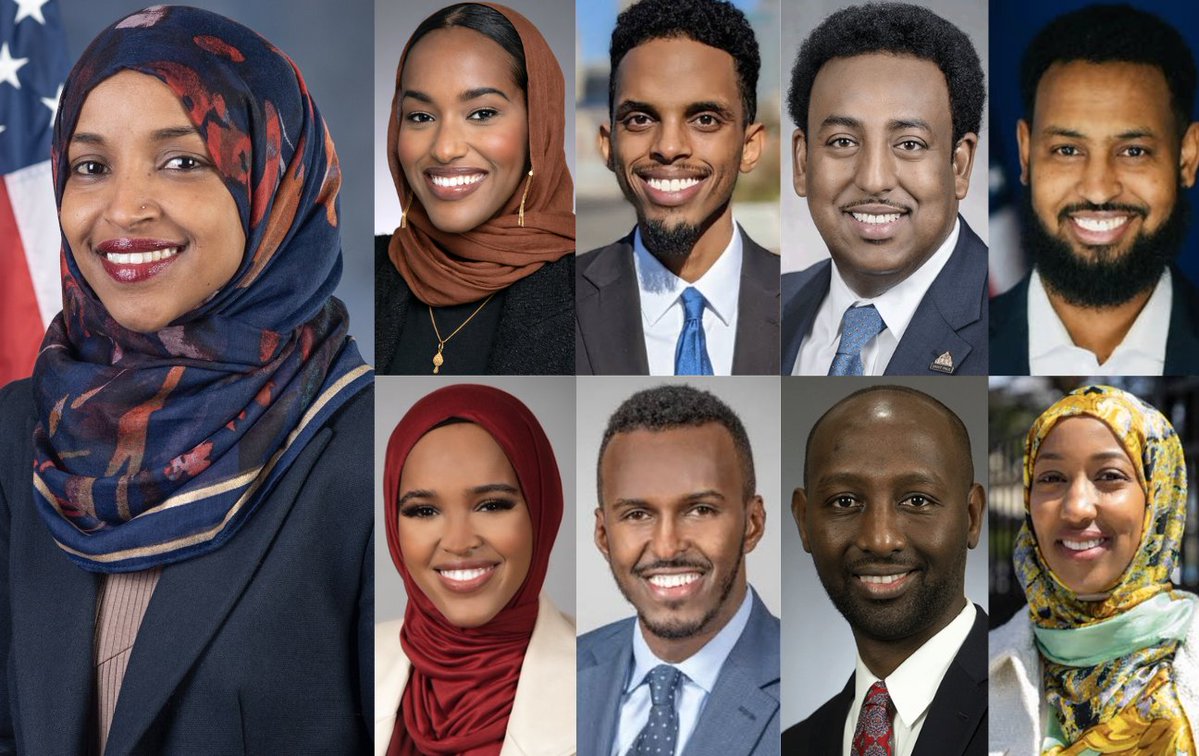
BREAKING: SOMALI STRONG! 9 Somali Americans won their elections last night despite the vile racist smear campaign that Trump has been waging against their entire ethnicity.
Victory is the best revenge...
Trump called Somalis "garbage." His relentless attacks against their communities were the most consistent racist barb in his arsenal this election cycle. He was convinced that throwing hateful red meat to his base would carry the day for MAGA.
“I don’t want them in our country," he said.
“They contribute nothing," he said.
“Ilhan Omar is garbage. She’s garbage. Her friends are garbage," he said.
“Let them go back to where they came from and fix it," he said.
He called Somalia “barely a country” and said Somalis come from “hell.” He said, “Their country stinks”.
But last night, the American people stood up and showed him exactly what they think of Somalis. We support them, value them, and we think they belong in government!
Rep. Ilhan Omar won reelection.
Omar Fateh and Zaynab Mohamed won Minnesota State Senate seats in Minneapolis.
Samakab Hussein won a Minnesota State House seat in St. Paul’s East Side.
Mohamud Noor and Anquam Mahamoud won Minnesota State House house seats in Minneaplois.
Abdi Daisane flipped a Minnesota State House seat in the the St. Cloud area.
Ismail Mohamed and Munira Yasin Abdullahi won Ohio House seats in Columbus.
Trump tried to make them a punchline. Instead, they made history. The MAGA era is over. We are sick and tired of letting these demented fascists divide us along racial and religious lines. America is vibrant, multiracial democracy and if Republicans don't like it, they can get out!
Please ❤️ and share to congratulate these winners!
BREAKING: In a stunning moment, Senator re-elect Jon Ossoff slams Trump after a major win:
“In sweeping and decisive victories, the American people have rebuked the depravity, corruption, and incompetence of the failed, lame duck president Donald Trump.”
It’s an honor to win re-election to represent WA-07 💜
Tonight’s win wouldn’t be possible without every organizer, volunteer, and voter who made it possible. Thank you, thank you, thank you from the bottom of my heart.
Y'all really need to watch this.
A 19-year-old speech Abdul El-Sayed gave at the University of Michigan in 2007 is suddenly blowing up across the internet.
The timing isn't random. Just one day after taking on nearly $65 million in opposition spending and winning the Democratic primary for the U.S. Senate, people are rediscovering what he was saying almost two decades ago.
He left the most powerful office in the world humiliated.
Two decades later, a President flew 1,000 miles just to prove he'd been right all along.
January 20, 1953. Harry Truman walked out of the White House at 68 years old with one of the lowest approval ratings in American history.
The newspapers had declared his presidency a failure.
Washington breathed a sigh of relief.
He returned to Independence, Missouri. To Bess. To their modest house on Delaware Street.
To a life without Secret Service, without staff, without the trappings of power.
Just an Army veteran with a pension and his dignity.
That spring, he did something no former president had ever done: he bought a Chrysler and drove himself—with only Bess beside him—across America.
No motorcade. No security.
Just two people stopping at gas stations, eating at diners, waving at stunned strangers who couldn't believe their eyes.
He answered his own telephone. He wrote thousands of letters by hand.
He walked the streets of his hometown every single morning, moving so fast that reporters struggled to keep up.
And while he lived quietly, history was working in his favor.
He had desegregated the Armed Forces when it could have ended his career.
He had stood against Soviet expansion at the exact moment the free world needed him to.
He had championed the Marshall Plan that rebuilt a shattered Europe.
And in 1945—twenty years before it would become reality—he stood before Congress and demanded something radical: national health insurance for every American.
They called it socialism.
They called him reckless.
They killed the bill without mercy.
He never apologized. He never retreated.
He simply waited.
Then came July 30, 1965.
President Lyndon Johnson could have signed Medicare into law in the Rose Garden.
Instead, he boarded Air Force One and flew to Independence, Missouri—to a small library in an old man's hometown.
When Johnson rose to speak, he turned to the 81-year-old man sitting beside him.
The man the world had written off.
The man who had been mocked, dismissed, forgotten.
And he said:
"The people of the United States love and voted for Harry Truman, not because he gave them hell—but because he gave them hope."
Then he signed the bill that would change millions of lives.
And handed Harry Truman the very first Medicare card ever issued in the United States of America.
Bess received the second.
The man who had left Washington in silence.
The man who had spent two decades being unpopular, then ignored, then undeniably right—sat in his own library, in his own town, and held proof that his vision had finally come to pass.
He died in 1972. Today, historians rank him among the greatest American presidents.
He didn't change his principles to earn that honor. He didn't soften his record or chase approval.
He remained exactly who he was—and trusted that the work would speak for itself, even when the world had stopped listening.
History doesn't move at the speed we need.
But it moves.
And sometimes—if you're principled enough, patient enough, and brave enough to be unpopular—it circles back and vindicates you.
Even if it takes twenty years, a thousand-mile flight, and a small card pressed into an old man's weathered hands.
Some people aren't ahead of their time.
They're just ahead of the recognition they deserve.
Why do you think stories like this disappear from history?
Dear Ms. Oates:
As someone who admires both your writing, and Flannery O'Connor's, a great deal, I thought I might respond to your recent comments about Flannery O'Connor and her Catholic faith.
As I see it, Flannery was definitely a foe of hypocrisy. (Her great and trenchant story "Revelation," in which the self-satisfied Mrs. Turpin is shown in a vision how those she considers "beneath her" are entering heaven ahead of her, is a case in point.) Flannery's frequent critiques of religion are not so much a critique of faith (she herself enjoyed a very strong faith, as you can see in her recently published collection, "A Prayer Journal") but a critique of falsely religious people. Hypocrites, to use Jesus's own language.
Flannery was herself was very pious (in her own way of course) and tried to paint her fictional characters in what you might call a loud way, in order to make them stand out. "To the hard of hearing you shout, and for the almost-blind you draw large and startling figures," she wrote. This, again, is not the result of her lack of faith (or her desire to make fun of faith) but her desire, as I see it, to have people understand true faith.
As for the Eucharist, her oft-quoted line came in response to a comment from Mary McCarthy at a dinner party of literary types. (Flannery was brought by Robert Lowell and his wife.) At one point, McCarthy, who considered herself a lapsed Catholic, opined that the Eucharist was a symbol ("and a pretty good one at that"). Flannery responded, "Well, if it's a symbol, to hell with it."
In other words, for Flannery, the Eucharist is much more than a symbol and a person wouldn't give their life or stake their faith on "just" a symbol. (Symbols are important of course, but the reality they point to is even more important.) Flannery believed in what we Catholics call the "Real Presence," where Christ is truly present in the Eucharist. So, "to hell with" anything that lessened the truth of that.
In any event, I hope this clarifies things a bit.
Thanks for all the wonderful work of yours that I've so enjoyed over the years.
Peace,
Fr. James Martin, SJ
Trump: You know what the weave is, right? You’ll tell a story, and during the course of the story, you have other stories that relate to it. So you’ll be telling a story about the king of Saudi Arabia, and then ba ba ba ba, and the jets, and it is being bah bah bah, and it all comes back, and then in the end, you get to the final point.
Now, there will be a time when I don’t get to the final point, and then you could say it’s a ramble. But the way I do it, it’s pure freaking genius, OK? The weave, it’s called the weave. Right, boom boom.
Elon Musk deleted this video from X. It shows Republicans telling the truth about Trump before they teamed up with him. In the end, they sold out the whole world for money.