Meet MariaDB Enterprise Platform 2027 — built for the agentic era, with a new look to match ✨
Agents are arriving faster than most data stacks are ready for, and every enterprise putting them to work is adding traffic its data layer was never built to carry. MariaDB Enterprise Platform 2027 is purpose-built for that load, and for the applications your teams already run — so you can build agents faster, run them faster, work from one live data layer, scale without the rebuild, and maintain security and control across every workload.
And because the platform has evolved far beyond a traditional database, the brand has evolved with it: open by design, unified across every workload, and built for the agentic enterprise. We’re the same team you depend on, with a new look and feel as bold as what we’re building for you.
MariaDB is the Unified Open Database Platform for the Agentic Enterprise. Explore it here: https://t.co/32zHFGcFPy
MariaDB has been named a Leader in the inaugural @IDC MarketScape: Worldwide Operational Databases 2026 Vendor Assessment. The assessment covered MariaDB Enterprise Server, the transactional core of the MariaDB Enterprise Platform.
According to IDC's Worldwide Data Management Survey, 30% of organizations already run agentic AI in production. Agents sit upon the systems that run the business — and those systems need to carry transactions, analytics, and AI on the same live data.
We believe the IDC MarketScape’s profile of MariaDB speaks to that need. According to the report, "MariaDB natively supports row-based, columnar, hybrid, in-memory, and vector storage architectures, with pluggable engines selectable per table to match each workload to the most suitable storage model. This allows a single database to serve transactional, analytical, mixed, and AI/vector workloads without adopting separate specialized systems, including native vector search for GenAI and retrieval-augmented generation built into the engine rather than added as a separate system." MariaDB Enterprise Platform 2027, introduced earlier this month, builds outward from that same foundation.
Read more: https://t.co/bKrjmMrZkw
“The AI race won’t be won by the smartest model. It will be won by the companies that unify the infrastructure underneath their agents.”
#ICYMI: MariaDB Enterprise Platform 2027, the Unified Open Database Platform for the Agentic Enterprise, is live. CEO Rohit de Souza shares why we built it the way we did here: https://t.co/Eqrain1ZlR
One database platform for every enterprise AI agent — that’s MariaDB Enterprise Platform 2027 💪
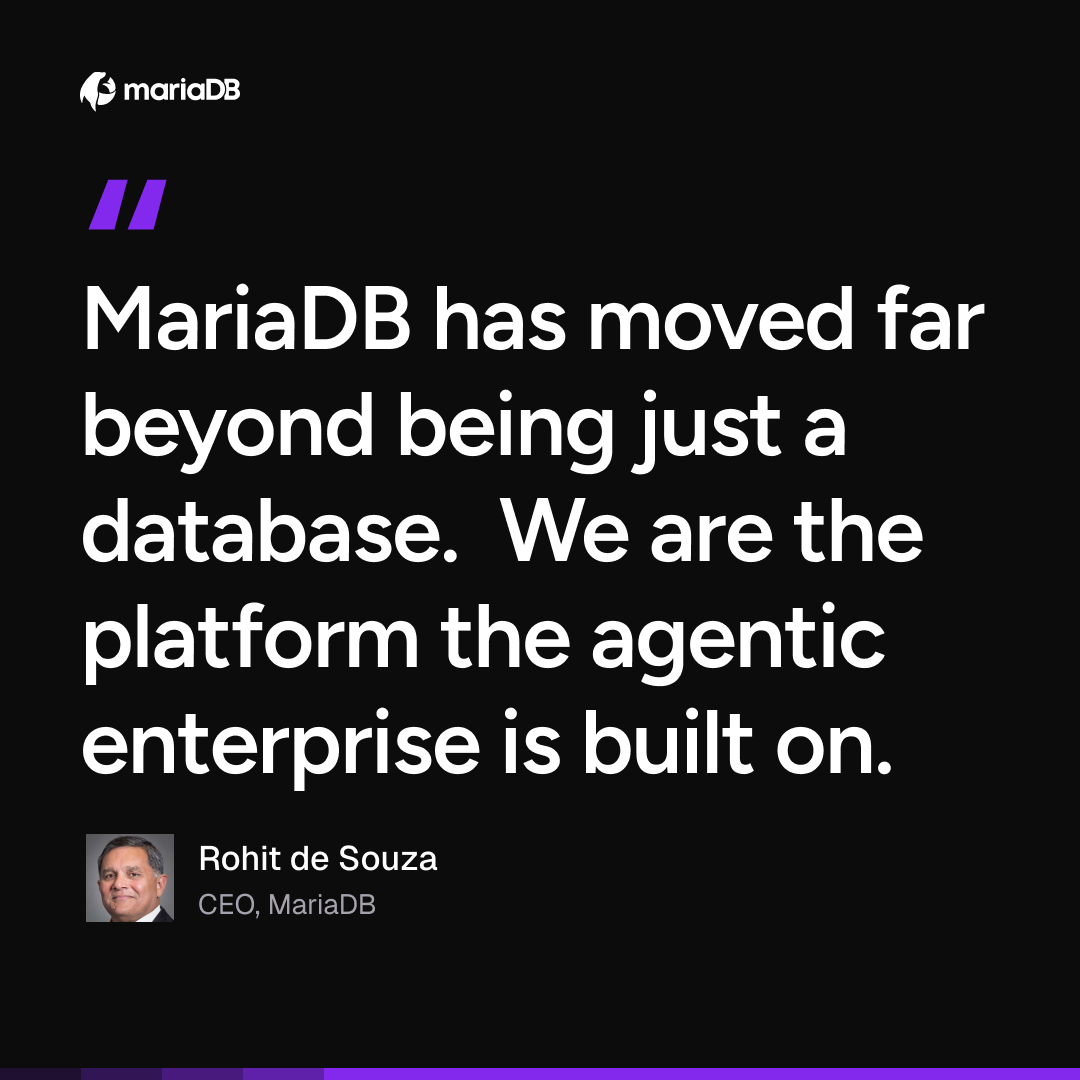
For @BlocksandFiles, MariaDB's Rohit De Souza shares why MariaDB has moved beyond being just a database, and what a single source of data for the agentic enterprise looks like when it’s built from the transactional core out — including 56% higher peak throughput in third-party testing, MariaDB Exa running real-time analytics on live operational data, and Raft clustering that holds across regions.
Read the latest: https://t.co/vtKXtma6hn
And that’s a wrap on Open Source in Finance Forum New York 🗽
Thank you to everyone who stopped by the booth this week and who attended our reception, to those that showed up for Max Mether and Kathy Gibbs on Thursday, and to the keynote crowd that heard our CEO Rohit De Souza on why partnering with FINOS to build in the open matters to us.
Kevät, which @FINOSFoundation and MariaDB jointly announced this week, is an open source distributed cache project built around the needs of financial services. MariaDB is contributing the initial code from MariaDB’s distributed caching technology (MariaDB GridGain) and several leading banks have already signed up to join the founding advisory committee for Kevät.
Explore the latest: https://t.co/rt0bjD10IK
Organizations across financial services are getting an open source distributed in-memory cache of their own 💥
At the Open Source in Finance Forum in New York, @FINOSFoundation and MariaDB announced Kevät: an open source distributed in-memory cache built around the needs of financial services, and seeded with code from MariaDB’s distributed caching technology. MariaDB is the maintainer at launch — with more to follow as the project grows.
In-memory caches sit underneath some of the most latency-sensitive systems in finance — from risk calculation, to trading and payments — and AI is about to raise the demands on them. As banks deploy agents on live financial data, those systems will see new access patterns at machine speed, and regulators will expect institutions to show who, or what, touched which data and why. Those rules also differ by country, and are still being written — which is exactly why organizations across financial services need infrastructure that can keep pace. Kevät is designed to meet those demands: performance and low latency at scale, with the security, auditability, and compliance capabilities to match, and the institutions running it steering where it goes next.
Kevät launches with a founding advisory committee of leading banks, and the initial code is expected on the FINOS GitHub in early 2027. Every institution that runs on it will also have the same codebase to build on and shape.
Learn more from MariaDB's Mani Nagasundaram: https://t.co/9CooNK29p4
Your agents are ready for production... but is your database?
Most enterprise applications were built for human users and predictable workloads, not agents that query constantly, act on live data, and expect answers in real time. That's why we’re excited to introduce MariaDB Enterprise Platform 2027 — the Unified Open Database Platform for the Agentic Enterprise.
On November 18th, join us for a walkthrough of what’s new:
➡️ AI Retrieval and Agent Memory
➡️ Raft-based clustering and active-active multi-region
➡️ One security model for every workload and agent
See why a single, open foundation is becoming the requirement for running agents in production: https://t.co/w7x9Ij5JIq
Psst… the NEW MariaDB Enterprise Platform 2027 is purpose-built for that problem 🙂↕️
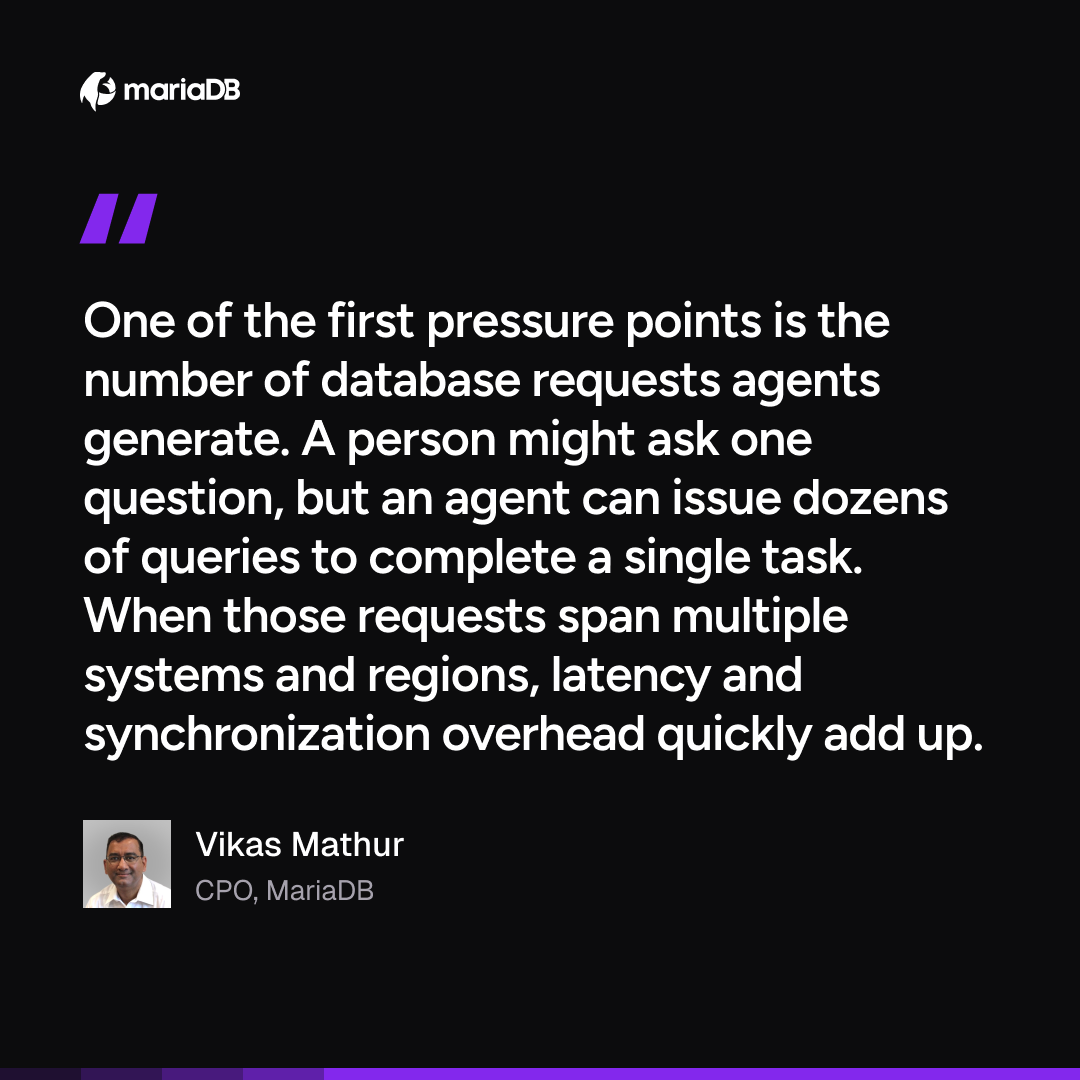
MariaDB's Vikas Mathur shares why MariaDB built toward agents from the transactional core outward with @CoderLegion1's Tom Smith — including how AI Retrieval, Agent Memory, and Semantic Cache keep agents on the same live data applications already use.
Read the full Q&A: https://t.co/nfKPBZLzHP
MariaDB is at the @FINOSFoundation Open Source in Finance Forum New York this week, and we brought the new platform with us 🙌
Join our team on-site at Convene Brookfield Place to see what a unified, AI-ready database platform looks like for the financial services industry — and stick around as co-founder and VP of Product Management Max Mether and MariaDB Manager of Solutions Engineering Kathy Gibbs take the stage tomorrow for their respective sessions:
📍 Open, But Not Unaccountable: Why Regulated Enterprises Need Curated Open Source (Max Mether, 11:55 AM ET, Hub 2)
📍 Look to AI for Your Financial Reporting Needs in an AI World (Kathy Gibbs, 2:45 PM ET, Hub 1)
Booth T10 in Hall 2 today and tomorrow — come find us: https://t.co/SSBJfha8J2
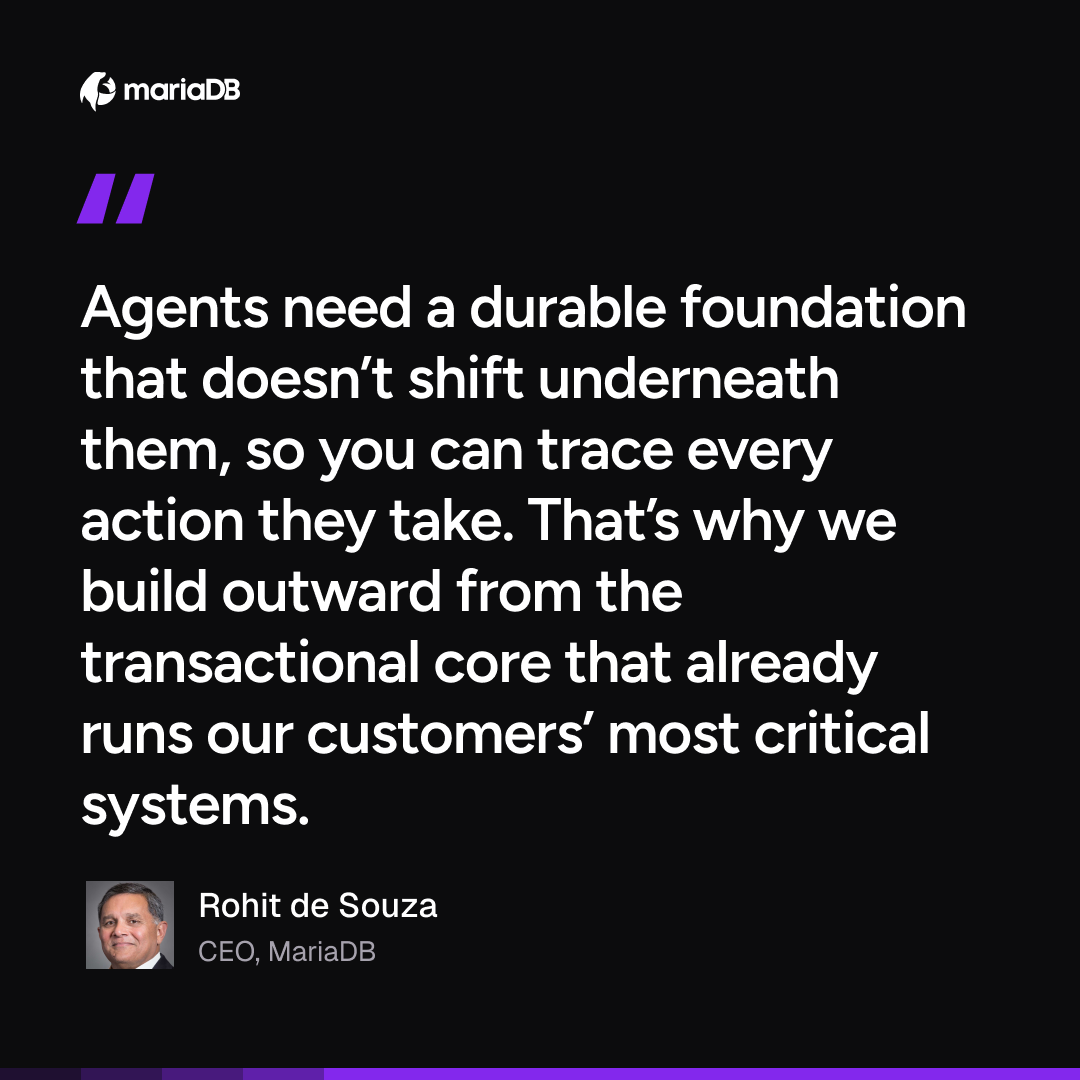
For two years, we’ve been building toward one idea: the enterprises that trust MariaDB with their most critical transactions shouldn’t need several stacks to run AI agents on that data.
On November 3, you’ll see where that’s taken us. Save the date.
#ICYMI: Adobe has shifted to MariaDB as the default recommended database for Adobe Commerce.
MariaDB's Neil Goldfarb explores what that means for commerce leaders heading into peak trading season — including MaxScale read/write splitting and auto-failover, transactional consistency under concurrent load, and a Migrator compatibility pass before code freeze: https://t.co/N4fEKSxPwE
Mark your calendars: MariaDB will be at the @FINOSFoundation Open Source in Finance Forum (OSFF) in New York on November 4th and 5th!
Join our team on-site at Convene Brookfield Place to explore AI-ready database platforms that take a unified approach to supporting the financial services industry — and stick around as MariaDB Manager of Solutions Engineering (NAMER) Kathy Gibbs and co-founder and VP of Product Management Max Mether take the stage on Thursday for their respective sessions:
📍 Open, But Not Unaccountable: Why Regulated Enterprises Need Curated Open Source (Max Mether, 11:55 AM ET, Hub 2)
📍 Look to AI for Your Financial Reporting Needs in an AI World (Kathy Gibbs, 2:45 PM ET, Hub 1)
Financial institutions run some of the most demanding workloads in the world leveraging open source software, and the next challenge is how to do so securely with AI agents. If you’re working through what agents mean for regulated data, come find us: https://t.co/fUasomvad7
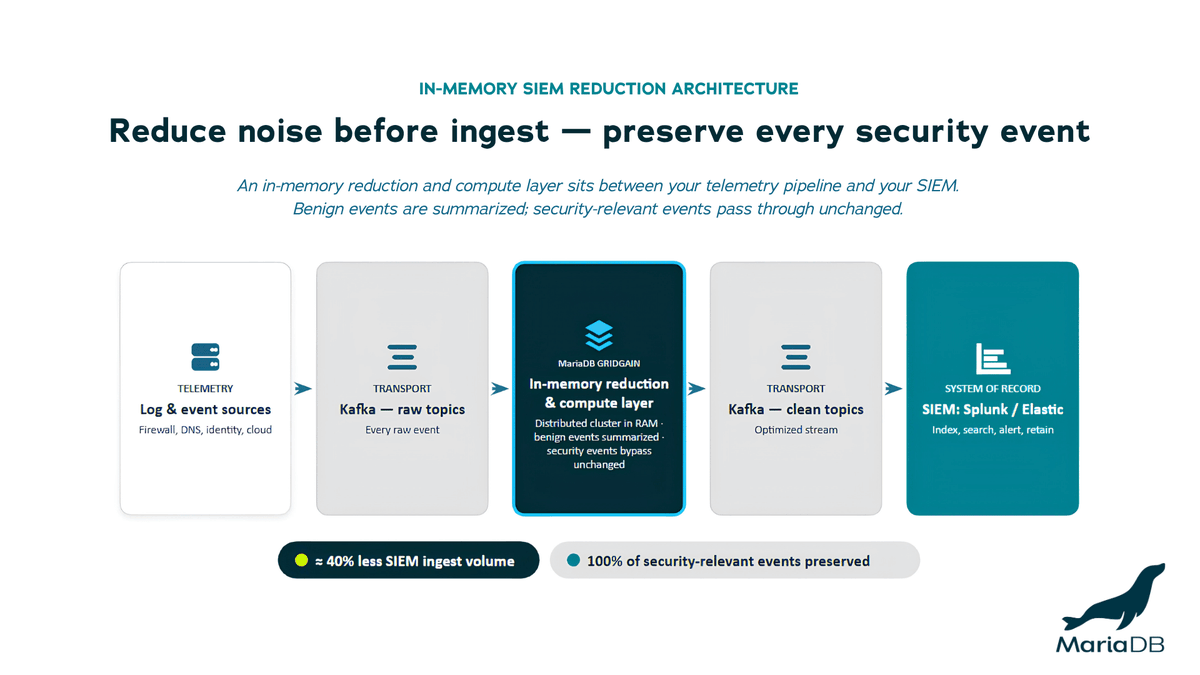
Security information and event management (SIEM) platforms charge by how much data they ingest — and most of that data is routine telemetry no one will ever investigate.
One way to control the bill is to put an in-memory compute layer between the telemetry pipeline and the SIEM, so routine events get summarized in memory before they go anywhere, security-relevant events pass straight through, and the SIEM stays the system of record without paying to store noise.
In a reference run on MariaDB's in-memory cache, that layer cut 10,000 events to 6,000 and kept all 170 security-relevant events.
MariaDB's Rohit Dharampal walks through the approach in our latest blog: https://t.co/DODkc44BHf
Partner collaboration in action across Southeast Asia 🌏
Great to bring the MariaDB team together with Redington ASEAN and @Lintasarta for a session on the MariaDB Enterprise Platform and how it supports agentic AI. The most useful part of the day was digging into the problems our partners’ customers actually bring to them, and working out together how MariaDB fits into the answer.
Thank you to everyone who joined! We’re looking forward to solving the next set of challenges side by side 🤝
Agentic commerce — including dynamic pricing and shopping agents — needs instant, stateful access to catalogs and live pricing. In-memory execution handles that, running AI logic and vector search alongside transactional workloads.
MariaDB's Neil Goldfarb walks through it for @Adobe Commerce: https://t.co/CHmgWtw6md
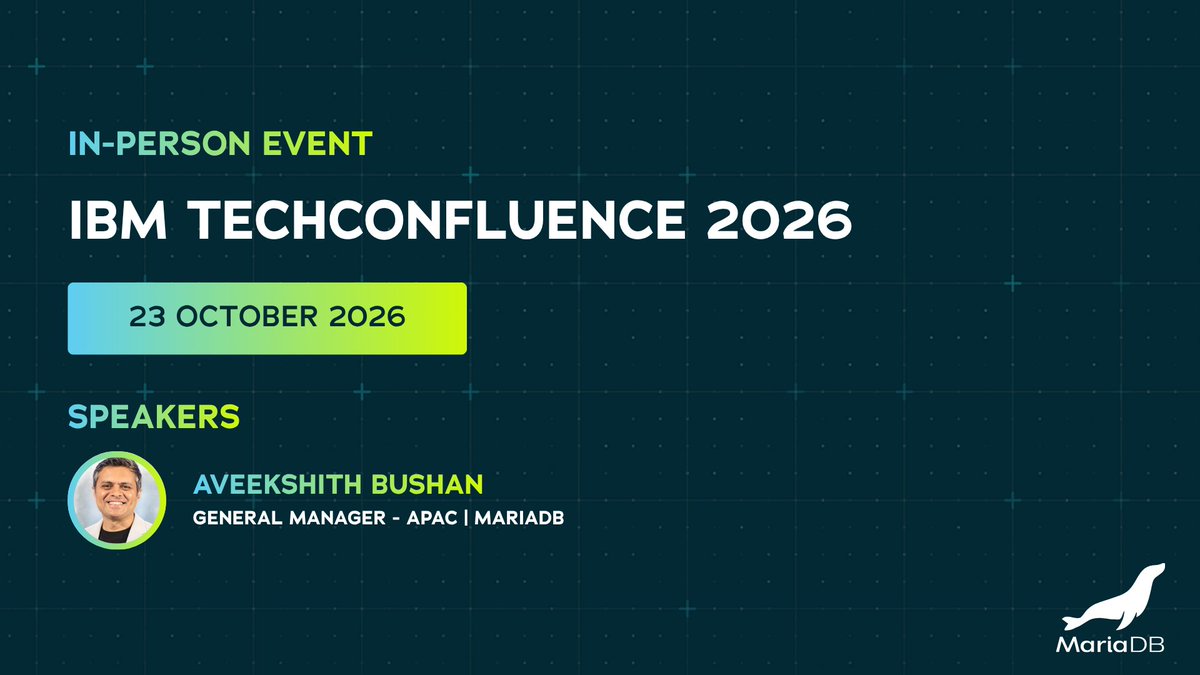
Save the date 📅 MariaDB is excited to attend @IBM TechConfluence 2026 with fellow IBM ecosystem players — including @tech_mahindra and @TCS.
Strong data foundations are critical to bringing enterprise AI to life at India’s scale, along with partners who can connect the pieces. At TechConfluence, MariaDB's Aveekshith Bushan will join a panel with Clarifai, in addition to speaking on the ISV Innovation panel.
We’re looking forward to exchanging ideas on AI, application modernisation and the data powering business-critical systems. If you’re building the next generation of enterprise applications in India, join us: https://t.co/WKhzrXjTai
The last version of MySQL Galera Cluster has shipped — so, make sure you have a plan to upgrade to the long-term supported version of MariaDB Galera Cluster.
We've released a few different options to aide your move, including a near zero downtime in-place migration. MariaDB's Max Mether lays it all out in our latest blog: https://t.co/OPE6onreVh
The MariaDB Migrator is now Generally Available — making it easier than ever to make the switch away from MySQL 🐬➡️🦭
The tool is available and free in standard MariaDB repos.
MariaDB's Manoj Vakeel shares the full rundown: https://t.co/rZRDdsnnuq
Mark your calendars — MariaDB is headed to the @sgfintechfest from November 18–20, 2026!
Data demands across the financial services sector are higher than ever. In an industry where downtime is simply not an option and strict data compliance is non-negotiable, resilient data infrastructure is critical.
Stop by Booth 4H07 in Hall 4 to see how our enterprise-grade database solutions support financial institutions navigating a fast-evolving digital landscape, and participate in interactive architecture reviews with our on-site technical experts. Topics on the table include powering mission-critical transactional workloads with high availability, cutting database total cost of ownership (TCO) and optimizing resources, migrating away from costly legacy databases to scale digital banking services, building cloud-native financial applications on a reliable foundation, and so much more.
Register here: https://t.co/yTa7h3Spiz
Porting PL/SQL out of Oracle just got easier with MariaDB Community Server 13.0!
A quick look at what's new:
➡️ TYPE .. IS REF CURSOR lands alongside SYS_REFCURSOR, so weak and strong-typed cursor variables declare the way they do in Oracle.
➡️ RECORD now works as a stored routine parameter and function return type, scoped to package routines and PACKAGE BODY for now.
Together, they cut the rework needed to port stored routines and procedural logic out of Oracle. Explore the full release with MariaDB's Ralf Gebhardt: https://t.co/5QDv56N84H