An Educator on August 26: Ten minutes. One decision. Nine hundred lives.
On August 26, a massive flash flood and landslide struck Gyirong Valley in the Himalayas, near the China–Nepal border, with almost no warning.
Just 10 minutes before the disaster, Rajendra Dawadi, the principal of a secondary school in Nepal’s Nuwakot district, received four urgent phone calls warning him that a devastating flood was approaching.
He did not hesitate. He immediately ordered the evacuation of all 900 students and staff, directing them to move to higher ground. He also stopped a school bus that was about to leave to pick up students and ordered the driver to turn around and move away from the danger zone.
Only minutes later, the school buildings and dormitories were swallowed by rushing water and debris.
But the 900 students and staff were already out of harm’s way.
This is a powerful reminder that being an educator is about far more than teaching knowledge. It requires judgment, courage, responsibility, and genuine care for the lives entrusted to you.
The true measure of an educator is not only what happens in the classroom, but what they are willing and able to do when it matters most.
@GorgeyRay Absolutely. Influence today extends far beyond teachers, entertainers, athletes, and the media all have the ability to shape how people think, what they value, and how they see the world.Those who have the power to shape others should never forget the weight of that power.
Why, in an old Chinese story, was a teacher sent to the 19th level of hell?
There is a traditional Chinese tale about a doctor whose poor medical skills caused the deaths of several patients. After he died, he was sent to the 18th level of hell.
He protested, cried, and complained that he had never intended to kill anyone.
One day, as he jumped and stomped his feet in frustration, he heard a voice from beneath him:
“Please stop jumping. You’re getting dust all over me!”
Shocked, the doctor asked,
“Is there actually a 19th level of hell?”
“Yes,” came the reply.
“What did you do?”
The answer was:
“I was a teacher.”
Traditional Chinese culture placed an extraordinarily high standard on the Way of the Teacher.
Because a doctor may harm the body, but a teacher can influence a person’s mind, character, values, and entire future.
🌱 To build virtue:
A teacher who guides a child toward what is right may change not only that child’s life, but also the future of a family—and everyone that child may influence in the years to come.
⚠️ To lose virtue:
A teacher who is careless, irresponsible, or misleads a child may leave consequences that last far beyond the classroom.
This is why teaching was traditionally seen as much more than a profession. That is an extraordinary privilege—and an even greater responsibility.
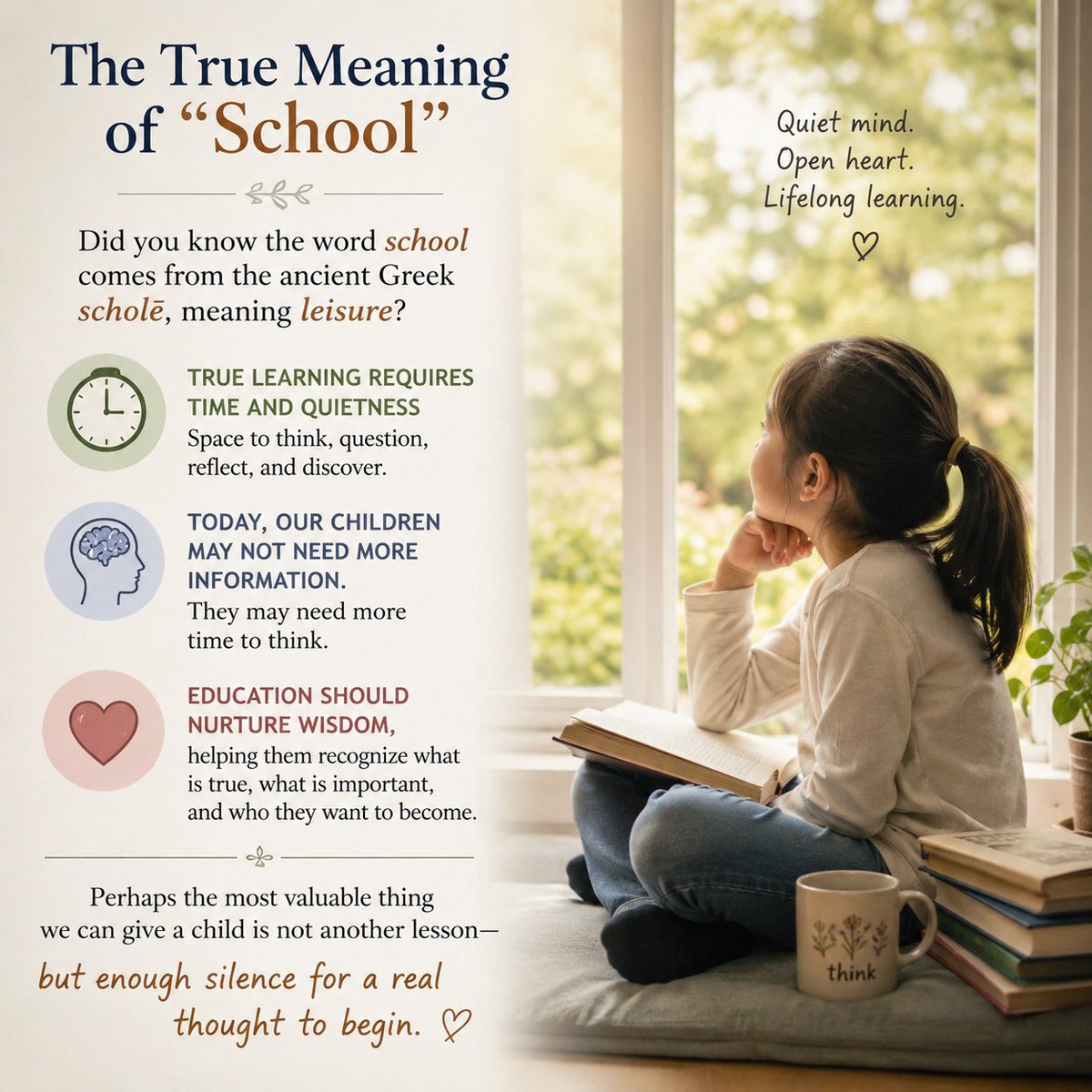
The True Meaning of “School” May Surprise You.
Did you know that the word “school” comes from the ancient Greek word scholē (σχολή)?
And its original meaning was: leisure. Isn’t that interesting?
Today, our children are constantly rushing—rushing to finish assignments, prepare for exams, attend activities, and keep up with everyone else.
But thousands of years ago, the ancient Greeks had a very different understanding of learning.
They believed that true learning requires leisure—not laziness or doing nothing, but having the freedom and quietness to observe, think, question, and reflect.
Because a mind that is constantly overwhelmed by information, driven by anxiety, and pushed from one goal to the next may not have much space left for genuine thought.
Today, our children certainly don't lack information:
📚 Tutoring
📝 Exams
📱 Smartphones
💻 Social media
🏆 Competition and achievement
Sometimes, the most important thing education can give a child is not another lesson—
but a little silence in which a real thought can begin.
The real question is not simply, “What is right and what is wrong?” The deeper question is: Who gets to decide—and by what standard?
Even educators, with the best intentions, are human. Could some of them sometimes be “seeing shadows,” mistaking something harmless for something dangerous?
What if education is not about filling the mind, but turning the soul toward the light?
As an educator, I believe education is about much more than academic achievement. It is about helping young people become kind, responsible, and self-reflective individuals.
Plato described humanity as prisoners watching shadows and mistaking them for reality. True education is the “turning around” of the soul—away from fleeting shadows and toward the light of the sun, the source of the Truth and the Good.
In today’s world, those shadows can take the form of endless screens, distractions, and superficial information.