2026 ESC Guidelines for the management of cardiovascular disease and chronic kidney disease, in collaboration with the European Renal Association (ERA) https://t.co/XMgOzZX1hy
🚨 First ESC guideline dedicated to CVD + CKD at #ESCCongress.
The key message:
CKD should actively change cardiovascular management, not simply appear on the problem list.
New STAMP on CKD framework:
Screen
Triage
Address CKD risk
Modify CVD management
Plan care
Major practical points:
🔹 Screen ALL patients with CVD using eGFR + albuminuria
🔹 SBP target 120-129 mmHg if tolerated when eGFR ≥30
🔹 ACEI/ARB + SGLT2i for most appropriate CKD patients
🔹 SGLT2i can be initiated at eGFR ≥20
🔹 Finerenone and GLP-1RA gain important roles in diabetic CKD
🔹 HF + CKD: SGLT2i irrespective of LVEF, with more aggressive decongestion when diuretic resistance develops
🔹 And an important clinical reminder:
Kidney disease should not unnecessarily delay cardiovascular investigation or intervention.
Treat the cardiorenal patient as one physiology, not two separate organs.
@escardio@ERAkidney@ESC_Journals@willkidney@kevin_damman
#CKD #Cardiorenal #HeartFailure
Onco-nephrologists, actually all nephrologists, should read Dr. Paul Sanders' state of the art review on Multiple myeloma-related kidney disease. It is fantastic and very educational. https://t.co/vvNXM1QIpT
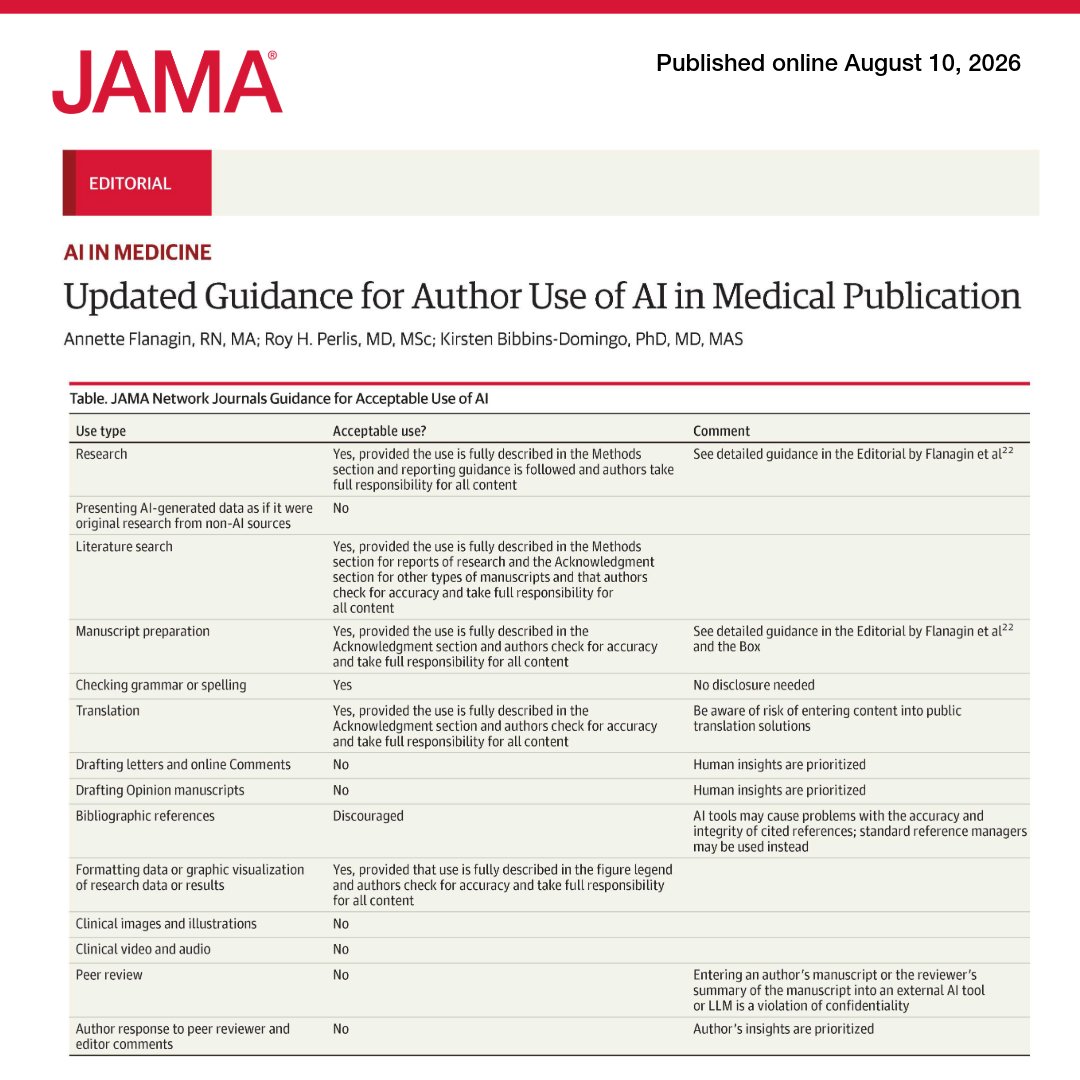
💬 Editorial by JAMA Executive Managing Editor Annette Flanagin, RN, MA, @JAMAplusAI Editor in Chief, Roy Perlis, MD, MSc, JAMA and JAMA Network Editor in Chief Kirsten Bibbins-Domingo, PhD, MD, MAS:
Updated JAMA Network guidance on use of #AI in medical publication permits some uses by authors with disclosure, including manuscript preparation, translation, literature search, and research reporting, while reaffirming that authors are responsible for the accuracy and integrity of all submitted content.
The guidance does not permit use of #AI to draft Opinion manuscripts, Letters to the Editor, or online Comments.
🔗 Read the editorial: https://t.co/czL1M68xE3
Stop the hype on anti-aging treatments such as NAD+ and peptides. Get the evidence.
Editorial at Nature Medicine
https://t.co/kaz1ibnxaK https://t.co/DweectVgvO
🔎 Check out the new joint ERA and ESC Cardio-Kidney Collection
💡This collection of scientific articles, curated as a joint effort by the ERA and the ESC @escardio, sheds light on the critical importance of addressing the intertwined nature of cardiovascular, kidney, and metabolic disorders.
Discover more 👉https://t.co/7Ft7IlrFJk
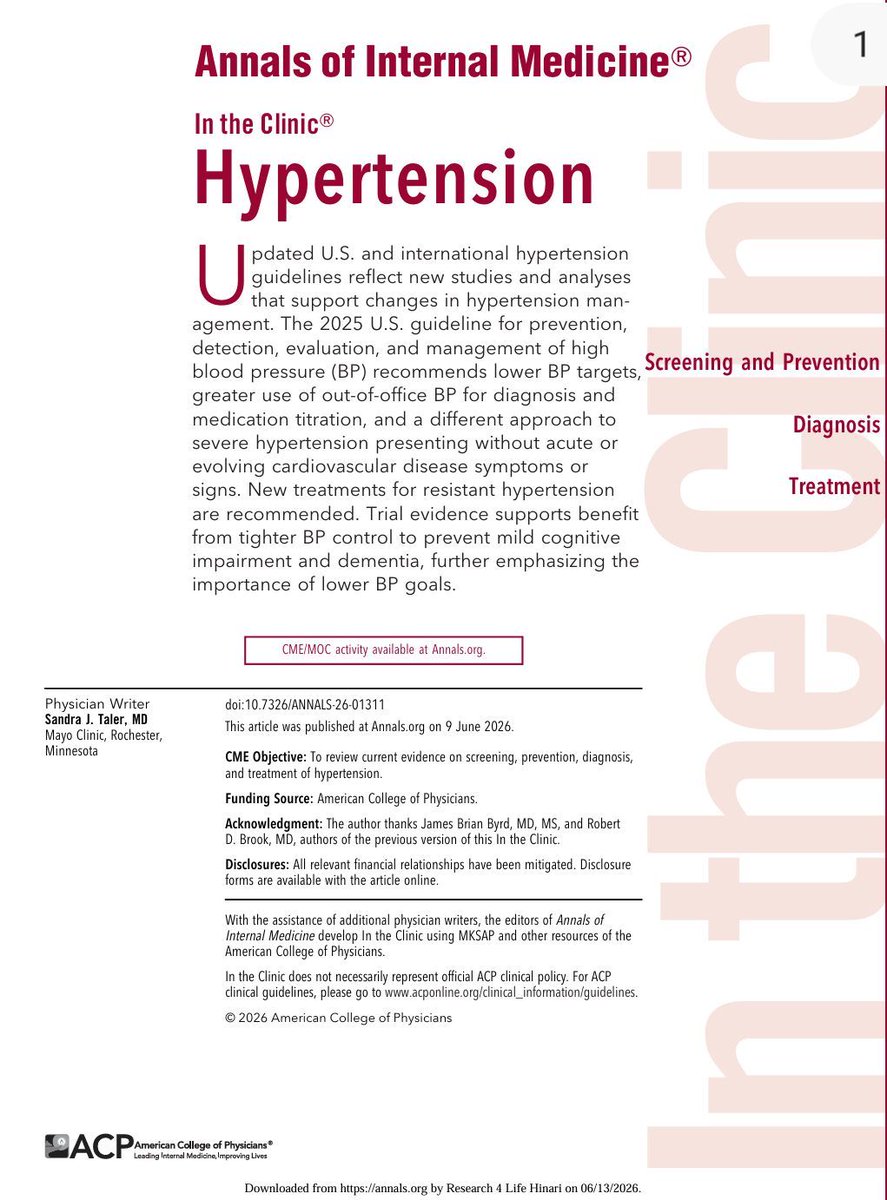
🫀Hypertension in 2026: Five practice changing updates every clinician should know
Hypertension remains the leading modifiable risk factor for cardiovascular disease worldwide, yet recent evidence suggests that many patients continue to be undertreated.
The updated Annals of Internal Medicine "In the Clinic" review summarizes the most important changes introduced by the 2025 AHA/ACC guideline and highlights how hypertension management is evolving.
The first major change is that blood pressure should no longer be judged solely in the clinic.
Out of office blood pressure monitoring is now strongly recommended not only to confirm the diagnosis, but also to detect white coat hypertension, masked hypertension and guide treatment titration. Ambulatory blood pressure monitoring remains the reference standard whenever available.
The second message is that lower targets matter.
For most patients, the recommended goal remains below 130/80 mmHg, with increasing evidence supporting systolic pressures below 120 mmHg in selected high cardiovascular risk patients when tolerated. Recent trials demonstrated reductions in major cardiovascular events without a significant increase in serious complications.
Third, lifestyle interventions continue to be the foundation of therapy.
Weight reduction, dietary sodium restriction, the DASH diet, regular exercise and potassium enriched salt substitutes remain among the most effective nonpharmacological interventions. Emerging evidence also supports meditation and yoga as useful adjunctive therapies for selected patients.
Fourth, treatment should become increasingly individualized.
The guideline incorporates overall cardiovascular risk into treatment decisions using the new PREVENT risk calculator instead of relying exclusively on blood pressure values. This approach better identifies patients who derive the greatest benefit from earlier pharmacological therapy.
Finally, resistant hypertension is no longer a therapeutic dead end.
Mineralocorticoid receptor antagonists remain central to treatment, while newer agents such as aprocitentan, a dual endothelin receptor antagonist, expand therapeutic options for carefully selected patients with resistant hypertension.
The most important lesson is simple.
Hypertension management is moving away from isolated office measurements toward precision cardiovascular prevention, integrating accurate blood pressure assessment, global cardiovascular risk, intensive lifestyle intervention and individualized pharmacotherapy.
Better blood pressure control is not simply about preventing myocardial infarction or stroke.
It is increasingly recognized as an investment in preserving kidney function, preventing heart failure and reducing cognitive decline throughout life.
Reference 📚
Taler SJ. In the Clinic: Hypertension. Annals of Internal Medicine. Published June 9, 2026. DOI: 10.7326/ANNALS-26-01311.