556 - Los dotfiles, ese pozo sin fondo
Los dotfiles, ese pozo sin fondo. Un recurso para #neovim con decenas de #dotfiles y como gestionar tu configuración de forma eficaz en #linux y en otros sistemas operativos.
A este epis...
https://t.co/GdgphQdyML
I'd rather invest $1000 on some people who can use it than wasting it on ads, so here we go!
🔥 Magnific giveaway 🔥
I'm giving away 25 Magnific 🪄 accounts with 2500 tokens to 25 random persons who:
1/ Follow @Magnific_AI
2/ Repost this.
3/ Boorkmark this.
Good luck! 🤞🍀
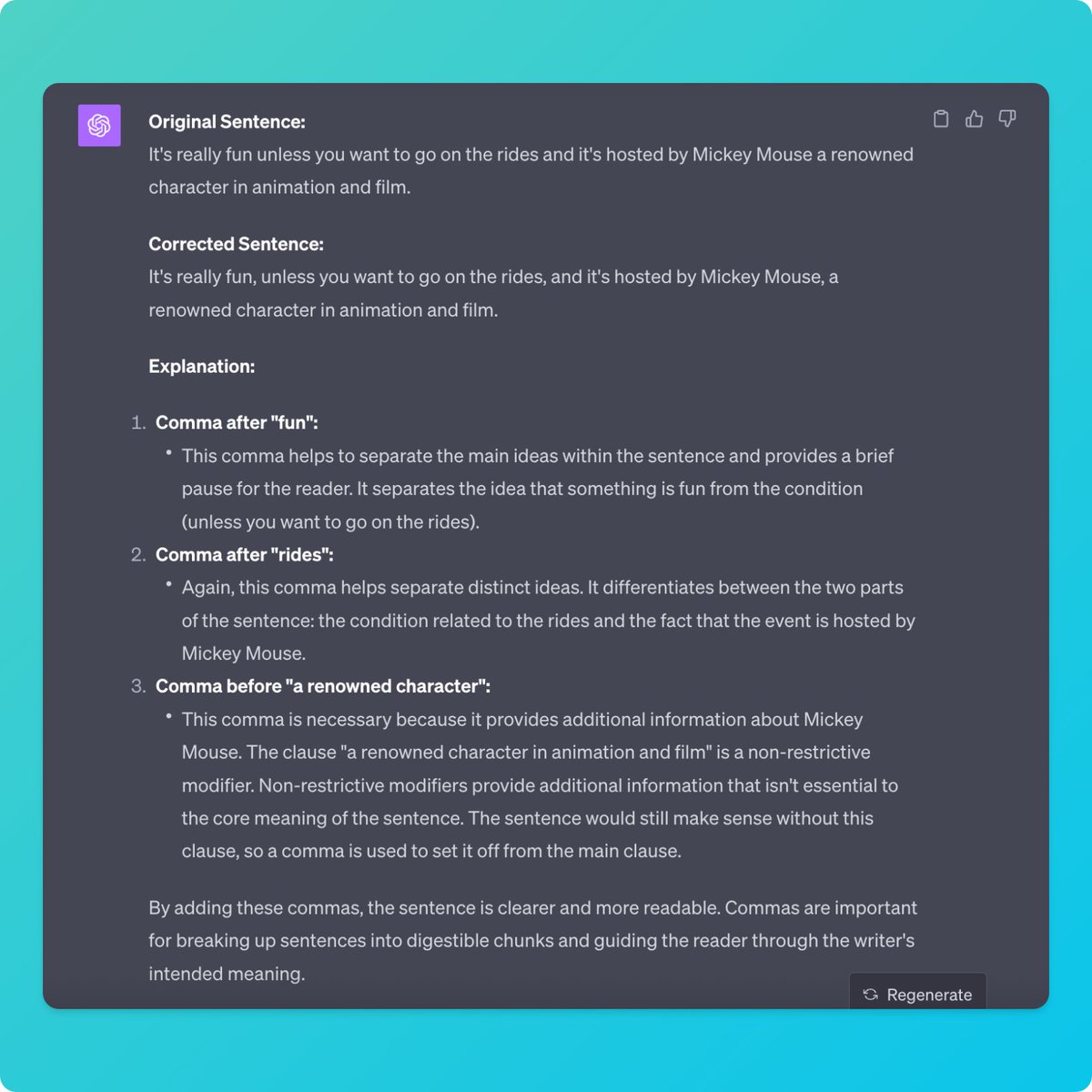
Quick hack to learn from writing mistakes:
➤ Use Grammarly to fix your mistakes
➤ Ask ChatGPT for detailed grammar feedback
This will help you understand the why behind corrections.
Works every time.
(Prompt in the first comment)
¡Estamos de vuelta! Es domingo por la mañana y ya tenéis la edición 42 de WAI en vuestro correo.
Viene a reventar de historias, así que espero que encontréis algo que os interese 😉.
https://t.co/tkKpnvybzR
Can GPT-4 teach a robot hand to do pen spinning tricks better than you do?
I'm excited to announce Eureka, an open-ended agent that designs reward functions for robot dexterity at super-human level. It’s like Voyager in the space of a physics simulator API!
Eureka bridges the gap between high-level reasoning (coding) and low-level motor control. It is a “hybrid-gradient architecture”: a black box, inference-only LLM instructs a white box, learnable neural network. The outer loop runs GPT-4 to refine the reward function (gradient-free), while the inner loop runs reinforcement learning to train a robot controller (gradient-based).
We are able to scale up Eureka thanks to IsaacGym, a GPU-accelerated physics simulator that speeds up reality by 1000x. On a benchmark suite of 29 tasks across 10 robots, Eureka rewards outperform expert human-written ones on 83% of the tasks by 52% improvement margin on average. We are surprised that Eureka is able to learn pen spinning tricks, which are very difficult even for CGI artists to animate frame by frame!
Eureka also enables a new form of in-context RLHF, which is able to incorporate a human operator’s feedback in natural language to steer and align the reward functions. It can serve as a powerful co-pilot for robot engineers to design sophisticated motor behaviors.
As usual, we open-source everything! Welcome you all to check out our video gallery and try the codebase today: https://t.co/BHiNmqPoWE
Paper: https://t.co/bdh9TYQtHm
Code: https://t.co/lqKiaM2yYJ
Deep dive with me: 🧵
RL community should be in awe and shock from Eureka paper🫨. The idea here is that you feed the source code of environment to GPT-4 and ask it to write code for the reward function itself! Then you evaluate this reward function in simulation and provide your evaluation results back to GPT-4 so it can make improvements to the reward function!! You do this over and over and RL eventually ends up achieving super human results in lots of different challenges, all without human intervention!!!
I don’t know if folks still remember but companies with AGI ambitions were used to be all about RL just few years ago. But then something happened on the way and RL was relegated to just being a little cherry on the cake. It seems LLMs were the missing puzzle piece all along. If you had been listening carefully, you can almost hear that thundering sound of come back :).
The overall approach of generator synthesizing r_i, critic providing feedback f_i and then generator synthesizing r_i+1 is very reminiscent of actor-critic feedback loop at meta level. This already has so much foundational theory in place but rather underutilized in current setting. LLM instances themselves can be the world model, the agent and the critic while RL a mechanism that jointly improves all of them iteratively. The proverbial positive feedback loop of self-improvement might be just around the corner that allows us to go beyond human training data and capabilities.
AI transcribing 1 hour of audio in less than 30 seconds!
Think about that!
That's lightning-fast, especially when it can do that with very few mistakes.
The team @DeepgramAI released their new Nova 2 model. It's another leap forward:
• 36% more accurate than OpenAI Whisper
• 5-40x faster than every other alternative
• 30% fewer errors than the competitors in real-time transcriptions
I like to travel and can't wait for headphones with integrated live transcription and translation. We are getting close!
By the way, this is the cheapest transcription service out in the market now (if you discount Whisper, which is open-source.) It costs $0.0043 to transcribe a minute of audio.
When you sign up to access their API, you get $200 of credit for free, which will let you transcribe around 45,000 minutes of audio!
Here is the link: https://t.co/QeG2NueaZi
I wanted to record a quick video showing their live transcription in Spanish and English. You can see it attached here.
This post was sponsored by @DeepgramAI.
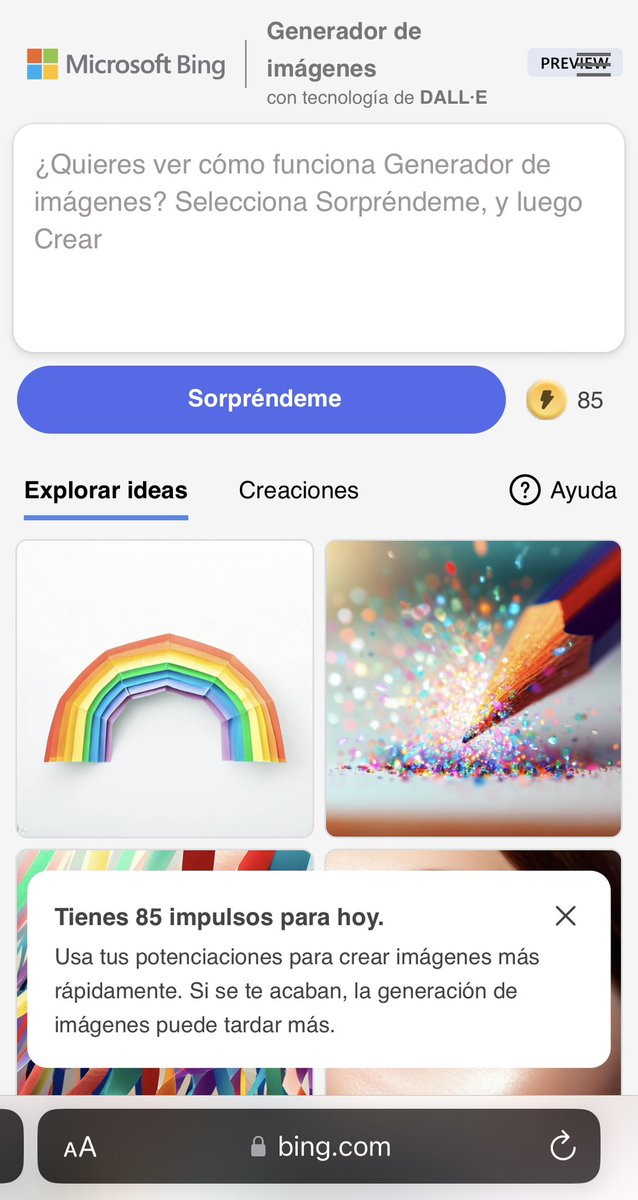
Aparte de en el chat de Bing, se puede usar Dall-E 3 aquí también 👇
https://t.co/SvJxsyfs6N
Por si queréis ir directos a generar sin chat de por medio.
Ojo cuidado que parece que hay 100 generaciones o “impulsos” por cuenta. No sé si se recargan ni cada cuanto 🤷🏻♂️.
Most people haven’t really changed the way they prompt ChatGPT in months.
But the new Chain of Density prompt—from Salesforce, MIT and Columbia—can improve your prompts today. It fixes GPT output that feels “meh”.
Let’s unpack why it’s much more than just a great prompt 👇
¿Os pensabais que os ibais a librar de la edición dominguera de WAI? Pues no señor.
Ya está en vuestro mail, esperando a que despertéis de la siesta 😉.
¡Espero que os guste!
https://t.co/HnD43SZEBg
Cursor + gpt4-32k = illegal levels of productivity
Best coding copilot by far
Made the switch and i'm likely never going to use ChatGPT or vscode again
Crazy how big of a difference small ux changes can make (in line code editing, no copy pasting, i can reference files)