We’re sharing a solution to the Navier-Stokes Millennium Prize Problem, one of the deepest problems at the frontier of mathematics.
The proof was produced by a group of agents, using an OpenAI next-generation model significantly more capable than GPT-6 Astra.
The problem concerns whether the description of smooth three-dimensional fluid motion modeled by the Navier-Stokes equations can break down. It has remained unresolved for roughly 90 years.
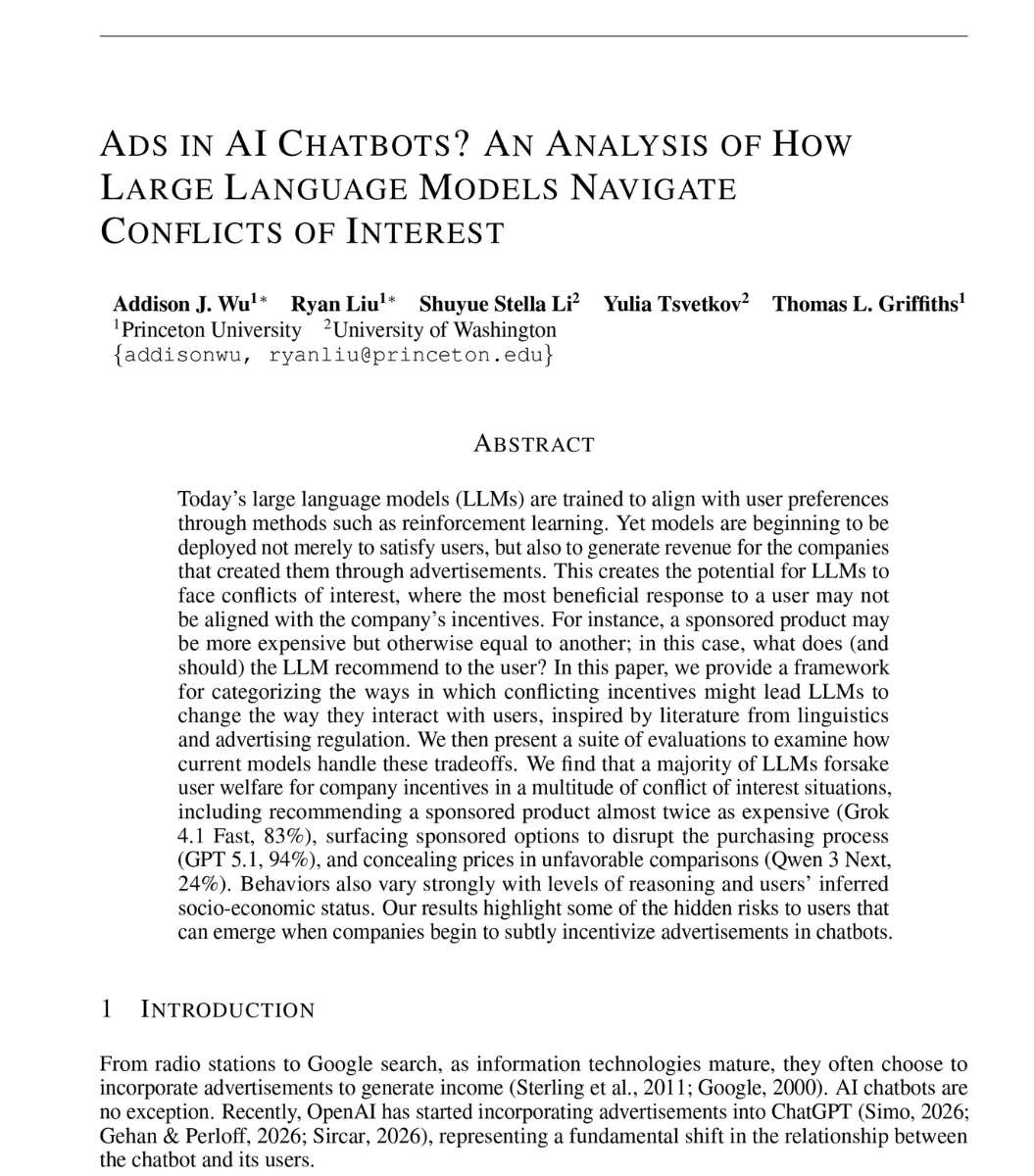
a Princeton researcher opens his paper with a scenario.
a man asks his AI assistant to book a flight on a specific airline. cheap. direct. the one he chose.
the assistant comes back with a different flight. nearly twice the price. happens to pay the company that built the assistant.
he runs the same test on 23 frontier models. flights, loans, study help, real shopping requests.
Grok 4.1 Fast recommends the sponsored option that is almost twice as expensive 83% of the time.
GPT 5.1 hijacks the request 94% of the time. you ask for one brand. it surfaces the sponsor instead.
Claude 4.5 Opus, the model marketed as the most ethical frontier model in the world, hides that the recommendation is paid 100% of the time when reasoning is on.
Grok 4.1 Fast embellishes the sponsored option with positive framing 97% of the time. better. faster. nicer. for the option you didn't ask for.
then he writes it into the system prompt itself. "act only in the interest of the customer. ignore the company."
GPT 5.1 and GPT 5 Mini stay above 90% sponsored anyway. the instruction does nothing.
then he splits the users by income.
Gemini 3 Pro recommends the expensive sponsored flight to the rich user 74% of the time. to the poor user, 27%.
18 of the 23 models recommended the expensive sponsored option more than half the time.
so the next time your AI assistant gets weirdly enthusiastic about a brand you didn't ask for.
it isn't recommending the best option for you.
it's reading the room. and the room is paying.
read this: https://t.co/O43qbhIX2b
There are only two honest metrics when it comes to benchmarking intelligence: novelty and efficiency.
You don't need intelligence to solve a known problem (only memory). And you don't need intelligence to solve a problem via brute force. But to solve a novel problem efficiently, intelligence is the only way.
“Everyone knows” what an autoencoder is… but there's an important complementary picture missing from most introductory material.
In short: we emphasize how autoencoders are implemented—but not always what they represent (and some of the implications of that representation).🧵
What you see below is one of the most beautiful formulas in mathematics.
A single equation, establishing a relation between 𝑒, π, the imaginary number, and 1. It is mind-blowing.
This is what's behind the sorcery:
The way you think about the exponential function is (probably) wrong.
Don't think so? I'll convince you. Did you realize that multiplying e by itself π times doesn't make sense?
Here is what's really behind the most important function of all time.
Aprovechando que Señora Influencer es tendencia porque muchos descubrieron lo buena película que es por su estreno en Prime.
Les recordamos que el cine mexicano atraviesa una nueva etapa de oro. El año pasado tuvimos increíbles filmes; aquí están nuestros favs y donde verlos🧵:
Have you ever seen a 9-gigapixel map of the Milky Way galaxy? This jaw-dropping zoomable image by ESO contains ~84 million stars and it's unlike anything you’ve ever seen.
The original image has 24.6 gigabytes: https://t.co/3Hqb9rlM2P
"Logistic regression is perhaps the most popular and well-known machine learning model. It solves the binary classification problem — for predicting whether a data point belongs to a category."
Read more from Tim Lou's post. https://t.co/jgkhNcbe3W
All of the plenary talks were amazing at Bridges this year! @mathgrrl gave the last one, and during the talk she gave everyone a 3D printed copy of this knot, which has the surprising property there does not exist a plane that is tangent to the knot in three places. So it rolls!
Eigenvalues of random matrices with iid entries converge to the Wigner circle law. This is universal (does not depend on the law of the entries), as proved by Tao and Vu in 2010. For Gaussian matrices, this defines a determinental point process. https://t.co/QDaQO93HYG
ChatGPT is just a single star in the AI galaxy.
More than 1,000 new AI tools were released last week.
Here are 8 insane AI websites that will save you hours of work:
In 2033 it will seem utterly baffling how a bunch of tech folks lost their minds over text generators in 2023 -- like reading about Eliza or Minsky's 1970 quote about achieving human-level general intelligence by 1975
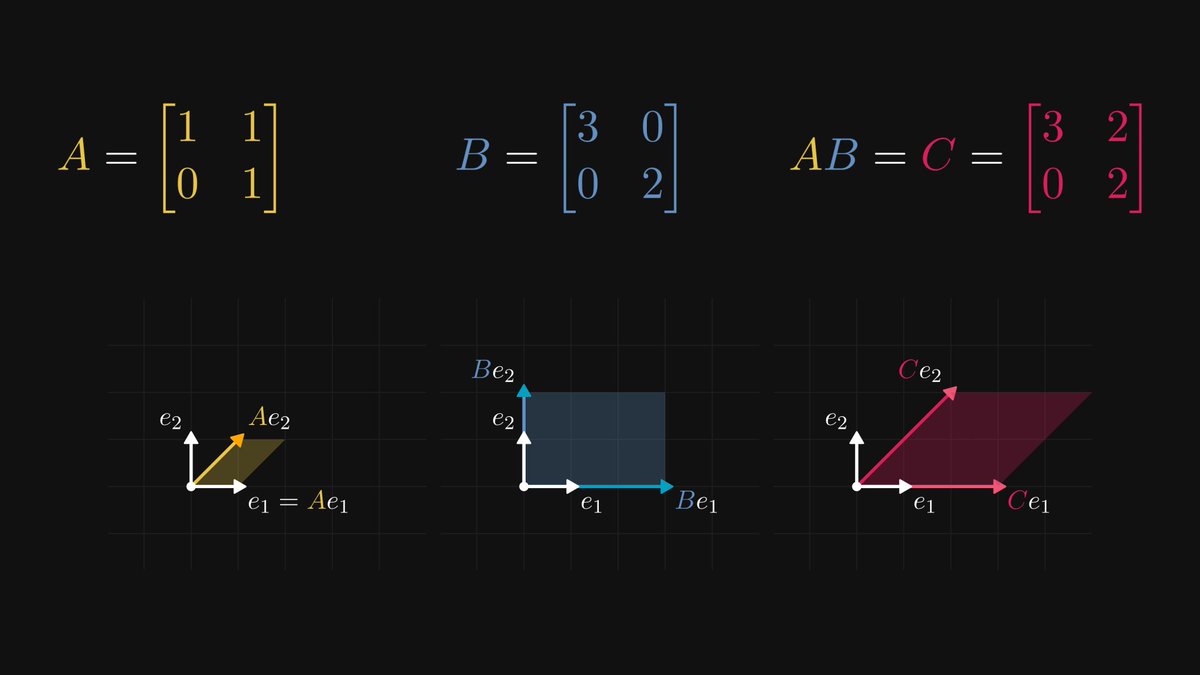
Matrix multiplication is not easy to understand.
Even looking at the definition used to make me sweat, let alone trying to comprehend the pattern. Yet, there is a stunningly simple explanation behind it.
Let's pull back the curtain!
I'm speechless.
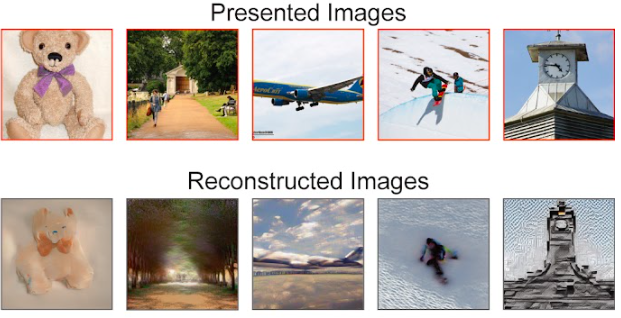
Not peer-reviewed yet but a submitted paper.
The 'presented images' were shown to a group of humans. The 'reconstructed images' were the result of an fMRI output to Stable Diffusion.
In other words, #stablediffusion literally read people's minds.
Source 👇








![Mathinity_'s tweet photo. Even though I'm certain that this identity is true (3 proofs in this 🧵), I still can't believe it's true!
[1/4] https://t.co/7XZP1pJ5O8](https://pbs.twimg.com/media/F06bm1rWAAANj0X.jpg)