The FED’s Only Crypto Exchange Is Buying 15% Of One Altcoin
The only crypto exchange the Federal Reserve let inside just bet its whole strategy on one altcoin.
Everything we break down lives inside the community, link in bio, one dollar a month.
Kraken is the first and only crypto native company in history to hold a Federal Reserve master account. That is direct access to the core payment system that moves money between every major bank in America, a door that was only open to traditional banks for 100 years. So when a company wired straight into the Fed makes a move, you pay attention.
Here is the move. Kraken is in talks to buy 15 percent of Aave, the largest DeFi lending protocol in crypto, at a 385 million dollar valuation. The most fed connected player in the game is buying a piece of one specific coin. The question is why.
Kraken already put more than 100 real stocks on chain through tokenized equities, with hundreds more coming. The SEC is clearing the path with its Project Crypto initiative, letting apps list tokenized securities directly and punching a hole in a 233 year old Wall Street monopoly. Picture it: you buy stocks on chain, then borrow against them instantly through DeFi, and the protocol built to do that at scale right now is Aave.
So this is the bet. Stocks move on chain, and the lending that powers all of it runs through one coin. That is why Kraken is buying the coin before the rest of the world catches up.
What it means for your money: this is what the start of institutional altcoin buying actually looks like. The most connected players position quietly, before it is obvious. The only real question is whether you see it before everyone else and act on it.
Follow for the moves the news skips.
🚨CLARITY ACT CONFIRMED!
🇺🇸 Senator Lummis says: “We think we’ve got it together with the White House, and I am so grateful!”
History is being made in 2026.
11 Crypto Companies Became Banks In 83 Days
Crypto companies didn't just get regulated. They quietly became the banks.
Did you even hear about this, or did it slip right past you?
For almost five years, exactly one crypto company was allowed to be a bank. Anchorage got a national trust charter from the OCC back in 2021 and then sat there alone.
Then on December 12, the OCC approved five more in a single day. Circle, Ripple, Paxos, BitGo, and Fidelity Digital Assets. Circle filed under the legal name First National Digital Currency Bank.
Zoom out and it is bigger than five. Eleven companies filed for or received this charter in 83 days. Circle, Ripple, BitGo, Paxos, Fidelity, https://t.co/o2oJM0XUtH, Morgan Stanley, and even the stablecoin arm Stripe bought. The dollars of the internet, USDC, PYUSD, and RLUSD, are now sitting under federal bank charters.
To be fair, these are trust charters. They cannot take your checking deposits or hand out loans yet. But the door to the banking system is open right now.
What it means for your money: the rails your money will run on are being built today, while most people look away. The early movers in a shift this size are usually the ones who profit from it. Learn how this plumbing works, watch the quiet filings instead of the loud headlines, and position before it is obvious to everyone.
Everything we break down lives inside the community, link in bio, one dollar a month.
Follow for the moves the news skips.
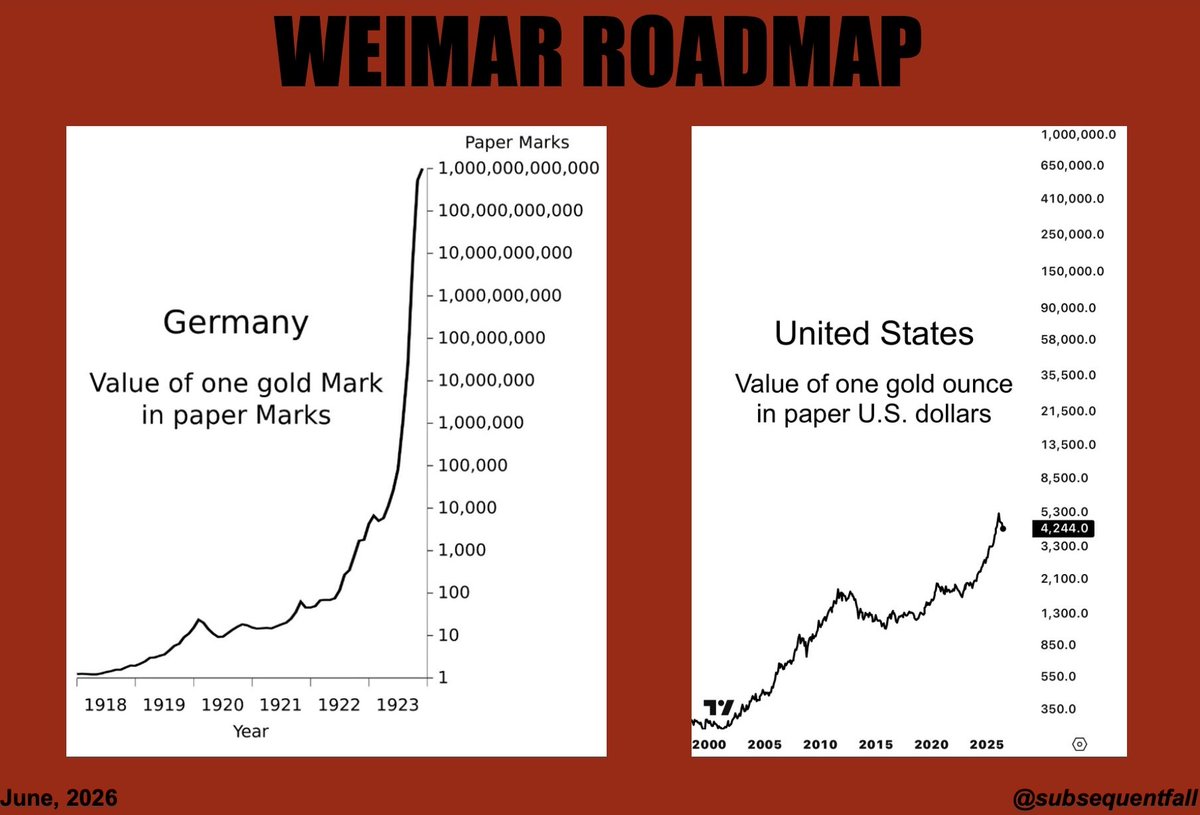
Gold is in a 45-year parabolic slingshot-move.
Posted on the blue breakout in linked post.
Target is $15 000 - $20 000 since many years back, and might raise it further.
Now in a much needed consolidation/pullback, which could last longer than many thinks. #joinus
Silver...Were you mentally prepared at peak fomo? Had you accepted that a test of $55-$57 was highly likely? Do you know what's likely next? This is the chart I put out as we were approaching $121, and anticipating a drop of 50% or more. Few listened back then.
JPMORGAN WALKED INTO RIPPLE’S OFFICE
AND TRIED TO BUY THE ENTIRE ESCROW.
2017. They wanted to control the supply.
Ripple said no, and that's why the programmatic monthly release exists today.
If the XRP sits in escrow, the banks can't touch it. It's a move most people in this space have never heard.
Save this for the next person who tells you Ripple is captured by the banks.
We left globalism behind.
There is a race for physical resources. They do not want speculators competing for the same things they need. Think about that for a moment.
Even the US Gov't is building a strategic stockpile of critical minerals which silver has now joined.
Looks like the Chinese authorities are in a hurry to get the public involved in gold. It's ironic that the supposedly "evil CCP" is telling their constituents to buy gold to protect their savings. In the West they want you to buy worthless gov't promises or bonds.
On September 15, 2008, Lehman Brothers filed for bankruptcy, and you were told this was the moment the system "let one fail." A noble act of discipline. Tough love from Washington. Lehman failed because Hank Paulson, a former Goldman Sachs CEO, had personal and political reasons to draw the line at that particular firm on that particular weekend.
Look at what happened on either side of Lehman. Bear Stearns got a $29 billion backstop in March so JPMorgan could swallow it. AIG got $85 billion the day after Lehman died, then billions more, because AIG owed money to the right people (Goldman collected $12.9 billion through the AIG bailout, at par). Fannie and Freddie got nationalized on September 7. Then came the $700 billion TARP, the alphabet soup of Fed lending facilities, and trillions in emergency liquidity. Lehman was not the rule. Lehman was the exception that let everyone pretend a rule existed.
This is what discretionary central planning actually looks like. Not a market clearing bad bets, but a handful of men in a conference room deciding who lives and who dies based on relationships, optics, and the phone calls they took that night. Free market economists have warned about this for a century: once you build a lender of last resort, you do not get neutral rules. You get favoritism dressed as crisis management. The Fed picks winners. Always has.
The real scandal is that Lehman was the single institution forced to obey the law of consequences while everyone around it got a printed-money parachute. Failure is the only honest feedback a market gives. Bad firms holding worthless paper should die, and their creditors should eat the loss. That is how capital gets reallocated to people who do not set fire to it.
The next time someone tells you 2008 proved capitalism needs adult supervision, ask them why the adults rescued every reckless gambler except the one whose CEO Paulson happened to dislike. You will not get a coherent answer. You will get a lecture about systemic risk from the people who built the system.
If you don't hold real gold and silver outside the financial system the financial oligarchy, of which Bessent and Trump are beholden to, will continue to fleece your savings just like the oligarchy has been doing since 1914.
If you’re buying silver as a long-term investor, as you should, you shouldn’t worry about corrections, even as big as the one we’ve seen since January. Why? Because you understand dollar cost averaging and so you simply keep on buying regularly, knowing that your purchases at higher prices average out against those at lower prices. Price is not the primary object gathering up as many ounces as possible is your aim. You want ounces, not dollars.
The Crypto War Is Officially Over, the Government Just Quietly Cleared These 16 Coins
The crypto war just quietly ended and almost nobody reported it.
Did your coin make the list of 16?
On March 17, 2026 the SEC and the CFTC signed a 68 page joint interpretation. For the first time, the two agencies that spent years fighting crypto agreed on the rules instead of just suing people.
They named 16 coins as digital commodities. That means they are officially off the SEC's hit list and clear from securities regulation: Bitcoin, Ethereum, Solana, XRP, Cardano, Avalanche, Chainlink, Polkadot, Hedera, Stellar, Litecoin, Dogecoin, Shiba Inu, Tezos, Bitcoin Cash, and Aptos.
They even got specific that staking, mining, and airdrops are not securities on these chains. The exact things that used to put regular people at risk.
One thing to understand: this is not law yet, it is an interpretation. That is exactly why the CLARITY Act matters and why it is moving through Congress right now.
The door is open. Now you have to walk through it. Do your homework and get after it.
Follow so you catch the next move before the headlines do.
In 2019 I sat in a closed meeting in London that I will never forget. It was held in a private consultation room at the Bank of England’s Threadneedle Street complex. Present were senior representatives from Barclays, Santander, Deutsche Bank, BNP Paribas, and a policy advisor from the ECB’s Directorate General for Market Infrastructure. Ripple’s institutional strategy team was also in attendance.
The discussion focused on the future of euro liquidity, settlement fragmentation, and the long term viability of cross border clearing within Europe. A confidential briefing pack circulated during the session outlined a proposed framework that, at the time, was considered highly strategic. The document stated that Ripple intended to introduce a euro backed stablecoin designed to operate as a programmable settlement instrument within the European financial system.
The proposed model did not resemble retail stablecoins. It was positioned as an institutional utility, fully collateralised, with mandatory visibility for central bank supervisory functions. The idea was simple yet transformative. Create a euro denominated digital settlement asset that could interact directly with the XRP Ledger and achieve near instant cross border finality across the SEPA network.
Deutsche Bank’s treasury team examined the liquidity compression benefits. Barclays evaluated the impact on intraday funding and collateral cycles. BNP Paribas highlighted how this instrument could reduce their dependency on nostro positions across central European corridors. The ECB representative focused on interoperability with TIPS, TARGET2, and future wholesale digital currency frameworks.
The economic modelling was extraordinary. Reduced counterparty exposure. Reduced capital drag. Near zero operational float. Real time reconciliation across correspondent flows. A unified settlement layer for both institutional and commercial transactions.
The final remark from the ECB advisor has stayed with me ever since. If a euro backed digital instrument achieves compliance alignment and harmonises with supervisory architecture, it becomes the de facto European standard by default. Not by mandate but by efficiency.
That meeting was a rare moment of clarity. Europe understood the direction of travel long before the public did. Ripple understood it as well.
For fifty years the economic establishment has told you that deflation is a disease. Falling prices, they warn, freeze spending, crush wages, spiral the economy into a tomb. Then there's Switzerland, which has spent decades doing the forbidden thing and somehow refuses to die.
The Swiss franc bought you roughly 0.23 dollars in 1970. Today it buys you about 1.20. The currency appreciated against the dollar by a factor of five while Swiss living standards rose to among the highest on earth. Consumer prices in Switzerland have repeatedly turned negative: 2015, 2016, 2020. Each time the Keynesian commentariat predicted catastrophe. Each time the Swiss kept buying watches, building tunnels through the Alps, and running a current account surplus that would envy any German.
Here's what a strong currency actually does to you. Your savings grow without you lifting a finger. The chocolate bar that cost five francs holds its value or gets cheaper as Lindt's productivity improves. You are not robbed in your sleep by a central bank printing your purchasing power into the pockets of the politically connected. A Swiss worker who stuffs francs under the mattress is rewarded for thrift, the oldest bourgeois virtue, the one Washington and Frankfurt have spent a century punishing.
Free market thinkers explained this generations ago. Prices fall because production rises. When a factory makes more shoes per hour, shoes get cheaper. This is not a malfunction. This is the entire point of an economy. The "deflationary spiral" the IMF dreads requires people to indefinitely postpone eating, heating, and clothing themselves in anticipation of a 0.8 percent price drop. Humans don't do this. The Swiss certainly don't.
So when the European Central Bank tells you it must hit two percent inflation forever to keep you employed, understand what it is confessing. It needs your money to lose value because its entire model depends on debtors outrunning savers, on stimulus over thrift, on the quiet transfer running underneath the floorboards. The Swiss declined the offer. Their reward sits in every vault in Zurich, getting heavier while everyone else's gets lighter.
Dr. Marc Faber just confirmed what many of us have known for years:
We’re already in the monetary reset.
Gold is being reinstated as Tier 1 collateral inside the banking system, while new blockchain infrastructure rises for a multi-polar world.
https://t.co/a42MbvSClo
It was great to sit down with @beyond_broke and have a thoughtful discussion covering digital assets, the macro environment, and the monetary transition that's reshaping the global financial system.
We're living through one of the most important periods in modern financial history, one filled with both significant challenges and extraordinary opportunities. We covered all of it in our conversation.
https://t.co/9yEsOOkqJI