@Elijah_reddoor@TheKouk This could drag on until the presidential election, demonstrations and all. French bond yields will keep grinding higher and the market will keep the pressure on. Grinding, not a crisis.
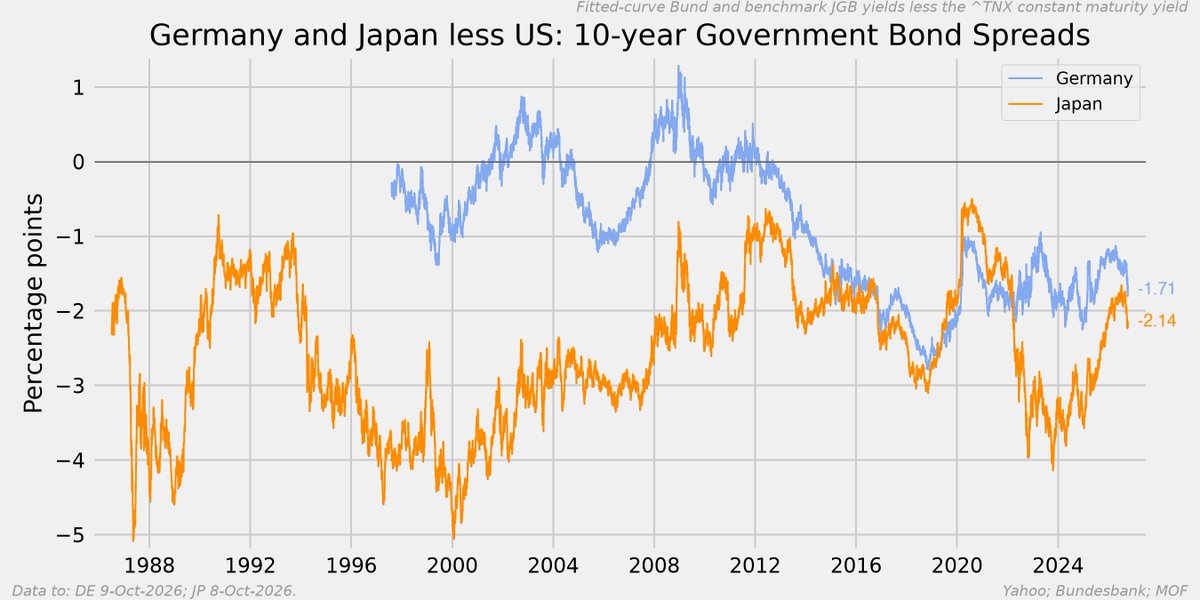
Why are bond yields so high?
1. This is global, not American. Ten-year yields are around 5.2% in the US, 5.4% in Australia and 5.5% in the UK. Germany has gone from negative to 3.5%. Japan from zero to above 3%.
2. Capital markets are global and interconnected. The price of capital is set internationally, with local adjustments on top.
3. The starting point was artificially low, thanks in large part to QE, the GFC and COVID.
4. The first leg was simple. In 2021-22, inflation came back and central banks tightened.
5. Then the AI gold rush. Roughly US$466 billion of AI-related debt was issued in the first nine months of 2026, and bonds are only part of the financing. That is a large new claim on the world’s saving (on top of ever more hungry governments).
6. Global uncertainty is also rising, particularly with the war in Iran and doubts over future supplies of crude and middle distillates.
7. There is also an American story, of ever-growing debt and deficits, sitting on top of the global one.
So part of the rise in yields may simply be a return towards normal. The odd thing is that we came to treat the yields of the 2010s as natural.
https://t.co/caxLf7rIfG
The government doesn’t have the numbers to do or say much at the moment. It’s a minority government trying to pass a €54bn adjustment through a fractured Assembly, with a presidential election next year and every opposition party playing to that. A 3% pledge it can’t legislate would hurt its credibility, not help it.
That’s really the whole story. The problem is political, not solvency. The market is applying the pressure the Assembly won’t.
The ECB doesn’t need to say anything. France is already in the EU’s naughty corner under the excessive deficit procedure, and that already complicates any ECB help. What more is there to say?
Daily dwelling prices from @cotality_au
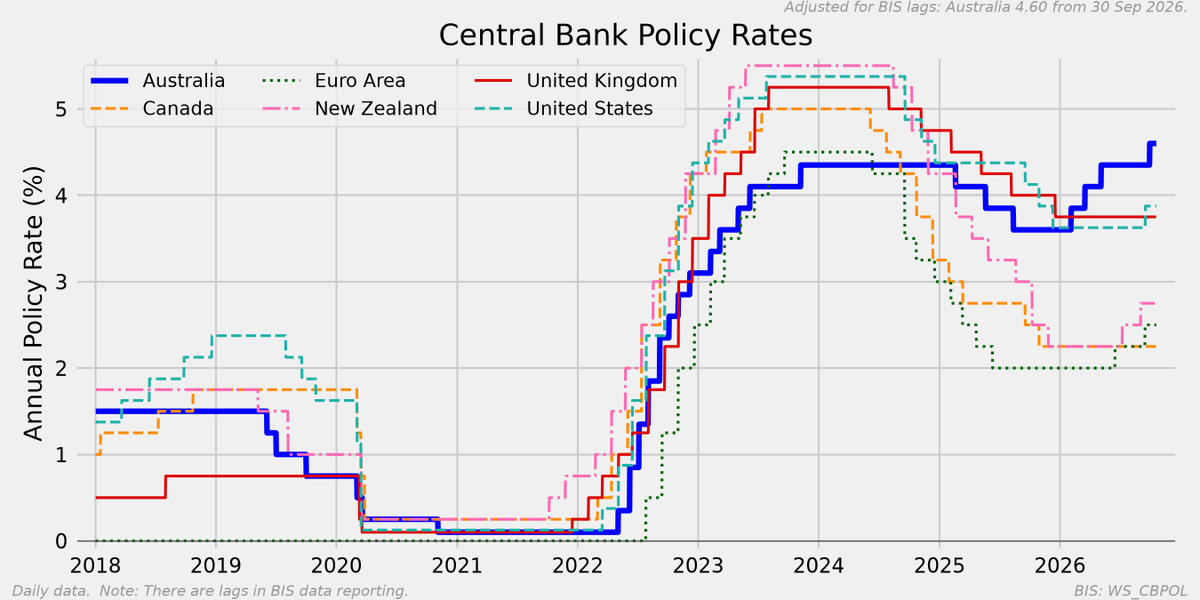
This will not stop that RBA from raising rates in November. And it shouldn't.
If the inflation outlook is "materially worse" then a material policy response is warranted and a lone 25bp hike in September isn't enough.
I don’t think France is any closer to default than it was a week ago. The riots are a political issue, not a solvency event.
France needs to adjust. It will be painful, and many people will be angry. The spread is the market telling Paris it has to follow through, and the price of delay is rising.
Even if Tuesday’s budget vote fails, it is not a crisis. France has rolled over a failed budget before. It would mean a wider spread, probably a downgrade, and another round of pressure to deliver. That is the market doing its job, not a country running out of road.
Nor should France expect the ECB to ride to the rescue. That would reward bad practice and set a precedent. The pressure has to come from the market, and it is. That’s not a crisis. It’s the system working.
Why did the RBA take the narrow path, and why is it now talking tough?
A balancing clause that treats jobs as a short-run trade-off against inflation. Two definitions of full employment. And a NAIRU estimate in the low 4s that was always wishful.
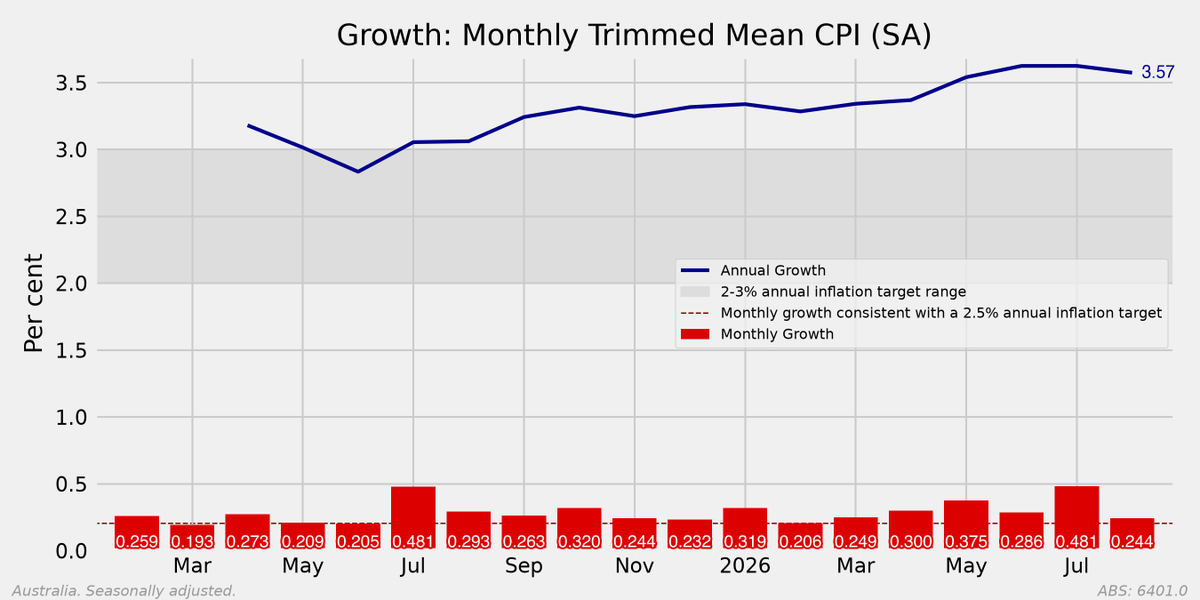
Three errors, all pointing the same way. Trimmed mean inflation persistent at 3.6 per cent is the bill.
https://t.co/KIgf5t14As
Trend productivity growth is hard to pin down after COVID, so look point to point: productivity has gone almost nowhere since 2015. On that record, target-consistent wage growth is about 2.5%. WPI at 3.25 is running well ahead of it, and so are unit labour costs. That’s showing up in trimmed mean at 3.6.
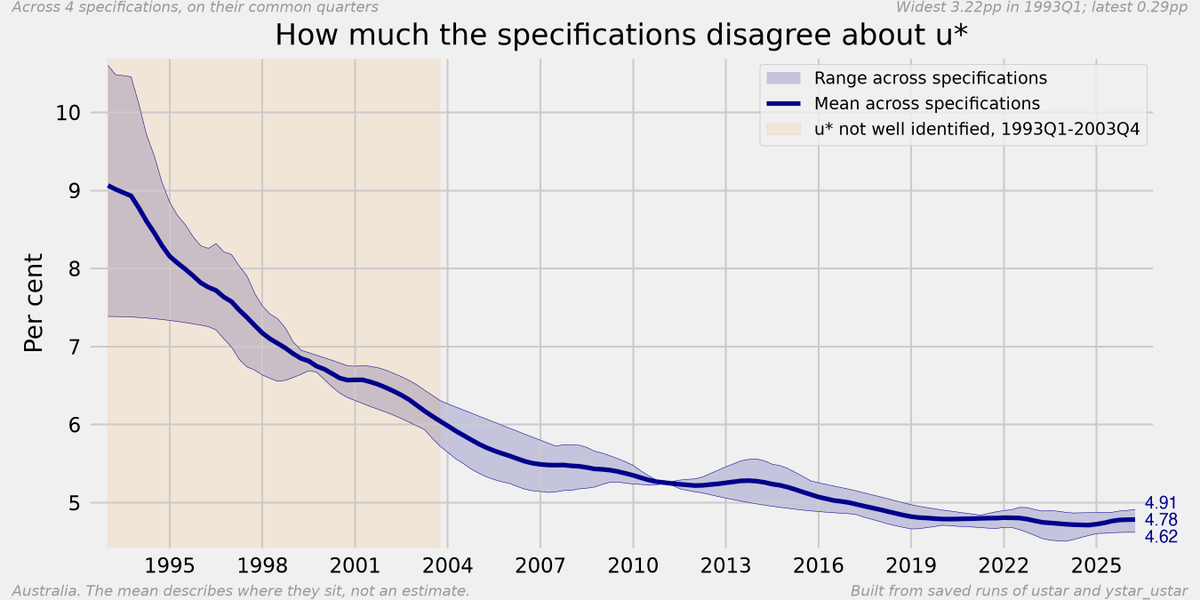
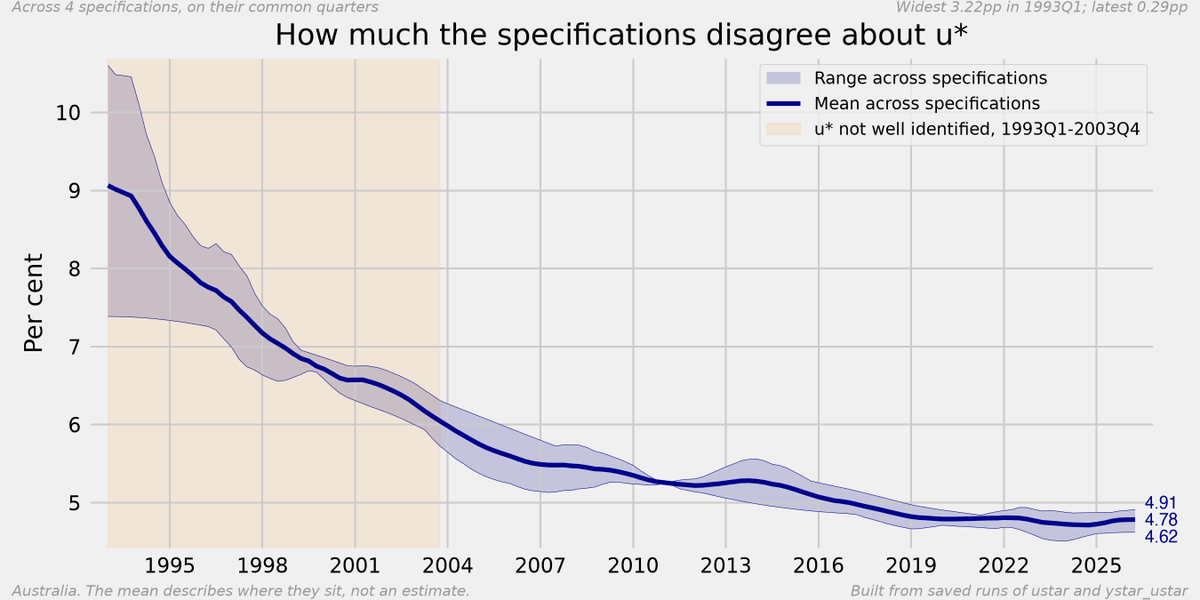
Here's some evidence. Two models, four specifications, all fitted to Australian wage and price data. Every one puts u* well above 4.25: between 4.6 and 4.9 at the June quarter 2026, where the chart ends. They're not independent, since they share the same data, but none comes close to 4.25.
The chart also shows unemployment below every estimate from 2021 onward, by more than a point at the 2022 low. That matches the inflation record. Unemployment sat around or below 4.25 for most of the past four years, and trimmed mean dipped into the band only briefly in 2025 before climbing back to 3.6, driven by domestic and services inflation. If u* were below 4.25, inflation should have settled at target with unemployment there. It hasn't.
u* is uncertain. But zero evidence is a stretch.
Agree the NAIRU is the benchmark, and we both called estimates in the low 4s wishful at the time. I’m not arguing for strict inflation targeting either. The board should diagnose what’s driving inflation and respond accordingly. Full employment, properly defined as the NAIRU, is the goal. Price stability is how you achieve and sustain it. Where I differ is on treating jobs as a short-run trade-off against inflation. That’s what the current balancing clause invites, and it’s how Australian inflation stayed above target for so long (ignoring government subsidy fiddles at the edges).
And the government pushed hard for that "balanced" reading. In 2024 the Treasurer said rate rises had smashed the economy and framed the goal as fighting inflation without smashing growth. Bullock held the line that year, warning entrenched inflation would cost jobs later. But the pressure, the balancing clause and a wishful NAIRU estimate all pointed the same way.
True, full employment has been in the Act since 1959. What changed is its weight. Under inflation targeting, price stability came first, as the way to deliver jobs over time. Since 2023, employment has sat on an equal footing, to be traded off against inflation in the short run. Same words in the Act, very different instructions to the bank.
And the inflation-first approach worked for jobs. Once the bank got on top of inflation in the 1990s, u* fell substantially, settling around 5 to 6 per cent by the late 2000s. Low, stable inflation is what let unemployment fall and stay down. Equal weighting puts that at risk to protect jobs in the short run.
Even the Fed accepts monetary policy can't set long-run employment. In practice, getting inflation right is how it serves the jobs side too.
Agreed, the 2–3% target hasn’t changed. What changed is how hard the RBA pushes toward it when unemployment is rising. A dual mandate builds in a short-run conflict: every step toward the inflation target costs jobs, and the jobs leg tells the bank to ease off. Equal weighting means the bank splits the difference. That’s the narrow path. The destination stayed the same. The slow speed of travel was set by the mandate.
The mandate was built to fix a 2016–19 problem, when policy was too tight. More recently policy has been too loose, and the mandate is part of the problem, not the solution.
It’s a big part of why Australia still had an inflation problem before the Iran war. And it’s why the RBA will now need to push unemployment above its sustainable rate to finish the job.
Good question. The government sets the framework, and the RBA sets the cash rate within it. The 2–3% target sits in an agreement signed by the Treasurer and the Governor. After the 2023 RBA Review, that framework was rewritten to put full employment alongside price stability as an objective of equal standing.
No one told the bank to hold rates down. But when jobs and inflation are weighted equally, the natural instinct is to go gently and try to keep both. That’s where the “narrow path” came from. My point is that the trade-off only lasts in the short run, so weighting jobs equally leads the bank to tolerate inflation for too long, and that ends up costing jobs anyway.
Independence covers the instrument, not the objective. The government set the objective, and it got it wrong. The jobs-inflation trade-off only exists in the short run, but the short run is where an equal mandate does its damage. It invites the bank to compromise: go slow, protect jobs, look for a narrow path, let inflation sit a little high. Then expectations drift, and the only way back is a recession. The jobs you protected at the start are the jobs you lose at the end. That’s a misaligned objective, and the government hog-tied the bank to it.
@cmkusher the government is more committed to reducing unemployment than it is to reducing inflation. it is happy to run stimulatory fiscal policy when the times call for restraint.
Independence covers the instrument, not the objective. The government set the objective, and it got it wrong. The jobs-inflation trade-off only exists in the short run, but the short run is where an equal mandate does its damage. It invites the bank to compromise: go slow, protect jobs, look for a narrow path, let inflation sit a little high. Then expectations drift, and the only way back is a recession. The jobs you protected at the start are the jobs you lose at the end. That’s a misaligned objective, and the government hog-tied the bank to it.