@DrDunnart Also, several long nosed potoroos were cached (almost certainly by foxes but can’t confirm 100%) after fire in the Carlisle. Hopefully will have this published soon!
@DrDunnart Good timing - had to find some references on this myself yesterday!
Foxes: Macdonald (1979), Jeselnik and Brisbin (1980), and vanPolanen Petel et al (2001) are good places to start.
Not aware of any feral cat papers, but other felids can cache (e.g pumas, Allen et al 2023)
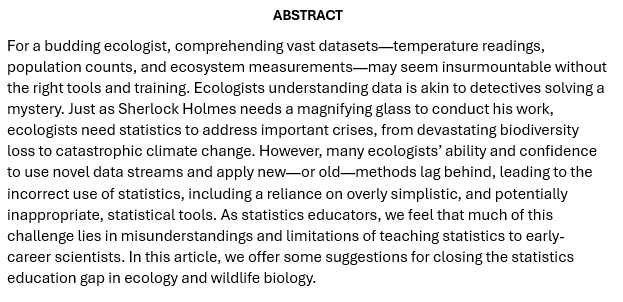
Here are some thoughts on teaching #statistics to non-statistical students, specifically those in #applied#ecology degrees. Thanks to @willpkay and @TiagoALOMarques for an enjoyable (and not last) collaboration.
request pdf here 👉https://t.co/7oDAM68DJG
📢 New publication! AWMS member Bronwyn Hradsky and Jack Pascoe and their colleagues have recently published a paper examining survival and site fidelity in the long-nosed potoroo after a prescribed fire in south-eastern Australia. Read the paper: https://t.co/1hPYRwautp
Our new research based on over 2 years of painstaking work creating detailed fire history information from satellite imagery shows the positive impact of indigenous fire management in the Kimberley.
Congratulations to our student award winners!
Adolph Bolliger Award: Mark Le Pla (accepted on his behalf by his partner!)
John Seebeck Travel Award: Tenaya Duncan @Talk2tt182
A. G. Lyne Award: Stephanie Stylli
#AusMammSoc24
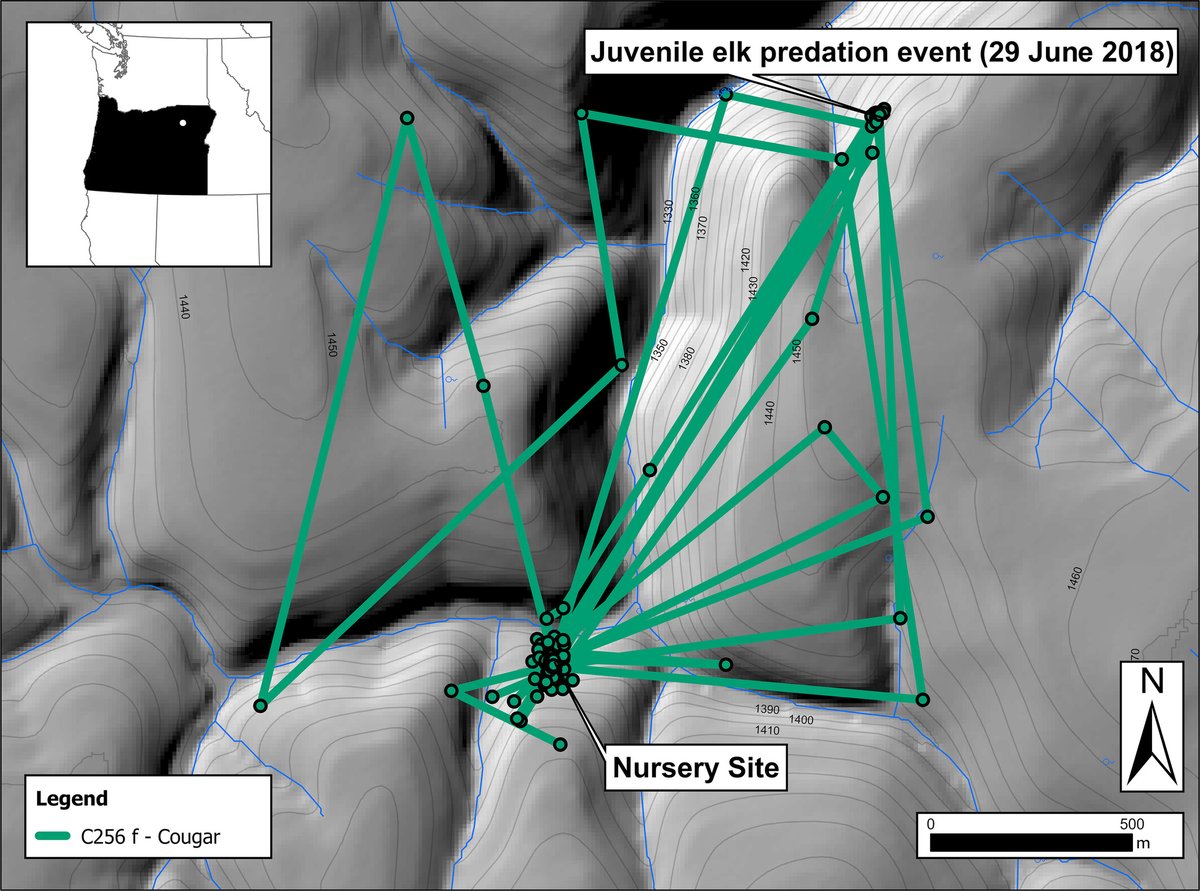
Let me tell you a story about 3 black bears and 2 cougars in a new natural history paper by MS student and amazing naturalist Marcus Bianco. Cougar C256 gave brith on June 14 at a nursery site. She killed an elk on June 29. A 129 kg male bear U2 arrives/1
https://t.co/dIcWcg04jW
Pest managers, no matter what stage of your career, please remember to focus on impacts first. Every program measured primarily on ‘No.
of baits delivered, no. of traps set, no. of dead animals or no. of shooting hours’ is fundamentally on the wrong track.
I really love conservation dogs. But there is a lot of variation in their performance. It's often unclear where that variation comes from - pubs don't include enough details. @CarMFin, Beth McKeague, and Nicola Rooney tackle this in a FABULOUS new pub.
https://t.co/mvKho9rTAM
Required reading for those that work in the sphere of fire and ecology in Australia.
Lighting a pathway: Our obligation to culture and Country - Pascoe - 2023 - Ecological Management & Restoration - Wiley Online Library https://t.co/5IeZEGpukw
Statistical #PowerAnalysis currently dominates #ExperimentalDesign. In this Essay, @itchyshin &co argue that we should move away from the current focus on power analysis and instead encourage smaller scale studies & collaborative projects #PLOSBiology https://t.co/ATYUwPYRFc
One of our field teams just had to stop to euthanise a #wallaby someone else had hit and left to die slowly, in freezing temps, by the side of the road.
Some animal lovers do kill animals, they’re just not always happy about it.
What should happen to native forests when logging ends? Ask Victoria's First Peoples
“First Nations voices must be heard”
Couldn’t agree more 👊 https://t.co/gx7kQtDuZw
@PLTaggart Not sand/track counts specifically but we assessed fox activity via a scat based index and then estimated density via genotyping in the Otway Ranges - the index wasn’t as reliable as one would hope 🤔 (https://t.co/oBkpHn8W1R)
🔥Hot off the press🔥
The first chapter of my Masters thesis is now published in @CSIROPublishing’s Wildlife Research!
We found that scavenging of carcasses in the Australian Alps was highly seasonal, and interestingly, was dominated by brushtail possums https://t.co/BO4UZW1ros
Huge congratulations to @SCBOceania#ESASCBO2022 student award winners Callan Alexander @QUT (best poster) and Mark Le Pla @UniMelb (best presentation)! 🥳🥳
Huge congratulations to @SCBOceania#ESASCBO2022 student award winners Callan Alexander @QUT (best poster) and Mark Le Pla @UniMelb (best presentation)! 🥳🥳