Ludwig von Mises sat down in 1920 and published a paper that ended the intellectual case for socialism, even if the socialists took another seven decades to notice.
The argument was precise. Mises showed that without private ownership of the means of production, there are no real prices for capital goods. Without prices, you cannot calculate profit and loss. Without profit and loss, economic planners have no way of knowing whether they are creating value or destroying it. They are flying blind, spending real resources with no feedback mechanism telling them whether the factory, the railway, or the grain depot was worth building. Every allocation becomes a guess dressed up as a decree.
This, he called the Socialist Calculation Problem, and nobody answered it. Oskar Lange tried in 1936, proposing that socialist planners could simulate prices by trial and error. Mises read this and was unimpressed (charitably put). Lange assumed you could reproduce the function of market prices without the institution that generates them: private property, genuine exchange, real skin in the game. You cannot fake the signal and expect accurate information.
The Soviet Union spent seventy years proving Mises right. Chronic shortages, misallocated steel, surplus winter boots in Georgia in July, famine engineered by committees convinced they understood grain supply better than the price system. The USSR collapsed in 1991 under the weight of precisely the inefficiencies Mises predicted in Vienna in 1920.
You are watching this play out again today, every time a government sets energy prices, rent ceilings, or pharmaceutical price caps, and then expresses shock at the resulting shortages. The calculation problem did not expire with the Soviet Union. Bureaucrats who override price signals recreate the same blindness Mises identified. Mises told you exactly what would happen.
CS Lewis on why “dumb blue collar people” usually do not fall for the same terrible ideas that the “educated elite class” so often does:
“Why, you fool, it’s the educated readers who can be gulled. All our difficulty comes with the others. When did you meet a workman who believes the papers? He takes it for granted that they’re all propaganda and skips the leading articles. He buys his paper for the football results and the little paragraphs about girls falling out of windows and corpses found in Mayfair flats. He is our problem: we have to recondition him. But the educated public, the people who read the highbrow weeklies, don’t need reconditioning. They’re all right already. They’ll believe anything.”
– CS Lewis, That Hideous Strength
… Or Romans 1: “Claiming to be wise, they became fools.”
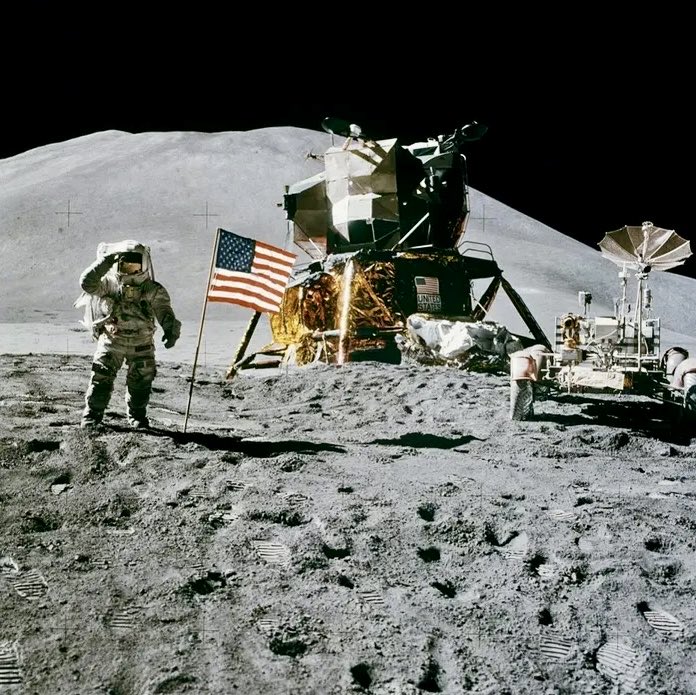
The Moon Landing
Yes, some people think it was faked. The cameras, the studio, the flag that moved in a vacuum. The Soviet Union, which had every reason to expose a fraud, confirmed it was real. Moving on. Because the conspiracy theory is not the interesting thing about the moon landing. What happened after it is.
1. On July 20, 1969, two human beings stood on the surface of another world. They had left Earth four days earlier on a rocket with less computing power than a modern dishwasher, navigated 384,000 kilometers of space, landed on a surface nobody had ever touched, and came back. The engineering precision required was so extreme that an error of 0.1 degrees at launch would have missed the moon entirely. They didn’t miss. This is what the West was capable of when it still believed in itself.
2. "We choose to go to the moon not because it is easy, but because it is hard."
The most anti-Last Man statement in modern political speech. The deliberate choice of difficulty as a civilizational value. The acknowledgment that the purpose of a civilization is not comfort but reaching. Aristotle’s eudaimonia applied to an entire nation: not the pursuit of happiness but the pursuit of excellence, because that is what human beings are for.
3. We went six times. Then we stopped. Not because we couldn’t continue – the technology existed, the knowledge existed, the infrastructure existed. Because the will evaporated. The most extraordinary achievement in human history was followed by fifty years of not trying to repeat it. The last man walked on the moon in 1972. Nobody has been back. The civilization that did the impossible decided, within three years, that the impossible was sufficient and returned to the possible.
4. The moon landing was a Cold War project – the response to Sputnik, the demonstration that the free world’s system produced better results than the command economy. Which means it required an enemy to motivate it. The moment the Cold War ended, the motivation evaporated. The deepest lesson of 1969: the West needed the competition to reach. Without it, comfort proved sufficient. A civilization without a frontier stops reaching. The Fall of Rome, with better television.
5. Tocqueville predicted this in 1835. The great danger of democratic equality is not poverty or tyranny – it is the slow retreat into private pleasures, the withdrawal from civic ambition, the replacement of the great collective project with the management of individual comfort. The moon landing was the last great collective civilizational project the West attempted. The energy that produced it fragmented afterward. 1969 is the hinge. Everything after trends downward in civilizational ambition.
6. Every child who watched understood, without being told, that human beings were capable of something extraordinary. That the ceiling was higher than anyone had said. The moon landing was shown in schools for a generation as the answer to the question: what are human beings capable of? The question is no longer asked. No child watching Western screens today receives that message – they receive the opposite: that the world is ending, that the future is dangerous, that having children is irresponsible. The moon landing was a formation event. Its absence forms a generation that believes less is possible – because nobody showed them otherwise.
7. The only person currently attempting to restore the civilizational ambition of 1969 is a South African immigrant building rockets in Texas, being told by the same bureaucratic apparatus that stopped going to the moon that his timelines are unrealistic. The moon landing was a state project. Mars will be a private one. This is itself the civilizational statement: the state that once reached for the moon now regulates the man trying to reach for Mars. The civilization that put men on the moon in 1969 is spending 2026 arguing about who should have gone. Something happened between then and now.
The Fall of Rome explains what.
Reminder to go touch grass
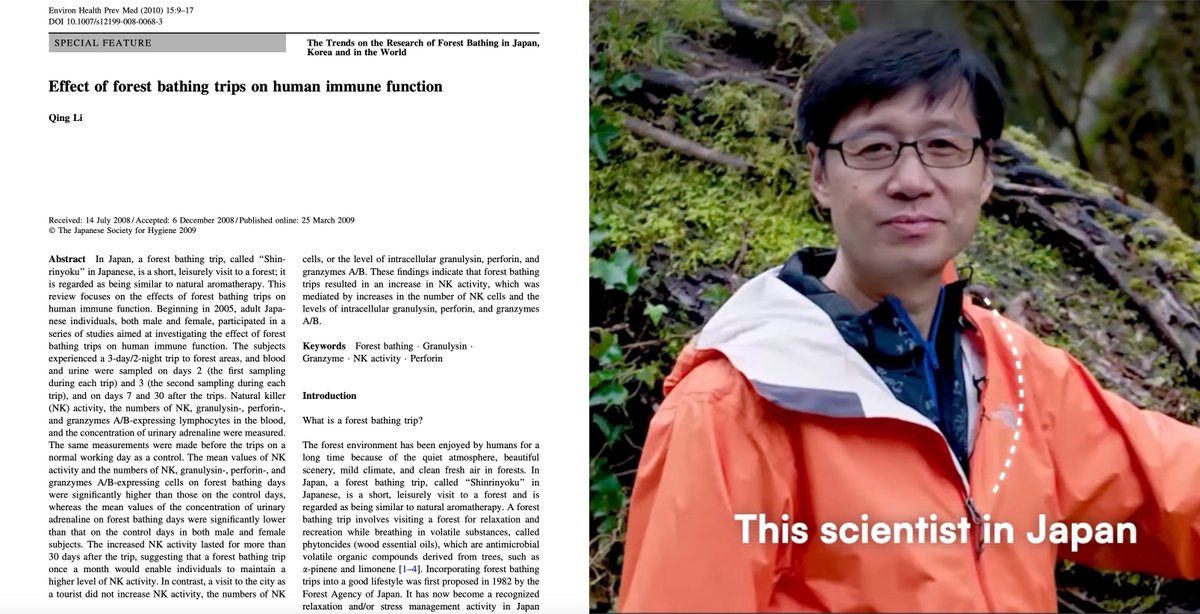
A scientist in Japan demonstrated that the air inside a forest strengthens your immune system for a full month
The study is incredibly fascinating:
Qing Li, an immunologist at Nippon Medical School in Tokyo, took 12 men on a 3-day forest trip. These were slow walks with no breathing exercises and no set route.
Then he tested their blood and found a surge in natural killer cells -- the immune cells your body uses to fight cancer and virus-infected cells.
Remarkably, the effect didn't fade when they went home, it was still measurable 30 days later.
A control group that walked the same distance through a city showed no change at all.
Pine, cedar, and cypress trees release compounds called phytoncides to defend themselves from insects and bacteria. You breathe them in, and Li believes they switch your immune cells into high gear.
He estimates one forest walk a month may be enough to keep those cells elevated all year.
The best medicine might not even need a prescription -- just a walk among the trees.
July 2020. Steps of the Supreme Court. America’s Frontline Doctors stood in white coats and told the American people the truth the regime did not want spoken:
COVID was treatable.
Early treatment worked.
Nobody needed to die.
Lockdowns were never necessary.
We were censored within hours. Facebook, Twitter, YouTube erased the video. Careers were destroyed. Doctors were threatened. Patients were denied the medicine that could have saved them.
They called us dangerous.
They were the danger.
History has already rendered its verdict. We were right. They lied. And the people paid the price in lives, liberty, and lost years.
Watch it. Share it. Bookmark it.
Never let them memory-hole what they did.
The truth was never the threat.
Their power was.
For those that still don’t understand what Benghazi was all about:
🚨So here's the REAL story:
Ambassador Stevens was sent to Benghazi to secretly retrieve US made Stinger Missiles that the State Dept had supplied to Ansar al Sharia in Libya WITHOUT Congressional oversight or permission.
Sec State Hillary Clinton had brokered the Libya deal through Ambassador Stevens and a Private Arms Dealer named Marc Turi, but some of the shoulder fired Stinger Missiles ended up in Afghanistan where they were used against our own military. On July 25th, 2012, a US Chinook helicopter was downed by one of them. Not destroyed only because the idiot Taliban didn't arm the missile. The helicopter didn't explode, but it had to land and an ordnance team recovered the missile’s serial number which led back to a cache of Stinger Missiles kept in
Qatar by the CIA.
Obama and Hillary were in full panic mode, so Ambassador Stevens was sent to Benghazi to retrieve the rest of the Stinger Missiles. This was a "do-or-die" mission, which explains the Stand Down Orders given to multiple rescue teams during the siege of the US Embassy.
It was the State Dept, NOT the CIA, that supplied the Stinger Missiles to our sworn enemies because Gen. Petraeus at CIA would not approve supplying the deadly missiles due to their potential use against commercial aircraft. So then, Obama threw Gen. Petraeus under the bus when he refused to testify in support of Obama’s phony claim of a “spontaneous uprising caused by a YouTube video that insulted Muslims.”
Obama and Hillary committed TREASON!
THIS is what the investigation is all about, WHY she had a Private Server, (in order to delete the digital evidence), and WHY Obama, two weeks after the attack, told the UN that the attack was the result of the YouTube video, even though everyone KNEW it was not.
Furthermore, the Taliban knew that the administration had aided and abetted the enemy WITHOUT Congressional oversight or permission, so they began pressuring (blackmailing) the Obama Administration to release five Taliban generals being held at Guantanamo.
Bowe Bergdahl was just a useful pawn used to cover the release of the Taliban generals. Everyone knew Bergdahl was a traitor but Obama used Bergdahl’s exchange for the five Taliban generals to cover that Obama was being coerced by the Taliban about the unauthorized Stinger Missile deal.
So we have a traitor as POTUS that is not only corrupt, but compromised, as well and a Sec of State that is a serial liar, who perjured herself multiple times at the Congressional Hearings on Benghazi. Perhaps this is why no military aircraft were called upon for help in Benghazi: because the administration knew that our enemies had Stinger Missiles that, if used to down those planes, would likely be traced back to the CIA cache in Qatar and then to the State Dept’s illegitimate arms deal in Libya.
Forward this again and again and again until everyone reads the true story of Benghazi.
The gun is the most misunderstood object in Western civilization. Not a weapon. A technology. The technology that made the idea of equality physically real.
1. The longbow democratized warfare – a peasant could kill a knight with a stick and a string, and Agincourt proved it. The gun completed the process. The armored warrior class whose claim to social dominance rested on physical superiority became obsolete. The aristocratic monopoly on violence ended not with a philosophy but with a mechanism. The gun is the physical enforcement of the idea that all men are created equal. Which is why the American founders put it in the second amendment – not as an afterthought, but as the guarantee of everything else.
2. The Roman citizen had the right to bear arms. The Greek citizen had it. The English yeoman had it. The Swiss canton built its entire civilization on it. The disarming of the population has always been, in every civilization, in every century, the first act of the government that intends to stop being answerable to that population. Show me a disarmed population and I will show you a population that lost something else shortly after.
3. The Second Amendment is not about hunting. It is not about sport. It is about the relationship between the armed citizen and the state – the explicit constitutional acknowledgment that the citizen’s right to defend himself, his family, and his civilization against any threat, including the government itself, is not granted by the state and cannot be revoked by it. Power flows upward from the armed citizen, not downward from the armed state.
4. The gun defends the family. The woman alone with her children. The farmer on the edge of civilization. The shopkeeper in the neighborhood the police no longer patrol. The gun is the equalizer – the technology that makes the physical difference between a large man and a small woman irrelevant. Every argument for disarmament is, at its core, an argument that the state will protect you better than you can protect yourself. The evidence for this proposition is not encouraging.
5. In Europe, the disarmament is now nearly complete – and it happened precisely as the state’s ability and willingness to protect its citizens began to decline. The timing is not coincidental. A population that cannot defend itself must trust the state to defend it – which is a population that cannot effectively question whether the state is doing so. The dependency is the design.
6. The gun is a civilizational technology in the deepest sense: it requires responsibility, judgment, and the willingness to accept the consequences of your decisions. You cannot outsource it. You cannot have a committee fire it. It is the most anti-bureaucratic object ever invented – a direct, personal, consequential instrument that puts the full weight of the decision on the individual holding it. Which is precisely why the administrative state finds it intolerable. Not because it is dangerous. Because it is sovereign.
7. The family that can defend itself does not depend on the state for its most fundamental security. The civilization that can defend itself has not yet outsourced its survival to an institution that will negotiate the terms of that survival on its own behalf. The gun determines who controls violence – and therefore who controls everything that violence can threaten. Which is everything. The Sobieski who rode down the hill had a sword and sixty thousand horsemen. The equivalent today is the armed citizen who understands what he is defending and why. Every civilization that forgot this discovered it the hard way. The ones that remembered it are still here.
In 1985 two scientists won the Nobel Prize for proving something that should have changed medicine forever.
Brown and Goldstein showed that your immune system cannot even see normal LDL. Native LDL floats through your blood and your body ignores it. The scavenger receptor is locked. No recognition. No uptake. No disease.
But when LDL gets oxidized by inflammation, seed oils, high blood sugar, or cigarette smoke, everything changes. The scavenger receptor unlocks. Your macrophages recognize it as a threat. They engulf it. They swell. They become foam cells. And foam cells are what build the plaque inside your arteries.
That is not a theory. That is Nobel Prize winning science from 40 years ago.
The disease does not start with how much LDL you have. It starts with what damages it.
Yet here we are in 2026. Doctors are still measuring total LDL and prescribing drugs to lower it. Nobody is asking what oxidized it in the first place.
The Nobel Prize answered the question. Medicine ignored the answer.
HOW THEY ENGINEERED THE FAKE PANDEMIC
1. China released staged footage of people “dropping dead” in the streets; scenes never witnessed anywhere else in the world before or after December 2019.
2. A PCR test was rolled out that could not determine whether someone was actually sick. The vast majority of results were false positives.
3. The claim of asymptomatic transmission was heavily promoted to justify restrictions on healthy people and to force mass testing on the entire population; which led to tens of millions of false positive test results.
4. Tech companies and media outlets were mobilized to censor dissent and rebrand inconvenient truths as “misinformation.”
5. Behavioral psychologists were brought in to design fear-based messaging specifically intended to secure public compliance.
6. To keep the illusion of a deadly pandemic alive, they required excess mortality data.
7. Ordinary mild respiratory symptoms alone could not produce those numbers, so the population was subjected to sustained psychological pressure capable of triggering mass psychogenic illness.
8. Relentless fear messaging kept cortisol levels chronically elevated, weakening immune function, particularly among the elderly.
9. Social isolation, delayed medical care, and lockdown policies then generated the excess deaths needed to prop up the narrative.
10. Cloth and surgical masks were suddenly declared effective, something no serious public-health authority had previously recommended for ordinary respiratory pathogens, turning every face into a walking advertisement for fear.
11. People were conditioned to remain isolated “until the vaccine was ready,” buying authorities additional time to expand control.
12. Billions were injected with an experimental product that was claimed to stop both infection and transmission.
13. When those claims collapsed, the goalposts were moved: “Your shot won’t work unless the unvaccinated also take it.”
14. New “variants” were announced every few months to justify an endless series of booster campaigns.
15. A new condition - “long COVID” - was introduced to reframe mounting vaccine side effects.
16. Pharmaceutical companies recorded unprecedented profits, shielded by government contracts and complete legal immunity.
17. Anyone who raised objections was silenced, deplatformed, investigated, or publicly discredited.
18. Once the story became too strained to maintain, the pandemic was abruptly declared over, and the entire episode was treated as if it had never happened.
NEVER FORGET AND PROSECUTE FAUCI!
Occasionally (not too often)...I share a video clip that should really be shared with every human on the planet. Seriously.
This is one of those - the only clip people need to see, on Rockefeller's Climate Change project:
One of the most dangerous ideas in politics is that good intentions create prosperous societies.
Bernard Mandeville, in one of the most scandalous and important books in intellectual history, argued almost exactly the opposite.
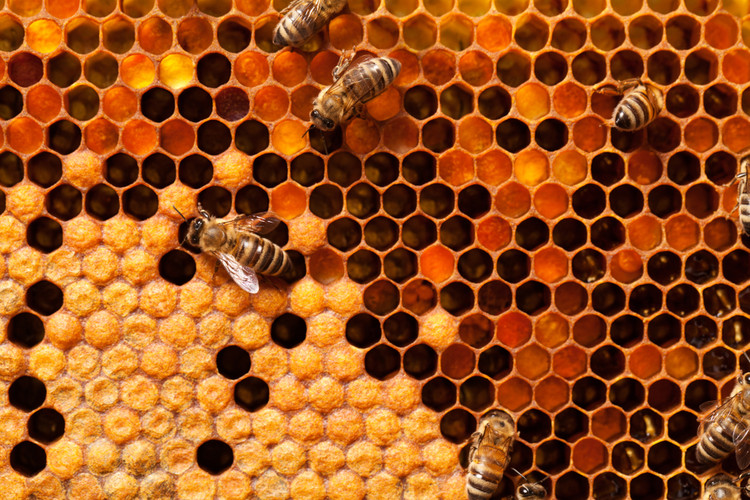
In his 1714 book The Fable of the Bees: or, Private Vices, Public Benefits, Bernard Mandeville told the story of a prosperous beehive where every bee was driven by vanity, greed, luxury and self-interest. The hive flourished with industry, trade, innovation and wealth precisely because of these private vices. Then, one day, the bees suddenly became virtuous and frugal. Demand collapsed, workers lost their jobs, and the once-thriving society descended into poverty and stagnation.
Mandeville’s provocative thesis was that what was often thought of as private vices often produce public benefits. Self-interested behaviour - when channelled through markets - creates far more prosperity and social cooperation than deliberate attempts at collective virtue or moral perfection.
This insight was revolutionary. It showed that the pursuit of personal gain does not lead to chaos, but to order and abundance. People working to satisfy their own desires end up producing goods and services that benefit others. Greed for profit drives innovation. Vanity fuels demand for quality and beauty. Self-interest, not altruism, powers the division of labour and economic progress.
Adam Smith would later refine this idea into the famous “invisible hand”. But Mandeville stated the uncomfortable truth more boldly: a society that tries to suppress self-interest in the name of virtue usually ends up poorer and less civilised.
The Fable of the Bees is a powerful defence of commercial society which reminds us that what left-wing moralists condemn as vice is frequently the engine of human flourishing.
L'économie, je te l'ai déjà dit, ce n'est pas une histoire d'argent.
C'est un problème d'allocation.
Des ressources finies, des usages infinis, et une seule question qui compte vraiment : qui décide où va la prochaine unité de ressource ?
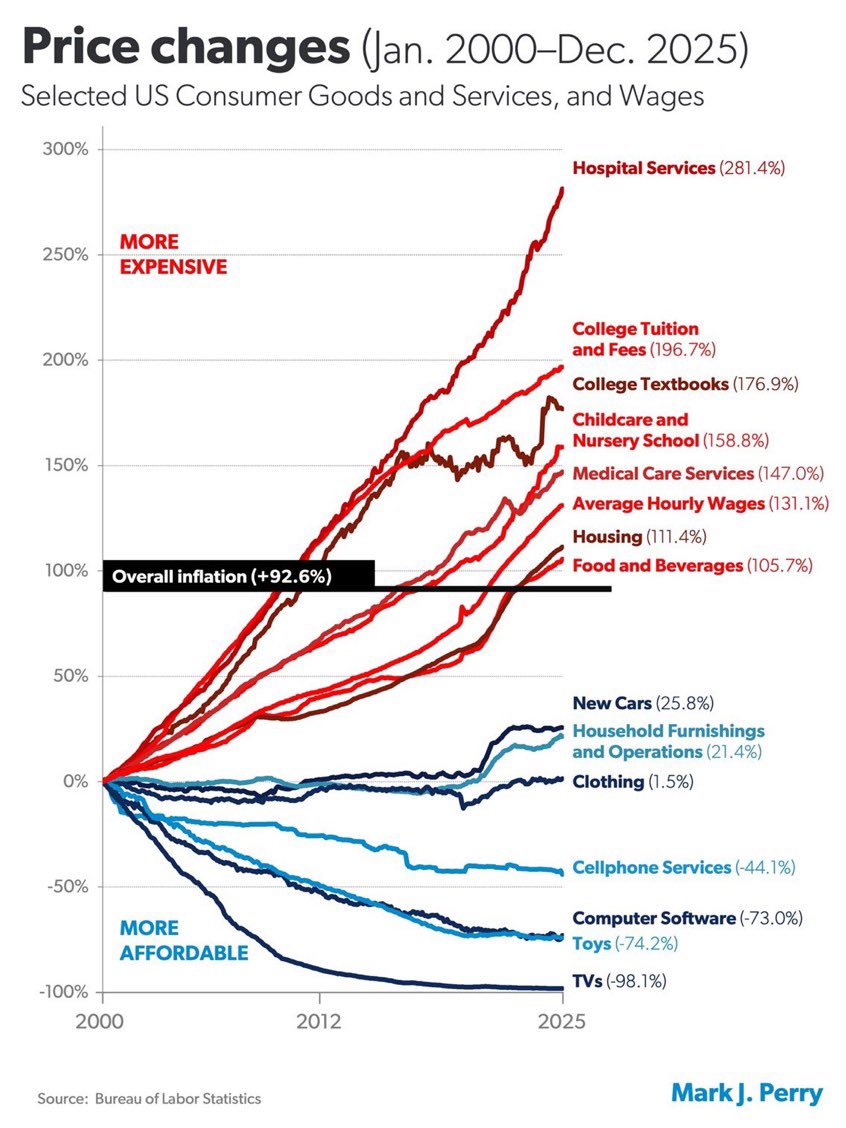
Ce graphique répond à la question mieux que dix mille pages de théorie. Vingt-cinq ans d'économie américaine, une seule image, et une frontière d'une netteté brutale.
D'un côté, tout ce que l'État administre.
Services hospitaliers, +281%.
Frais de scolarité universitaire, +197%.
Manuels, +177%.
Garde d'enfants, +159%.
Soins médicaux, +147%.
Tous très au-dessus de l'inflation générale, +93%.
Prix qui explosent, et qualité qui se dégrade en même temps.
De l'autre, tout ce qu'on a laissé à l'entrepreneur.
Téléviseurs, -98%.
Jouets, -74%.
Logiciels, -73%.
Téléphonie, -44%.
Prix qui s'effondrent, et qualité qui explose. Ton smartphone de 2025 humilie ton ordinateur de 2000, et il coûte moins cher.
Deux mondes. Deux logiques. Une seule variable qui change : qui tient les clés.
Et là est tout le problème. On a confié la création des systèmes publics à des gens qui ne savent produire qu'une seule chose : de la friction. Le bureaucrate n'alloue pas, il empile. Des normes, des guichets, des comités, des autorisations, des circulaires. Chaque année il ajoute une couche, jamais il n'en retire. Il ne crée pas de valeur, il crée de la procédure. Et une société qui accumule de la procédure au lieu de la valeur finit par ressembler exactement à la partie rouge du graphique : chère, lente, et qui empire.
C'est précisément la stagnation que Thiel diagnostique depuis vingt ans. On nous avait promis des voitures volantes, on a eu des applications de messagerie. Le monde des bits, celui que la réglementation n'a pas encore réussi à étrangler, a foncé à une vitesse hallucinante. Le monde des atomes — santé, énergie, transport, logement, éducation — là où l'État règne en maître, s'est figé. Le graphique n'est pas une curiosité statistique. C'est la carte de la stagnation. Partout où le bureaucrate a la main, le temps s'arrête et les prix montent.
Elon a administré la preuve, grandeur nature. Prends le domaine que tout le monde jugeait par nature réservé à la puissance publique : l'espace. Des décennies de NASA, des budgets pharaoniques, un coût au kilo en orbite qui ne bougeait plus. Arrive un entrepreneur. Fusées réutilisables, coût divisé par dix, cadence de lancement que plus aucune agence d'État ne sait tenir. La démonstration est close. L'entrepreneur doit être le roi de la création des systèmes. Le politique, jamais. Non pas parce que l'entrepreneur serait plus vertueux, mais parce qu'il prend un risque réel et qu'il paie ses erreurs, quand le bureaucrate ne risque rien et fait payer les autres.
Et pendant que l'Europe théorise, un pays fait l'expérience en vrai. L'Argentine. Milei arrive fin 2023 sur un champ de ruines : 211% d'inflation, la plus élevée du monde, des décennies de déficit sur 113 des 123 dernières années. Il prend la tronçonneuse au sens propre. Il fusionne des ministères, licencie près de 56 000 fonctionnaires, supprime les subventions. La première année saigne, personne ne le nie, la pauvreté grimpe brutalement. Puis la courbe s'inverse. Deux ans après : inflation retombée autour de 31%, au plus bas depuis 2018. Premier excédent budgétaire en 14 ans. Pauvreté redescendue sous son niveau d'héritage, plus basse qu'en 2018. Croissance autour de 4 à 5%, la plus forte d'Amérique latine. Et les Argentins, loin de le punir pour la douleur, lui redonnent une majorité aux législatives d'octobre.
Javier Milei est un héros. Pas un communicant, un allocateur. Il a fait l'inverse exact du bureaucrate : il a rendu les ressources à ceux qui les créent, au lieu de les confisquer pour ceux qui les gèrent. C'est le laboratoire que le monde entier regarde, et c'est la marche à suivre.
La question n'est jamais qui possède combien. C'est qui alloue le mieux la prochaine unité de ressource pour maximiser le futur. Ce graphique est la réponse empirique. L'Argentine en est la démonstration en direct. Et la France, 57% du PIB en dépense publique, record absolu, est le contre-exemple qu'on montrera un jour dans les manuels. On avance quand on laisse créer. On recule quand on laisse gérer. Tout le reste n'est que friction.
Trump Was Right All Along
Donald Trump’s core claim about trade and industrial policy was simple and unfashionable: trade is a tool of national power, not an end in itself. The last year has gone a long way toward proving him right.
The damage was done when China was accepted into the WTO and then implemented mercantilist trade practices while global technocrats sat idle. The bet was that China’s integration into the rules-based system would liberalize its politics and normalize its economics.
Instead, subsidized overcapacity, managed exchange rates, and aggressive export targeting gutted large parts of U.S. manufacturing and weakened the broader Western industrial base. What elites treated as efficient globalization was, in practice, the offshoring of productive capacity, the hollowing out of industrial regions, and the strategic empowerment of a geopolitical rival.
That insight shaped everything that followed. Trump argued that the era of frictionless globalization was over, that trade deficits and supply-chain dependence mattered, and that national strength would again rest on productive capacity, industrial depth, and control over strategic resources.
Trumps America First strategy, anchored in the Hamilton–Clay tradition, treated tariffs, trade reviews, and infrastructure as instruments of statecraft. That was dismissed as crude protectionism. It now looks like early recognition of the world we’re actually in. Operation Epic Fury made the geopolitical point even more starkly: Pax Americana is dead.
The evidence is now coming not just from Trump’s allies but from the broader political and intellectual class. Even Paul Krugman has conceded that “conditional tariffs” on Chinese cars are “probably going to be necessary” and warned that Europe cannot allow its auto industry to be hollowed out by Chinese overcapacity. When a progressive Nobel laureate starts agreeing with Trump that tariffs and industrial capacity have a legitimate strategic role, the old consensus is gone. The argument now is no longer over first principles, but over how far and how fast to move.
That shift is showing up in North America as well. The Trump administration’s refusal to extend the current trade pact on existing terms codified what Trump’s worldview had already implied: the age of automatic continental trade management is over. The agreement remains in force, but it is now under deliberate strategic review. Trade is being judged less by abstract efficiency and more by whether it strengthens industrial depth, energy security, and continental resilience.
Canada is now being forced to adjust.
The next round of U.S.–Canada trade talks should deepen integration where it already makes strategic sense, energy, critical minerals, power, and industrial inputs—while targeting the old protected zones of the Canadian economy where reciprocity with the United States still does not meaningfully exist: supply‑managed agriculture, softwood lumber, sheltered finance, and telecom. Canada’s dependence on U.S. downstream refining capacity for heavy crude shows how real continental interdependence already is, while its openness to subsidized Chinese EV imports underscores the same danger Krugman identified in Europe: allowing Chinese overcapacity to hollow out domestic industry.
Trump saw that first. He understood before most of the establishment that the global economy was shifting from efficiency to security, from comparative advantage in the abstract to productive capacity in the real world. Now even his critics are conceding the point. The only serious question left is whether governments are prepared to act on what Trump understood long before they did.
Robin Williams’ emotional tribute to the American Flag leaves an entire stadium speechless — then in tears.
Is there a single Hollywood star who would give this performance today?
Total Patriot.
RIP Legend 🇺🇸
Lettre à l'Amérique, d'un Français qui a vu la fin du film.
Vous vous croyez encore le dernier pays libre. Vous l'êtes pour l'instant. Je vous écris depuis un pays qui l'était aussi, et qui a signé sa reddition sans qu'un seul coup de feu ne soit tiré.
En France, l'État capte et redistribue 57% de tout ce que la nation produit. Cinquante-sept pour cent. Arrêtez-vous sur ce chiffre. Pour chaque unité de valeur créée par un ingénieur, un ouvrier, un fondateur qui a risqué sa peau, plus de la moitié transite par une main qui n'a rien bâti. Ce n'est pas une ligne budgétaire. C'est une hypothèque permanente sur l'existence des gens.
Et voici ce que personne ne vous avouera : ça n'arrive jamais par la révolution. Personne ne vote pour le déclin. On vote pour la compassion, pour la sécurité, pour la justice, pour la planète. À chaque étape, on troque un morceau de liberté contre une promesse. Et les promesses sont toujours belles. C'est ça, le piège.
Le collectivisme d'aujourd'hui n'agite plus le drapeau rouge il a compris que ça ne se vend plus. Il a appris à parler la langue du soin. ESG, gouvernance, conformité, « responsabilité » : ce sont les mots nouveaux d'une très vieille idée. L'idée qu'une élite éclairée sait mieux que vous ce qui est bon pour vous, et qu'il faut donc lui transférer, ligne après ligne, le pouvoir de décider à votre place. Ce n'est pas un complot. C'est pire : c'est un consensus. Personne ne se cache. Tout se fait à visage découvert, applaudi, subventionné.
Hayek l'avait écrit il y a quatre-vingts ans : la route de la servitude est pavée de bonnes intentions et de planification centralisée. La France a marché sur cette route en souriant. On a nationalisé le risque, socialisé l'échec, taxé l'audace, et administré tout le reste. Résultat : un pays magnifique qui ne construit plus rien, qui gère sa décrépitude avec une élégance funèbre, et où le jeune le plus doué rêve d'une seule chose partir. Beaucoup atterrissent chez vous.
L'Amérique a encore ce que nous avons perdu : le réflexe de bâtir plutôt que d'administrer. Le fondateur y est un héros, pas un suspect. La réussite y est une preuve, pas une faute à expier. C'est votre trésor. Et un trésor, ça se perd sans qu'on s'en aperçoive un formulaire, une agence, une « bonne cause » à la fois.
Alors ne cherchez pas d'ennemis cachés. C'est inutile et c'est indigne de vous. Regardez plutôt le chiffre. Regardez la France. Chaque point de PIB que vous laissez glisser vers l'État est un point de liberté qui ne revient jamais.
La liberté ne meurt pas assassinée. Elle meurt anesthésiée, sous les applaudissements.
Ne signez pas. Construisez.
Atlas Shrugged made simple:
1. Society runs on a small number of highly capable producers – industrialists, inventors, engineers – whose work everyone depends on but takes for granted.
2. The system starts rewarding need over achievement: the more capable you are, the more you’re expected to sacrifice for those who aren’t.
3. Success gets treated like a debt – taxed, regulated, resented – until the most capable start asking why they bother trying at all.
4. One by one, led by a man named John Galt, they simply withdraw – walking away rather than keep propping up a system that punishes them for producing.
5. Without them, the whole structure collapses, revealing that the “automatic” prosperity everyone assumed was actually being generated by specific, irreplaceable people.
6. Atlas is the Titan from Greek myth, condemned to carry the sky on his shoulders forever – Rand’s stand-in for the producer class, holding up civilization while getting blamed for it.
7. “Shrugged” is the whole argument in one word: Atlas doesn’t fight, doesn’t protest – he just quietly sets the weight down. Nobody realized the sky was being held up by anyone in particular, until the day it isn’t.
You don’t want us? We just go…🤷🏻♂️
The most dangerous thing in politics is not malice. It's arrogance: the belief that a small group of experts can redesign society better than the countless individuals who actually live in it.
Friedrich Hayek had a name for this mistake: The Fatal Conceit.
In his final book, Friedrich Hayek delivered his most pointed critique of socialism and central planning. The book’s title refers to the fatal intellectual error at the heart of socialist thought: the arrogant belief that human reason is capable of deliberately designing and controlling the complex order of society. Hayek called this “constructivist rationalism” - the idea that we can scrap inherited institutions and traditions and rebuild society according to a rational blueprint.
Hayek argued that this conceit is based on a fundamental misunderstanding of how civilisation actually works. The extended order of the market - our system of prices, division of labour, property rights and moral traditions - was not invented or designed by anyone. It emerged through a long process of cultural evolution. No single mind, and certainly no central planning board, possesses the knowledge required to coordinate millions of individuals with constantly changing needs, preferences, and local circumstances.
The price system, Hayek explained, is a remarkable mechanism that communicates dispersed knowledge far more effectively than any planner ever could. When socialists attempt to replace this spontaneous order with conscious direction, they do not merely cause inefficiency. They destroy the very foundations that make advanced civilisation possible.
The Fatal Conceit goes beyond economics to defend the moral and cultural foundations of a free society. Hayek showed that the socialist project is not just impractical - it is based on a dangerous overestimation of human reason and ability, and an arrogant dismissal of evolved wisdom.
The fatal conceit is still very much alive today in every attempt to centrally engineer society, the economy, or human behaviour. Hayek’s warning endures: civilisation is fragile, and those who believe they are wise enough to redesign it are usually the ones who end up destroying it.
Posez-vous une seule question, et tout l'édifice s'effondre.
Pourquoi des causes qui n'ont, en apparence, rien à voir entre elles finissent-elles toujours par dire exactement la même chose, avec les mêmes mots, contre les mêmes gens?
Le droit des homosexuels n'a rien à voir avec le climat. Le climat n'a rien à voir avec la question raciale. La question raciale n'a rien à voir avec la théorie du genre. Quatre sujets distincts, quatre histoires, quatre publics, quatre champs d'expertise séparés.
Et pourtant. Prenez le porte-parole le plus visible de chacun de ces combats. Mettez les quatre dans une pièce. Vous obtenez quatre personnes qui votent pareil, qui méprisent les mêmes gens, qui emploient le même lexique (systémique, déconstruire, privilège, inclusif), et qui ne se contredisent jamais. Jamais.
Ce n'est pas une coïncidence. C'est une loi. Elle fonctionne en trois temps, et chacun se vérifie avec des chiffres.
Premier temps. Dans n'importe quel groupe, ce n'est jamais la majorité qui parle. C'est la frange la plus militante.
La masse vit sa vie. Le petit noyau le plus idéologisé s'empare du micro, parce que lui seul a le temps, l'argent et le fanatisme de le tenir. Ce n'est pas une intuition. L'étude Hidden Tribes (8 000 Américains interrogés) chiffre cette frange, les Progressive Activists, à 8% de la population. Un Américain sur douze. En face, une majorité épuisée de deux tiers qui n'a jamais demandé le micro et qui n'a jamais voté pour le porte-parole.
Robert Conquest avait formulé la mécanique dès les années 1960 : toute organisation qui n'est pas explicitement de droite finit, avec le temps, par devenir de gauche. Pas par complot. Par sélection naturelle. Le fanatique reste quand le modéré rentre chez lui.
Deuxième temps. Cette frange ne ressemble en rien à ceux qu'elle prétend représenter, et elle est plus radicale qu'eux.
Voici le chiffre qui devrait clore le débat. Le bloc militant le plus à gauche d'Amérique, celui qui parle au nom des minorités à longueur de journée, est composé à 67% de Blancs. Sept pour cent de Noirs (Pew, juin 2026). Le groupe le plus diplômé, le plus aisé, le plus connecté du pays. Ceux qui hurlent le plus fort au nom des opprimés sont, statistiquement, les plus privilégiés du tableau.
Et ils sont plus extrêmes que les concernés eux-mêmes. 71% des Blancs progressistes veulent couper le budget de la police. Les Noirs américains, eux, sont partagés (53% pour, 44% contre), et seulement 28% ont soutenu le slogan "defund the police". Les Hispaniques y étaient majoritairement opposés (57%). Le porte-parole autoproclamé était donc plus radical que la communauté au nom de laquelle il prétendait parler. Une étude (ANES) pousse jusqu'au vertige : les Blancs progressistes sont le seul groupe du pays à mieux noter les autres races que la leur.
Traduction. Un diplômé aisé a décidé de parler au nom de l'opprimé. Et l'opprimé n'est pas d'accord.
Et ces franges sortent toutes du même moule. Le même appareil universitaire (Foucault, Derrida, l'École de Francfort, dont j'ai raconté la généalogie). Le même écosystème de fondations, qui financent ouvertement, sur catalogue public, l'associatif militant de chaque cause. Le même séminaire, le même lexique, les mêmes formations. On ne produit pas vingt idéologies. On produit vingt antennes d'un seul émetteur.
Troisième temps. Une fois installée, la frange parle au nom de tous et écrase ceux qui, à l'intérieur du groupe, refusent de suivre.
L'homosexuel discret qui ne se reconnaît pas dans le mégaphone. Le Noir conservateur. La femme qui refuse qu'on efface le mot femme. Tous traités en traîtres. Parce que le premier ennemi du militant n'est jamais l'adversaire d'en face. C'est le modéré de son propre camp. Le modéré est le danger absolu : il prouve, par sa seule existence, que le mégaphone ment quand il dit parler au nom de tous.
Résultat. Vous croyez voir une mosaïque de combats pour les droits. Vous voyez en réalité un seul logiciel, installé sur des machines différentes.
La cause n'est jamais la cause. La cause est le costume.
Et celui qui porte le costume sert toujours le même propriétaire : l'idée que tout, absolument tout (la famille, la nation, le mérite, la norme, la frontière, la vérité elle-même) est une structure d'oppression à abattre. C'est la matrice marxiste, qui a simplement quitté l'usine pour l'identité. La lutte des classes ne fonctionnait plus (les ouvriers s'embourgeoisaient), alors on a multiplié les classes : une par minorité, une par cause, à l'infini. Un prolétariat de rechange, renouvelable indéfiniment.
Et voici le test qui ne trompe jamais, le seul qui compte. Une cause sincère accepte la contradiction en son sein. Un costume idéologique, non. Le jour où vous verrez le porte-parole d'une de ces causes défendre publiquement un dissident de son propre camp, contre son propre camp, vous saurez que c'était une vraie cause. Vous attendrez longtemps.
La bonne nouvelle, c'est que ce qui tient par un seul fil tombe par un seul fil. Une frange de 8% ne gouverne que tant que les 92% se taisent. Le jour où la majorité silencieuse de chaque groupe reprend son micro, l'émetteur se retrouve sans antennes. Il n'émet plus que dans le vide.
Ce micro, personne ne vous interdit de le reprendre.
Au travail.