@GarnettGenuis Because China funds/supplies/gives weapons to Iran and Russia and yet Canada sells potash to China. The USA buying potash from Belarus means less potash for Russia.
@jkenney You are the divisive one. As Kim Dobranski said. All he did was repost a photo already posted by the cadet program. This is real. Are you saying it's not real?
@Polysesouvient@BBCWorld@liberal_party lol less than 3% of gun owners declared. 2.5 million gun owners. 26,000 declared. Complete and utter failure. lol
@Polysesouvient@OPP_News Legal gun owners represent 0.4% of crime. Of course they don't have resources to decrease crime by less than 1%. it is criminals and smuggled guns that are he problem. Your group is delusional.
@Polysesouvient@gary_srp 51,000 out of a conservative number of 4.5 million banned firearms. LOLOLOL That is a compliance rate of 1.13%. This is a historic fiasco of a failure. Thank God.
@nut_meggy Blatant lie? Misinformation? you are the liar and dis-informer. The New York times wrote an article a month ago on the MAID seasonal depression murder....
https://t.co/D9o1HtMLUR
To the carbon tax intellectual mob now mobilized by the Prime Minister’s Office to defend the carbon tax,
You argue the carbon charge on diesel fell by ~21¢/L and suggest my analysis assumes a linear increase to 29¢/L. That’s convenient — but incomplete.
You’re isolating one component of a much broader cost structure and presenting it as the full story. It isn’t.
Food prices are not determined by what a truck pays at the pump alone. They reflect cumulative costs across the entire supply chain: refining, fertilizer, processing, refrigeration, logistics — all of which remain exposed to carbon pricing mechanisms.
And while you focus on a partial rollback in one area, you ignore two inconvenient truths:
1️⃣ Industrial carbon pricing is still very much in effect, and tightening
2️⃣ Energy costs overall are rising, amplifying cost pressures across the system
Cherry-picking a 21¢/L figure does not invalidate broader cost transmission. It simply narrows the lens.
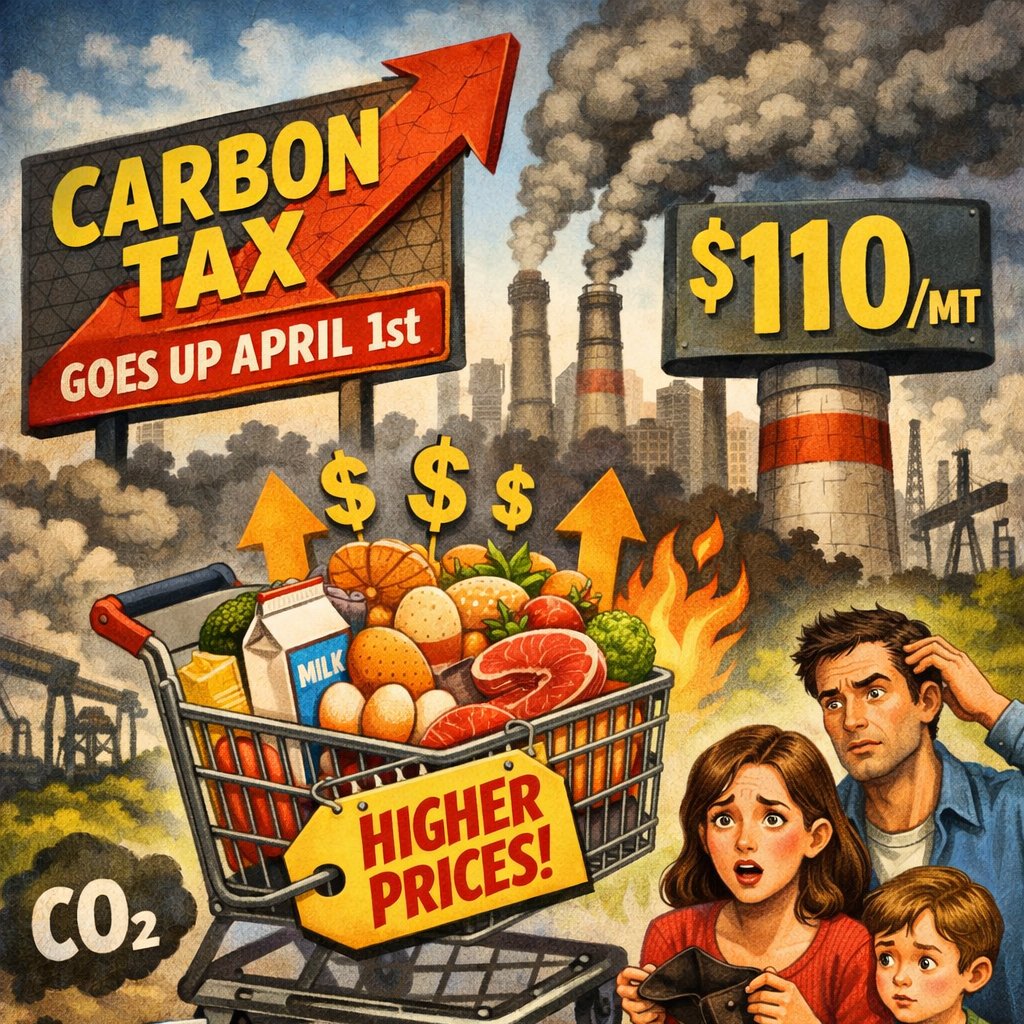
With another carbon price increase coming April 1, Canadians deserve an honest conversation — not selective math.
This isn’t a comprehension error. It’s a refusal to look at the full system.
To the carbon tax intellectual mob now mobilized by the Prime Minister’s Office to defend the carbon tax,
You argue the carbon charge on diesel fell by ~21¢/L and suggest my analysis assumes a linear increase to 29¢/L. That’s convenient — but incomplete.
You’re isolating one component of a much broader cost structure and presenting it as the full story. It isn’t.
Food prices are not determined by what a truck pays at the pump alone. They reflect cumulative costs across the entire supply chain: refining, fertilizer, processing, refrigeration, logistics — all of which remain exposed to carbon pricing mechanisms.
And while you focus on a partial rollback in one area, you ignore two inconvenient truths:
1️⃣ Industrial carbon pricing is still very much in effect, and tightening
2️⃣ Energy costs overall are rising, amplifying cost pressures across the system
Cherry-picking a 21¢/L figure does not invalidate broader cost transmission. It simply narrows the lens.
With another carbon price increase coming April 1, Canadians deserve an honest conversation — not selective math.
This isn’t a comprehension error. It’s a refusal to look at the full system.
To the carbon tax intellectual mob now mobilized by the Prime Minister’s Office to defend the carbon tax,
You argue the carbon charge on diesel fell by ~21¢/L and suggest my analysis assumes a linear increase to 29¢/L. That’s convenient — but incomplete.
You’re isolating one component of a much broader cost structure and presenting it as the full story. It isn’t.
Food prices are not determined by what a truck pays at the pump alone. They reflect cumulative costs across the entire supply chain: refining, fertilizer, processing, refrigeration, logistics — all of which remain exposed to carbon pricing mechanisms.
And while you focus on a partial rollback in one area, you ignore two inconvenient truths:
1️⃣ Industrial carbon pricing is still very much in effect, and tightening
2️⃣ Energy costs overall are rising, amplifying cost pressures across the system
Cherry-picking a 21¢/L figure does not invalidate broader cost transmission. It simply narrows the lens.
With another carbon price increase coming April 1, Canadians deserve an honest conversation — not selective math.
This isn’t a comprehension error. It’s a refusal to look at the full system.
To the carbon tax intellectual mob now mobilized by the Prime Minister’s Office to defend the carbon tax,
You argue the carbon charge on diesel fell by ~21¢/L and suggest my analysis assumes a linear increase to 29¢/L. That’s convenient — but incomplete.
You’re isolating one component of a much broader cost structure and presenting it as the full story. It isn’t.
Food prices are not determined by what a truck pays at the pump alone. They reflect cumulative costs across the entire supply chain: refining, fertilizer, processing, refrigeration, logistics — all of which remain exposed to carbon pricing mechanisms.
And while you focus on a partial rollback in one area, you ignore two inconvenient truths:
1️⃣ Industrial carbon pricing is still very much in effect, and tightening
2️⃣ Energy costs overall are rising, amplifying cost pressures across the system
Cherry-picking a 21¢/L figure does not invalidate broader cost transmission. It simply narrows the lens.
With another carbon price increase coming April 1, Canadians deserve an honest conversation — not selective math.
This isn’t a comprehension error. It’s a refusal to look at the full system.
To the carbon tax intellectual mob now mobilized by the Prime Minister’s Office to defend the carbon tax,
You argue the carbon charge on diesel fell by ~21¢/L and suggest my analysis assumes a linear increase to 29¢/L. That’s convenient — but incomplete.
You’re isolating one component of a much broader cost structure and presenting it as the full story. It isn’t.
Food prices are not determined by what a truck pays at the pump alone. They reflect cumulative costs across the entire supply chain: refining, fertilizer, processing, refrigeration, logistics — all of which remain exposed to carbon pricing mechanisms.
And while you focus on a partial rollback in one area, you ignore two inconvenient truths:
1️⃣ Industrial carbon pricing is still very much in effect, and tightening
2️⃣ Energy costs overall are rising, amplifying cost pressures across the system
Cherry-picking a 21¢/L figure does not invalidate broader cost transmission. It simply narrows the lens.
With another carbon price increase coming April 1, Canadians deserve an honest conversation — not selective math.
This isn’t a comprehension error. It’s a refusal to look at the full system.
To the carbon tax intellectual mob now mobilized by the Prime Minister’s Office to defend the carbon tax,
You argue the carbon charge on diesel fell by ~21¢/L and suggest my analysis assumes a linear increase to 29¢/L. That’s convenient — but incomplete.
You’re isolating one component of a much broader cost structure and presenting it as the full story. It isn’t.
Food prices are not determined by what a truck pays at the pump alone. They reflect cumulative costs across the entire supply chain: refining, fertilizer, processing, refrigeration, logistics — all of which remain exposed to carbon pricing mechanisms.
And while you focus on a partial rollback in one area, you ignore two inconvenient truths:
1️⃣ Industrial carbon pricing is still very much in effect, and tightening
2️⃣ Energy costs overall are rising, amplifying cost pressures across the system
Cherry-picking a 21¢/L figure does not invalidate broader cost transmission. It simply narrows the lens.
With another carbon price increase coming April 1, Canadians deserve an honest conversation — not selective math.
This isn’t a comprehension error. It’s a refusal to look at the full system.
To the carbon tax intellectual mob now mobilized by the Prime Minister’s Office to defend the carbon tax,
You argue the carbon charge on diesel fell by ~21¢/L and suggest my analysis assumes a linear increase to 29¢/L. That’s convenient — but incomplete.
You’re isolating one component of a much broader cost structure and presenting it as the full story. It isn’t.
Food prices are not determined by what a truck pays at the pump alone. They reflect cumulative costs across the entire supply chain: refining, fertilizer, processing, refrigeration, logistics — all of which remain exposed to carbon pricing mechanisms.
And while you focus on a partial rollback in one area, you ignore two inconvenient truths:
1️⃣ Industrial carbon pricing is still very much in effect, and tightening
2️⃣ Energy costs overall are rising, amplifying cost pressures across the system
Cherry-picking a 21¢/L figure does not invalidate broader cost transmission. It simply narrows the lens.
With another carbon price increase coming April 1, Canadians deserve an honest conversation — not selective math.
This isn’t a comprehension error. It’s a refusal to look at the full system.
To the carbon tax intellectual mob now mobilized by the Prime Minister’s Office to defend the carbon tax,
You argue the carbon charge on diesel fell by ~21¢/L and suggest my analysis assumes a linear increase to 29¢/L. That’s convenient — but incomplete.
You’re isolating one component of a much broader cost structure and presenting it as the full story. It isn’t.
Food prices are not determined by what a truck pays at the pump alone. They reflect cumulative costs across the entire supply chain: refining, fertilizer, processing, refrigeration, logistics — all of which remain exposed to carbon pricing mechanisms.
And while you focus on a partial rollback in one area, you ignore two inconvenient truths:
1️⃣ Industrial carbon pricing is still very much in effect, and tightening
2️⃣ Energy costs overall are rising, amplifying cost pressures across the system
Cherry-picking a 21¢/L figure does not invalidate broader cost transmission. It simply narrows the lens.
With another carbon price increase coming April 1, Canadians deserve an honest conversation — not selective math.
This isn’t a comprehension error. It’s a refusal to look at the full system.
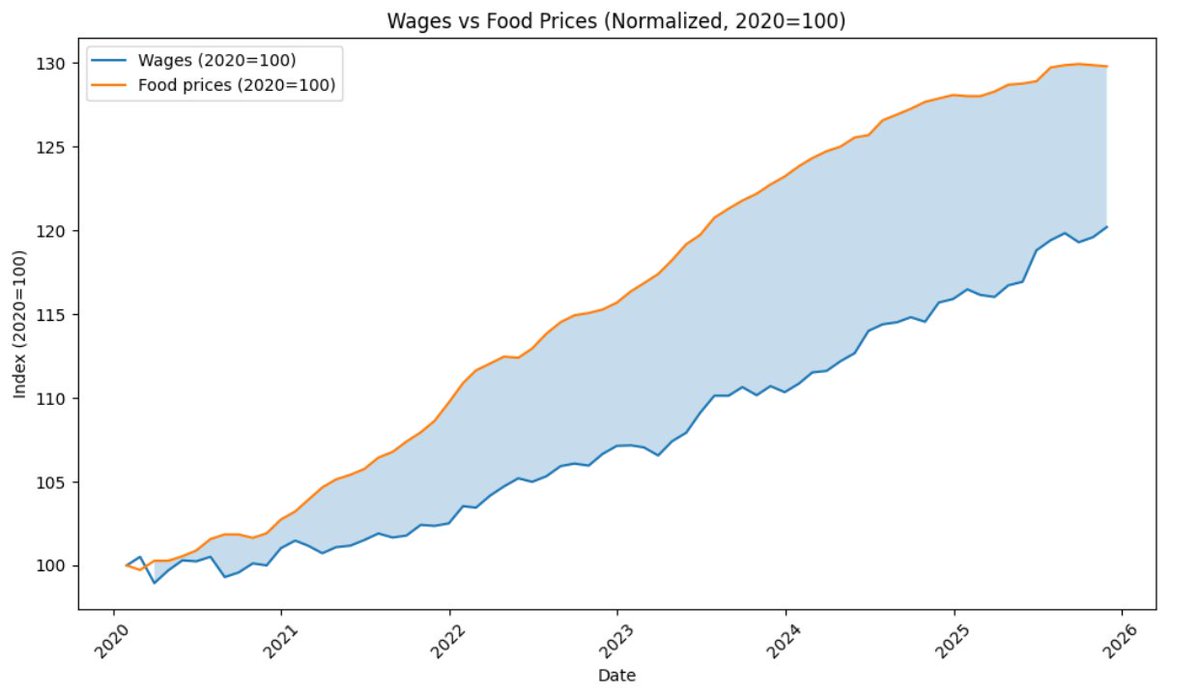
Feel poorer at the grocery store? Here’s exactly why.
Since 2020:
Food prices ↑ ~30%
Wages ↑ ~20%
That shaded gap? That’s lost purchasing power.
Canadians aren’t imagining it.
Feel poorer at the grocery store? Here’s exactly why.
Since 2020:
Food prices ↑ ~30%
Wages ↑ ~20%
That shaded gap? That’s lost purchasing power.
Canadians aren’t imagining it.
Feel poorer at the grocery store? Here’s exactly why.
Since 2020:
Food prices ↑ ~30%
Wages ↑ ~20%
That shaded gap? That’s lost purchasing power.
Canadians aren’t imagining it.