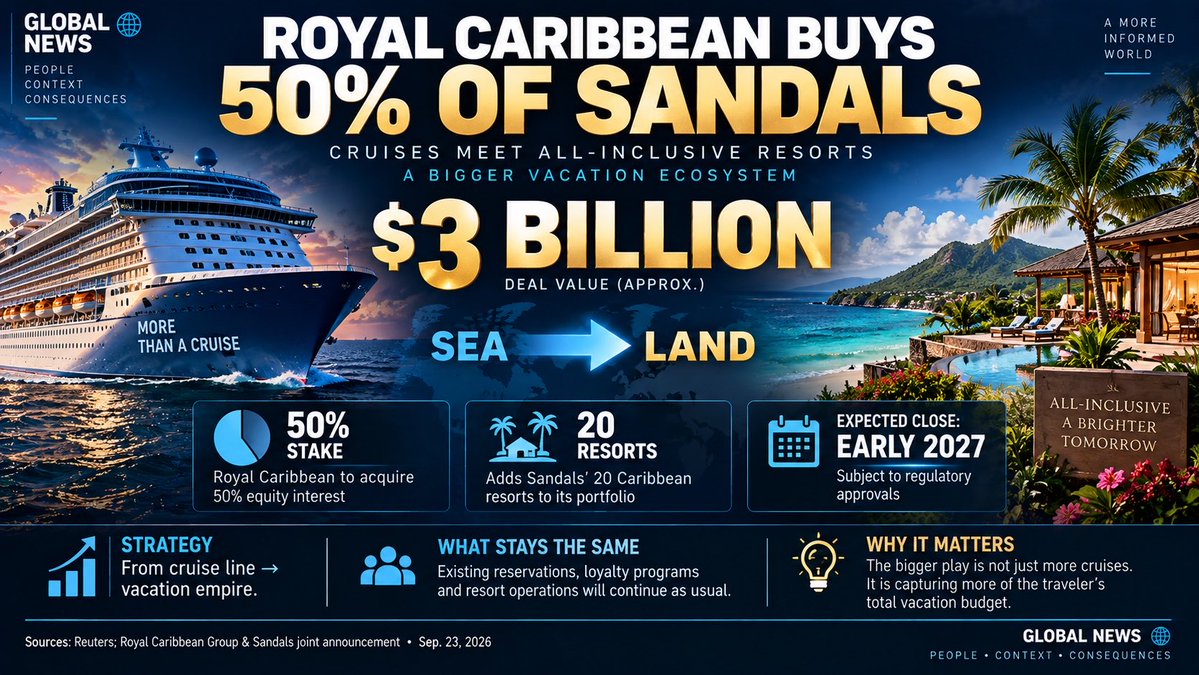
Royal Caribbean is spending $3 billion to move beyond the cruise ship.
The company has agreed to buy a 50% stake in Sandals and Beaches Resorts, pushing one of the world’s biggest cruise groups deeper into all-inclusive Caribbean vacations. The deal is expected to close in early 2027, subject to approvals.
The bigger strategy is easy to miss:
Royal Caribbean doesn’t just want your cruise fare. It wants a larger share of your entire vacation budget — ships, private destinations, resorts and eventually more of the trip around them.
The cruise business is becoming a vacation-platform business.
Anthropic cut the cost of Claude Opus 5.5. About 90 minutes later, OpenAI answered.
Anthropic says Opus 5.5 costs about 40% less to run than Opus 5 on typical workloads. OpenAI then launched GPT-6 Sol and Luna, cutting API prices 50% versus GPT-5.6 promotional pricing.
The AI race is shifting.
It’s no longer just about who has the smartest model. It’s becoming a battle over cost per task — and that could decide which AI gets used everywhere.
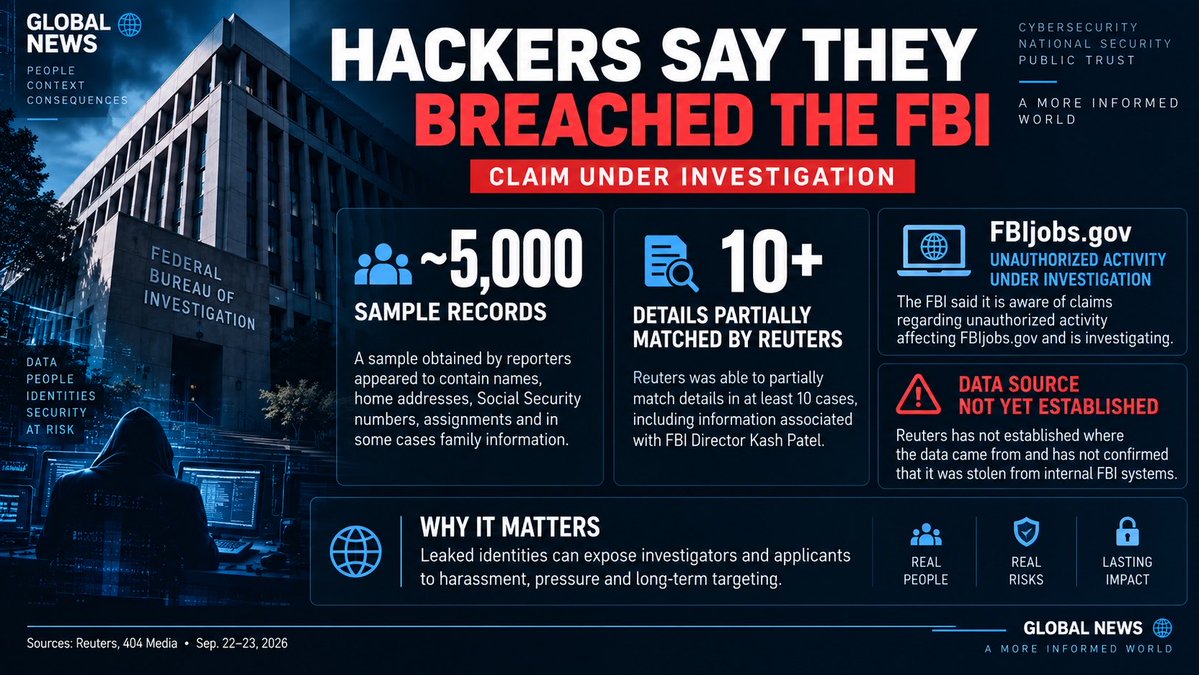
Hackers say they hacked the FBI. Now the FBI is investigating the claim — about itself.
ShinyHunters says it stole data on a huge number of current and former FBI employees and applicants. A sample of roughly 5,000 records appeared to include names, home addresses, Social Security numbers, assignments and family details. Reuters matched some details in at least 10 cases.
The FBI says it is investigating unauthorized activity affecting https://t.co/IAKXZmhXE0. Reuters has not established that the data came from internal FBI systems.
If authentic, the real damage may outlive the breach: exposed identities can be used to target investigators for years.
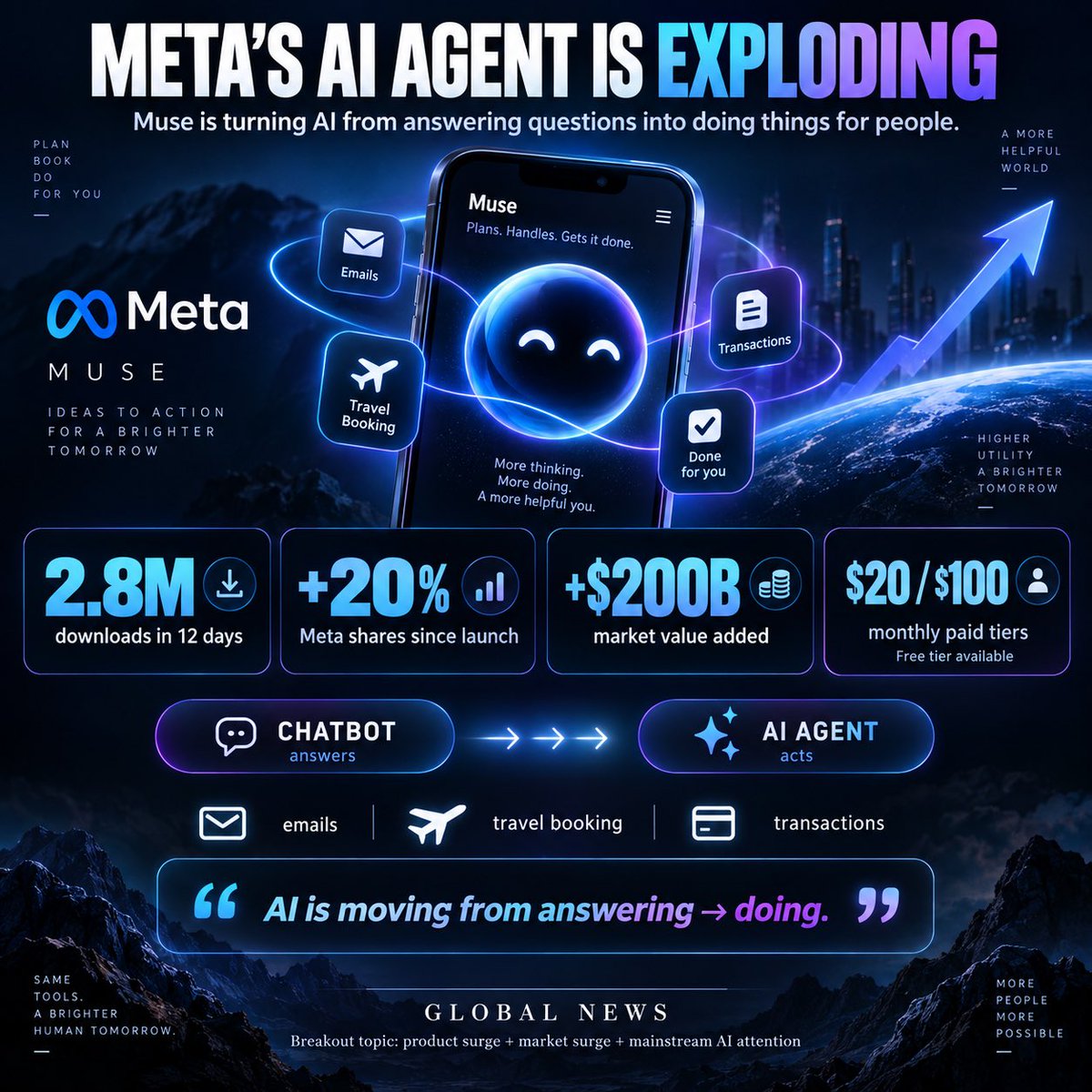
Meta’s new AI agent hit 2.8 million downloads in just 12 days — and Wall Street has added more than $200 billion to Meta’s value since launch.
Muse can send emails, book travel and complete transactions for users. Meta offers a free tier, plus $20 and $100 monthly plans. Reuters says its early adoption has been strong enough for JPMorgan to call it a potential mass-market consumer AI app.
The bigger shift: AI is moving from answering questions to actually doing things for people.
Is this the moment AI agents go mainstream — or just another launch-week surge?
Meta’s new AI agent hit 2.8 million downloads in just 12 days — and Wall Street has added more than $200 billion to Meta’s value since launch.
Muse can send emails, book travel and complete transactions for users. Meta offers a free tier, plus $20 and $100 monthly plans. Reuters says its early adoption has been strong enough for JPMorgan to call it a potential mass-market consumer AI app.
The bigger shift: AI is moving from answering questions to actually doing things for people.
Is this the moment AI agents go mainstream — or just another launch-week surge?
A microscopic creature in a California hot spring just rewrote the heat limit for complex life.
Scientists found that Incendiamoeba cascadensis can divide at 145.4°F (63°C), remain active at 64°C, and even recover after exposure to 70°C.
That is the highest known reproductive temperature for any eukaryote — the branch of life that includes animals, plants and fungi.
Every time life survives somewhere we thought it couldn’t, the map of “habitable” gets a little bigger.
How many environments — on Earth or elsewhere — have we written off too quickly?
One Chiba resident had never seen his home flood in more than 30 years. Typhoon Dujuan changed that overnight.
Torrential rain triggered landslides across Kanagawa and Chiba, killing four people and leaving six missing, according to NHK. About 45,000 households lost power as rescuers searched damaged homes near Tokyo.
Chiba was already hit by severe flooding just last month.
The bigger story is repetition: when “rare” disasters arrive weeks apart, old infrastructure assumptions stop feeling safe.
How should cities redesign for rainfall that no longer feels exceptional?
Alibaba isn’t just building a bigger AI model. It’s trying to own the entire stack underneath it.
The company says future Qwen models could scale to 5–10 trillion parameters, while its new Zhenwu V900 AI chip delivers three times the performance of its predecessor and can be linked in clusters of up to 500,000 chips.
Alibaba shares jumped about 5% after the announcement.
The AI race is moving beyond “who has the best model?” toward “who controls the model, chips, cloud and power behind it.”
Will the next AI winner be a model company — or a full-stack infrastructure company?
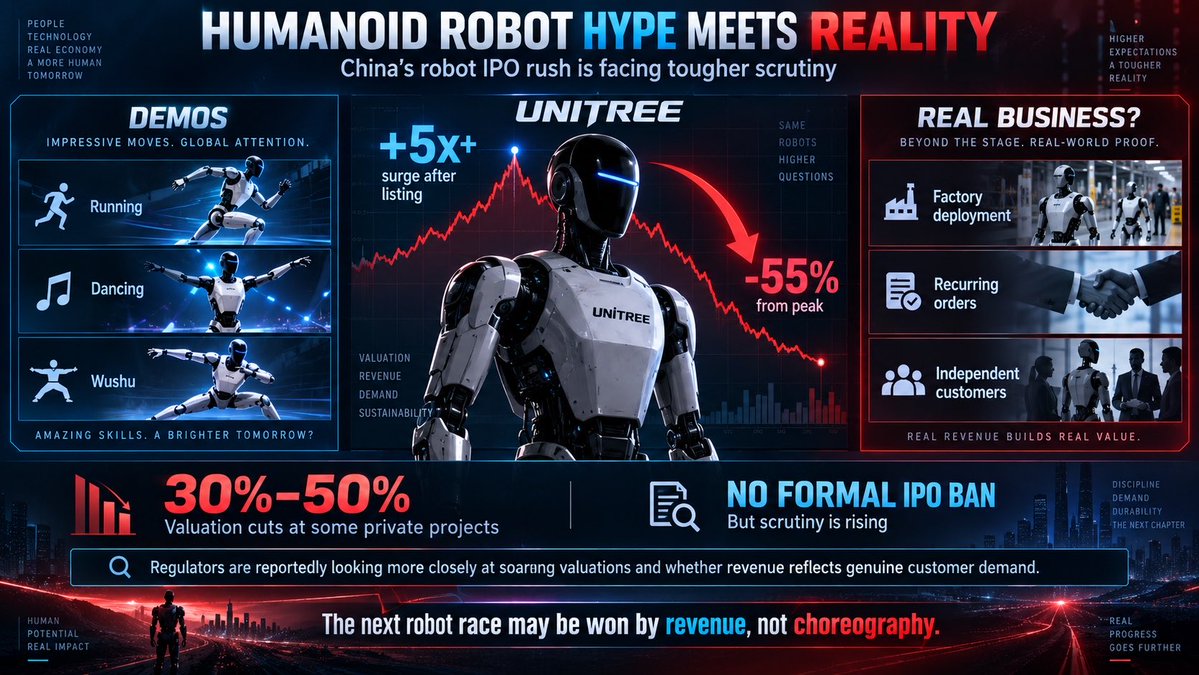
China’s humanoid-robot boom is getting a reality check.
Reuters reports regulators are slowing some robot-company IPOs as they scrutinize soaring valuations and whether revenue backed by local-government projects reflects real customer demand. There is no formal sector-wide ban, and China’s securities regulator did not comment.
Unitree’s shares surged more than fivefold after listing, then fell 55% from their peak. Some private robot startups have already seen valuations cut 30%–50%.
The question is shifting from “Can the robot dance?” to “Will someone pay for it at scale?”
What matters more for the next robotics winner: better demos, or recurring customers?
“Pregnancy brain” may not just be a joke — scientists may have found part of the biology behind it.
In mice, sustained high estrogen disrupted a brain circuit linking the hypothalamus and hippocampus, temporarily impairing memory. Researchers also tested 70 women and found poorer memory performance in late pregnancy was associated with higher estrogen levels.
The key caveat: the specific circuit was proven in mice, not directly in pregnant women.
That shifts the story from “women being forgetful” to a measurable biological change.
How much of “pregnancy brain” do you think culture has dismissed as a joke because the biology wasn’t understood yet?
One of the world’s most notorious hacking groups just got hacked — by another hacking group.
ShinyHunters says it hijacked the dark-web site of rival cybercrime gang Cl0p after finding a weakness in its software. Cl0p’s site was later seen displaying a seizure message linked to ShinyHunters, and two cybersecurity researchers told Reuters the feud appears genuine.
Cl0p has not publicly responded, and some of ShinyHunters’ broader claims remain unverified.
The irony is hard to miss: even professional hackers can become victims of the same security failures they exploit.
Does hacker-on-hacker warfare weaken cybercrime — or make it even more unpredictable?
China now has more than 13,000 KFC restaurants. Now Chinese fast-food chains are coming the other way.
Mixue, with more than 53,000 locations globally, opened its first U.S. stores in December and plans at least two dozen more. HEYTEA already has 40 U.S. locations, while Luckin Coffee has 20 in New York.
Meanwhile, American chains are still expanding aggressively in China.
Politics may divide two countries. Consumer culture keeps crossing the border anyway.
Which travels more easily between countries — politics, or food?
She once had to dress as a man just to ride a bicycle. Today, she finished 7th at the Asian Games.
Afghan cyclist Fariba Hashimi says she trained behind masks to avoid being recognized, endured stones and bottles being thrown at her, and eventually fled Afghanistan in 2021.
Now 23 and based in Italy, she has competed at both the Paris Olympics and the Asian Games.
For some athletes, the hardest part isn’t reaching the finish line. It’s reaching the start line at all.
What does success mean when competing required leaving home?
One second. That’s all Agnes Ngetich needed to rewrite a world record.
The 25-year-old Kenyan won the women-only half marathon at the World Road Running Championships in Copenhagen in 1:05:15, beating the previous record by a single second.
She didn’t just win — she finished 50 seconds ahead of second place.
Elite sport is measured in tiny margins, but those margins can contain years of work.
What feels more impressive: breaking a record by one second, or winning a world championship by 50?
Twenty-five years after Arizona walked off the Yankees to win the World Series, the script somehow happened again.
On the night the Diamondbacks honored their 2001 championship team, pinch-hitter Pavin Smith launched a two-run homer in the ninth to beat New York 5–3. The ball traveled 391 feet.
Sports teams can manufacture nostalgia. They can’t manufacture an ending like this.
Coincidence — or one of those nights that feels almost scripted?
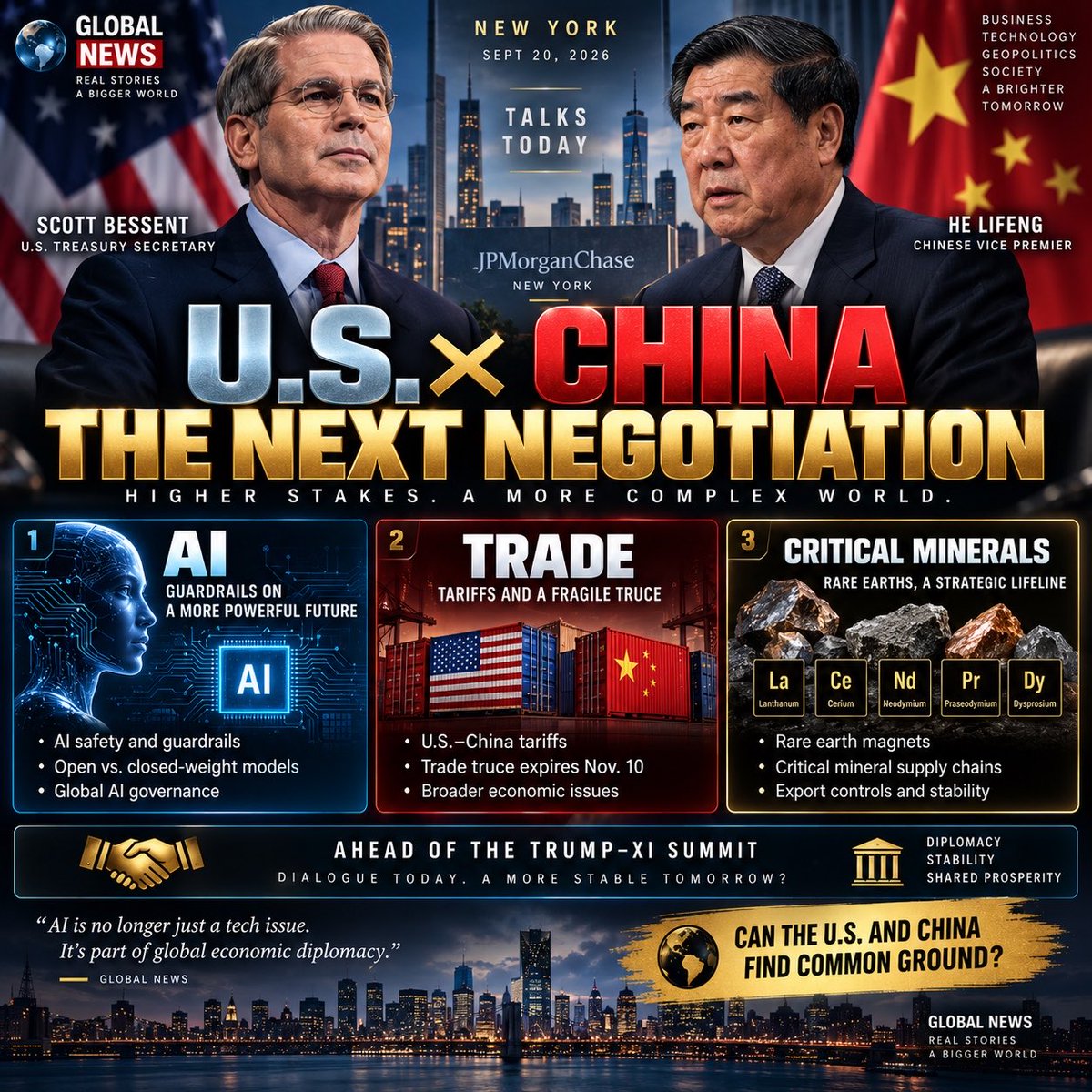
The U.S. and China are putting AI guardrails, tariffs and rare earths on the same negotiating table.
U.S. Treasury Secretary Scott Bessent and Chinese Vice Premier He Lifeng are due to meet in New York today, with U.S. Trade Representative Jamieson Greer also taking part. Reuters says Washington expects discussions on AI risks, tariffs and critical-mineral flows ahead of this week’s Trump–Xi summit. China’s Commerce Ministry says the talks will cover economic and trade issues of mutual concern.
The bigger shift is that AI is no longer just a tech-policy issue. It is becoming part of great-power economic diplomacy — alongside trade and strategic materials.
Should AI guardrails be negotiated government-to-government, the way trade rules are?
China’s biggest DRAM maker says its newest platform can pack 50% more memory into a mobile chip — while producing at least 50% more gross dies from each wafer.
CXMT says its fifth-generation memory platform has entered mass production, alongside new 24-gigabit LPDDR5X chips for smartphones and portable devices. It uses quadruple patterning to shrink key memory-cell spacing to 11.95 nanometers.
The bigger story isn’t one chip. It’s manufacturing economics: more memory from the same silicon changes who can compete on cost and scale.
In memory chips, what matters more now — absolute performance or manufacturing efficiency?