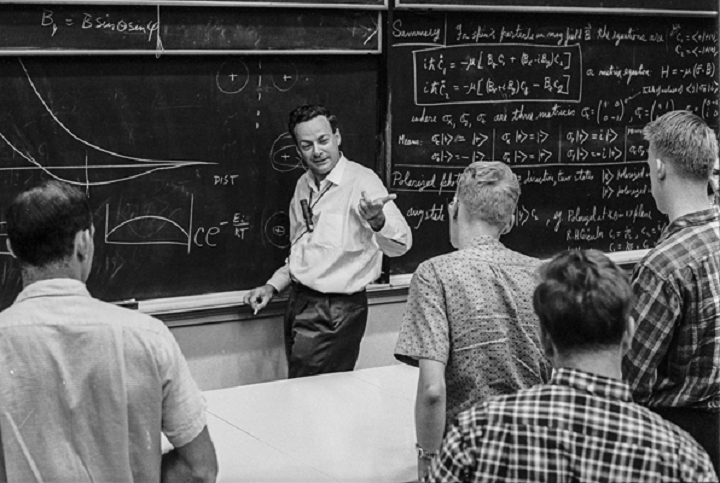
In 1964 a soon-to-be Nobel laureate walked into a Cornell auditorium and spent seven evenings explaining the nature of physical law to a general audience. Bill Gates paid the BBC out of his own pocket to keep those recordings on the internet forever.
His name was Richard Feynman, and the lectures are called The Character of Physical Law.
He was 46 years old when he gave them. He would win the Nobel Prize in physics the following year for his work on quantum electrodynamics. The BBC filmed every session. The tapes then went into distribution at universities through the 1970s, disappeared in the 1980s, and stayed lost until Gates licensed them for a Microsoft research project in 2009 specifically so they would never go offline again.
Here is the framework buried inside those lectures that changed how I think about knowledge itself.
In the final lecture of the series, titled Seeking New Laws, Feynman stops the philosophy and tells the room exactly how scientific discovery actually works. Not in metaphors. In three sentences.
He says in general we look for a new law by the following process. First we guess it. Then we compute the consequences of the guess to see what would be implied if the law we guessed is right. Then we compare the result of the computation directly to nature, to experiment, to observation, to see if it works.
And then he delivers the line that has outlived him by forty years.
If it disagrees with experiment, it is wrong. In that simple statement is the key to science. It does not matter how beautiful your guess is. It does not matter how smart you are, who made the guess, or what his name is. If it disagrees with experiment, it is wrong. That is all there is to it.
Read that again slowly.
He is not describing physics. He is describing the only intellectually honest way to hold any belief about the world. The method is indifferent to credentials, indifferent to elegance, indifferent to how much you want the idea to be true. Reality is the only referee, and reality never explains its rulings.
The second thread running through the whole series is the one Feynman kept circling back to across all seven nights.
He argued that the deepest beauty of a physical law is not in what it depends on but in what it refuses to depend on. Newton's law of gravitation works the same way on a falling apple, a moon in orbit, and a galaxy at the edge of the observable universe. That is not a detail. That is the entire point. A law that only works in one place is not a law. It is a coincidence. The test of a real generalization is whether it survives contact with situations its inventor never imagined.
The part that hits hardest comes in the opening lecture on gravitation.
Feynman is walking the audience through how Newton assembled the theory, and he pauses to say something most scientists never say out loud.
The importance of a physical law, he tells the room, is not how clever we were to find it. It is how clever nature was to pay attention to it. The universe did not have to be lawful. It did not have to reward pattern recognition with deeper pattern. The fact that it does is what makes science possible at all, and it is a standing miracle no one has ever explained.
Feynman ends the final lecture with a warning almost everyone misses.
He says the principles we now have may still be wrong in places we have not noticed. He suspects, out loud, that space being continuous is one of them. He offers no replacement. He just marks the edge where his own confidence runs out and tells the audience that honest uncertainty is the correct default for anyone actually trying to find the truth, instead of defend a position.
Sixty years later the full series still streams for free. Seven hour-long lectures. The best of Feynman at the peak of his powers, filmed before he was famous to the general public, speaking to a crowd that was never supposed to understand physics at this level.
Bill Gates kept them online because he understood what most people still miss.
A three-sentence method for testing any belief against reality is worth more than most of what graduate school teaches in three years.
AAE-2: Next-gen subsea + terrestrial network connecting Asia, Africa & Europe. High-speed, resilient, future-ready. Discover IDC’s insights on this game-changing project.
Get the @IDC report: https://t.co/vafeU07QdI
#DigitalInfrastructure#AAE2#Connectivity#SubseaCable
Managed cloud services are no longer optional — they’re essential.
@IDC’s latest report explores cloud adoption trends in Sub-Saharan Africa and how providers can lead with value-added services and strategic guidance.
📥 Get the insights: https://t.co/O8rMoiDuv1
In today’s market, it is just as important to know your share in the marketplace. Use the @IDC Tracker to assess your market, identify new opportunities, and accelerate growth with up-to-date IT market data.
https://t.co/ngGzVtxHd3
@MarkWalker36@ranjitrajan1@PrateekHShah
Tech decisions made easy! 🎯
#IDCTechMatch delivers AI-powered recommendations to help you select the right software and IT solutions in no time.
🔗 Smarter choices start here: https://t.co/erHHOk1VT2
@IDC
#Huawei and IDC’s Global Digitalization Index 2024 has highlighted the link between ICT maturity and prosperity as technology such as AI and #5G drives economic growth. It urges nations to invest in digital infrastructure, talent, and green tech. #InnovateForImpact#HuaweiFacts
Attention #PC and #tablet vendors – could #China be your next big expansion opportunity? https://t.co/B9jdz169V7
Click the link above to learn more and fill out the form to schedule a live demo.
🌐 UAE IT Services Forecast 2023-2028 🌐
The #UAE's IT market is booming with #AI, #cloud, and #digitaltransformation investments. @IDC emphasizes innovation and agility for tech suppliers. Embrace UAE's AI leadership vision.
Get this exciting report: https://t.co/3M3PuPL30I
Boost your game in #Software and #CloudServices! 🚀
Uncover the latest industry trends and software spending forecasts in @IDC's new eBook.
📈 Download now to compare industry performance and tailor your strategies for success!
Grab it here: https://t.co/awqnQ4gvVy
#IDCData
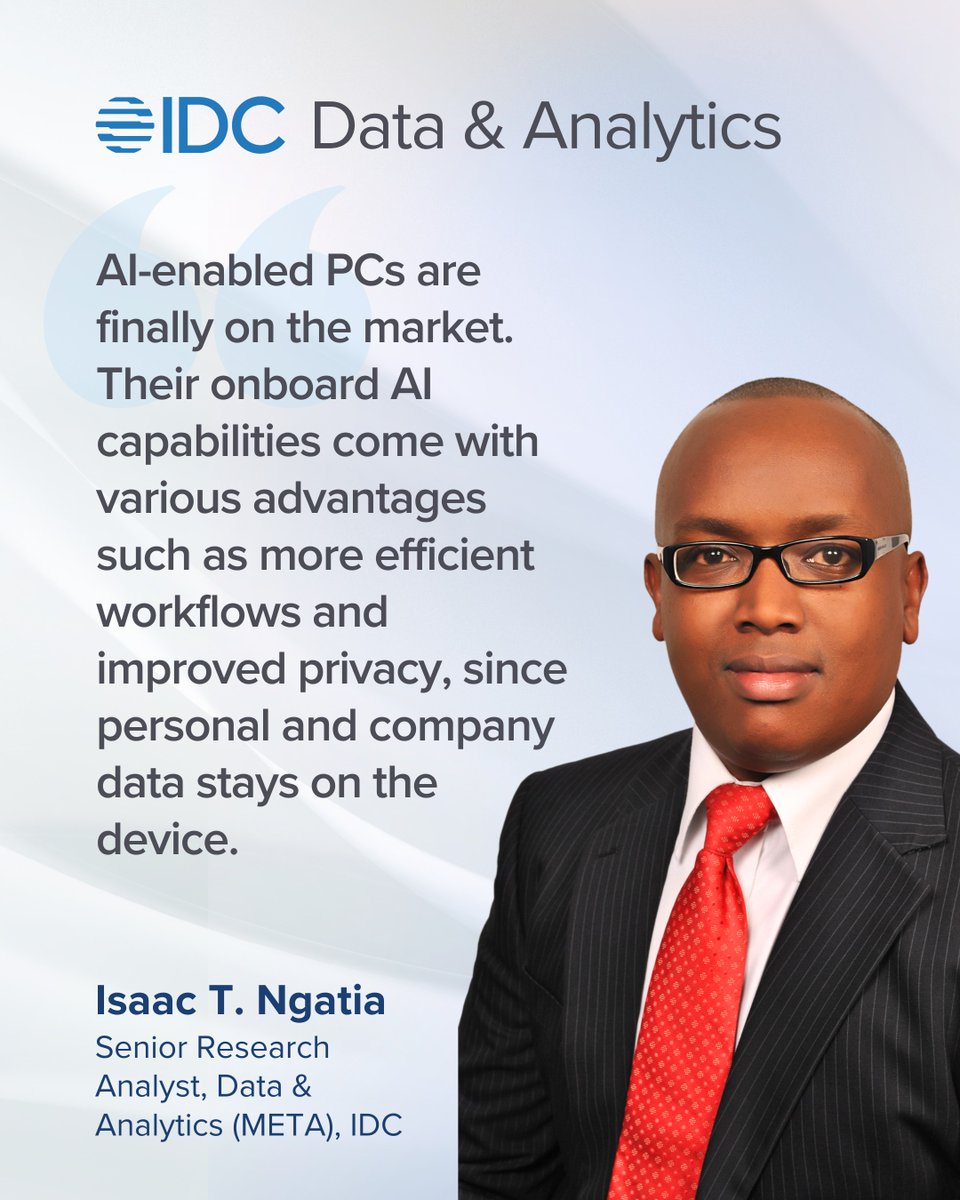
** PC boom in the Middle East, Türkiye & Africa!**
12.2% growth in Q1'24 & AI-powered machines are coming!
Get ready for the future of computing!
Read more at: https://t.co/UhsvOw36RX
#AI#METAregion#Technology#IDCreport@IDC