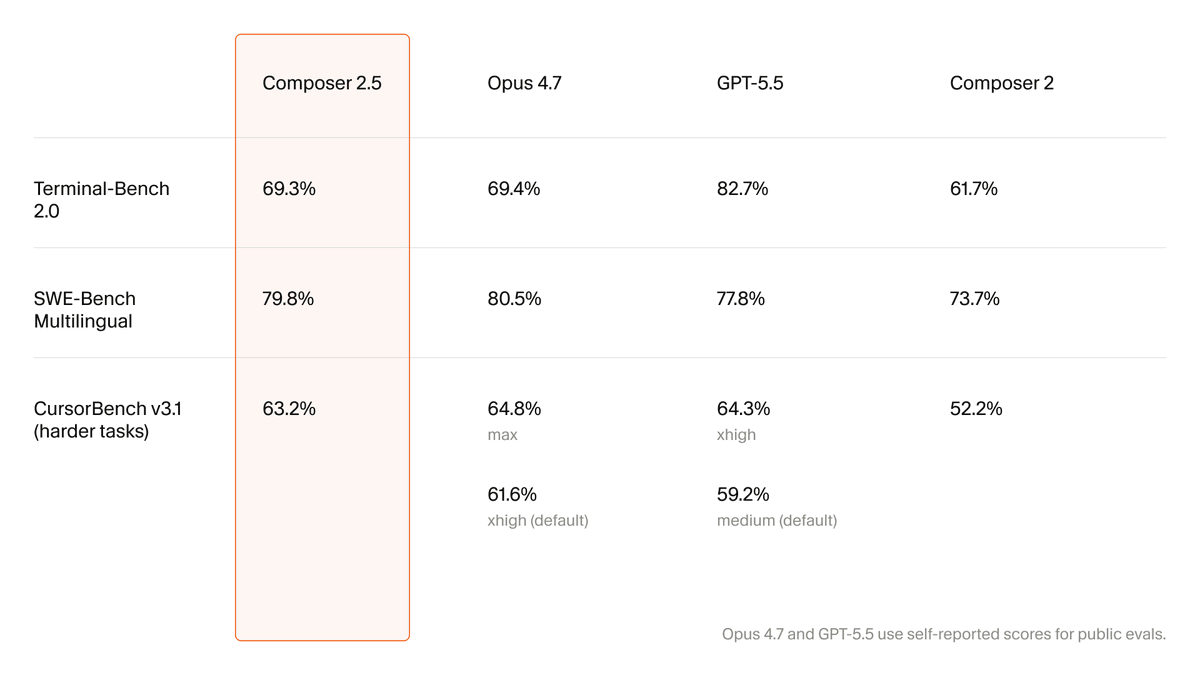
Introducing Composer 2.5, our most powerful model yet.
It's more intelligent, better at sustained work on long-running tasks, and more reliable at following complex instructions.
For the next week, we’re doubling the included usage of the model.
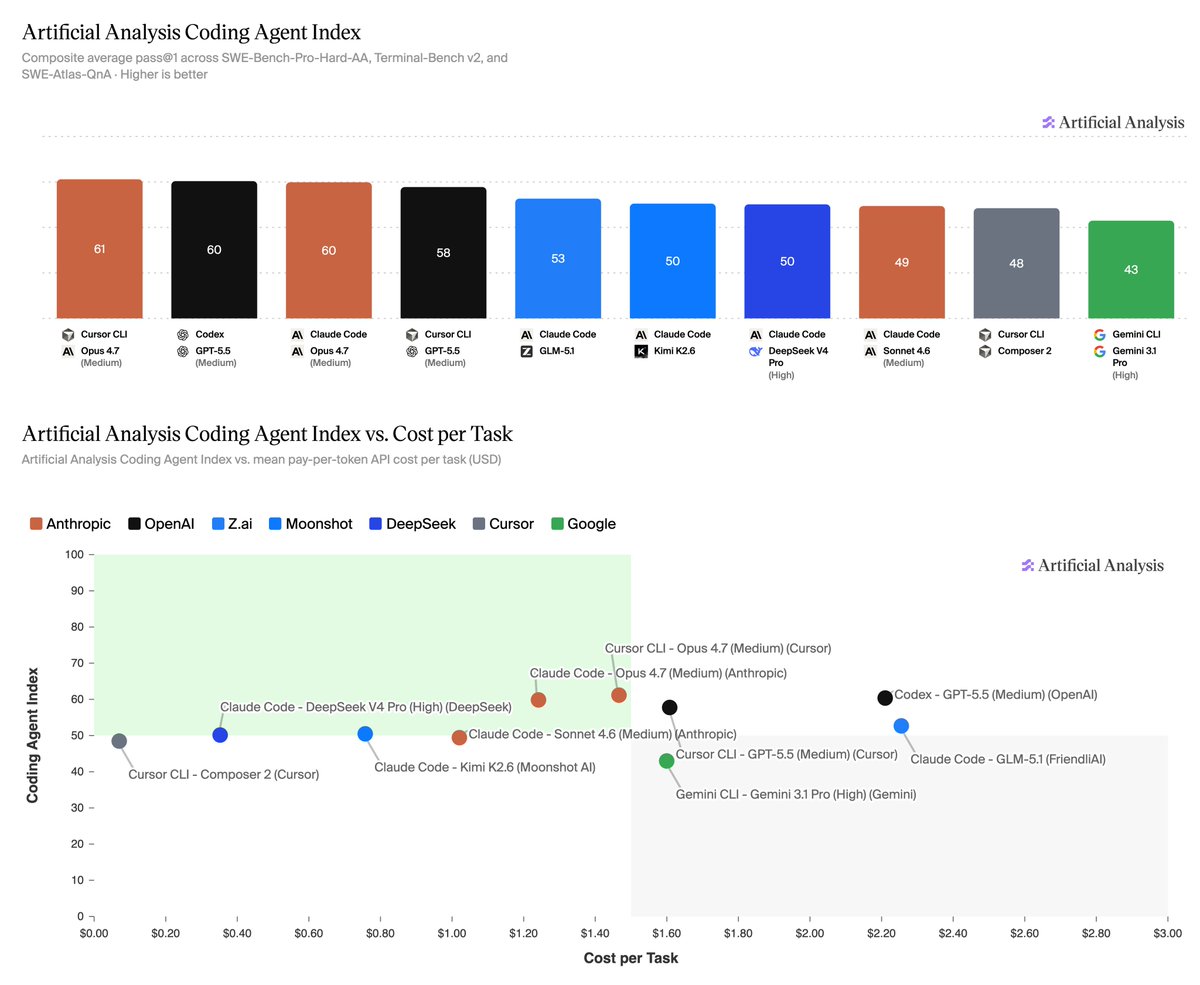
Announcing the Artificial Analysis Coding Agent Index! Our new coding agent benchmarks measure how combinations of agent harnesses and models perform on 3 leading benchmarks, token usage, cost and more
When developers use AI to code they’re choosing a model, but also pairing it with a specific harness. It makes sense to benchmark that combination to understand and compare performance.
The Artificial Analysis Coding Agent Index includes 3 leading benchmarks that represent a broad spectrum of coding agent use:
➤ SWE-Bench-Pro-Hard-AA, 150 realistic coding tasks that frontier models struggle with, sampled from Scale AI’s SWE-Bench Pro
➤ Terminal-Bench v2, 84 agentic terminal tasks from the Laude Institute and that range from system administration and cryptography to machine learning. 5 tasks were filtered due to environment incompatibility
➤ SWE-Atlas-QnA, 124 technical questions developed by Scale AI about how code behaves, root causes of issues, and more, requiring agents to explore codebases and give text answers
Analysis of results:
➤ Opus 4.7 and GPT-5.5 lead the Index: Opus 4.7 in Cursor CLI scores 61, followed closely by GPT-5.5 in Codex and Opus 4.7 in Claude Code at 60. GPT-5.5 in Cursor CLI follows at 58.
➤ Open weights models are competitive, but still trail the leaders: GLM-5.1 in Claude Code is the top open-weight result at 53, followed by Kimi K2.6 and DeepSeek V4 Pro in Claude Code at 50. These are strong results, but still meaningfully behind the top proprietary models.
➤ Gemini 3.1 Pro in Gemini CLI underperforms: Gemini 3.1 Pro in Gemini CLI scores 43, well below where Gemini 3.1 Pro sits on our Intelligence Index, highlighting that Gemini’s performance in Gemini CLI remains a relative weak spot for Google’s offering.
➤ Cost per task (API token pricing) varies >30x: Composer 2 in Cursor CLI is cheapest at $0.07/task, followed by DeepSeek V4 Pro in Claude Code at $0.35/task and Kimi K2.6 in Claude Code at $0.76/task. At the high end, GPT-5.5 in Codex costs $2.21/task, while GLM-5.1 in Claude Code costs $2.26/task. For both models this was contributed to by high token usage, and in GPT-5.5’s case by a relatively higher per token cost.
➤ Token usage varies >3x: GLM-5.1 in Claude Code uses the most tokens at 4.8M/task, followed by Kimi K2.6 at 3.7M/task and DeepSeek V4 Pro at 3.5M/task. GPT-5.5 in Codex uses 2.8M tokens/task, substantially more than Opus 4.7 in Claude Code at 1.7M/task. In GLM-5.1’s case, higher token usage, cost and execution time were partly driven by the model entering loops on some tasks.
➤ Cache hit rates remain high but vary materially: Cache hit rates range from 80% to 96% across combinations. Provider routing, harness prompt structure and cache behavior can materially change the economics of running the same model given cached inputs are typically <50% the API price of regular input tokens.
➤ Time per task varies >7x: Opus 4.7 in Claude Code is fastest at ~6 minutes/task, while Kimi K2.6 in Claude Code is slowest at ~40 minutes/task. This is contributed to by differences in average turns per task, token usage and API serving speed. Opus 4.7 had materially lower amount of turns to complete a task than all other models while Kimi K2.6 had the most.
➤ Cursor made real progress with Composer 2: Composer 2 in Cursor CLI scores 48, near the leading open-weight model results, while being the cheapest combination measured at $0.07/task. Cursor has stated Composer 2 is built from Kimi K2.5, showcasing they have made substantial post-training gains.
This is just the start. We are planning to add additional agents (both harnesses and models). Let us know what you would like to see added next.
A new PR review experience is now available in Cursor 3.
Take PRs from creation to merge, all in one place.
You can see comments, diffs, commits, and review status to understand what changed and next steps. Navigate larger PRs more quickly with the file tree and changes picker.
We’re introducing the Cursor SDK so you can build agents with the same runtime, harness, and models that power Cursor.
Run agents from CI/CD pipelines, create automations for end-to-end workflows, or embed agents directly inside your products.
We’re introducing the Cursor SDK so you can build agents with the same runtime, harness, and models that power Cursor.
Run agents from CI/CD pipelines, create automations for end-to-end workflows, or embed agents directly inside your products.
Introducing /multitask in the new Cursor 3 interface.
Cursor can now run async subagents to parallelize your requests instead of adding them to the queue.
For already queued messages, you can ask Cursor to multitask on them instead of waiting for the current run to finish.
Claude Opus 4.7 is now available in Cursor. We've found it to be impressively autonomous and more creative in its reasoning.
We're launching it with 50% off for a limited time. Enjoy!
Cursor can now respond by creating interactive canvases to visually represent information.
Ask it to generate dashboards and custom interfaces that are richer than plain text.