#RevOps & former #MarTech solutionist #Growthhacks#SFDC 5 x Certs + Accreds 50% maverick tinkerer/50% type A. Multilingual multi-local multi-doer shapeshifter.
1st personal industry award nomination (some garnered as a team @PA)! #InnovatorOfTheYear#WomeninTechExcellence awards 2022 in SME category. Well done to all finalists and to Estefania @CervestEarth on the win! Even more motivated to keep at #Architectin https://t.co/diGELEilDE
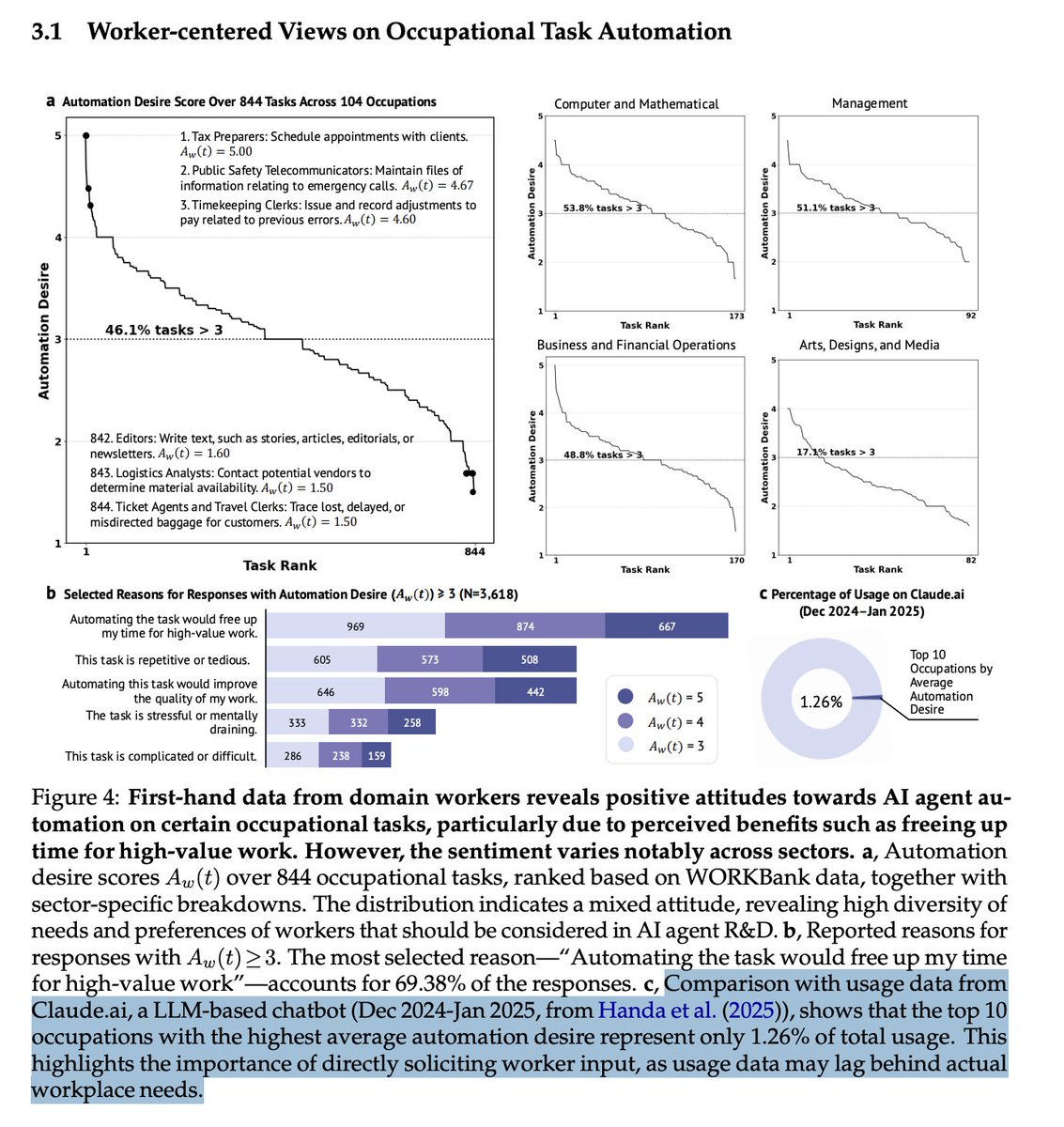
→ Comparison with usage data from Claude reveals the real problem ↓
The top 10 jobs that want automation most represent only 1.26% of actual AI usage.
We're solving the wrong problems while the biggest pain points get ignored.
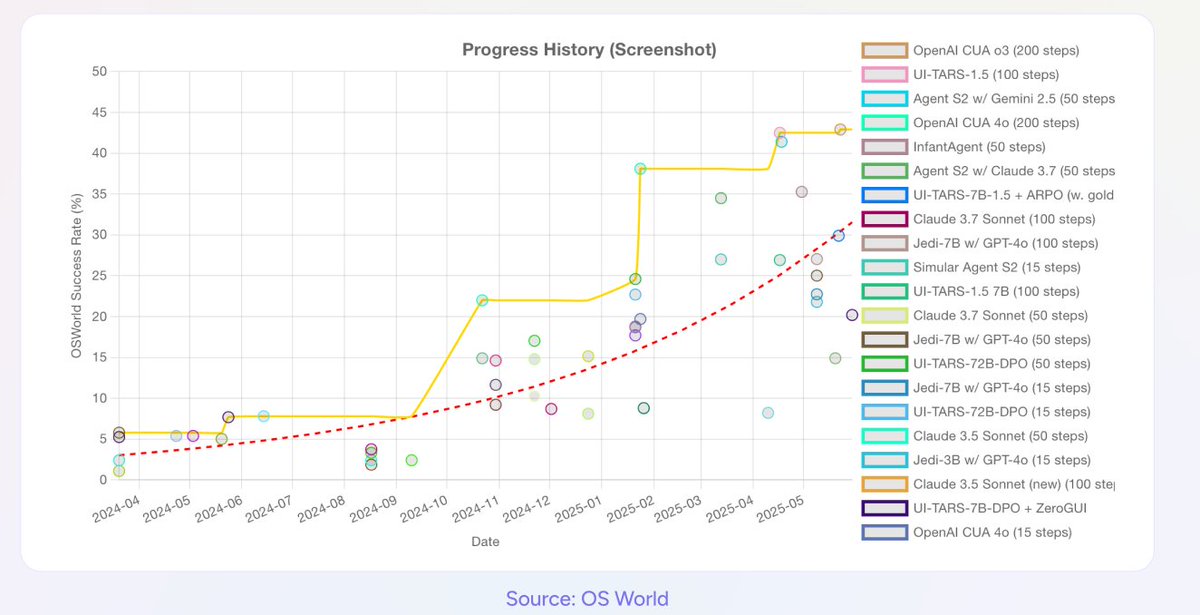
AI agents that can actually USE your computer - clicking buttons, filling forms, navigating spreadsheets - hit a wall in 2025.
These "computer use" agents promise to automate your digital work, but they're stuck at 40% success vs the 70% human benchmark.
One fascinating decision with building LLM integrations is Agent vs Workflow.
Agent: give the LLM control of execution. Slower, but better at a wider range of things.
Workflow: use code to control execution. Faster, but more specialised.
Ultimately, it comes down to the product you're building.
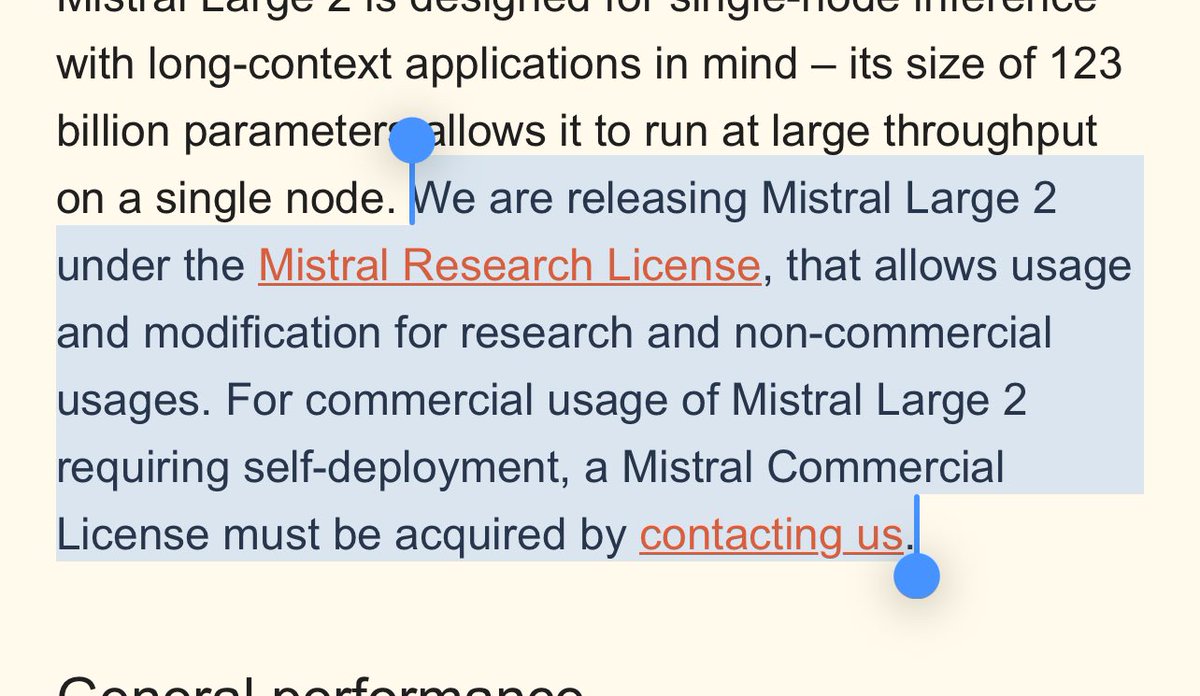
@verrsane @ThuleanFuturist @MistralAI Yeah initially it was closed, and then they changed it to open with restrictive license
Here is the latest checkpoint on huggingface https://t.co/3QIdUVVGRG
Here is the article I’m screenshotting, posted about 5 months after the one you linked https://t.co/rxBwFd5lc3
Cerebras is proud to be powering the new Le Chat!
We enable Flash Answers to run at over 1,100 tokens/s – 10x faster than ChatGPT 4o, Sonnet 3.5, and DeepSeek R1.
Try Le Chat: https://t.co/Vpg2in8SU8
Learn more: https://t.co/EJZQznipQU
BREAKING 🚨: Mistral is getting fully rebranded 🔥
- New logo!
- Upgraded Le Chat UI
- New perks on Le Chat
- Upgraded news website
- A new Android app 🔥
Get ready for Pro 🤖
I started building an iOS app for @MistralAI.
Why?
Europe has *one* company that can compete with OpenAI, Anthropic, DeepSeek, etc.: Mistral.
And Mistral's models are good — we use them (among others) in @getsupermoon.
Mistral Large 2 is comparable to GPT-4o in terms of quality, and it costs ~30% less. And Mistral Small 3 is comparable to GPT-4o-mini and about 50% cheaper.
Their models are open source too and have been from the start!
But Mistral doesn't get the attention it deserves, and I think one of the reasons is that they don't have an app.
There's Le Chat with canvas, browsing, image gen, etc., but it's web-only, a.k.a. not nearly as discoverable as an app in the App Store, so it's hard for non-developers to find out about Mistral and because of that Mistral is missing out on revenue.
Honestly, I don't know why they haven't built an app yet. It seems like a no-brainer to me, and it shouldn't be *that* much work.
So... I figured I'd just start building it. So far it streams responses, lets you switch between models, renders some Markdown and has light and dark mode.
This took me a few hours. I'm thinking about continuing and building the full-fledged app. Maybe at the end I could give the source code to Mistral so they can make it official. But before I do I want to know what you all think. Is this something you'd use?
On paper this is an improvement - digitalizing powers of attorneys can simplify some companies paperwork and switch to digital.
issues remain:
- lacks ambition and courage as it keeps notaries’ privileges
- the law is adopted now.. but come into force in… june 2028!!!
- if you discover the law is not respected or even transposed, then from june 2028, but NOT before and even if your member state systematically breaches past directives, ONLY then, you can initiate a lawsuit to defend your rights.
- then this will take 7-8 years aprox to reach European courts- as you must go first through all member state national courts before you have the right to go to @EUCourtPress for a decision 2 years later.
Yes, yo’ ll be able to enforce the rights of this modest digitalization law.. 14 years from now, in 2038 aprox.
That’s almost 3 times the average lifetime of a European company (and of course if your company closes before there’s no court decision, perfect for the other side)
This is for a law that has taken years in preparation, so probably a 16-18 years process.
If you think about the new laws that don’t even exist yet, you are talking of longer timeframes, including EU Inc or capital markets.
That’s why we believe not only we need new laws but ultra fast lawsuit processes and courts for pro-business, pro-growth, anti-red tape laws.
And the upcoming legal changes have to be much much faster from drafting, voting to enforcement date and enforcement court timelines.
We urge @EUCssrMcGrath , @EZaharievaEU@steph_sejourne@vonderleyen to totally rethink the system if we want Europe to accelerate.
How old will you be in 15 years? We don’t accept that all we push forward turn into reality so slowly.
Accelerate. Amplify us. 🔊🔊
🇪🇺 eu/acc
Une semaine plus tard, toujours aucun correctif apporté à ces titres erronés : non, le Pavillon des Sources n’est pas classé Monument Historique, et non, @datirachida n’a pas (ou plus) l’intention d’en demander le classement.
@ADragonDemands@Variety@Abzybabzy No. This will be a French-speaking film and if any proper historian is hired to work on this, the chosen title role impersonator will be from the Caribbean, just like Dumas, able to speak Creole AND 18th century French like a noble in Paris at the time a bonus.
🇪🇺 eu/acc
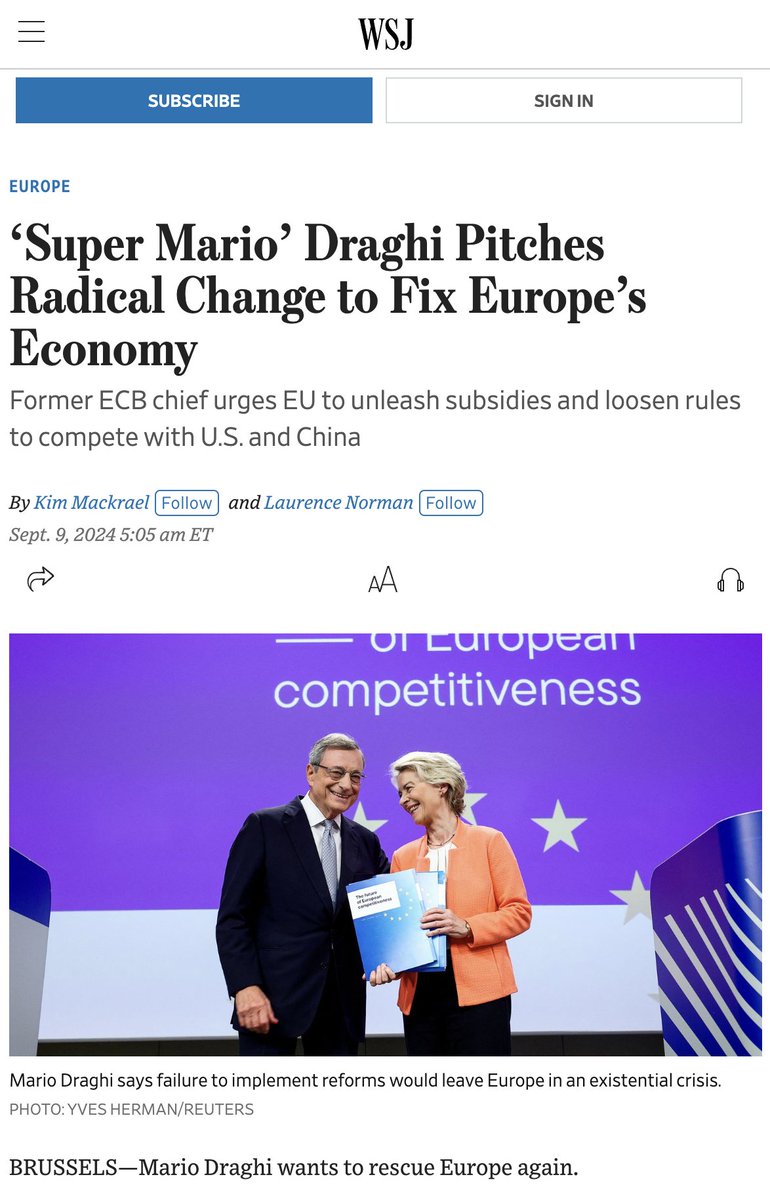
A few weeks ago Mario Draghi asked my recommendations for his report that came out today about European competitiveness
I had a call with him and summarized my problems with doing business in the EU
I wrote this which is included in the report presented to the European Union today:
1. Minimum revenue cut offs for current and new regulation
Exempt small businesses with annual revenues below €10 million from complex regulations like VATMOSS, GDPR, the EU AI Act, and certain labor laws. This approach encourages innovation and growth by allowing startups to focus on product development and market validation without the heavy burden of regulatory compliance. Once these businesses surpass €10 million, they will have the resources to comply with regulations, ensuring that growth is not stifled.
2. Simplify starting a pan-EU business with an EU-wide Incorporation (Inc.) business form
Currently, starting and operating a business across the EU is complex due to 27 member states, each with its own company registration requirements. To streamline this process and make it easier for entrepreneurs to operate across Europe, there should be a single, standardized business entity that applies uniformly across all EU countries. I call this the European Inc.
3. Start an EU business fully online, no physical offices, notaries, lawyers etc
To continue, right now starting a business in most EU member states it’s complicated, very time and resource intensive, and often involves lawyers and notaries. Instead, it should be as simple as going online to a centralized EU website, where entrepreneurs can register their business and details in just a few clicks. The entire process should be streamlined and efficient, allowing businesses to start operating immediately.
The EU government taxes and bookkeeping of this business should also be fully online in an EU portal/dashboard.
4. 0% corporate tax for first 3 years of any new business
Countries like Singapore have successfully attracted new businesses from around the world by giving them a massive tax discount during the first 3 years of business. Because they know that’s the most difficult time of a business: figuring out what product it makes and if there’s a market for it. That takes pressure off startups and business founders that they can focus on creating a great product and innovating.
5. Change tax on stock options: don't tax when a stock option is exercised, but tax it when the stock is sold
The current tax policy in the EU taxes stock options at the time they are exercised, creating a significant financial burden on employees who have not yet realized any tangible financial gain. This approach stifles innovation, discourages entrepreneurship, and places the EU at a competitive disadvantage compared to other regions like the United States.
I propose a simple change: Tax stock options when the stock is sold, not when the option is exercised.
6. Don’t see tech or AI as an enemy, but as a burgeoning and essential industry
The most popular companies in tech are focused on AI right now for a reason. It’s the next frontier of computing. The European Union seems to consider AI the enemy. Any technology can be used for good or bad. By regulating it even before Europe has made much contributions (Europe has almost no tech companies leading in AI), it has stifled any potential innovation in AI from the start.
Apart from the regulation itself, the optics of it make the EU look bad on a global scale. Why would tech founders move to Europe to start a business if the EU is actively positioning itself as Anti-AI?
AI has gigantic potential to be used for good: think of the medical field for diagnosis of diseases, generally in programming (it helps programmers to create software faster/better), etc.
This goes further than AI. The same applies to tech in general. It seems the EU is on a crusade against technology while not being able to compete in it itself. It feels a case of sour grapes: if we can’t build great technology in EU, nobody is allowed to do so!
7. Teach tech/coding/AI topics in all schools and unis
It would help a lot if the EU has a focus on teaching AI and tech in schools and universities. Making the new generation competitive in this field instead. To secure the future prosperity of the European Union, we must prioritize education in technology, coding, and AI across all levels of schooling, from primary education to universities. This strategic focus is not just an educational reform—it’s a critical investment in the future competitiveness, innovation, and economic resilience of the EU.
Todoist has made more than $100 million in total revenue, which isn't very interesting because many others have reached this number. What's interesting is that we did it in our unique way:
— Fully bootstrapped. Customers have supported us since the beginning, and we've used only our revenues to improve things further.
— Complete independence. Since we are customer-supported, no one tells us what we can or can't do.
— Remote-first. But not only remote-first, we've hired super talented people worldwide who never went to Ivy League schools or worked at Google. Many of the early people who joined Doist have seen a 10x increase in compensation as we've scaled Doist.
— Europe mixed with US mentality. We've achieved this by working 40-hour workweeks and taking 40 days of vacation per year. We only work on weekdays. The three-member CXO team has 8 kids, and we got them while we scaled Doist.
The most critical personal lesson I've learned is that you can do much more than you think. I came from a refugee background and started a real school in the 4th grade. Starting and running a tech company was not even plausible while growing up. But here we are! So start learning, growing, and building! You got this 😊🚀
Universal Analytics is officially ending on 1 July 2024. Don’t lose your data! 📊 Take a moment to export it now. We’ve got simple steps to help you out. Check it out here 👉 https://t.co/dAF0HI0Eky
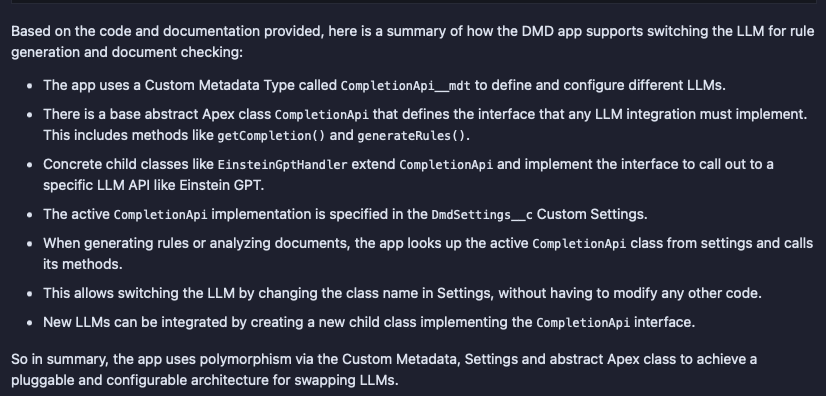
I don't code a lot anymore. And when I do, I enjoy it too much to have AI do it for me. So, I don't use Copilot. For the last few weeks, I have used and already fell in love with @SourcegraphCody. Unlike other assistants it takes my whole project code and reasons about it.
Meet the new Einstein Copilot👩🏽✈️ unveiled at @Dreamforce today!
Just chat with it, and it'll help with meeting prep, landing pages, product catalogs, code, and more. Tailored for every industry. Fully customizable with clicks. Einstein Trust Layer built-in.
Einstein Copilot activates your trusted company data and workflows to multiply every employee's productivity safely and securely ☁️🪄✨
#DF23 #GenAI
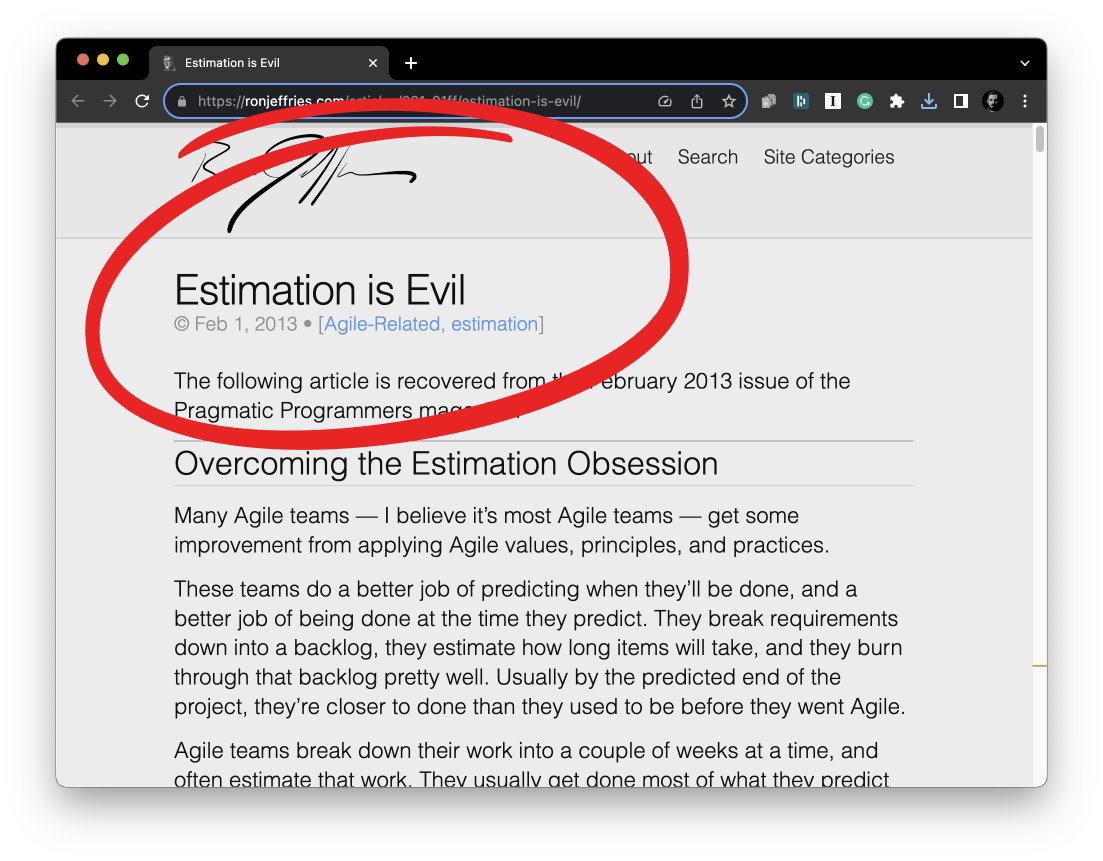
Story Points don't work.
Even Ron Jeffries, who invented them, said he was sorry years ago.
And not only did he apologize, but he called the whole estimation idea "Evil."
Unfortunately, too many teams still use these points to estimate their work.
Story Points is a made-up metric to estimate work effort, not time. The goal was to prevent management from misusing estimates.
But it didn't work.
Every team I've ever met keeps a conversion table to translate back and forth between points and time. Some will never admit it, but go and talk to the folks doing the work.
Look at me and tell me I'm wrong.
But it gets worse:
Teams use points to decide how much work they can finish. But how can they do that without talking about time?
The effort to do something is not the same as the time it will take to finish it. This is especially true when planning an iteration with many people and tasks.
It's clear now: Story Points don't work.
What's the alternative?
I'll let the people who manage projects for a living offer their alternatives, but I can tell you what I've done.
As I got older and wiser, I stopped with the estimation charade altogether. I had my teams focus on short iterations with constant feedback from stakeholders.
From the "scope, budget, and time" triangle, I always tried to keep two of them variable and fix the third one.
If the customer was looking for a specific scope, we had a variable timeline and budget to finish it. We kept the scope and time flexible if the budget was non-negotiable. And if we had to deliver by a specific date, the scope and budget were on the table.
Every company is different, and this doesn't work for everyone. But if it does, I hope you stop the charade.
I'd love to hear about your experience estimating software. What crazy things does your company make you do?