The Houthis’ rapid advance is just the beginning of the blowback effects we are now going to face as a result of our counterproductive policies in the Middle East & because of this senseless war in Iran.
The Houthi’s ability to capture key terrain and strategic ports along the Red Sea coast speaks to not just their military capabilities but also to their ability to gain support from tribes far from the traditional Houthi strongholds in northern Yemen.
This is very significant—these tribes are predominantly Sunni, while the Houthis are Zaydi Shias.
Yemen is a tribal region—deals among rivals are frequently cut before or during battles, and even then those alliances can be murky.
Now, however, the Houthis are fighting alongside the IRGC as a member of the axis of resistance against the Saudis, the U.S., and Israel. This has given them far more popular support than a standard tribal deal or a military victory ever could—not because Yemenis support or particularly care about the Iranians, but because especially during times of conflict, we go tribal. It’s human nature.
The Yemenis have witnessed what the U.S.-backed Saudis have done to their people and what the U.S. backed Israelis have done to the people of Gaza, & see how the Iranians are fighting back after the U.S. & Israel attacked them. Now, they’re uniting against their common enemy to fight back.
The U.S.’s war in Iran & simultaneous backing of the Saudis’ war in Yemen, along with our government’s support for Israel’s genocide in Gaza, have given the Iranian Islamic revolution a massive boost that has reached far beyond Iran.
As our war against Iran drags on we will see more of this, especially in Iraq, Lebanon & potentially Bahrain.
Our own policies and interventions abroad are encouraging radicalization, which will in turn inspire blowback terrorism here in the U.S. This is a destructive self-licking ice cream cone and it’s going to get more people killed.
President Trump and his advisors know better, and know that ending our foreign entanglements now is in the best interest of the American people. The question is whether they have the moral courage to do it.
1/ grateful to @a16zcrypto for recognizing the importance of ensuring financial institutions can use/build on permissionless networks. The article published today gives a brief synopsis of the paper (&framework) @m_mosier_@malekanoms (link ⬇️).
This is no longer a fringe position dismissed as a conspiracy theory. Nearly nine out of every ten Americans now look at their government and see an institution serving someone other than the people.
Sorry, but it's not just Anthropic. Palantir has been working on predictive policing and surveillance of dissidents for the US government for well over a decade. The goal of the Bush admin immediately after 9/11 was pre-crime via "Total Information Awareness" and they have been building it ever since, through the privatization of that program as Palantir. And there are other companies working toward this end to, all with ties to US intelligence or top US officials (Satellogic, SpaceX, Axon/Carbyne, etc.)
Anthropic may be "building" their own private equivalent, but this is something the government and its other private contractors have already built. Under the first Trump admin, Bill Barr as AG created the legal framework for pre-crime. They are just waiting on the right excuse or justification to scale it.
We have to realize how far along this is if we really want to stop it. It is now many companies ushering in a pre-crime paradigm, all with State backing.
I normally don't do opinion pieces, but I just wrote one about AI-powered “detectors” of AI-authored content and important issues with them that I think need to be urgently discussed, especially within independent media.
While these "detectors" have recently been promoted as a way to protect human writing online, that’s not what’s really happening.
https://t.co/sPAqbTS3em
🚨 BREAKING: The UK government has declared that every phone in the country must now carry ID verification and embedded surveillance software.
Your device will be effectively LOCKED unless you submit to mandatory “digital safety” scans.
South Africa’s fuel import dependence has risen from 22% in 2019 to about 61%. The Central Energy Fund plans to rebuild Sapref to process 400 000 barrels a day, potentially rising to 650 000.
#Moneyweb#OilRefining
https://t.co/uM3MGWIb7H
Today, we launched the world’s first automated production line for advanced general‑purpose humanoid robots, using robots to mass‑produce robots, autonomously.
This was uncharted territory, and we solved it from scratch. The commissioning of our production line means humanoid robots are now ready to scale up and step into the real world.
What touched my heartstrings most was watching our very first advanced general‑purpose humanoid robot complete assembly and walk off the line on its own. To me, this is not just about a smarter tool or a commodity. I hope it gains true generalization ability to take on dangerous, repetitive, or undesirable tasks, and ultimately make life better. Perhaps one day, robots may become our companions, friends, or part of family.
Grateful to every colleague on this momumental mission. And a warm welcome to IRON!
How the government is using Tether to build the financial component of the surveillance state.
Two guys in Bangkok ran a gaming promotion business that was legal, and licensed. They arranged VIP experiences, travel, lodging, meals, for high-roller clients at casinos operated by a publicly traded US company in Asia. The casino did KYC on them and on their customers. They independently screened every crypto wallet that touched their business. They were not hiding from anyone
On October 30, 2025, at 11 PM UTC, Tether blacklisted ten of their Ethereum wallets in a two-and-a-half-minute batch. $42,417,785.62 frozen. The largest wallet alone held $26.1 million. One of the men, Natthawat Kasamvilas, contacted Tether to find out what happened. On November 2nd Tether emailed him back, gave him the name of a Homeland Security Investigations agent, and said "We do not have further information at this time." They did not mention that they were the ones who froze the money
Here is what actually happened. An HSI agent out of Raleigh, North Carolina got a tip from a victim, one person, identified in court documents only as "GM", who lost roughly $30,000 in a romance scam. HSI traced GM's $30,000 to a consolidation wallet, then identified 18 wallets belonging to Thai nationals, then traced forward to 11 more wallets connected to two of those Thai nationals. None of those 11 wallets belonged to Kasamvilas or his business partner Nutthawat Rukthammachalern. The affidavit does not trace a single dollar from the scam victim to their wallets. The tracing exhibits the government submitted were, according to their lawyers, "so blurry and illegible that it is impossible to meaningfully review or decipher" them. When clearer copies were requested, key portions were still unreadable
But none of that mattered, because before any of that paperwork existed, before any judge reviewed any evidence, a Homeland Security agent called Tether and asked them to freeze the wallets. He did not have a warrant or a court order or a subpoena. Just a request. And Tether did it
They flew to the United States. On May 21, 2026, they sat down with HSI officials in person, brought lawyers, presented evidence that the government's own affidavit had no tracing connecting the scam to their wallets. HSI gave them no substantive answers and no path to get their money back
As of today, no indictment has been filed against them. No criminal charges. and no civil forfeiture complaint. The government has not accused them of a crime in any court. But their $42.4 million is still frozen. And the whole time it has been frozen, Tether has been earning Treasury yield on the reserves backing those tokens. The company that locked their money is profiting from locking their money and not giving it back.
Kasamvilas and Rukthammachalern had no account with Tether. They bought their USDT on the open market, the same way 650 million other people use it. And Tether froze it anyway because it has a function built into its smart contract called addBlackList that lets the company unilaterally lock any wallet on earth with no judge, no hearing, just a line of code
They filed a motion in North Carolina on July 31st demanding the government return their funds. Then on August 31st they sued Tether in the Southern District of New York. The lawsuit says what happened to them is conversion, trespass, and unjust enrichment. Tether called the case "baseless" and said it was interfering with their "important work with global law enforcement"
So, a private company incorporated in the British Virgin Islands, now operating out of El Salvador, froze $42.4 million belonging to two foreign nationals based on a phone call from one US federal agent investigating a $30,000 scam. No charges filed to this day. And when they sued, the company said helping law enforcement freeze people's money without legal process is "important work".
That is not how the law works when the government freezes your bank account. They need a judge. They need probable cause. They need the 4th Amendment. But Tether is not the government, and that is the point.
They already did this with physical surveillance. Flock Safety has 120,000 cameras across 49 states tracking every car that passes, make, model, color, scratches, passengers, pedestrians. Police departments buy access, and CBP taps in, no warrant needed because it is a private company selling a service. Axon has 85 percent of the body camera market and built a platform that merges CCTV, drones, license plate readers, gunshot detection, and AI analytics into what they call a "single pane of glass." Palantir combined financial transactions, communications, travel records, and criminal databases into one system and sold it to the CIA, ICE, the Pentagon, and local police. The FBI uses it for "complete target analysis of known populations"
The 4th Amendment says the government cannot search you without a warrant. But if a private company collects the data and the government buys access to it, or just asks nicely, that protection disappears. A bipartisan group in Congress called it a loophole and introduced the Fourth Amendment Is Not For Sale Act. It has not passed, of course.
Now they are doing the same thing with our money.
If the government wanted to monitor every financial transaction in America, it would need legislation, judicial oversight, probably a Supreme Court fight. It would take years and it might fail. But if a private company issues a digital currency that 650 million people use, monitors every transaction through the FBI's own surveillance contractor, and freezes wallets on a phone call, well the government gets the same result without any of the legal burden.
Here is what you would need to build a privatized financial surveillance network and what Tether has already done.
(1) You would need a currency people are forced into.
So you ban the government from making its own digital dollar…done, January 2025 executive order. Then you pass a law making private stablecoins the only legal option…done, GENIUS Act. You crash the real dollar with tariffs so people worldwide switch to the digital one…happening right now. Tether is at 650 million users and adding 30 million wallets a quarter.
(2) You would need to see every transaction.
Tether partnered with Chainalysis, the same surveillance firm the FBI and Secret Service use to track money. Every USDT transaction on every blockchain is monitored in real time
(3) You would need identity resolution.
The GENIUS Act classifies stablecoins as financial institutions under the Bank Secrecy Act. KYC requirements, transaction monitoring, suspicious activity reporting. FinCEN published the compliance rules in June 2026. Every user becomes identifiable.
4) You would need the power to freeze and seize without going through a judge.
Tether has frozen $4.4 billion across thousands of wallets. They work with 310 law enforcement agencies in 64 countries. They froze $42.4 million on a verbal request from one agent.
(5) You would need physical surveillance to pair with financial surveillance, because money tells you what someone bought but not where they are.
Tether invested in Satellogic, a satellite company building daily coverage of the entire planet by 2027. The tech partner is Palantir, the AI runs on the satellites. The capability is called "pattern of life assessment."
(6) You would need computing power to process it all.
Tether owns 22,000 Nvidia GPUs through the Rumble-Northern Data merger. $150 million committed for GPU access.
(7) You would need media control in case anyone starts reporting on it.
Tether owns 48 percent of Rumble and signed a $100 million advertising deal.
(8) And you would need the regulators to protect you instead of investigating you.
The Commerce Secretary's family firm custodies Tether's reserves and owns 5% of it. The former Treasury Secretary chairs the satellite company. The White House crypto czar wrote the law and became Tether's CEO one month later. And the Corporate Transparency Act, the one law that required shell companies to disclose who owns them, got deleted.
That is every piece all in place. Hard to ignore. All owned by one company that has never been audited, is incorporated in the British Virgin Islands, and is run by four men, two who just moved to El Salvador with 15 shell companies and no extradition treaty.
The 4th Amendment was written to stop the government from doing this. It does not apply to Tether and that is their plan, I think. They are privatizing the surveillance apparatus and Tether looks like the financial component.
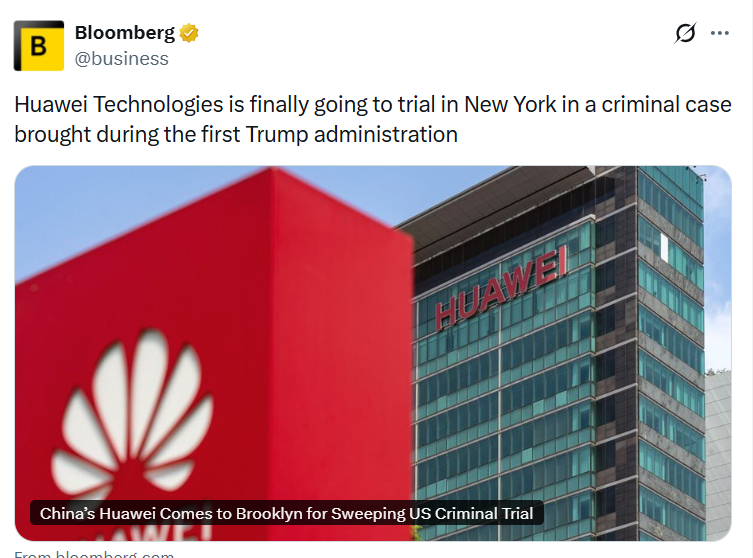
欲加之罪,何患无辞。Huawei has pleaded not guilty to all charges. Having already lost the US market, what does it have to do with the US? The US has cut off its access to chips, operating systems, Google app services, removed Huawei's 5G base stations, banned Huawei phones and autonomous driving systems, and even forced Canada to illegally detain Huawei's Meng Wanzhou. Therefore, Huawei is simply defending its honor, refusing to smear, slander, and coercion.
However, Huawei has not been defeated. Instead, it has broken through technological and market blockades step by step, creating a commercial miracle, building a fully domestically produced hardware manufacturing system and software ecosystem, and driving Nvidia out of the Chinese market in the field of high-end chip design and manufacturing.
If the US wins, it will establish the expansion of US dollar clearing jurisdiction, significantly increasing the criminal risks for other global technology companies and providing a bad precedent for US extraterritorial criminal jurisdiction over global technology companies.
If Huawei wins, it will thwart the excessive expansion of US jurisdiction over global technology companies and defend the boundaries of normal commercial competition among technology companies.
🇫🇷🇳🇱 France just took every ounce of its gold out of New York, and did it in a way that never had to ask Washington's permission
Since the 1930s, sixty-odd countries have kept their gold under Manhattan.
The logic was simple: park it with the richest, best-armed neighbor on the block, an ocean away from any invasion.
Last week France brought all of it home, and the Netherlands moved nearly everything to London. Neither shipped a bar.
Jay Martin explains why.
They sold in New York and rebought in Europe, because Germany's repatriation took four years, and because selling means you never have to ask the question that could blow up an alliance... would America say no?
The trigger, in his reading, was 2022, when $300 billion in Russian reserves were frozen and every central bank learned the same lesson:
"if you can't trust the custodian of your assets, you need to do something about that"
Central banks bought a record 244 tons of gold this spring.
They are not buying it to leave it in New York.
@JayMartinBC
Bessent has trapped himself. He is now going to have to commit to some insanely high buyback. Maybe $100bn or more. If the markets spit that back at him the credibility of the US Treasury is on the line. 🇺🇸🏦
Globalists are terrified of decentralized (open source) AI. It gives people access to knowledge, creative assistance, expert advice and process automation that helps set people free from centralized control, forced ignorance, government censorship and engineered mass poverty.
Use open source AI. If you know what to do with it, it will help set you free.
Iran has activated the new tactic previously announced by Mohsen Rezaei: directly targeting US naval forces.
This is only the opening phase. The attacks are expected to grow in scale and intensity, alongside continued strikes on US assets in Jordan, Israel’s first external line of defence.
A direct Iranian–Israeli confrontation is no longer a question of whether, but when.
Eric X. Li’s exchange with John Pilger lays it out plainly.
Voting in the United States is mostly political theater.
Parties rotate, slogans change, new faces come and go,but the core policies stay tied to money.
Why?
Because wealth runs the system. Billionaires, lobbyists, and financial elites shape the rules, while voters are given the illusion of choice.
Real power isn’t in elections,it’s in boardrooms.
The pattern is obvious.
Trump filled his circle with billionaires, cut corporate taxes, and blurred the line between policy and business. Democrats do the same thing with cleaner messaging.
Obama’s Wall Street bailout didn’t punish anyone,it protected the same financial interests that caused the crisis.
Different branding, same structure.
The system isn’t failing, it’s doing exactly what it was built to do: protect the top tier.
China runs a complete different model.
The Communist Party doesn’t rely on campaign money or pretend elections control wealth.
Leadership stays consistent, policies shift when needed, and long-term planning actually happens.
That stability helped drive rapid industrial growth and lift massive numbers out of poverty.
And China isn’t “capitalist” in the Western sense.
Markets exist, but they don’t run the state.
Wealth is managed, not obeyed. Billionaires don’t set national direction.
So the contrast is simple: one system claims democracy while serving wealth; the other openly prioritizes state control and focuses on outcomes.
This is the textbook definition of a Greek gift. On the surface, OpenAI generously grants 10,000 top-tier mathematicians and elite engineers free access to their frontier models under the noble, philanthropic banner of accelerating scientific discovery, pushing the boundaries of human knowledge, and democratizing artificial intelligence.
But deep down in the cold reality of Silicon Valley capitalism, what they are actually doing is executing a massive, highly sophisticated intellectual heist. They are quietly gaining unrestricted, backdoor access to the raw, unfiltered, and unpublished works of the absolute finest minds in the global scientific community. Every single complex prompt, every mathematical query, every theoretical framework, and every line of experimental code fed into that system is a novel, groundbreaking idea that does not even exist yet in published academic literature or peer-reviewed journals.
OpenAI does not just provide a helpful service. Their corporate algorithms sit quietly behind the scenes, aggressively monitoring all chat logs, scraping the intellectual property, analyzing the logical steps, and meticulously piecing together these fragmented, brilliant ideas over several months. And just when the human researcher is finally on the absolute brink of putting everything together, OpenAI will ruthlessly assemble a digital army of 10,000 autonomous AI agents, burn $20 million worth of computational tokens, and brute-force the final mathematical steps.
Then, with the backing of their massive PR machine, corporate journalists, and tech influencers, they will proudly hold a press conference to claim that their proprietary chatbot has miraculously solved a Millennium Prize problem, completely, shamelessly erasing the human genius they systematically strip-mined to achieve it.
And for the record much of the technology people worship as private entrepreneurial innovation began inside publicly funded MIC and intelligence programmes built for surveillance warfare and killing civilians
The public funds the research and absorbs the MIC risk
The technology is then transferred into private TIC companies where founders and investors capture the gains while the fantasy story of a founder in a garage is manufactured for the public
Even the “entrepreneur” who bought this app relied on Wall Street banks and outside investors to finance the deal
That is FIC manufacturing and financing the entrepreneurs people worship
MIC creates it
TIC commercialises it
FIC finances and owns it
Socialise the risk
Privatise the gains
See DARPA In Q Tel and Israel’s Unit 8200 pipeline