Ichiro started in the majors at 27 and finished with 3,089 hits, and in 2016 Pete Rose, shown in a Reds uniform, pushed back on adding his hits from Japan.
"I'm not trying to take anything away from Ichiro, but the next thing you know, they'll be counting his high school hits."
As a 15-year-old high school sophomore from Sparks, Nevada, Gabby Williams finished fifth in the high jump at the 2012 U.S. Olympic Trials with a personal best of 6 feet 2¼ inches - the youngest competitor in any event at the trials.
She cleared the height on her first attempt at Hayward Field in Eugene, Oregon, after a dramatic sequence earlier (missing twice at a lower height before making it on her third try to stay in the competition). The crowd of nearly 21,000 gave her a standing ovation.
She tied a long-standing high-school sophomore class record held by five-time Olympian Amy Acuff and qualified as an alternate for the London Olympics, though she was too young for the U.S. junior team.
At the time, she was a multi-event track standout (Gatorade Nevada Track Athlete of the Year as a freshman and sophomore, state champ in hurdles and high jump) who also played basketball at Reed High.
She once said she preferred high jump to basketball for its pure “you’re either good, or you’re not” atmosphere with no trash talk.
Two successive ACL tears in high school (the first midway through her junior basketball season) ended the track path. After the second, she realized she wanted to focus on basketball - a decision that led her to UConn (two national titles), the WNBA (one title), and a dual-citizenship international career representing France (where her mother is from and her grandmother taught her the language).
That high-jump elasticity still shows up in her basketball game: the way she elevates for rebounds and contests shots. This is a lesser-told chapter for someone now known as a versatile two-way WNBA forward.
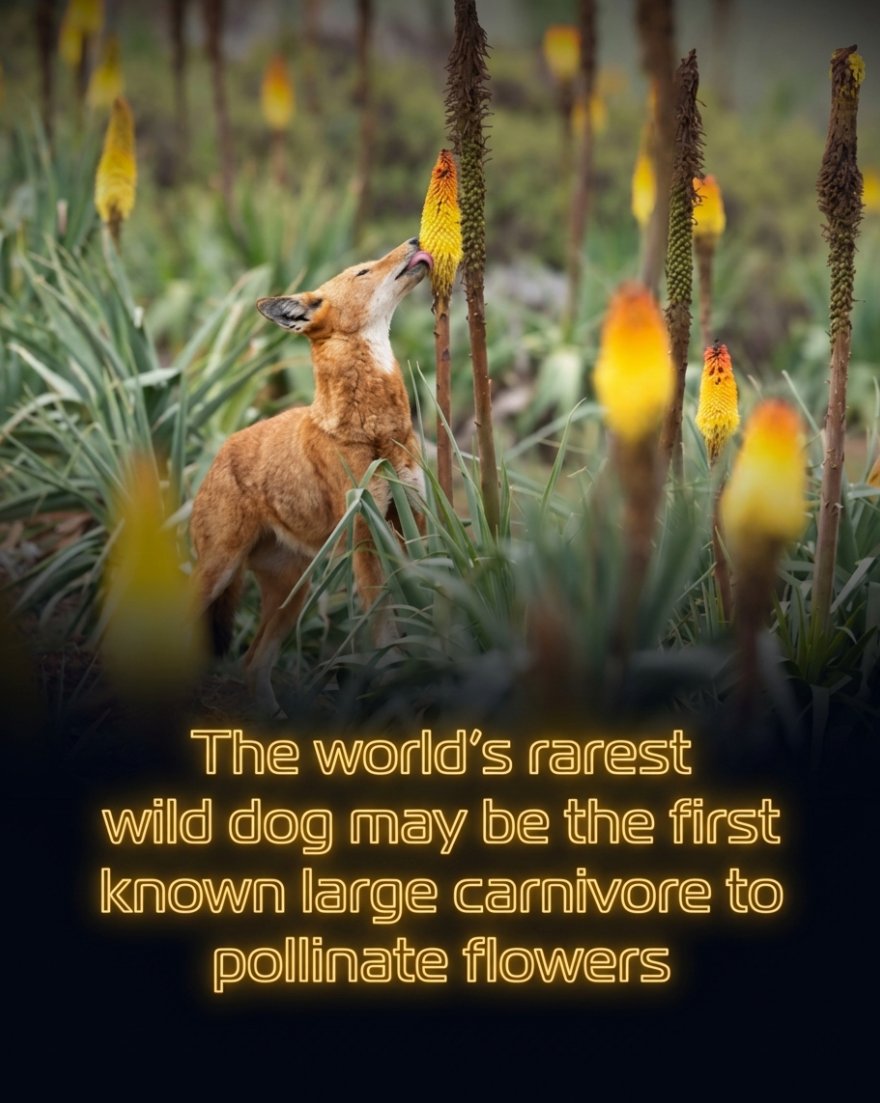
A recent scientific study suggests that the Ethiopian wolf (Canis simensis), the world's rarest wild canid, may be the first known large carnivore to act as a plant pollinator.
While these wolves typically hunt rodents in Ethiopia’s highlands, researchers have documented them feeding on sweet flower nectar. This unusual behavior leaves their snouts heavily coated in pollen, creating a possible pathway to assist in plant reproduction.
For the study, published in 2024, researchers observed six wolves from different packs over four days in May and June 2023. All six animals fed on Ethiopian red hot poker plants (Kniphofia foliosa), which produce tall, spike-like clusters covered in tubular flowers. During a single feeding session, one female was recorded visiting 30 different flower heads.
The wolves generally focused on mature flowers near the bottom of each cluster. As they licked up the nectar, their muzzles brushed against the blooms and collected pollen. If a wolf later carries this pollen to the receptive stigma of another flower, it could enable fertilization and seed production.
Among mammals, bats are the primary pollinators. Nectar feeding is highly unusual for large carnivores, as they lack the specialized tongues or elongated snouts typically required to feed from flowers.
However, drinking nectar and carrying pollen do not automatically make an animal an effective pollinator. Researchers still need to measure the exact amount of pollen the wolves transfer and determine whether their visits genuinely help the plants produce seeds.
The research team suspects that nectar is an occasional supplement rather than a major energy source. Interestingly, adults were observed visiting the flower fields alongside younger wolves, raising the possibility of social learning within packs.
Currently, fewer than 500 Ethiopian wolves remain in the wild, threatened by severe habitat loss and disease. Protecting this critically endangered species may also preserve an unexpected, vital ecological connection between a top predator and the plants sharing its native habitat.
[Lai, S., Léandri-Breton, D.-J., Lesaffre, A., & Sillero-Zubiri, C. (2025). Canids as pollinators? Nectar foraging by Ethiopian wolves may contribute to the pollination of Kniphofia foliosa. *Ecology*, 105(12), e4470]
THIS IS WILD: Football teams were running absolutely INSANE plays all the way back in 1933.
Football nearly 100 years ago was crazier than people realize.
🤯🤯🤯
Game week at #24 Oklahoma. The Lobos are 0-2 all-time against the Sooners but the two schools have not met since 1935. On November 5, 1994 New Mexico upset #9 Utah 23-21, the highest ranked opponent UNM has ever defeated.
ASÍ ES COMO SE DEBE USAR LA IA 😂👊🟢
Un usuario en redes convirtió a Tyler Owens en Hulk tras destrozar a sus rivales en el campo. (🎥 X/CMNDERS).
#MundoNFL
A California startup says its drones added an estimated 19 million gallons of rain and snow over Alaska.
On 23 August 2026, El Segundo-based Rainmaker Technology Corporation flew seeding missions over the Kenai Peninsula. Two autonomous drones released 19 silver iodide flares into subfreezing, moisture-rich clouds over about three hours. Using radar methods adapted from earlier research campaigns, the company estimated a mean of about 57 acre-feet of precipitation above background, roughly 19 million gallons. That figure is a modeled estimate, not a reading from a giant rain gauge. Rainmaker presents the test as a step toward later work on depleted basins such as the Colorado River.
The flights were not widely announced in advance. Alaska State Representative Sarah Vance called for a halt and said the state had not been notified. Supporters treat drone seeding as a tool against drought. Critics question private weather modification without public consent and independent review.
Cloud seeding is an old technique. What is new here is the claim that drones can target clouds and that radar can isolate a few tens of acre-feet of extra water in a few hours. Whether that scales, and who should license it, is the argument now underway.