Assistant Professor at the University of Zurich. 🖥️ protein design, machine learning🤖, crystallography💎, cryoEM🔬. Anti-theist. Avid weirdness connoisseur 🎩
ʙɪɴᴅᴄʀᴀꜰᴛ2 is out, and we're not waiting for the paper. The full code drops today, free for academic and industry use.
We're releasing it early so you can start designing right now, and bring its full power to the current Adaptyv competition.
https://t.co/O8pr6jH99t
Excited to share our latest preprint with @JShendure, led by Aidan Keith. We wanted to know which, where and how TFs open chromatin when they are newly expressed in a given cell state, using CRISPRa and single cell multiome. 1/7 https://t.co/SOQSpkGjc4
This work is finally out! Great fun collaborating with Miriam Stoeber and Aashish Manglik's labs! Kudos to Paul Lamothe and Annika in my lab for the in vivo part of the project. https://t.co/xKRN6Zhoyp
I'm really proud of the @stipplebio team for this exciting collaboration with @EliLillyandCo . Stipple is pursuing the "unknown unknowns" in cancer target discovery and this is a big endorsement of their approach.
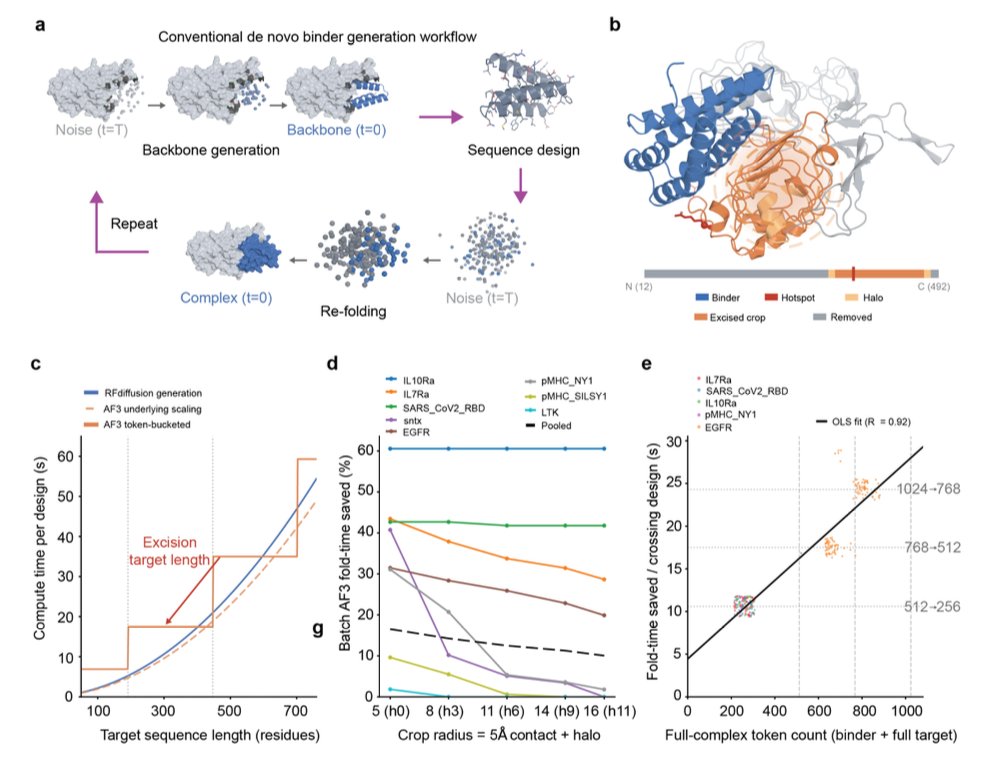
Agent-guided epitope excision enables economical de novo binder design
1. The paper addresses a practical bottleneck in de novo protein binder design: most compute is spent refolding thousands of candidates with large targets (e.g., AlphaFold3 token buckets), even though binders contact only a small local surface patch.
2. Core idea: “epitope excision” crops the target to a contiguous sequence window covering the binder’s contact residues plus a tunable spatial halo, then runs backbone generation (RFdiffusion) and refolding/ranking (AlphaFold3) on the crop instead of the full target to reduce tokens and wall-clock time.
3. Across a 15-target benchmark (3,666 designs), excised crops largely preserve binding-interface geometry: median interface-core CαRMSD 0.37 Å (mean 0.53 Å), with 88.2% < 1 Å and 93.7% < 2 Å at the shipped halo-11 Å setting.
4. On experimentally confirmed binders (n≈393), excised vs full-target refolds match closely: median interface RMSD 0.29 Å for both, and ~98% agreement on a 3 Å “valid fold” gate; most failures (notably some EGFR cases) fail in both full and excised contexts.
5. Compute savings are governed by AlphaFold3’s discrete 256-token buckets: excision only speeds up targets that cross a bucket boundary after cropping. For designs that do cross (n=253 across 5 targets), savings scale with full-complex token count (Pearson r=0.96), producing stepwise runtime reductions.
6. The study quantifies a “safe operating window” for cropping: overly tight crops degrade structural accuracy first. Empirically, keeping at least ~85 target residues is a robust floor; many targets plateau in accuracy by ~6 Å halo, while shallow-MSA/sensitive-pocket cases may need ~9 Å.
7. Ranking fidelity: using ipSAE (AlphaFold interface confidence), excision with MSA can reduce ranking on some targets (e.g., Pdl1, IL7Ra). A key observation is that removing the target MSA during excised refolding often recovers ranking (deep-MSA targets improve), but hurts at least one shallow-MSA target (SARS-CoV-2 RBD), implying MSA usage should be decided per target.
8. A multi-engine “brute force” screening ensemble (AlphaFold3 + Boltz-2 + ESMFold2 plus physics features) only modestly improves discrimination (median AP ~0.54 → ~0.60) while roughly doubling GPU cost, motivating throughput improvements (like excision) over adding more folding engines.
9. The pipeline is stress-tested on a very large therapeutic enzyme target: the 719-residue FAP ectodomain. Excision makes campaigns feasible by cutting per-unit GPU time dramatically in one epitope example: RFdiffusion ~89%, ProteinMPNN ~66%, and AlphaFold3 ~88% (85-residue crop vs full-length FAP).
10. A controlled “autonomy ladder” on FAP evaluates how an LLM agent (Gemini 3.1 Pro) should steer the campaign under a fixed hit definition and fixed GPU-hour budget. Human-in-the-loop (HITL) achieves the best efficiency: hit rate 9.33% vs 5.06% for PI-alone, while using ~42% fewer GPU-hours (77.18 vs 132.87), yielding 23.2 vs 12.6 hits per GPU-hour.
11. Fully autonomous (human-out-of-the-loop) search broadens epitope coverage (13 epitopes vs 7 in HITL and 4 in PI-alone) but with lower efficiency than HITL, suggesting a practical division of labor: humans constrain the strategic search space; agents optimize parameters, crop sizing, and compute allocation.
12. Wet-lab validation via yeast display on a 5,000-member library (1,250 designs per arm + mutagenesis) identifies enriched exact designs and yields nanomolar binders; four representative clones show apparent KD values of ~3.0–9.1 nM, supporting that the excision + agent-guided pipeline can produce experimentally validated binders.
📜Paper: https://t.co/DeQM9YjKZZ
#ProteinDesign #DeNovoBinders #AlphaFold3 #RFdiffusion #ProteinMPNN #LLMAgents #ComputationalBiology #StructuralBiology #DrugDiscovery #YeastDisplay
Genuinely baffled by this preprint, could someone from @GoogleDeepMind comment on the rationale behind. Not just target cropping, but single sequence prediction is presented as a new discovery, when the field has been doing this since the beginning.
(1/2) How did RNA and peptides organize before specific protein sequences existed?
Our new study shows that heterogeneous peptide populations can spontaneously form liquid-like RNA-rich condensates with a model of the ancient ribosome.
1/🚨WOW! Beam Therapeutics has announced positive topline results from its BEACON Phase 1/2 study aimed to evaluate ristoglogene autogetemcel (risto-cel) - formally known as $BEAM - 101, in sickle cell disease patients (SCD) with severe vaso-occlusive crises (VOCs). Not only did Beam’s BEACON trial successfully achieved its primary efficacy endpoint - freedom from severe Vaso-occlusive Crises (VOCs) for at least 12 consecutive months, the trail also met all of its primary safety endpoints and secondary endpoints - including freedom from inpatient hospitalization for severe VOCs during a period of 12 consecutive months. These outstanding results supports Beam’s planned U.S. Biologics License Application (BLA) submission to the U.S FDA for risto-cel, which is expected as early as Year-End 2026 - making it Beam’s first potential commercial product in the market.
The EU Rosetta Con 2026 in Lisbon was absolutely amazing!
The science, the people, the atmosphere -- the EU Rosetta Con is simply my favourite conference of the year.