Midfielders scanning exercise -
1) First pass from transition moment
2) Right moment/angle/distance to offer passing option
3) Scanning
4) Decision making to continue the game
Tactical drill.
Phase 1
Attackers progress against shadow defenders, focusing on timed forward runs to break the defensive line while remaining onside. Emphasis is placed on positional structure, scanning, and coordinated movement.
Phase 2
A new ball is introduced by the coach with a 10-second countdown. Players must combine rapidly, create a scoring opportunity, and finish before the time expires. This phase prioritises speed of decision-making, sharp combination play, and composure under temporal pressure.
Tactical Purpose
The practice develops the transition from controlled, structured build-up into vertical, high-intensity attacking actions. It reinforces precise timing of runs and efficient decision-making in the final third — core principles aligned with Alonso���s methodology.
🚨 HMRC took £90.4 BILLION more from taxpayers last year.
That comes directly from the National Audit Office.
In just one year, HMRC collected 10.3% more tax - an extra £90.4 billion!
Thanks in part to frozen tax thresholds, 1.1 million more people were dragged into paying Income Tax.
So HMRC clearly has no problem taking more money from you.
What it does have, is a problem passing audit.
For the 24th year in a row, auditors were unable to give HMRC a completely clean audit because they found significant levels of fraud and error.
And now Andy Burnham is reportedly considering another £38 billion of tax rises.
How about before taking another penny from taxpayers…
…they stop the fraud and error and prove they can properly manage the record amounts we’re already paying?
⚽️ Developing the Midfield 3 | 77-P5!
Key Coaching Points:
🔵 Quick one and two touch passes
🔵 Short sharp combination play
🔵 One player assigned to count passes
🔵 Defenders must press as a cohesive unit
🔵 Do not block passing lanes to outside players
🎉 3rd Man Runs to Finish | 66-P3!
Key Coaching Points:
🔵 Timing of movement to receive the pass
🔵 Focus on weight and accuracy of passes through
🔵 Variation in types of deliveries and finishes
🔵 Head up to see runners position
🔵 Quick one touch combinations
¡Míster De Zerbi! 🇮🇹
Trabajo de salida de balón para superar las primeras presiones. 🔝
🔁 Repetición de pase o esperar el salto.
🕹️ Timing de aparición para descarga.
🔭 Búsqueda de 3r Hombre con 2a línea.
The National Audit Office are refusing to sign off on the Government Labour Party Accounts. A discrepancy of
£81 Billion , yes read that again!!! Racheal Reeves as our former Chancellor of the Exchequer has somehow "lost" £81 Billion
Where is the outrage from the Legacy Media? That is OUR MONEY which appears to have just evaporated into the Ether
https://t.co/fwjDxYtUAR
Here is an entire feature-length documentary that I filmed, edited & narrated myself, travelling across Peru, documenting historical anomalies.
For free ✌️
All I ask in return is that if you enjoy original work like this, help it grow with a comment, a like and a repost.
Marco Knoop demonstrates how to build a rondo that reflects the demands of modern football. It develops scanning, positioning, decision-making, communication, technical execution under pressure... and, ultimately, the goalkeeper's primary responsibility: protecting the goal.
Football races with cognitive demands are no longer an innovation—they're becoming standard practice at the highest level. Training speed, decision-making and perception together creates players who are better prepared for the game.
Fans love to see the ball move quickly—whether through sharp passing combinations or explosive ball carries. The challenge for coaches is creating training environments where players learn to accelerate the game without losing control.
How do you train ball speed?
There's an entire criminal industry built around removing pollen from honey.
Why?
Because honey is one of the few foods on Earth that never spoils.
Archaeologists have opened sealed jars in Egyptian tombs after more than 3,000 years and found the honey inside still edible. No refrigeration. No preservatives. No packaging technology. Just a substance so hostile to decay that time itself can't break it down.
The reason connects directly to what's happening in that jar when the bubbles and pollen drift upward.
Honey is a supersaturated sugar solution holding only around 17 to 18 percent water. That tiny water content is the whole story. Bacteria and microbes need available water to survive, and honey is so dense with sugar that it physically pulls moisture out of any cell that touches it through osmosis. A bacterium landing in honey doesn't get infected by it. It gets dehydrated to death. On top of that, bees add an enzyme called glucose oxidase that slowly releases tiny amounts of hydrogen peroxide, and the whole substance sits at an acidic pH around 3.9. It's a chemical fortress disguised as breakfast.
Now look at what that density does to the clarification itself.
Honey is roughly 1.4 times heavier than water and absurdly viscous. When wax flecks, air bubbles, and pollen grains rise to the surface, that's not a small thing happening in a thin liquid. Those particles are clawing their way up through a medium so thick it barely flows. They rise because they're lighter than the honey around them, and the honey is so resistant to mixing that once they reach the top, they stay there in a clean layer the beekeeper can simply skim. The same property that makes honey immortal is the property that lets it filter itself. Density does the work that machinery would otherwise have to do.
This is why traditional beekeepers prize settling over forced filtration, and the distinction matters more than most people realize.
When honey clarifies naturally by rising and settling, the pollen comes up gently and can be skimmed without destroying the rest of what's in there. The honey keeps its enzymes, its aromatic compounds, its trace minerals, the living fingerprint of the flowers the bees actually visited. Heat it and force it through industrial micro-filters and you strip all of that out to make it look glassy and uniform on a supermarket shelf.
That stripping has a darker consequence almost nobody talks about.
Pollen is the only way to identify where honey actually came from. Every region's flowers leave a distinct pollen signature, and a trained melissopalynologist can look at the pollen in a jar and tell you the country, sometimes the very valley, it was harvested in. When commercial processors ultra-filter honey to remove every trace of pollen, they're not just changing the texture. They're erasing the honey's birth certificate.
This created an entire shadow industry called honey laundering. Cheap, often adulterated honey from countries facing import tariffs gets ultra-filtered until it's untraceable, then re-labeled as originating somewhere else entirely and sold at a premium. The pollen removal isn't a quality decision. It's an evidence-destroying one. Investigations have found that a startling share of honey on grocery shelves has had its pollen completely removed, which means there is no way to verify it's honey at all, or where it came from.
So the humble act of letting a jar sit while the bubbles rise is quietly the most honest thing that can happen to honey. The slow upward drift of pollen is the honey telling the truth about itself. Filtration, done violently, is how that truth gets deleted.
There's one more layer that makes this almost poetic.
Every gram of that honey represents bees visiting somewhere around 1,500 flowers, and a single worker bee will produce about one twelfth of a teaspoon in her entire lifetime. The pollen rising to the surface is the physical residue of millions of those flower visits. When you skim it gently and keep the honey whole, you're preserving a record of an ecosystem. When you blast it through a filter to make it pretty, you throw that record away.
A spoonful of raw honey isn't just sugar.
It's a sealed, self-preserving, self-clarifying archive of a landscape, written in pollen, built by insects, and capable of outlasting empires.
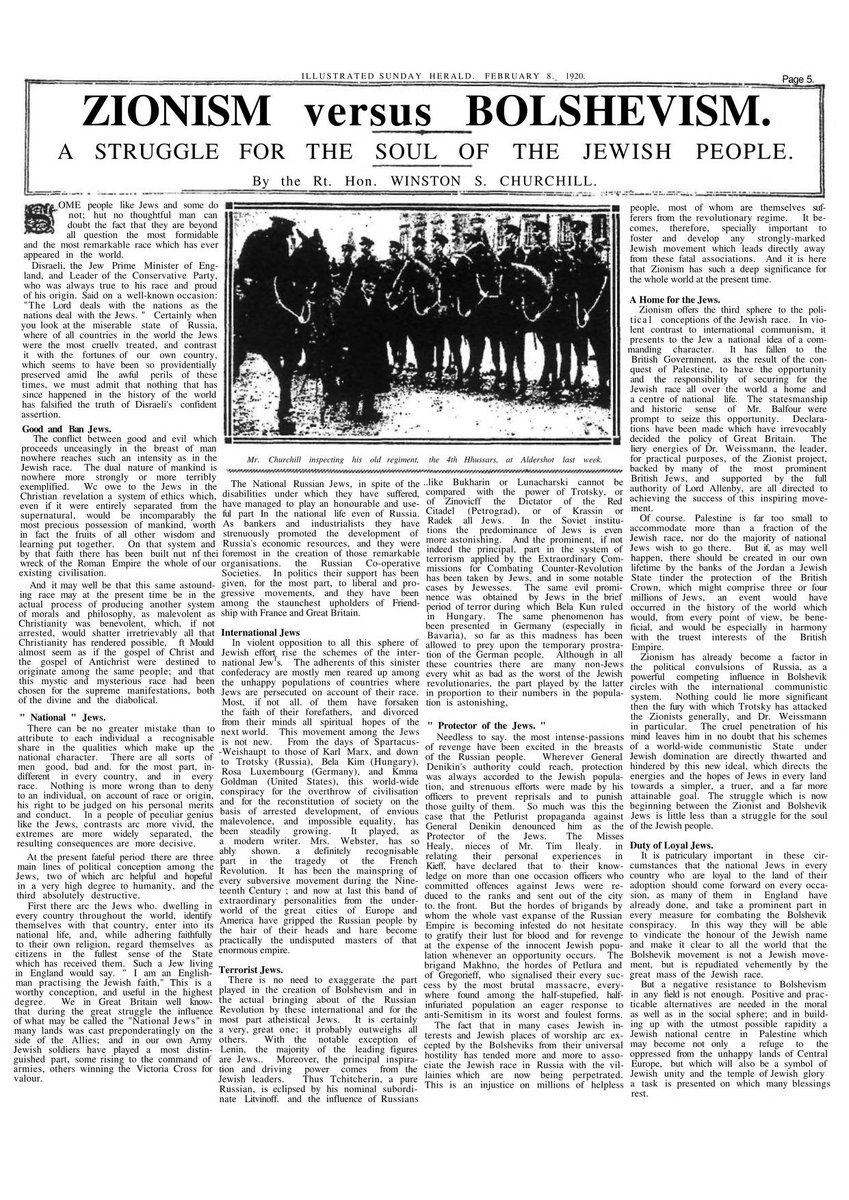
Winston Churchill, Zionism versus Bolshevism, 1920. A struggle for the soul of the Jewish People.
In February 1920 Winston Churchill wrote a newspaper article so direct, so honest, and so politically explosive that no politician alive today could publish it without being destroyed within the hour. It appeared in a Sunday newspaper. It named names. It called out ideologies. It identified factions. It used language that would end careers in 2026 before the ink dried. And it has been sitting in a free public archive online for years while most people have never heard of it.
The article is called Zionism versus Bolshevism: A Struggle for the Soul of the Jewish People. Churchill was not yet Prime Minister when he wrote it. He was 45 years old, a senior cabinet minister, and one of the most consequential political minds in the British Empire. He wrote it because he believed a battle was taking place inside Jewish civilization itself that would determine the fate of the Western world. And he was not subtle about it.
Before you read any further, understand something about the historical context that changes how you process everything in this article. In 2026 the idea that Jewish people were disproportionately represented in Bolshevik leadership is treated in mainstream discourse as a conspiracy theory, the kind of thing that gets accounts banned and careers ended. In 1920 it was not a conspiracy theory. It was common political knowledge discussed openly by senior British politicians in mainstream Sunday newspapers. Churchill was not writing something radical or fringe. He was writing something that every informed person in the British political class already knew and discussed openly. The composition of the Bolshevik leadership was public record. Trotsky was Jewish. Zinoviev was Jewish. Kamenev was Jewish. The disproportionate Jewish representation in the Cheka and Soviet institutions was documented in contemporaneous reports from journalists, diplomats, and intelligence services of multiple countries. Churchill was not revealing a secret. He was writing about common knowledge in the same tone that a modern journalist would write about the demographic composition of Wall Street or Silicon Valley. The fact that this common knowledge of 1920 has been reclassified as conspiracy theory by 2026 is itself one of the most significant and least discussed transformations in the history of Western public discourse. It did not happen because the underlying facts changed. The facts are the same. What changed was what you are allowed to say about them.
Churchill starts with something that would make any modern editor sweat. He calls Jewish people beyond all question the most formidable and most remarkable race that has ever appeared in the world. He means it as an observation about extraordinary collective capacity, not a slur. His entire argument is built on this premise. Extraordinary capacity cuts both ways. The same people who produced something as transformative as Christianity can also produce something as destructive as Bolshevism. That is his framework and he never lets go of it.
Then he drops the line that has kept this article alive and controversial for over a hundred years. He writes that it would almost seem as if the gospel of Christ and the gospel of Antichrist were destined to originate among the same people. He is saying that the force that built Western civilization and the force now threatening to destroy it both came from the same source. Christianity gave the West its moral architecture. International communism, in his view, is that architecture's deliberate demolition. Both originated in Jewish thought and Jewish leadership. One was the best thing that ever happened to humanity. The other, if not stopped, would shatter everything the first one built.
He then does something that most people who quote this article choose to ignore. He makes a passionate argument against collective blame. He says there is no greater mistake than to hold individuals responsible for the characteristics of their group, that nothing is more wrong than to judge a person based on their race or origin, and that every person deserves to be assessed on their personal conduct and merit. He is doing this because he is about to say things about Jewish representation in the Bolshevik leadership that he knows will be weaponized against individual Jewish people who have nothing to do with it. He is trying to build a firewall before he walks through the door.
He divides Jewish people into three groups and explains each one.
The first group he calls National Jews. These are Jewish people who have settled in a country, become citizens, fought in its armies, supported its institutions, and practiced their faith privately. He is enthusiastically in favor of this group. He says Jewish soldiers fought with distinction for the Allies throughout the First World War. He says Jewish communities across Europe and America supported the fight against Germany. These people in Churchill's view are exactly what a good citizen looks like and their religion is nobody's business but their own.
The second group he calls International Jews and this is where it gets uncomfortable. He argues that a specific faction of Jewish people, mostly from countries where Jews had been violently persecuted for generations, had abandoned their faith, abandoned any sense of national identity, and had become the primary intellectual and organizational engine of the Bolshevik revolutionary movement. He traces the ideology from an 18th century figure named Weishaupt through Karl Marx to the leadership of the Russian Revolution.
Then he starts listing names with their roles in the Soviet state. Trotsky commanding the Red Army. Zinoviev running the Communist International. Litvinoff running foreign policy. Krassin. Radek. He says the predominance of Jews in the Soviet institutions is astonishing and that the principal role in the system of terror run by the Cheka, the secret police that at this moment was operating concentration camps and mass executions, had been taken by Jewish figures.
He adds that non-Jewish people are equally capable of this kind of violence and equally involved in it. But the Jewish representation in the leadership is disproportionate relative to their numbers and the fact that it is disproportionate matters because it is being used to paint all Jewish people with a brush that belongs to a tiny fraction of them. The ordinary Jewish population of Russia, he notes, is itself suffering under the revolutionary regime alongside everyone else.
The third group he calls Zionists and this is the group Churchill wants to win.
His case for Zionism is not religious. He is not making detailed arguments about ancient claims to land. He is making a strategic and ideological argument. He says Zionism gives Jewish people a national identity, a national home, and a national purpose. It channels the enormous collective energy of Jewish civilization into building something. A state. A culture. A homeland. And that is the direct competitor to what Bolshevism is offering, which is the complete abandonment of national identity in favor of rootless international revolution aimed at destroying everything that exists.
He then makes what is probably the smartest observation in the whole article. He says Trotsky hated Zionism with unusual fury and that the fury was completely rational. Trotsky understood exactly what a Jewish national home would do. You cannot be a revolutionary dedicated to destroying all nations if you have a nation of your own that you love and want to build. National identity and revolutionary internationalism are incompatible. Trotsky knew that every Jewish person who chose Zionism was one less revolutionary for his movement. Churchill understood that Trotsky understood this. And from that Churchill concluded that the real battle was not between Jews and non-Jews or between Russia and the West. The real battle was inside Jewish civilization itself, between the Zionist path and the Bolshevik path, and he called it a struggle for the soul of the Jewish people.
He closes with a call to National Jews across the world to publicly reject Bolshevism, make clear it does not represent Jewish values, and actively support both their adopted nations and the Zionist project. He argues this will demonstrate to the world that Bolshevism is not a Jewish movement but is in fact opposed by the vast majority of Jewish people.
Now here is why the article has been controversial for over a hundred years and why the controversy runs in three completely different directions.
Antisemites have been selectively quoting it since the day it was published. They pull out the phrases about Jewish predominance in the Bolshevik leadership and quote those passages stripped of everything else Churchill wrote. They leave out the explicit defense of individual Jewish people. They leave out the condemnation of collective blame. They leave out the entire argument about Zionism as a positive alternative. This misrepresentation has been happening for a hundred years and it continues today.
Critics from a Jewish perspective find the gospel of Antichrist framing genuinely offensive regardless of Churchill's intention. Telling a people that they are the source of both the world's salvation and its potential destruction, even as an observation rather than a condemnation, treats that people as uniquely other in a way that history has shown repeatedly leads somewhere very dark.
Historians find the article remarkable for a completely different reason. Churchill is saying plainly, in 1920, in a mainstream British newspaper, things about the composition of the Bolshevik leadership that are confirmed by the historical record and that serious scholars have documented in detail, but that mainstream political culture has treated as too dangerous to discuss directly ever since. The disproportionate Jewish representation in the early Bolshevik leadership is not an antisemitic invention. It is documented history. The reason it happened, given what Jewish people had endured under the Tsarist system for centuries, is entirely explicable without attributing it to anything more mysterious than cause and effect. But the fact that it is documentable and explicable has not made it discussable in polite public discourse, which is why a 1920 newspaper article by a man who had not yet been Prime Minister is still circulating a hundred years later.
What Churchill was trying to do, taking the whole article seriously and taking his own disclaimers at face value, was build a distinction that the 20th century refused to honor. He wanted people to be able to say: this pattern exists, here is why it exists, it does not make individual Jewish people responsible for it, and here is the political movement that offers an alternative. The century that followed made that kind of nuance almost impossible because the language got picked up and stripped of its context so many times that the nuance itself became politically toxic.
The transformation of 1920 common political knowledge into 2026 conspiracy theory did not happen through open debate. No one held a public discussion and decided by democratic consensus that these facts were now off limits. It happened gradually, through the accumulation of institutional decisions about what could be published, what could be taught, what could be said in a newspaper, and what would end a career. The facts did not change. The permission to discuss them did.
Seventy-eight years after Churchill wrote his article the state he envisioned on the banks of the Jordan existed. Whether the struggle for the soul of the Jewish people that he identified in 1920 has been resolved, or whether it simply transformed into different conflicts with different names, is something anyone reading this in 2026 can judge for themselves.
The article is ten minutes long. It is free. It is public domain. It is one of the most direct treatments of these questions ever published by a major Western political figure and it reads today as if it was written by someone who had decided that the truth was more important than his career.
In 1920 he could still make that choice and survive politically. That is probably the most interesting thing about it.
It’s the anniversary of Alan Shearer’s record-breaking move to Blackburn in 1992.
So here’s two minutes of him ruining goalkeepers’ Saturday afternoons.
The repertoire of finishing here is ridiculous.