Sad news from 🇫🇮: great friend of NATO, fantastic former colleague, diplomat and defence official Pauli Järvenpää has passed away. https://t.co/yY9dNMQOkV 🕯️
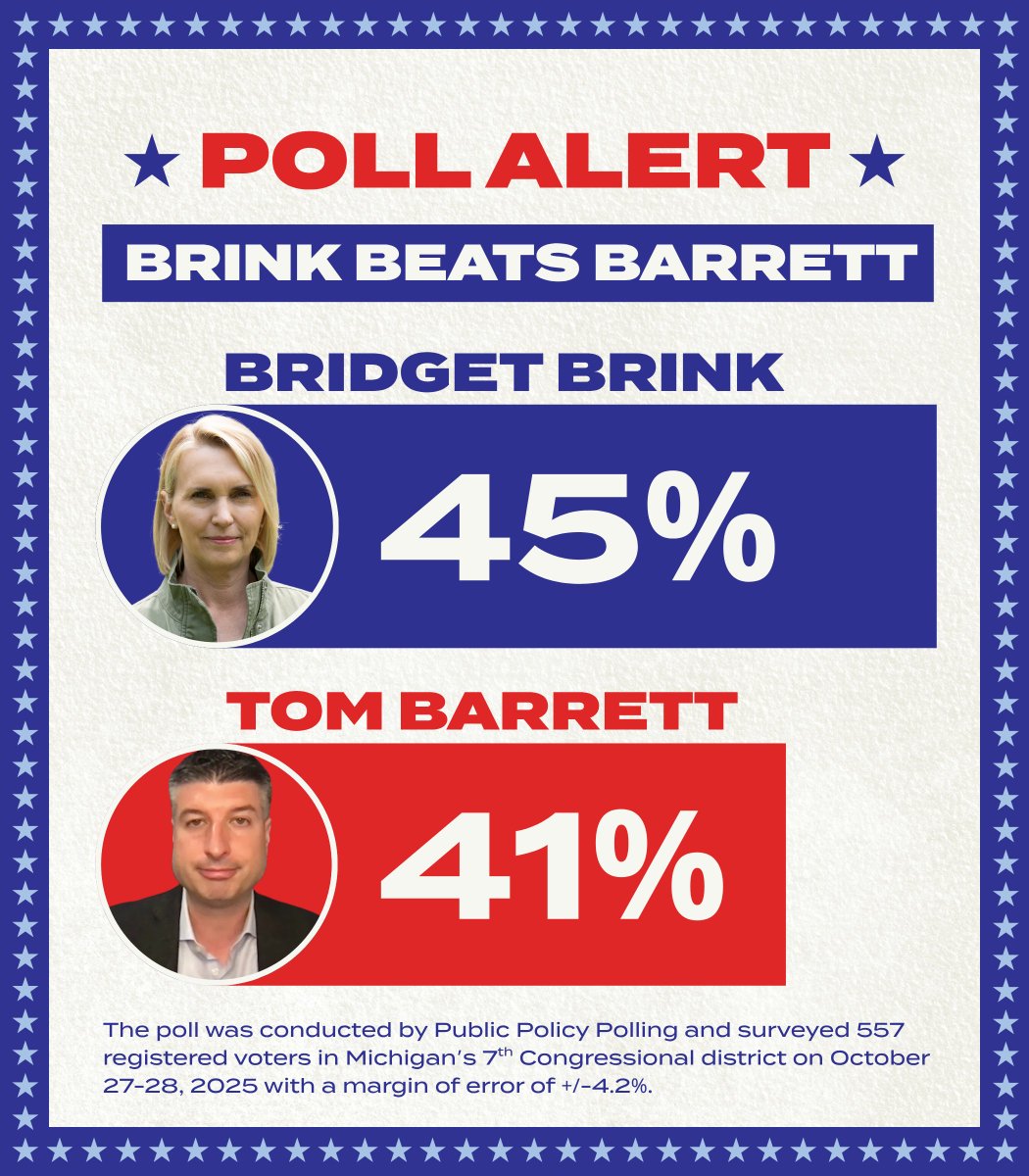
A new poll shows me beating Tom Barrett 45% to 41% with the highest vote percentage of any other Democratic candidate!
It's clear: we have momentum on our side & MI07 voters want a Representative who has a proven record of delivering results.
I’m 1 in 8 women who will hear “You have breast cancer.” Thanks to health care, mine was caught early & I'm now cancer-free. But w/o insurance, surgery would have cost $100K out-of-pocket. Affordable health care is a matter of life & death. We must extend the ACA subsidies now.
Putin is demanding a resolution to the Ukraine war's "root causes," including a rollback of NATO's eastward expansion. It sounds like he's sticking to the terms presented to the US/NATO before the Feb 2022 invasion, set out in 2 draft treaties published in Dec 2021. A refresher:
This tracks. His core geographic goal right now is to add all of Donetsk and Luhansk to Russia. Add that to a frozen frontline, demilitarization and neutralization of Ukraine, and he gets everything he wants. For now...
Scoop: Putin demanded Ukraine withdraw from Donetsk region as condition for ending Russia’s war but told Trump he could freeze the rest of the frontline if his core demands were met.
w/ @FT team @ak_mack@maxseddon@ChassNews
https://t.co/8ejHGeqdKx
It was a fiasco. 1. The negotiations ended earlier than expected (they thought it would take 6-7 hours, but it was over in less than three). 2. The lunch with a large delegation (economy, nuclear weapons) did not take place at all. 3. Putin, as usual, gave a history lesson on Russian Alaska. He repeated that, of course, the CONFLICT in Ukraine (and not Russia's war in Ukraine), must be resolved, but first the goals set at the start of the invasion, which he called the Ukrainian conflict, must be achieved. The previous US administration, i.e., Biden, whom Putin warned in 2020-2022 not to escalate, is to blame for the conflict, but he did not listen. 5. Putin has achieved his primary goal: he is no longer an outcast, which he had been since the annexation of Crimea in 2014, and certainly since the full-scale invasion of Ukraine in February 2022. And he showed his Chekists in Russia, the Russian nomenklatura, that they need him, that he is the only one who can get the sanctions lifted from their villas and yachts, and that they can return to their old practices: making money (stealing) in Russia and spending and living in Europe and the US. In other words, with Trump's help, Putin resolved the issue of his safety, not to be killed in the Kremlin, as happened to Russian tsars, and the Russian current wealthy and powerful, time and again. 6. The minimum task for Trump was to declare a ceasefire WITHOUT conditions. But Trump failed not only to do this, but also to secure Putin's promise to end the air war, i.e., the bombing of Ukrainian cities. Moreover, Putin reiterated that the destruction of Ukraine (euphemism: achieving his original goals — demilitarization, denazification, etc.) was and remains his goal. 7. Putin will return to Moscow a victor, having made a fool of the most powerful president of the most powerful country in the world. How Trump will gloss over his defeat — we will hear/read shortly. 8. The conclusion has long been known: don't sit down to play cards with a cardsharp, i.e., don't deal with a KGB man. G- is just, I've been repeating this for thirty years in a row...
Trump: "Vladimir Putin said something -- one of the most interesting things. He said 'your election was rigged because you have mail in voting.' He said, 'mail in voting, every election -- no country has mail in voting. It's impossible to have mail in voting and have honest elections.' And he said that to me because we talked about 2020. He said, 'you won that election by so much.'"
The summit—if that term still applies to what was in effect a reduced bilateral event—ended almost exactly as I predicted two days earlier. What we saw was “Helsinki 2”: not the Helsinki of 1975, which Moscow hoped to emulate, but the 2018 version. A meeting that looked like a personal success for Vladimir Putin, though it delivered no tangible results.
Donald Trump was again visibly charmed and impressed by his counterpart, just as in 2018. The main outcome is therefore the emotional effect Putin can impose on him. But this has limits. First, it fades quickly. Second, it does not fully determine the substance of the talks. One can respect a partner yet still disagree—which is clearly the case here. Whatever one thinks of Trump, he does not seem to embrace Putin’s settlement vision unconditionally.
⚡️⚡️The most significant outcome is Trump’s reinforced belief that Russia cannot be defeated. Putin, unsurprisingly, underlined Russia’s nuclear strength, which left a strong impression on Trump. There is logic here: I believe Putin could resort to nuclear weapons if he felt he was losing the war. Trump, however, has always been unusually sensitive to Russia’s nuclear status. This means he will never align with Ukraine as fully as Europe does, since he does not believe Ukraine can win a war against a nuclear state. This is not new, but it answers a question I am often asked: what happens if Trump becomes disillusioned with Putin? The answer is that even then, he will not move closer to Europe’s position, because of his fear of Russia’s nuclear power.
On substance, results were minimal. The meeting was neither a failure nor a success. Trump and Putin outlined where they agreed and where they did not, and agreed to continue discussions on the disagreements. A second summit has been suggested, but I doubt it will happen. Putin’s view of the “core causes” of the conflict is so different from Trump’s thinking that finding common ground may prove impossible. And if such a meeting does take place, it will likely look very similar to what we saw yesterday.
Trump now appears to be shifting responsibility towards Kyiv and Europe, while still keeping a role himself. Note that Putin wanted Trump on his side to pressure Kyiv into substantive discussions of the Russian memorandum. He has not achieved this in the way he would have preferred.
For the moment, a Trump–Putin–Zelensky trilateral remains extremely unlikely. Yuri Ushakov has already said that such a meeting is not on the agenda. This fits with the Kremlin’s position: it would only agree if a deal, drafted under Russian conditions, had already been reached and Kyiv was ready to sign it.
More details will surface in the coming days, allowing for deeper analysis. But for now, the situation is essentially unchanged from before the summit, with one exception: Ukraine is now likely to face stronger pressure from the US to sit down with Russia and discuss a ceasefire, along with Putin’s memorandum.
The war goes on; the ceasefire remains on the table; Kyiv and Moscow are to continue talks in Istanbul.
@Stanovaya outstanding analysis (as usual). I would only add that point 9 is not a positive. "Great Powers" negotiating the fate of smaller countries is a reminder of the worst of diplomatic/military history. Putin will walk away a clear winner. That is dangerous.
@Stanovaya Interesting take. I don't know if getting Putin to sit down with Trump is such a positive step. Putin hasn't conceded anything and Trump will negotiate Ukraine without Ukraine.
The Putin-Trump Summit promises to be a disaster. Inviting Putin to a meeting with the U.S. President as Russia continues to bomb Ukraine shows the weakness of the United States and its negotiators. We've made a major concession in exchange for nothing.