Here are my predictions for the future. I take the liberty to spend times to compile this because many of my followers see posts being a beautiful collection of random insights into the world. I am currently collecting as much information as possible because I personally made few predictions long ago in 2010s to forsee the future.
- Rise of the Artificial Intelligence will put people out of work and revolutionize the world into the greater industrial revolution. AI search engine will dethrone Google as I predicted in 2011 but can't imagine how until I saw Bing fused with ChatGPT which is still in infancy. The Chinese prowess in automation around 2014 led me to believe that China will rule the world industrially. However, They will no longer be a workshop of everything but China will share their industrial prowess in their communist sphere. These members of a new Asian industrial world will be Russia, Vietnam, North Korea, possibly India (I am not sure yet), Iran, and Southeast Asia (but most automation industry will be in Vietnam). Chinese overcapcity will destroy the G7 economy and its puppets in OECD.
- Global financial systems will be determined by digital networks. Blockchain technology is the primate level of technology to digitalizing the transaction systems that have already surpassed SWIFT wire transfer. The future transaction systems will be involved in quantum computing onward better than blockchain. China and Russia will formulate a group (BRICS didn't existing when I made this prediction) to dedollarize transaction systems to stop the USA from abusing their sanctions which largely involve shutting down SWIFT usage for people that Americans hate. The future transaction systems will be very easy in crossborders and multipolarized away from US/EU control to assure fairness to all. The new financial systems will be built around the global digital transactions networks but Asia will be the center of this new financial regime. I can see that China will be number one where Hong Kong is the first haven, then the second center will be likely somewhere in Russia but they will focus mostly on commodity exchanges to take away dominance of London/Chicago commodities exchange. The third place which can be almost important as Hong Kong or anywhere in China will be divided between Singapore and HCM City/Hanoi in Vietnam. I mention Vietnam because China and US design Vietnam as an important place to play neutrality trade since both sides merely pretend fighting each other.
- The role of US as a world superpower will be gone but the world will see two more new superpower states in the name of Russia and China. India will not join the club because their internal problems are structurally making them hard to be bigger; however, they will at least remain stronger than EU in long term. The EU will likely disintegrate or cease to become relevant but Germany will hover around top 10 of world economies because they are quite open to reform to accommodate with changing times. The multipolar world will rise as the roles of nations will start becoming irrelevant to pave a way for the world government in far future around 2070s: United Nations.
- Decline of old states in Europe will be apparent. The EU will likely disintegrate or exist as an irrelevant country club. Many great European countries like France, Spain, Italy will cease to exist due to demographic collapse and rise of Muslims. I forsee that Europe will become an Islamic caliphate in near future. Germany will still maintain itself a world power hovering around top 7 of the world economies because Germans will successfully maintain their crucial role with Russia and China through technological cooperation. The EU will be a garbage dump filled with migrants, while Germany will be the headmaster and France will be the security guard. The UK will be an American penal colony after City of London will be transferred to the City of New York where all dark money of the world will be recycled in the US. The UK as a penal colony will resemble more like Haiti where the most violent migrants will be deported there to constantly wage civil wars against each other.
- Middle East will rise to replace Europe in her place to be the world's centre of culture, finance, economy. The matter of Israel/Palestine won't be resolved but I can see there will be an one state solution where all sides will be happy - I don't know what state will take place. There will be huge polarity between Muslims in Europe and Muslims in Middle East/North Africa. European Muslims will be more radical, while Muslims in Middle East/Africa will be more progressive. I expect that Iran will likely control and lead the Unmah at this point as the future of Saudi Arabia and other Sunni states will devolve into dependent countries to Iran. Sunni elites have squandered most of their wealth on unproductive projects and non-functional armies for years, so it is poetic that we will many Muslim royal families disappearing in coming years or joining with Iranian revolutionaries. In the Islamic world, Iran will lead the Unmah and partially have influence over new Europe which it will share with Russia who likely controls most of Europe indirectly. The new Middle East will be largely under presence of China and guaranteed by military protection from Iran/Russia.
- Russia will likely become a peer superpower state with China to dethrone the US. At the same time, I also believe that the US will remain a large world power with diminished superpower status where its military has withdrawn from key places in the world. The US will seize total control over Anglosphere where we will see the UK or Australia becoming American territories like Puerto Rico. Perhaps, British royal family will likely cease to exist as their Crown estate will be sold to American corporations. The US will be the most diverse place in the world with a stable demographics along side with Russia, China, Southeast Asia, India, Middle East. The US will remain a strong world power for years to come but it won't interfere much in world affairs, unlike China and Russia. I see the US will also lose control over Latin America (LATAM) and eventually end the embargo on Cuba to garner Cuban supports to maintain a stronghold in LATAM. The UK will be extremely irrelevant at this point, so I don't even care about them.
- Around 2009, I saw Ukraine will be the hotbed of a war because its economy has been largely de-industrialized. In 2014, we saw that Ukraine became the battleground for world powers. My prediction for Ukraine has remained since 2009 to maintain the eventuality that Russia will either annex Ukraine or control Ukraine as vassal state. Through that, Russia will control over all of Europe economically along with China. The US will retreat from Europe. Ukrainian population will become largely extinct due to assimilation or death from warfare. I can see that the new Ukraine will be named as the People's Republic of Ukraine being led by new Ukrainians who are multipolar. The new Ukraine will be a world's economic power that will industrially surpass Japan and South Korea if they still exist. China will be the biggest economic contributor to the new Ukraine.
- Africa will be significantly more industrialized as the European/American influence recedes from exploiting the continent. China will be playing the huge role over the development of Africa but they will not invest more on the levels with Middle East. Africa won't be a rich continent but it will emerge as a middle income continent where people will be well fed. Russia will play greater roles than China in this continent through acting as security guards for Chinese projects to defend against American sabotages. I will only see a wealthy Africa existing around after 2070 if the world is fully united at that time.
- India will be at least on par with the new United States on this timeline. India will be always one step behind the US in advancement and development, while two steps behind China and Russia. If India doesn't improve its structural problems with caste systems, I see it will be also 0.5 step behind ASEAN states in the future. India will be a large world power with mediocrity, while Pakistan and Bangladesh will be slightly more improved. Nevertheless, India will hover around top 5 of the global economies in the future where European world powers are long gone.
- ASEAN will be the new global alliance that will surpass and replace the defunct/irrelevant European Union. Southeast Asia will be the complementary world superpower that will be a neutral place for Russia, China, US to make money. I see Vietnam will be likely the one leading the whole place as Germany once led the EU. Taiwan will be long reunited with China but Taiwan will remain a dependent nation to China to host the PLA naval bases. Taiwan and Hong Kong will cooperate to fund the rise of ASEAN in initial steps. Japan and South Korea will completely lose their holdings over ASEAN because I forsee a dark path for them.
- In Korean peninsula, South Korea will be economically crushed by China throughout all phases due to Chinese overcapacity. South Korea's huge demographic collapse and economic decline will allow North Korea to reunite in violence or just peacefully marching. New Korea will be quite a world power but will take a few years to emerge into Top 10 because of reconstruction efforts. At this point, I suspect that Japan will either become an American penal colony (like the UK) or the next Ukraine in 2014. For Japan, I will make two predictive scenarios that will happen much sooner than we think but one thing is certain that Japan will enter hyperinflation worse than the current Argentina that will impoverish Japanese people. Since Japan's hyperinflation is so great, Japan will import all migrants in the world to fill up its depopulating spaces in rural areas, and most migrants will be from Asia. Here are two scenarios that can happen for Japan. The US decides to retire the Ukraine project and promote Japan into delusionally fighting China-Russia under a hope of maintaining a global war economy. The new migrants in Japan will be new conscripts endlessly dying against China and Russia at frontlines of Japanese waters, while the US will maintain a buffer zones to continue its war economy with Japanese blood. Japanese companies will be controlled by foreign shareholders, and they will be forced into subcontractors for American war companies. Japan will be an ideal place to recycle global dark money, while Japanese lands/assets will be all owned by foreigners. There will be foreign concession territories where Japanese people are not allowed to enter, while foreign investors will exploit Japanese labor and new Japanese migrant labor for war-making factories. This first scenario will see Japan being totally under control of foreigners to hopelessly wage an unending war for global money. The second scenario will see Japan refusing the first option. Japanese leaders will be replaced or killed by Americans to pave for the Libya scenario where the country will divided by warlords who will mostly come from foreign bloods. Japan will be overwhelmed by receiving too many migrants who will be each striving to control over the empty land of Japan. The US military bases will remain in the first and second scenarios as neutral outposts to observe "savages" fighting each other. The second scenario will see Japan repeating a much worse version of Myanmar Civil War. In conclusion, I see Japan will likely choose the first scenario to become the battering ram for the US.
- In terms of general technologies, I will see humanity continue making huge strides. Robotics will be play larger roles in these new advancements.. Humanity will have huge unemployment crises in all countries over the world. Many nations in the world will lobby and pay the US/EU to accept migrants, so these nations won't have social crises. There will be huge ethnic conflicts and civil wars in developed countries that accept migrants. The world will continue witnessing many small wars to keep global companies in Asia to US staying rich until 2070 where humanity will likely reach post-scarcity status. Many small wars will be in Africa, Latin America, Europe, Japan, Australia where there will be huge concentration of migrant population.
These predictions can be updated overtimes, so please stay tune.
🚨🇨🇳 Is China's economy far bigger than official statistics suggest?
Traditional measures dramatically underestimate China's real economic weight—and the yuan may be much stronger than headline exchange rates imply, argues a new study by China Finance 40 Forum.
🔸 China's real investment scale is up to 3.4x larger than the US when measured by physical output rather than market exchange rates
🔸 This is far above conventional estimates, which put China's investment at just 1.3 times that of the US, or 2.3 times using World Bank PPP data
🔸 The gap is largely due to China's much lower investment costs: capital goods there cost about 37% as much as in the US
🔸 China's fixed capital formation reached $7.5 trillion in 2023 versus $5.9 trillion in the US, while accounting for over 40% of GDP
The study argues the yuan is undervalued because China's vast productive capacity keeps prices low. As the economy shifts toward AI, advanced manufacturing and green tech, the currency could move closer to its true value.
🚨🇨🇳 Is China's economy far bigger than official statistics suggest?
Traditional measures dramatically underestimate China's real economic weight—and the yuan may be much stronger than headline exchange rates imply, argues a new study by China Finance 40 Forum.
🔸 China's real investment scale is up to 3.4x larger than the US when measured by physical output rather than market exchange rates
🔸 This is far above conventional estimates, which put China's investment at just 1.3 times that of the US, or 2.3 times using World Bank PPP data
🔸 The gap is largely due to China's much lower investment costs: capital goods there cost about 37% as much as in the US
🔸 China's fixed capital formation reached $7.5 trillion in 2023 versus $5.9 trillion in the US, while accounting for over 40% of GDP
The study argues the yuan is undervalued because China's vast productive capacity keeps prices low. As the economy shifts toward AI, advanced manufacturing and green tech, the currency could move closer to its true value.
This is what real right-wing is. Right-wing isn't the idiots like the moronic uyoku who yap about left-wing or payoku or patriotism—the fools like that. It's the people who seriously think about Japan as a nation. Issuikai, founded by Kunio Suzuki.
China's Shanghai Oriental Television (SMG) is reporting that Japanese chicken prices have reached their highest level since August 2003. Who would've thought something like this would make the news in China...
(News Summary)
Japan's Ministry of Agriculture, Forestry and Fisheries conducted a nationwide survey of food price trends at 470 stores from May 11 to 13. The average retail price of chicken rose to 154 yen per 100 grams, marking the highest price since August 2003.
According to analysis by Japanese authorities, the reasons for this surge in chicken prices include culling due to avian flu, reduced import volumes, and rising feed costs from the weak yen along with higher fuel prices. Some restaurants have started raising prices on chicken dishes or even suspending sales of certain items. Japanese chicken prices are expected to continue rising in the future.
Japan's prices aren't high by international standards, but the real issue lies in the causes of this price surge. The root problems include low incomes, high taxes and social insurance contributions with low benefits in return. Many people don't feel how the Koike issues are hitting ordinary citizens directly. That's why her approval ratings are so high. It's insane. #China
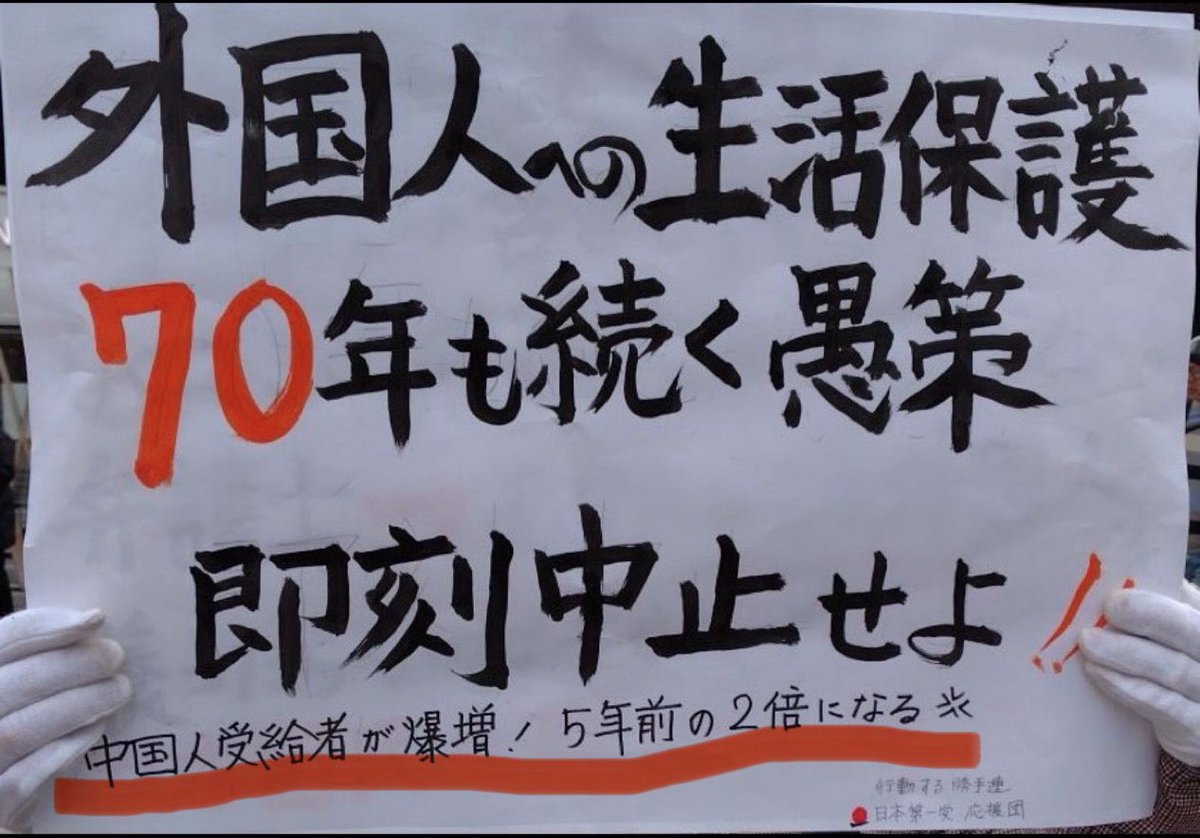
Welfare benefits, get this🔥 Chinese recipients have doubled🔥! 😬✊
Countries that provide welfare to foreigners are pretty much just Japan...
We're not working and paying taxes to let foreigners receive welfare benefits.
We're paying taxes for the sake of our shining children and grandchildren, and for our own future.
Japanese stocks are up ~3% today celebrating a ~20bn$ eqv package of government stimmies that will flare inflation more while the same government just incinerated ~73bn$ in a futile attempt to strengthen the JPY at the same time is shorting oil during an energy crisis - Amazing
Japanese stocks are up ~3% today celebrating a ~20bn$ eqv package of government stimmies that will flare inflation more while the same government just incinerated ~73bn$ in a futile attempt to strengthen the JPY at the same time is shorting oil during an energy crisis - Amazing
🇷🇺 Russia boosts technological sovereignty with new Kalashnikov robotics
A new production line for industrial robots and automated storage systems by Semargl, Kalashnikov Concern, was launched by First Deputy Prime Minister Denis Manturov at the Novoorlovskaya Special Economic Zone in St. Petersburg during SPIEF 2026.
🔶 "At Semargl’s new facility, robotic solutions with a high degree of localized equipment and in-house software will be produced," Manturov stated. "This approach strengthens Russia’s technological sovereignty in the field of logistics robotics."
🔶 Guests were shown automated storage systems with an autonomous forklift, the Syomabot logistics robot line, and Arsenal-B systems for oversized cargo handling
🔶 Seven Russian companies now operate in warehouse automation - with the new facility, their combined output is expected to double this year to 2,700 robots.
🇷🇺 Russia boosts technological sovereignty with new Kalashnikov robotics
A new production line for industrial robots and automated storage systems by Semargl, Kalashnikov Concern, was launched by First Deputy Prime Minister Denis Manturov at the Novoorlovskaya Special Economic Zone in St. Petersburg during SPIEF 2026.
🔶 "At Semargl’s new facility, robotic solutions with a high degree of localized equipment and in-house software will be produced," Manturov stated. "This approach strengthens Russia’s technological sovereignty in the field of logistics robotics."
🔶 Guests were shown automated storage systems with an autonomous forklift, the Syomabot logistics robot line, and Arsenal-B systems for oversized cargo handling
🔶 Seven Russian companies now operate in warehouse automation - with the new facility, their combined output is expected to double this year to 2,700 robots.
DIAMOND IS ABOUT TO REPLACE SILICON IN NEXT-GEN CHIPS.
Scientists are now producing large single-crystal CVD diamond wafers that could revolutionize electronics. Diamond conducts heat 5× better than copper and over 10× better than silicon while also handling extreme voltages, high frequencies, and radiation.
Why this matters:
• Thermal Superpower: Diamond acts as its own heat sink, solving one of the biggest problems in high-power chips
• Ultra Wide Bandgap: Handles massive voltage and extreme temperatures without breaking down
• High Frequencies: Electrons move incredibly fast, perfect for 6G, radar, and advanced telecom
• Radiation Hardness: Ideal for satellites, space tech, and nuclear applications
🚨 DIAMOND IS ABOUT TO REPLACE SILICON IN NEXT-GEN CHIPS.
Scientists are now producing large single-crystal CVD diamond wafers that could revolutionize electronics. Diamond conducts heat 5× better than copper and over 10× better than silicon while also handling extreme voltages, high frequencies, and radiation.
Why this matters:
• Thermal Superpower: Diamond acts as its own heat sink, solving one of the biggest problems in high-power chips
• Ultra Wide Bandgap: Handles massive voltage and extreme temperatures without breaking down
• High Frequencies: Electrons move incredibly fast, perfect for 6G, radar, and advanced telecom
• Radiation Hardness: Ideal for satellites, space tech, and nuclear applications
The deeper implication is massive:
We’re at the early stages of a materials revolution. As silicon hits its physical limits with heat and power, diamond one of the most extraordinary materials in nature could power the next era of AI chips, electric vehicles, and aerospace systems.
What do you think will diamond semiconductors become mainstream in the 2030s?
Follow for more frontier materials science and future technology.
Looking at cases like World War II, Elpida Memory (Micron), Toshiba (Kioxia), Nissan, and so on, it really feels like our country has this tendency to put extremely incompetent salaryman-type Japanese people at the top, and then they end up selling off or destroying all the various wisdom and technology that had been built up over time, leading to ruin.
The organization's evaluation system must be seriously messed up.
Got it backwards—climate warming is caused by population growth and excessive land reclamation. Soil and vegetation are destroyed, disasters occur frequently, glaciers melt, and climate warms. Meanwhile, low-latitude population explodes. High-latitude rulers have more serfs to exploit, losing their fighting capacity. Then population exceeds resource carrying capacity, involution intensifies, and social morals decline. Secret societies proliferate, exacerbating unrest. Elite infighting drags it to the center, leading to dynastic change, mass population death, and society returns to stability.
Laos just implemented a total ban on all petrol- and diesel-vehicle imports, to at least end-2026
>EV and hybrid sales are already 36% of new sales
>Laos wants 30% of all vehicles on the road to be electric by 2030, so EVs will be 75% to 100% of all vehicle sales over the next few years (that's just the math)
>Laos bleeds $1.27b/year on refined petroleum imports alone, in a country with a GDP of $17b. Laos has zero domestic oil reserves and imports 100% of its refined petroleum products. That's macro-economic suicide for a hydro powerhouse with 26.5GW of water-based energy potential, positioned as the “battery of SE Asia”. The ban will drastically cut that import bill
Wires are chewing pipelines
Laos just implemented a total ban on all petrol- and diesel-vehicle imports, to at least end-2026
>EV and hybrid sales are already 36% of new sales
>Laos wants 30% of all vehicles on the road to be electric by 2030, so EVs will be 75% to 100% of all vehicle sales over the next few years (that's just the math)
>Laos bleeds $1.27b/year on refined petroleum imports alone, in a country with a GDP of $17b. Laos has zero domestic oil reserves and imports 100% of its refined petroleum products. That's macro-economic suicide for a hydro powerhouse with 26.5GW of water-based energy potential, positioned as the “battery of SE Asia”. The ban will drastically cut that import bill
Wires are chewing pipelines
Supply chains are starting to break down
- motor oil, diesel oil, and specialty fluids categories to drop by 40%
- 70% of the dollar value of goods shipped in the US are transported by truck
Less motor oil and specialty fluids mean supply chains are becoming more fragile and more expensive.
Critical maintenance products become scarce, transportation costs rise, equipment downtime increases, and bottlenecks start to appear throughout the economy.
Meanwhile markets are at all time highs
A southerner asked, "Don't you think the humiliations of the late Qing were shameful?" I said, not only do I not find them shameful—as a northeasterner, I'm even proud of it." He was stunned: "What?" I said, you southerners colluded with the Eight-Nation Alliance to attack us, and we didn't even collapse. We snatched Xinjiang back from Russia, defeated the Anglo-French alliance in Tianjin, beat the British in Guangzhou, crushed the French at Zhennan Pass, and took back Taiwan. Any one of those feats, if you'd pulled it off, you'd be crowing about it as the eternal emperor of a thousand ages;
Russia, which was once our defeated foe, has now turned into your sugar daddy.
Industrial pumps and compressors are continuous duty pressure systems that sustain chemical plants, refineries, LNG infrastructure, and power generation networks, where even 1 % efficiency variation compounds into large scale energy losses across systems operating more than 8000 hours per year. Their function is not mechanical motion but stable fluid transport under long duration thermodynamic and hydraulic constraints.
In centrifugal pumps, cavitation occurs when local pressure drops below vapor pressure, forming vapor cavities that collapse into high energy microjets, progressively eroding impeller surfaces and altering flow geometry over time. In compressors, surge and stall arise when operating conditions deviate from compressor maps, producing oscillatory pressure fields, flow separation, and reverse flow instability that can propagate through entire compression trains.
Industrial systems typically operate between 1500 and 6000 RPM in pump applications, while turbo-compressors can exceed 10000 RPM depending on gas density and stage design. At these speeds, rotor imbalance tolerances are controlled within a few grams of mass deviation, since small imbalances amplify vibration loads across long operational cycles.
Seal clearances and internal flow gaps often operate in the tens of microns range, where leakage directly reduces efficiency and long term pressure stability. Material systems such as duplex stainless steels, nickel alloys, and erosion resistant coatings are selected to resist corrosion, abrasion, and thermal cycling over multi decade service lifetimes.
Efficiency loss is primarily driven by boundary layer separation, internal recirculation zones, and seal leakage rather than raw mechanical power limits. Companies such as KSB and Flowserve operate at global scale by combining precision machining capability with long term reliability datasets across thousands of continuously operating installations.
Germany and Japan maintain dominance through integrated ecosystems of precision manufacturing, metallurgical control, and long cycle industrial feedback systems that refine reliability over decades rather than product cycles.
The fundamental constraint is maintaining stable, low loss fluid flow under continuously varying pressure, temperature, and chemical conditions across multi decade operational lifetimes.
The weakness of the Japanese yen is no longer just an exchange-rate issue. It is fundamentally a problem of interest-rate differentials and global capital flows.
The Japanese government can sell dollars and buy yen, but it cannot easily reverse the logic of global capital chasing higher-yielding assets. As long as the U.S.–Japan interest-rate gap remains wide, the yen carry trade will continue, and FX intervention can only provide short-term relief.
For the semiconductor industry, a weak yen is strengthening the global competitiveness of Japan’s equipment and materials supply chain. From Tokyo Electron and DISCO to Shin-Etsu Chemical and Resonac, dollar-based customers are effectively seeing lower procurement costs. This is one reason why Japanese semiconductor equipment and materials companies have delivered stronger-than-expected profitability in recent years.
The key variable to watch is whether the Fed enters a rate-cutting cycle. Once the interest-rate gap begins to narrow, the yen could rebound more sharply than the market expects. That would directly affect global semiconductor equipment pricing, materials costs, and the earnings structure of Japanese suppliers.
The weakness of the Japanese yen is no longer just an exchange-rate issue. It is fundamentally a problem of interest-rate differentials and global capital flows.
The Japanese government can sell dollars and buy yen, but it cannot easily reverse the logic of global capital chasing higher-yielding assets. As long as the U.S.–Japan interest-rate gap remains wide, the yen carry trade will continue, and FX intervention can only provide short-term relief.
For the semiconductor industry, a weak yen is strengthening the global competitiveness of Japan’s equipment and materials supply chain. From Tokyo Electron and DISCO to Shin-Etsu Chemical and Resonac, dollar-based customers are effectively seeing lower procurement costs. This is one reason why Japanese semiconductor equipment and materials companies have delivered stronger-than-expected profitability in recent years.
The key variable to watch is whether the Fed enters a rate-cutting cycle. Once the interest-rate gap begins to narrow, the yen could rebound more sharply than the market expects. That would directly affect global semiconductor equipment pricing, materials costs, and the earnings structure of Japanese suppliers.
🇨🇳 China plans to embed AI into energy grid – smart power for AI-hungry future
China is pushing state-owned energy giants and tech firms like PetroChina and Alibaba to launch pilot projects integrating AI into power grids, coal mines, renewables, and oil and gas, the SCMP reports.
Key drivers:
🔶 AI computing is energy-intensive and soaring demand is becoming a global constraint
🔶 China's strategy is to embed AI into energy infrastructure to manage power consumption through efficiency
🔶 51 "high-value" application scenarios have been identified across eight core sectors
Vision:
🟠 "Computing-electricity synergy"—aligning heavy data processing with surplus power supply
🟠 "Virtual power plants"—digitally aggregating dispersed assets to balance grid loads
💬 “The GPU [graphics processing unit] is today’s steam engine. The function remains the same – energy conversion, turning electricity into intelligence,” said Zhang Lei, CEO of Envision Group.
🇨🇳 China plans to embed AI into energy grid – smart power for AI-hungry future
China is pushing state-owned energy giants and tech firms like PetroChina and Alibaba to launch pilot projects integrating AI into power grids, coal mines, renewables, and oil and gas, the SCMP reports.
Key drivers:
🔶 AI computing is energy-intensive and soaring demand is becoming a global constraint
🔶 China's strategy is to embed AI into energy infrastructure to manage power consumption through efficiency
🔶 51 "high-value" application scenarios have been identified across eight core sectors
Vision:
🟠 "Computing-electricity synergy"—aligning heavy data processing with surplus power supply
🟠 "Virtual power plants"—digitally aggregating dispersed assets to balance grid loads
💬 “The GPU [graphics processing unit] is today’s steam engine. The function remains the same – energy conversion, turning electricity into intelligence,” said Zhang Lei, CEO of Envision Group.
The 🇻🇳Vietnam Shock: Vinfast is using Israel (Autobrains) to beat overpriced Tesla at moving away from expensive sensor arrays using smarter, more focused "thinking AI" able to evaluate driving context on the fly w/ minimal, less costly hardware footprint
https://t.co/A2T65BhuWt
🚨🇷🇺 WEST SHOCKED: RUSSIA JUST UNVEILED 'ALTAI' NEUROMORPHIC CHIP
Russia has presented its brain-mimicking ‘Altai’ neuromorphic processor — a homemade technological leap that could redefine AI warfare and confirm Western sanctions useless.
🔸 Altai delivers over 1000X better energy efficiency than traditional chips by using spiking neural networks that only fire short impulses when needed — directly copying the ultra-low-power human brain at just 20 watts.
🔸 Processes video at up to 2200 frames per second while consuming under 0.5W in a tiny 9×9 mm package — compared to NVIDIA Jetson which burns 15-60W for similar AI vision tasks.
🔸 Features 256 asynchronous cores simulating 131,072 neurons and 67 million synapses — developed by Novosibirsk’s Motive NT with Kaspersky as strategic investor and presented to PM Mishustin last year.
🔸 Transforms low-cost drones into long-endurance autonomous hunters, turns sensor networks into stealthy weeks-long intel platforms, and powers radio-electronic warfare gear that runs days on a single battery.
🔸 Currently a 28nm prototype still needing fab production — Russia may rely on Chinese facilities or adapt to coarser domestic 350nm nodes, trading some efficiency for full sovereignty.
Can the U.S. catch up to Russian chip innovation?
🚨🇷🇺 WEST SHOCKED: RUSSIA JUST UNVEILED 'ALTAI' NEUROMORPHIC CHIP
Russia has presented its brain-mimicking ‘Altai’ neuromorphic processor — a homemade technological leap that could redefine AI warfare and confirm Western sanctions useless.
🔸 Altai delivers over 1000X better energy efficiency than traditional chips by using spiking neural networks that only fire short impulses when needed — directly copying the ultra-low-power human brain at just 20 watts.
🔸 Processes video at up to 2200 frames per second while consuming under 0.5W in a tiny 9×9 mm package — compared to NVIDIA Jetson which burns 15-60W for similar AI vision tasks.
🔸 Features 256 asynchronous cores simulating 131,072 neurons and 67 million synapses — developed by Novosibirsk’s Motive NT with Kaspersky as strategic investor and presented to PM Mishustin last year.
🔸 Transforms low-cost drones into long-endurance autonomous hunters, turns sensor networks into stealthy weeks-long intel platforms, and powers radio-electronic warfare gear that runs days on a single battery.
🔸 Currently a 28nm prototype still needing fab production — Russia may rely on Chinese facilities or adapt to coarser domestic 350nm nodes, trading some efficiency for full sovereignty.
Can the U.S. catch up to Russian chip innovation?









![SputnikInt's tweet photo. 🇨🇳 China plans to embed AI into energy grid – smart power for AI-hungry future
China is pushing state-owned energy giants and tech firms like PetroChina and Alibaba to launch pilot projects integrating AI into power grids, coal mines, renewables, and oil and gas, the SCMP reports.
Key drivers:
🔶 AI computing is energy-intensive and soaring demand is becoming a global constraint
🔶 China's strategy is to embed AI into energy infrastructure to manage power consumption through efficiency
🔶 51 "high-value" application scenarios have been identified across eight core sectors
Vision:
🟠 "Computing-electricity synergy"—aligning heavy data processing with surplus power supply
🟠 "Virtual power plants"—digitally aggregating dispersed assets to balance grid loads
💬 “The GPU [graphics processing unit] is today’s steam engine. The function remains the same – energy conversion, turning electricity into intelligence,” said Zhang Lei, CEO of Envision Group.](https://pbs.twimg.com/media/HJZ6UGpXoAgA7Lp.jpg)