Amen to this summary, all the other pro crypto boys on X should just read this! Facts and data, no speculations or other bs…
Thanks to @RealVision@RaoulGMI and his team
Comment where Bitcoin will be on 1.1.2026 00:00 EST on Coinbase and win $5,000
One comment per person.
Must follow, like and share.
Must comment before 25.12.25
Final,The signals are undeniable: SEC surrender, banks flipping, 2026 exemptions, Vanguard prepping ETFs… The bull run doesn’t start in 2026 — that’s when the dam BREAKS. The positioning is happening NOW. XRP is sitting exactly where it needs to be.
🚨 BREAKING — BRAD GARLINGHOUSE JUST SAID THE QUIET PART OUT LOUD 💥
Ripple CEO Brad Garlinghouse is calling 2026 the most bullish year in crypto history
and the reasoning is absolutely explosive for XRP.
Here’s why his statement matters more than people realize:
1. The giants are here
Franklin Templeton
BlackRock
Vanguard
These aren’t “crypto-curious” funds
These are the institutions that decide where global capital flows.
Their entry means crypto is not a niche anymore
it is becoming a pillar of global finance.
2. ETFs are just getting started
Brad expects crypto ETFs to grow well beyond one to two percent of the entire ETF market.
Let that sink in.
The ETF market is over ten trillion dollars.
Even a small share flowing into crypto becomes a liquidity hurricane.
3. Early inflows show something massive — pent up demand
Not hype
Not retail mania
But institutional appetite.
And yes
Brad explicitly said that demand is showing up in XRP products as well.
4. This signals what comes next
When BlackRock, Vanguard and Franklin Templeton lock onto an asset class…
they don’t nibble
they reshape the entire market structure.
And XRP is now officially part of that structure.
XRP ETFs
Ripple Prime
GTreasury
RLUSD
DNA Protocol
global licensing
institutional corridors
the groundwork is done.
Brad isn’t making a prediction
He’s telling you what the data already shows.
2026 won’t just be bullish
It will be the capital rotation event the XRP community has waited a decade for.
The tide isn’t coming
It’s already rising. 🔥
I wanted to give everyone something meaningful, a gift…
This comes from Global Macro Investor (GMI) and a deep, long-running body of research developed by @RaoulGMI and myself.
Many of you already know The Everything Code, which is our framework for understanding the macro landscape and why major central banks are debasing their currencies to manage aging demographics and overwhelming debt loads.
I call this a gift because these four charts, while only scratching the surface of The Everything Code, give you the big-picture context you actually need in moments like this.
They stop you from getting lost in every Bitcoin pullback and explain why Raoul and I never panic, even when, to borrow one of his expressions, everyone’s acting like monkeys throwing poo at each other.
Once you understand The Everything Code, you stop trading short-term noise and expand your time horizon. You cannot unsee it.
The starting point is what we call The Magic Formula:
GDP growth = population growth + productivity growth + debt growth.
Population growth and productivity growth have been falling for decades. Debt growth is the only thing filling the gap.
The private sector has been deleveraging since 2008, mainly households, but debt levels are still around 120% of GDP. The public sector sits at roughly the same level.
Here’s the problem…
If the government is running debt at 100% of GDP and the private sector is sitting on another 100%, and for simple math we call rates 2% even though they are really closer to 4%, then the entire 2% trend growth of the economy is being consumed by servicing private-sector debts. That is a completely unproductive use of GDP. And then there’s the issue of public-sector debts. There’s just not enough organic growth to service the existing debt load.
To understand why this dynamic persists, you need demographics.
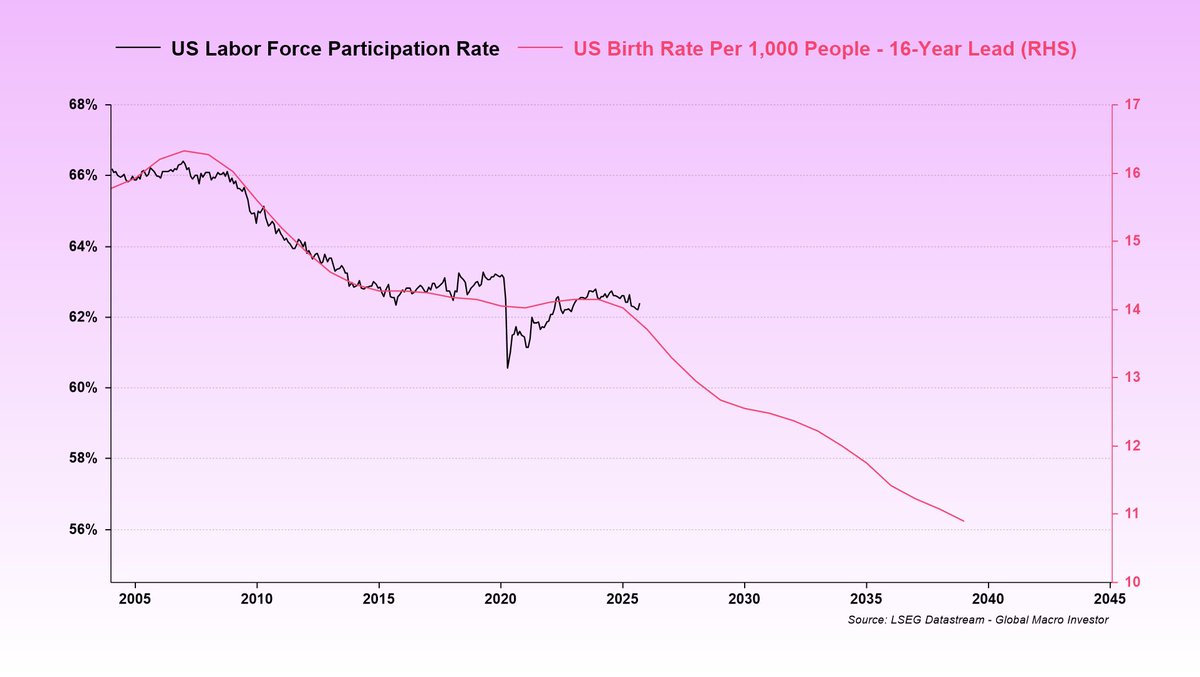
Birth rates peaked in the late 1950s and have been declining ever since. This shows up about sixteen years later in the labor force participation rate as each generation enters the workforce (chart 1).
That means the labor force participation rate is not going to rise any time soon. It is set to keep drifting lower. This is a structural problem.
Aging populations, falling birth rates, and rapidly expanding automation make the backdrop even more deflationary. AI and robotics are replacing humans at scale, and we are only at the beginning. This reinforces the need for ongoing stimulus to keep the system functioning.
With weak population growth and sluggish productivity, the only way to keep GDP expanding is through debt.
Now here’s where it gets interesting…
Government debt growth is completely offsetting the demographic decline and policymakers know exactly what they are doing (chart 2).
And what happens next?
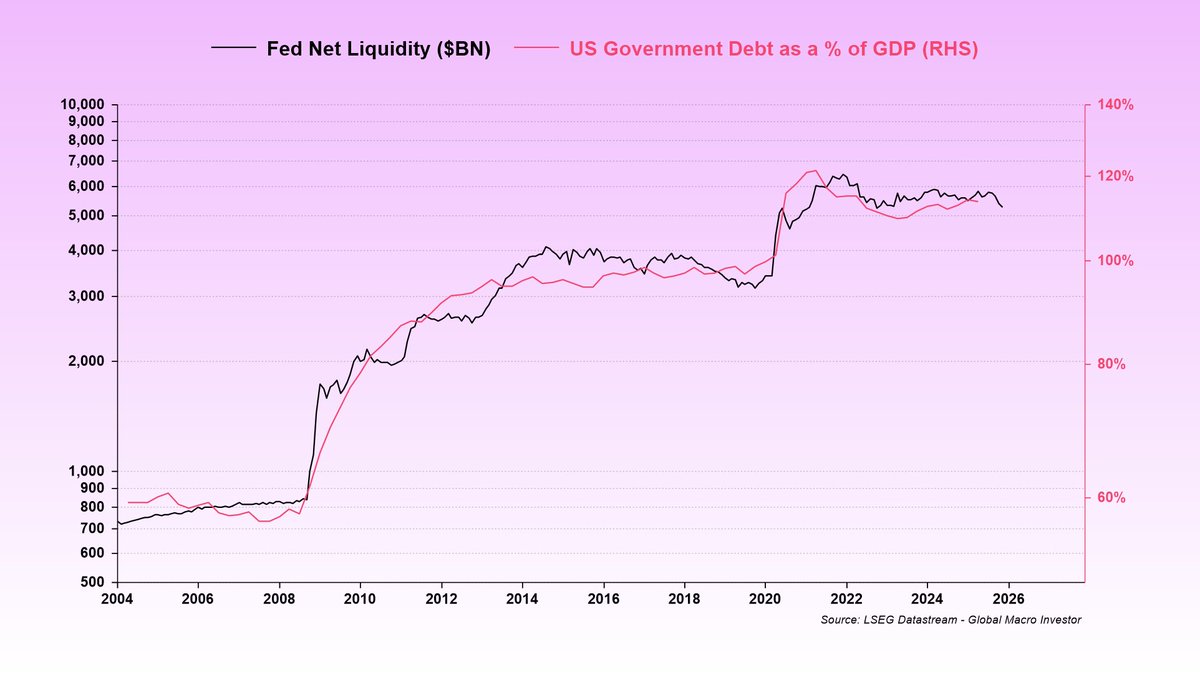
All debt growth in excess of GDP gets monetized (chart 3).
Basically, since 2008, magic money has effectively been paying the interest. Governments issue new debt to cover old interest, and once rates fall enough, central banks absorb it onto their balance sheets.
So to wrap this up, demographics drive the decline in the labor force. Governments offset that decline with more debt. That debt eventually gets monetized through quantitative easing (QE) style operations, not always directly by the Fed, but through the coordinated ecosystem of the Fed, the Treasury, and the banking system. And the bottom line is that there’s still a massive wall of interest that needs to be monetized, far more than GDP can ever cover. Liquidity is literally the only game in town.
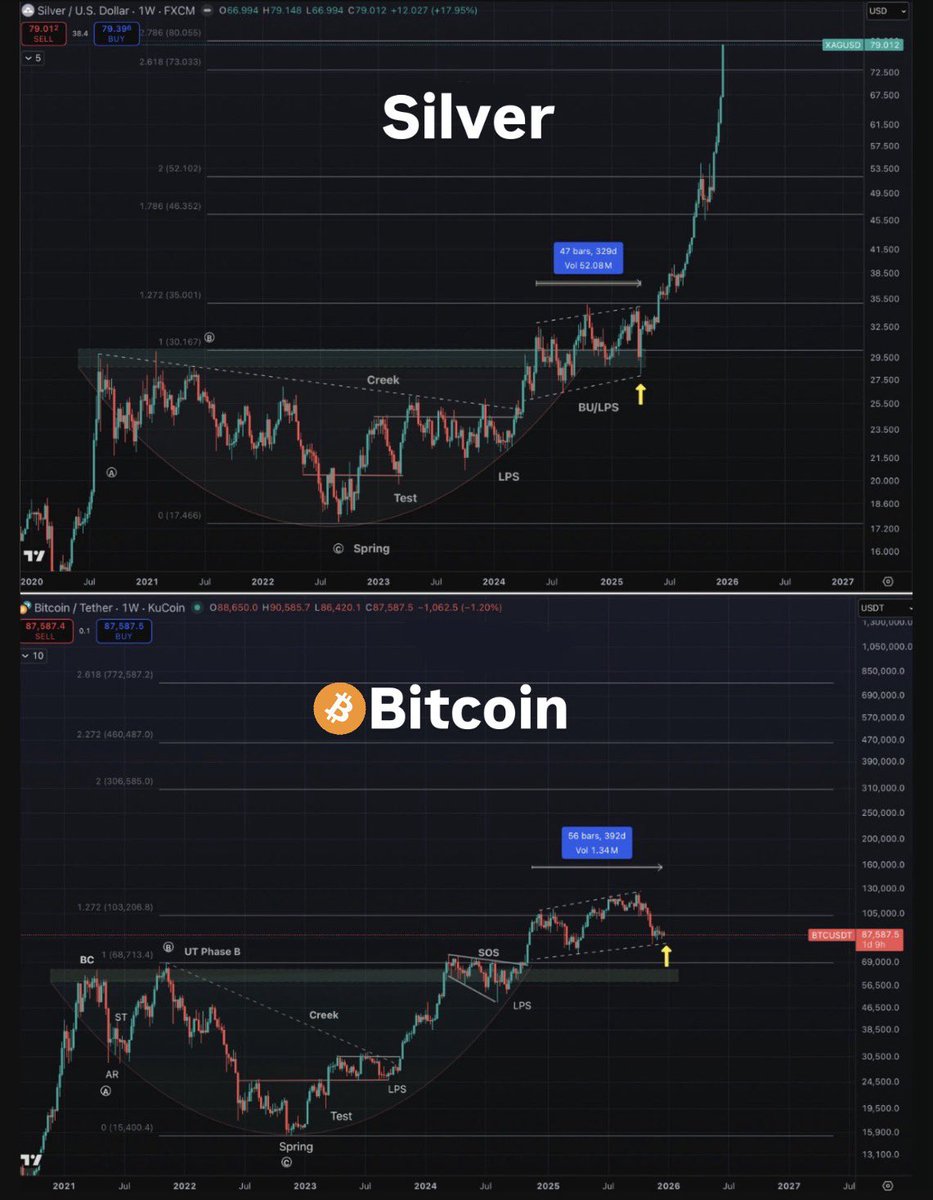
And what thrives in a world of perpetual debasement? Bitcoin (chart 4).
I know this correction has been painful, but it’s all part of the journey. These periods feel brutal in the moment, then they fade and the trend resumes. This too shall pass…
To quote Walter White from Breaking Bad, later echoed by @LynAldenContact, nothing stops this train.
MOAR COWBELL (liquidity) = number go up over time. Zoom out and be more bullish…
October’s sell-off wasn’t the end of the cycle—it may have been the reset it needed.
Excess leverage is flushed, fundamentals remain intact, and institutional players are quietly rotating back in. Smart money is clustering around EVM chains, RWAs, and yield protocols—pointing to selective re-risking, not retreat.
Key takeaways:
• Leverage is cleaner, but liquidity gaps remain.
•Capital is rotating, not entering—selectivity remains critical.
• Macro risk lingers, but structural demand builds.
We think this is the base-building phase before the next leg up, not a cycle top.
Get more on these and other key insights in this Monthly Outlook report:
https://t.co/MMzJSdanTO
With today’s close of Hidden Road (now Ripple Prime), Ripple has announced 5 major acquisitions in ~2 years (GTreasury last week, Rail in August, Standard Custody in 2024, Metaco in 2023). As we continue to build solutions towards enabling an Internet of Value – I’m reminding you all that XRP sits at the center of everything Ripple does. Lock in.