MaThRad is #hiring! We are delighted to announce that our Clinical partners at UCLH are looking to a recruit a talented Radiotherapy Research Physicist to join their team
🚀 Join our team at UCLH! Explore an exciting opportunity in Radiotherapy Physics research and make a significant impact.. Apply now! https://t.co/sifyarbiFv
Warwick's Dr Emma Horton reacts to news that Prada will design NASA's new space suit - and what the science behind it all means 🚀👨🚀
Read more⬇️ https://t.co/oLXuoK9WLb
@warwickstats
Latest research by Jacobs ANSWERS has brought attention to the potential advantages that Quantum Computing could offer in enhancing the planning, design and operation of radiation facilities across the nuclear, medical, and space sectors: https://t.co/H7V58Xaajd
🎓PhD Project Opportunity🎓 This project with @MathsatBath and @NPL aims to quantify the personalised impact of physical & biological uncertainties in customising radiotherapy treatment planning. Read more here: https://t.co/6I2O7Z3fqs #PhDProject#Radiotherapy#UQ#ApplyNow
📢 Opportunity Alert!📢 @uniofwarwick's new centre CAMaCS https://t.co/qEVbqVch8b is currently recruiting for a Centre Manager, a Programme Manager and 3 Innovation Research Associates (InRAs) to help boost knowledge transfer activities. Read more: https://t.co/qEVbqVch8b #hiring
Some serious food for thought in the latest paper from @RosyCers, @lbpartay & #ErinTeich in @npj. Although the points made are levelled at computational materials modellers they should have a wider relevance for anyone working in the Sciences https://t.co/DGx0hEwRSh
For the final presentation of the @MaTh_Rad workshop, Mikolaj Kowlaski (Cambridge) discussed methods for modelling Neurons moving through a highly inhomogeneous material. A great talk on Markov media and Arak dynamics. #MaThRad#ANSWERS
Oliver Tough (@MathsatBath and @MatTh_Rad) gave a detailed and insightful talk connecting genetic population models to Neutron MC, demonstrating a method to estimate clustering time #MaThRad#ANSWERS
Day 2 in Bournemouth at the ANSWERS seminar enjoying the🌊views & lively discussions! Eric Dumonteil from @CEA_Officiel started today's #MaThRad workshop with fascinating talk relating to clustering in Neutron Monte Carlo simulation to gambling discussions by Pascal and Fermat
Finally, we finished the day listening to John Tramm (ANL) demonstrating the power of the random-ray method - with 650 times the speed of a deterministic solver, uniform uncertainty compared to Monte-Carlo. Cutting Edge stuff!
We welcomed @warwickstats Adam Johnson to the floor next to present a fascinating talk about the formulation of sequential Monte Carlo, the history and the particle population control method
MaThRad's Alex Cox (Bath) discussed using exact methods for simulating the stationary distribution, giving theoretical background to the evolution of the expectation
Valeria Raffuzzi (Cambridge) explored in greater depth about MC source convergence acceleration. She showed how multi-group MC approximates the highly varying nuclear cross-sections
Paul Smith (@JacobsConnects) took the floor next to give a great report on mesh-free and mesh-based convergence diagnostics and accelerating fission source convergence
Mikolaj Kowalski (Cambridge) followed with an overview of SCONE - a free, open-source MC solver designed for easy use which can implement random ray methods
We began the day with Simon Richards showing us the @JacobsConnects MONK program, using superhistory powering to avoid bias even in inhomogeneous domains
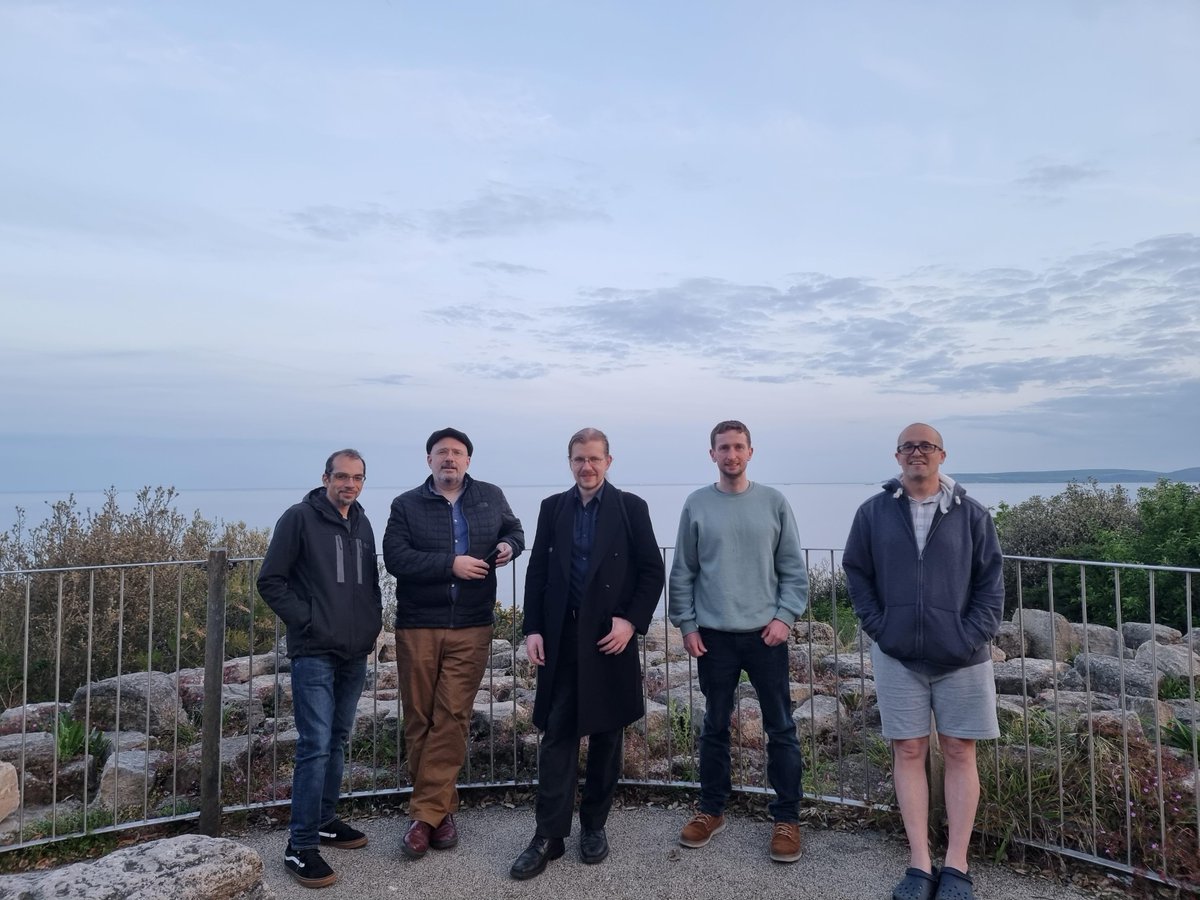
The MaThRad team are excited to be in beautiful Bournemouth to contribute to the annual ANSWERS seminar this week. It's been a fantastic day so far....