In November 2002, a short paper appeared on the preprint server @arXiv. Its author was a 36-year-old mathematician in Saint Petersburg, Russia, who had largely withdrawn from the mathematical mainstream and had published relatively little since his celebrated work of the mid-1990s. He was working as a researcher at the Steklov Institute, but had turned down academic positions at several leading universities. Within four years, mathematicians around the world had reached consensus that the paper and two that followed had achieved something no one had managed in a century: they had solved the Poincaré conjecture. It was the first of the seven Millennium Prize Problems to be resolved, and it remains the only one officially recognized as solved. Its author, Grigori Perelman, would then decline almost every major honor and financial award offered to him for the achievement.
The conjecture is often described as a question about the "shape" of three-dimensional space. That captures the basic idea, but not quite the mathematics. Henri Poincaré posed the problem in 1904 as a question in topology: if every loop in a closed three-dimensional manifold can be continuously shrunk to a point, must that manifold be topologically equivalent to the three-sphere, (S^3)? In modern terminology, the question asks whether every closed, simply connected 3-manifold is homeomorphic to (S^3). The corresponding higher-dimensional problems were solved in stages. Stephen Smale proved the generalized conjecture in dimensions five and higher in 1961, while Michael Freedman solved the topological four-dimensional case in 1982. The three-dimensional case remained open and became one of the most famous unsolved problems in mathematics.
Beginning in the 1970s, William Thurston transformed the subject with his geometrization program, proposing that three-dimensional manifolds could be decomposed into pieces carrying one of eight standard geometric structures. The Poincaré conjecture would follow as a special case of this much broader statement. In 1982, Richard Hamilton introduced Ricci flow, a geometric evolution equation that changes a manifold's metric according to its Ricci curvature. The basic idea can be compared, loosely, to the way heat spreads through an object: irregularities tend to smooth out over time. Hamilton hoped that Ricci flow could transform complicated three-dimensional spaces into geometrically understandable ones and thereby prove Thurston's conjecture. But there was a major obstacle. As Ricci flow evolved, curvature could become arbitrarily large in finite time, producing singularities that Hamilton could not completely control.
Grigori Perelman had been immersed in mathematics from an early age. Born in Leningrad in 1966, he attended Sergei Rukshin's famous mathematics circle and, at sixteen, represented the Soviet Union at the 1982 International Mathematical Olympiad in Budapest. He received a perfect score of 42 out of 42 and won a gold medal. Perelman went on to study at Leningrad State University and completed his doctorate in 1990 before joining the Steklov Institute. In 1993, he received a Miller Research Fellowship at the University of California, Berkeley. In 1994, he published a remarkably short proof of the soul conjecture of Cheeger and Gromoll, a significant result in Riemannian geometry. Several leading American universities subsequently offered him positions, but Perelman declined them and returned to Saint Petersburg in 1995. In 1996, he wrote to Richard Hamilton explaining that he believed he had found a way around the difficulties in the Ricci-flow program and offering to collaborate. The collaboration did not materialize, and Perelman continued working largely on his own.
His breakthrough finally appeared on arXiv. On 11 November 2002, Perelman posted "The Entropy Formula for the Ricci Flow and Its Geometric Applications". The paper did not contain a conventional announcement that the Poincaré conjecture had been solved. Instead, in Perelman's extremely compressed style, it developed new tools for Ricci flow and included a sketch of how they could be used to prove Thurston's geometrization conjecture. Two more papers followed, in March and July 2003. Together, they supplied the mathematical framework that completed Hamilton's program and established the geometrization conjecture in the form needed to settle the Poincaré problem.
Among the crucial ingredients were Perelman's no-local-collapsing theorem and his analysis of canonical neighborhoods. These results gave mathematicians the control they needed over the shapes that appear near singularities of three-dimensional Ricci flows. When a singularity developed in a controlled cylindrical region, the problematic neck could be cut out and replaced with suitable caps, after which the Ricci flow could continue. This process, known as surgery, provided the mechanism needed to carry the flow through singularities. Perelman's papers were remarkably terse, often stating sophisticated arguments with far fewer intermediate details than a conventional mathematical exposition would normally provide. Several groups therefore undertook detailed examinations of the work, including Bruce Kleiner and John Lott, Huai-Dong Cao and Xi-Ping Zhu, and John Morgan and Gang Tian. Their extensive expositions, together with the scrutiny of many other mathematicians, helped establish the consensus reached by 2006 that Perelman's arguments were correct.
The recognition that followed was extraordinary. In May 2006, the Fields Medal committee voted to award Perelman mathematics' highest distinction. Sir John Ball, then president of the International Mathematical Union, traveled to Saint Petersburg that June and spent roughly ten hours over two days trying to persuade Perelman to accept the medal. Perelman had already made up his mind. At the International Congress of Mathematicians in Madrid in August 2006, he was announced as one of the Fields Medalists, but he did not attend the ceremony and declined the medal, becoming the first person to refuse a Fields Medal. Perelman explained that he was not interested in money or fame and expressed deep dissatisfaction with aspects of the mathematical community and its standards of recognition. His rejection of major honors was not new: in 1996, he had also declined the European Mathematical Society Prize awarded to him. Later in 2006, Science magazine named the proof of the Poincaré conjecture its Breakthrough of the Year, the first time the distinction had gone to a mathematical achievement.
That same year, another controversy surrounding the proof became highly public. In August 2006, The New Yorker published Sylvia Nasar and David Gruber's article "Manifold Destiny," which described tensions surrounding the recognition of Perelman's work and the detailed proof written by Huai-Dong Cao and Xi-Ping Zhu. The article portrayed Fields Medalist Shing-Tung Yau as attempting to give greater prominence to the work of Cao and Zhu in a way that diminished Perelman's contribution. Yau strongly disputed the article's characterization and threatened legal action, although no lawsuit followed. The details and interpretations surrounding that episode remain contested. Perelman had, however, already resigned from the Steklov Institute in December 2005 and had expressed serious concerns about ethical standards and what he regarded as tolerated dishonesty within parts of the mathematical community.
The Poincaré conjecture was not immediately eligible for the Millennium Prize. The Clay Mathematics Institute's rules require a proposed solution to be published in an appropriate outlet, to have at least two years pass after publication, and to receive general acceptance from the mathematical community. On 18 March 2010, Clay formally awarded Perelman the $1 million Millennium Prize for the solution of the Poincaré conjecture. He declined it. Perelman did not attend the June 2010 Paris conference organized to celebrate the solution, and on 1 July the Russian news agency Interfax reported that he had confirmed his decision to reject the money. His explanation was more specific than simply saying that he disliked publicity: Perelman said that he considered his contribution to the solution no greater than Richard Hamilton's and that he was dissatisfied with the way the mathematical community had treated him and Hamilton. The Clay Mathematics Institute subsequently used the funds associated with the declined prize to establish the Poincaré Chair at the Institut Henri Poincaré in Paris, intended to support promising young mathematicians.
Since then, Perelman has largely disappeared from public mathematical life. He has given very few interviews and has avoided the public spotlight. Reports over the years have described him as living privately in Saint Petersburg, but his current circumstances are not publicly documented. One reported anecdote captures his attitude toward publicity particularly well: a journalist who reached him by telephone was reportedly told that Perelman could not talk because he was out picking mushrooms. There have also been occasional Russian media reports about his activities, including a 2014 report claiming that he had taken a position connected with nanotechnology in Sweden, but such reports have not been independently confirmed by Perelman.
The Poincaré conjecture remains the only one of the seven Millennium Prize Problems that the Clay Mathematics Institute has officially recognized as solved. That status is particularly relevant in September 2026, following recent attention surrounding an OpenAI research result on the Navier–Stokes problem. OpenAI has reported a result concerning a forced version of the equations and has explicitly said that it does not intend to claim the Millennium Prize for that result. The Clay Mathematics Institute has described the Navier–Stokes problem as apparently settled while emphasizing that its evaluation process is deliberately slow and that mathematical scrutiny remains necessary before the problem can be formally recognized as solved.
Perelman's story illustrates why extraordinary mathematical claims are not settled by announcements alone. They become accepted through sustained scrutiny, reconstruction, verification, and the willingness of other mathematicians to spend years trying to determine whether an argument actually works. In the end, Perelman's achievement was not simply that he solved a problem that had resisted mathematicians for a century. He completed a program begun by Hamilton, established the much broader geometrization theorem, and then walked away from the fame, medals, and million-dollar prize that followed.
[References: Grigori Perelman, Manifold Destiny, and Millennium Prize Problems (Wikipedia); Clay Mathematics Institute; Science, "Breakthrough of the Year" (Dec 2006); The New Yorker, "Manifold Destiny" by Sylvia Nasar and David Gruber (Aug 2006); Masha Gessen, Perfect Rigor (2009).]
(Photo: Grigori Perelman at Berkeley, 1993. George M. Bergman / Wikimedia Commons, CC BY-SA 4.0.)
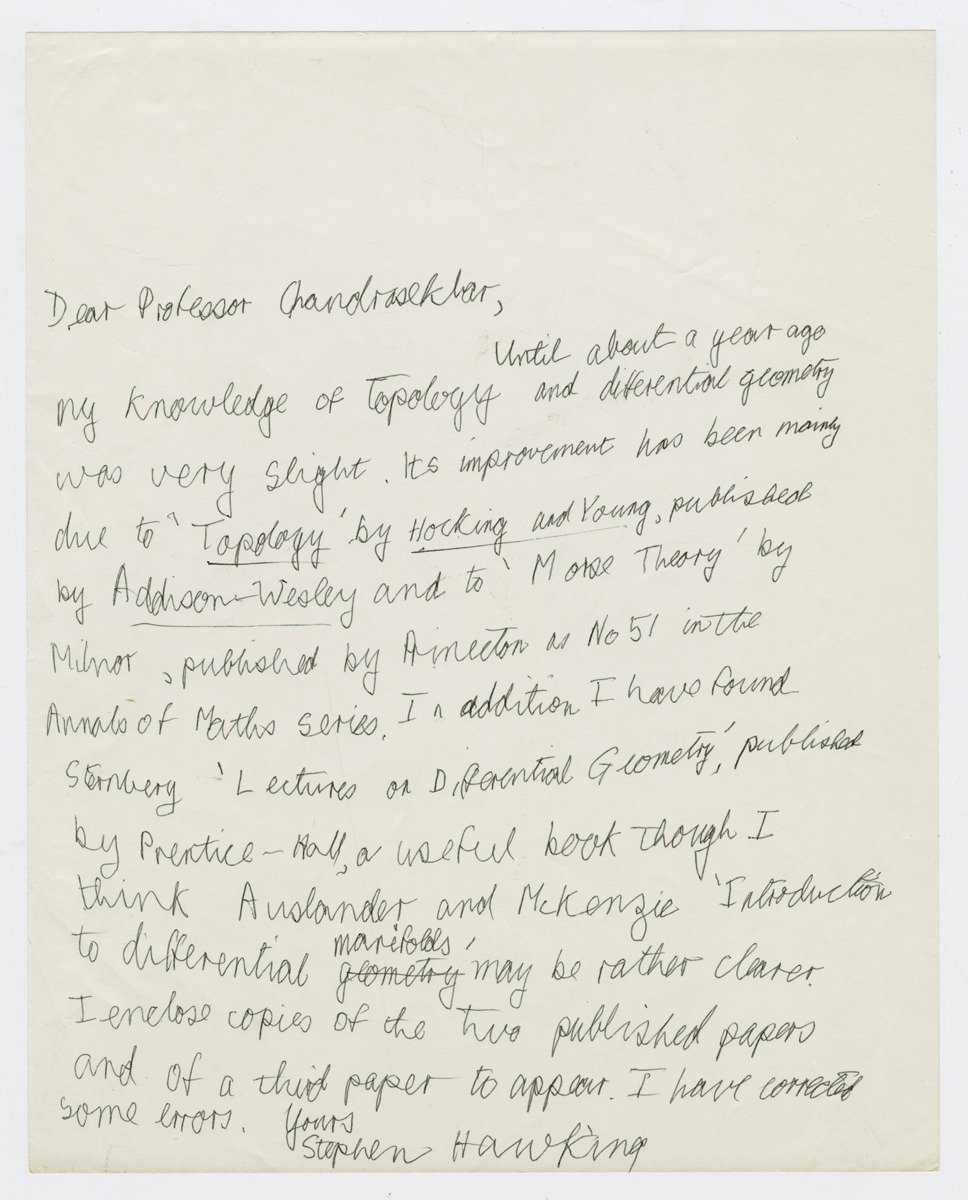
In February 1967, Subrahmanyan Chandrasekhar, then 56 and already renowned for his work on stellar structure and the Chandrasekhar limit, wrote to 25-year-old Stephen Hawking.
Chandrasekhar was trying to understand the mathematics underlying Hawking’s work on singularities in cosmology. He asked Hawking for references and described reading his papers as “climbing a staircase moving downwards.”
Hawking replied, recommending books on topology and differential geometry, along with some of his own papers.
Chandrasekhar would go on to receive the 1983 Nobel Prize in Physics for his theoretical studies of the physical processes important to the structure and evolution of stars.
(Letters: Subrahmanyan Chandrasekhar Papers, Box 16, Folder 23, “Hawking, Stephen W.,” Hanna Holborn Gray Special Collections Research Center, University of Chicago Library.)
String theory did not begin as a theory of gravity. It emerged in 1968 from an attempt to understand the strong nuclear interaction, when Gabriele Veneziano discovered a scattering amplitude that captured important features of hadronic interactions. Within a few years, physicists realized that the mathematics could be interpreted in terms of quantized, vibrating strings—and, unexpectedly, that the spectrum of closed strings contained a massless spin-2 state with the characteristic properties expected of a graviton. This discovery helped transform string theory into a candidate framework for quantum gravity.
From there came superstring theories, extra dimensions, dualities, M-theory, black-hole microstate counting, and holography. Decades later, researchers continued exploring whether string theory's scattering amplitudes could be derived from fundamental consistency conditions, including through modern amplitude-bootstrap approaches.
General relativity and quantum mechanics are two of the most successful frameworks in physics, yet combining gravity with quantum mechanics presents a profound problem. General relativity is a classical theory, while the electromagnetic, weak, and strong interactions are described by quantum field theory. Gravity itself can be treated as an effective quantum field theory at energies well below the Planck scale, but perturbative quantum general relativity is nonrenormalizable: increasingly many higher-order counterterms are required as one goes to higher loop orders. Thus, perturbative point-particle quantum gravity does not provide a conventional ultraviolet-complete quantum field theory.
String theory is the most extensively developed framework that attempts to address this problem by replacing point particles with one-dimensional extended objects. In perturbative string theory, different elementary particles can arise as different vibrational states of strings, including a massless spin-2 state with the characteristic quantum numbers and low-energy couplings expected of a graviton. Because string interactions are spread over extended worldsheets rather than concentrated at pointlike interaction vertices, the ultraviolet behavior is dramatically softened. Perturbative superstring theory therefore provides a mathematically consistent quantum framework containing gravity, although a complete nonperturbative formulation of the theory in arbitrary backgrounds remains an open problem.
That is the modern pitch. The origin story is stranger, because nobody set out to quantize gravity in 1968. Gabriele Veneziano, then at CERN, was trying to describe the strong nuclear interaction, particularly the scattering of hadrons, and was looking for an amplitude with the appropriate resonance and Regge behavior. He found that Euler's beta function provided an amplitude with the analytic properties he needed. His 1968 formula became known as the Veneziano amplitude and launched the dual-resonance model, although at the time there was no established physical picture behind the mathematics.
The physical interpretation emerged in 1969–70, when Yoichiro Nambu, Leonard Susskind, and Holger Nielsen independently developed interpretations of the dual-resonance amplitudes in terms of relativistic strings. Nambu and, independently, Tetsuo Goto formulated the natural area action for a relativistic string: an action proportional to the area of the two-dimensional worldsheet swept out by the string as it moves through spacetime. This is now known as the Nambu–Goto action.
The reinterpretation was elegant but came with serious problems. The conventional critical bosonic string is critical in 26 spacetime dimensions, far more than the four we observe, and its spectrum contains a tachyon, indicating an instability of the perturbative vacuum. Meanwhile, experimental and theoretical developments were rapidly establishing quantum chromodynamics as the theory of the strong interaction. In 1973, David Gross and Frank Wilczek, and independently David Politzer, discovered asymptotic freedom, providing a crucial explanation of the short-distance behavior of non-Abelian gauge theories such as QCD. By the mid-1970s, most particle physicists had abandoned string theory as a phenomenological model of hadrons. A relatively small group, with John Schwarz among the prominent holdouts, continued to investigate it.
They were rewarded with a discovery that fundamentally changed the interpretation of the theory. In 1974, Joël Scherk and John Schwarz, and independently Tamiaki Yoneya, recognized that the closed-string spectrum contains a massless spin-2 state with the characteristic properties expected of a graviton. What had been developed as a model of hadrons therefore contained, unexpectedly, a quantum degree of freedom associated with gravity. Scherk and Schwarz proposed that string theory should instead be interpreted as a candidate quantum theory of gravity, with the fundamental string scale vastly higher than the hadronic scale and potentially associated with physics near the Planck scale. For several years this remained a minority position.
The turning point came in 1984 in what became known as the first superstring revolution. Michael Green and John Schwarz discovered that gauge and gravitational anomalies could cancel in certain ten-dimensional supersymmetric string constructions. The anomaly-cancellation mechanism imposed extraordinarily strong restrictions on the possible gauge structure, with SO(32) playing the crucial role in Type I superstring theory. In 1984–85, David Gross, Jeffrey Harvey, Emil Martinec, and Ryan Rohm constructed the heterotic string, obtaining the gauge groups Spin(32)/Z₂ and E8 × E8. By the mid-1980s, physicists had identified five consistent ten-dimensional perturbative superstring theories: Type I, Type IIA, Type IIB, heterotic Spin(32)/Z₂, and heterotic E8 × E8. The supersymmetric constructions, together with the appropriate projections, eliminate the tachyonic states present in the bosonic theory.
The five theories still required extra dimensions. In 1985, Philip Candelas, Gary Horowitz, Andrew Strominger, and Edward Witten showed how six of the ten dimensions could be compactified on suitable Calabi–Yau manifolds while preserving N=1 supersymmetry in four-dimensional spacetime. Calabi–Yau compactification provided a promising route toward obtaining realistic low-energy physics from ten-dimensional superstring theory, although it did not uniquely determine the Standard Model or the compactification geometry.
Five apparently different perturbative superstring theories was an uncomfortable place for a supposedly fundamental theory to end up. During the late 1980s and early 1990s, a growing body of work revealed exact relationships between apparently different theories. Indian physicist Ashoke Sen played a major role in establishing strong���weak coupling dualities, or S-dualities, showing in important examples that a strongly coupled description of one theory could be equivalent to a weakly coupled description of another. T-dualities, which relate compactifications of string theories at different radii, provided another important part of the emerging web of connections.
Joseph Polchinski then showed in 1995 that D-branes—extended p-dimensional objects on which open strings can end—are physical dynamical objects carrying Ramond–Ramond charge in the appropriate superstring theories. At the 1995 Southern California conference that became associated with the second superstring revolution, Edward Witten synthesized the emerging web of dualities, D-branes, and eleven-dimensional supergravity into the proposal that the five perturbative superstring theories were different limits of a deeper framework, which he called M-theory. In the strong-coupling limit of Type IIA string theory, an additional spatial dimension emerges, and the low-energy description becomes eleven-dimensional supergravity.
M-theory remains incompletely formulated. There is no universally accepted, complete nonperturbative formulation describing the theory in all regimes and backgrounds, although an extensive web of dualities, limits, and consistency checks strongly supports the idea that the five perturbative superstring theories are different manifestations or limits of a deeper structure. Even the meaning of the “M” was deliberately left ambiguous.
The following years produced some of string theory's most concrete theoretical successes. In 1996, Andrew Strominger and Cumrun Vafa used D-brane state counting to reproduce the Bekenstein–Hawking entropy of a particular class of supersymmetric extremal black holes. Their microscopic counting gave the same leading entropy as the thermodynamic formula: S = A / (4Gℏ) in conventional units. The result provided a striking demonstration that black-hole entropy can arise from counting microscopic quantum states in string theory, although the calculation applied to a specific class of highly symmetric extremal black holes rather than to every astrophysical black hole.
In 1997, Juan Maldacena proposed the AdS/CFT correspondence. In its canonical example, Type IIB string theory on AdS5 × S5 is conjectured to be exactly equivalent to four-dimensional N=4 supersymmetric Yang–Mills theory living on the boundary. This is a concrete realization of holographic duality, in which a gravitational theory in a higher-dimensional spacetime can be equivalent to a nongravitational quantum field theory in one fewer dimension. AdS/CFT has since become one of the most influential frameworks in theoretical physics, with applications to black holes, quantum information, strongly coupled gauge theories, and systems inspired by condensed-matter physics.
That caveat matters, because nearly six decades after Veneziano's amplitude, there is still no direct experimental evidence that fundamental strings, their characteristic excitation spectrum, D-branes, or the extra dimensions and supersymmetry appearing in conventional superstring constructions describe nature. No characteristic string spectrum has been observed, and neither supersymmetry nor extra dimensions have been experimentally established as consequences of string theory.
The six extra spatial dimensions of ten-dimensional superstring theory can be compactified in an enormous number of ways. In particular classes of flux compactifications, estimates of order 10^500 or larger have been obtained for the number of metastable vacua. The famous 10^500 figure, however, should not be interpreted as a rigorous count of all possible string vacua. Different constructions, assumptions, and counting methods lead to different estimates.
This enormous collection of possible low-energy realizations is commonly described as the string landscape. Cumrun Vafa's swampland proposal introduced a complementary distinction between effective field theories that can arise from consistent theories of quantum gravity—the landscape—and apparently consistent low-energy theories that cannot be completed into a consistent theory of quantum gravity—the swampland. The swampland program has produced a large number of conjectures and consistency conditions, but these are not all established theorems.
One major unresolved issue concerns positive vacuum energy. Constructing controlled, metastable de Sitter vacua in string theory remains difficult and controversial. This difficulty motivated the de Sitter swampland conjectures, which propose restrictions on scalar potentials compatible with quantum gravity. These proposals remain conjectures rather than established results, and proposed constructions of metastable de Sitter vacua continue to be debated.
Critics such as Peter Woit have argued that string theory's lack of distinctive experimentally confirmed predictions represents a serious problem for its connection to empirical physics. Defenders point out that, regardless of whether string theory ultimately describes our universe, its dualities and mathematical structures have generated important results and techniques across quantum field theory, geometry, topology, quantum information, and mathematical physics.
The story has not stopped. In January 2026, Henriette Elvang, Aidan Herderschee, and Roger Morales studied a highly constrained class of four-dimensional, non-gravitational, maximally supersymmetric effective field theories whose leading low-energy theory is N=4 super-Yang–Mills. By imposing supersymmetry and SU(4) R-symmetry, together with tree-level factorization and positivity constraints, they found that the allowed four-point Wilson coefficients converge toward those of the open-string Veneziano amplitude. Their analysis also uses factorization properties of higher-point amplitudes. The results strongly suggest that, within this highly constrained setup and at tree level, the combined consistency conditions single out the open-string UV completion. This does not prove that string theory is uniquely required by nature, nor that N=4 supersymmetry describes our universe.
In August 2025, Clifford Cheung, Grant N. Remmen, Francesco Sciotti, and Michele Tarquini released the preprint “Strings from Almost Nothing,” which was subsequently published in 𝘗𝘩𝘺𝘴𝘪𝘤𝘢𝘭 𝘙𝘦𝘷𝘪𝘦𝘸 𝘓𝘦𝘵𝘵𝘦𝘳𝘴 in June 2026. They studied tree-level four-point scattering amplitudes under specific assumptions, including prescribed zeros in residues and ultrasoft high-energy behavior. Under those assumptions, the allowed amplitudes collapse onto the Veneziano and Virasoro–Shapiro amplitudes familiar from open and closed string theory. Rather than assuming strings from the beginning, the analysis derives these characteristic string amplitudes from scattering-consistency conditions. But the conclusion is conditional on the assumptions imposed; it does not establish that nature must be described by string theory.
Separately, in 2026, Mudit Jain, Elijah Sheridan, David J. E. Marsh, Elli Heyes, Keir K. Rogers, and Andreas Schachner developed Bayesian methods for connecting axion phenomenology with the statistical properties of Calabi–Yau compactifications. Using Monte Carlo methods and normalizing flows, they constructed statistical frameworks for relating possible axion observations to distributions of compactification geometries and associated parameters. Their work illustrates how future observations—including hypothetical QCD-axion detections in experimentally accessible mass ranges—could update statistical information about classes of Calabi–Yau compactifications. It is a framework for confronting string-inspired compactification models with future data, not an already confirmed experimental prediction that an axion measurement will reveal the geometry of the extra dimensions.
Nearly six decades after an Italian physicist found a beta-function formula while searching for a description of hadronic scattering, string theory still has not delivered an experimentally confirmed theory of everything. What it has produced instead is something more complicated and, in some ways, more remarkable: a framework in which gravity, gauge theory, black-hole physics, holography, quantum field theory, and deep mathematics are tied together by a web of unexpected relationships.
The most intriguing recent developments may be shifting part of the question from “What happens if we assume strings?” toward “Under what consistency conditions are string-like amplitudes singled out?” The 2025–26 amplitude-bootstrap results do not prove that strings are the fundamental constituents of nature, but they strengthen the case that some mathematical structures discovered through string theory can emerge from deeper consistency principles rather than being arbitrary assumptions.
Whether this ultimately changes string theory's status—from an extraordinarily rich theoretical framework and candidate quantum theory of gravity to a physically confirmed description of nature—remains an open question.
In 1945, the great mathematician and theoretical physicist Hermann Weyl prepared this remarkable assessment of leading physicists and mathematicians for Frank Aydelotte, then Director of the Institute for Advanced Study (IAS), Princeton. The memorandum evaluated potential candidates for affiliation with the Institute, and its names read like a who's who of twentieth-century science.
Weyl placed Niels Bohr, Erwin Schrödinger, Werner Heisenberg, Paul Dirac and Enrico Fermi in his top-ranked group, while George Gamow, Hans Bethe, Eugene Wigner and Wolfgang Heitler appeared in the second rank. Both Bethe and Wigner would later receive Nobel Prizes in Physics. Weyl considered the four second-ranked physicists to be of the same rank as J. Robert Oppenheimer, though several steps below Wolfgang Pauli, and described Oppenheimer as “the most inspiring for younger physicists.”
The memorandum also highlights Weyl's assessment of individual scientific achievements. He praised Dirac's relativistic quantum equation for the electron, rated Fermi's early theoretical work highly, and noted Wigner's application of group theory to quantum mechanics.
Read the full memorandum here: 🔗 https://t.co/EEtCIeB3vZ
[Credit: Hermann Weyl, "Theoretical Physicists and Mathematicians," April 19, 1945. Shelby White and Leon Levy Archives Center, Institute for Advanced Study, Princeton.]
In 1945, the great mathematician and theoretical physicist Hermann Weyl prepared this remarkable assessment of leading physicists and mathematicians for Frank Aydelotte, then Director of the Institute for Advanced Study (IAS), Princeton. The memorandum evaluated potential candidates for affiliation with the Institute, and its names read like a who's who of twentieth-century science.
Weyl placed Niels Bohr, Erwin Schrödinger, Werner Heisenberg, Paul Dirac and Enrico Fermi in his top-ranked group, while George Gamow, Hans Bethe, Eugene Wigner and Wolfgang Heitler appeared in the second rank. Both Bethe and Wigner would later receive Nobel Prizes in Physics. Weyl considered the four second-ranked physicists to be of the same rank as J. Robert Oppenheimer, though several steps below Wolfgang Pauli, and described Oppenheimer as “the most inspiring for younger physicists.”
The memorandum also highlights Weyl's assessment of individual scientific achievements. He praised Dirac's relativistic quantum equation for the electron, rated Fermi's early theoretical work highly, and noted Wigner's application of group theory to quantum mechanics.
Read the full memorandum here: 🔗 https://t.co/EEtCIeB3vZ
[Credit: Hermann Weyl, "Theoretical Physicists and Mathematicians," April 19, 1945. Shelby White and Leon Levy Archives Center, Institute for Advanced Study, Princeton.]
Bryan Birch turns 95 today.
Born on 25 September 1931 in Burton-upon-Trent, England, he is one of the most influential number theorists of the past century, and one of the two mathematicians behind one of the seven Clay Mathematics Institute Millennium Prize Problems.
Among his early major results came work on rational solutions of homogeneous forms. As a Cambridge doctoral student, supervised by J. W. S. Cassels, Birch was also influenced by Harold Davenport. Using the Hardy–Littlewood circle method, he proved important results showing that systems of homogeneous forms of odd degree have nontrivial rational zeros when they involve sufficiently many variables.
The work that defined his career began in the late 1950s and early 1960s, when he and Peter Swinnerton-Dyer used Cambridge’s EDSAC computer to study elliptic curves by calculating their numbers of points modulo primes. The patterns in their data led them to conjecture that the rank of an elliptic curve’s group of rational points equals the order of vanishing of its L-function at s = 1. The Birch and Swinnerton-Dyer conjecture has shaped arithmetic geometry ever since.
When the Clay Mathematics Institute announced its seven Millennium Prize Problems in Paris on 24 May 2000, each carrying a $1 million prize for a correct proof, the Birch and Swinnerton-Dyer conjecture was among them. It remains unsolved.
Birch continued making important contributions beyond this celebrated conjecture. Around 1971, he introduced modular symbols, a tool that Yuri Manin also developed independently. They are now important in computational number theory. Birch also worked on the Birch–Tate conjecture in algebraic K-theory.
He further helped reassess Kurt Heegner’s 1952 solution to Gauss’s class number one problem, which had gone unrecognized for years. Birch developed Heegner’s ideas and studied Heegner points on elliptic curves, helping establish the groundwork for the later Gross–Zagier theorem.
His academic career took him from Trinity and Churchill Colleges, Cambridge, to the University of Manchester, and then to Oxford. There, he became a Fellow of Brasenose College and Professor of Arithmetic, and is now Emeritus Professor of Arithmetic. He was elected a Fellow of the Royal Society in 1972 and went on to receive the Senior Whitehead Prize, the De Morgan Medal, and, in 2020, the Royal Society’s Sylvester Medal.
Among the mathematicians influenced by Birch’s work was John Cremona, who completed his doctorate under Birch at Oxford in 1981 with a thesis on modular symbols, and went on to make important contributions to computational number theory.
Happy 95th birthday to Professor Bryan Birch. More than six decades after the conjecture that bears his name emerged, it remains one of mathematics’ great open questions.
[Photo credit: William Stein / Wikimedia Commons (CC BY 3.0)]
An fascinating question at the intersection of mathematics, physics, and artificial intelligence.
Could AI eventually discover mathematical structures and physical principles beyond the reach of human intuition? An intriguing perspective from Prof. Brian Greene.
Can AI discover new mathematics and physical principles that humans have never imagined?
One of the curators & archive cataloguers at Physics Archives, Manish Mishra (@Astro_Manish), recently asked renowned theoretical physicist Prof. Brian Greene (@bgreene) whether AI could eventually discover new physics and mathematics that humans might never have imagined.
Prof. Greene’s perspective offers plenty to think about as artificial intelligence increasingly becomes part of scientific research. His answer touches on everything from the complexity of the Navier–Stokes equations to the ultimate limits of human intuition.
Watch the video to hear Prof. Greene’s perspective on the intersection of human intellect and artificial intelligence:🔗https://t.co/bPipn1WOlc
(Video via: https://t.co/3bJV8aNTJ1; credit: @WorldSciFest)
#PhysicsArchives
Can AI discover new mathematics and physical principles that humans have never imagined?
One of the curators & archive cataloguers at Physics Archives, Manish Mishra (@Astro_Manish), recently asked renowned theoretical physicist Prof. Brian Greene (@bgreene) whether AI could eventually discover new physics and mathematics that humans might never have imagined.
Prof. Greene’s perspective offers plenty to think about as artificial intelligence increasingly becomes part of scientific research. His answer touches on everything from the complexity of the Navier–Stokes equations to the ultimate limits of human intuition.
Watch the video to hear Prof. Greene’s perspective on the intersection of human intellect and artificial intelligence:🔗https://t.co/bPipn1WOlc
(Video via: https://t.co/3bJV8aNTJ1; credit: @WorldSciFest)
#PhysicsArchives
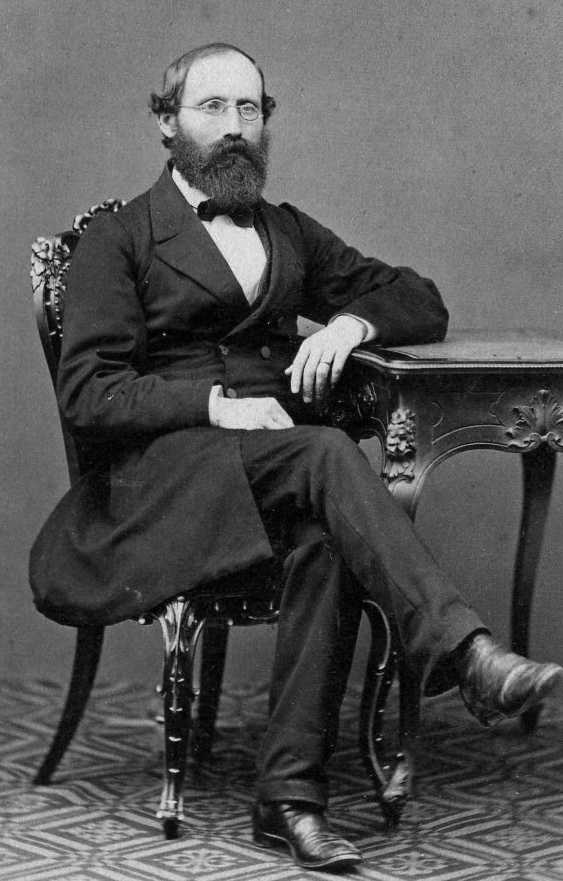
200 years ago today, on September 17, 1826, Georg Friedrich Bernhard Riemann was born in the Hanoverian village of Breselenz, the second of six children of a poor Lutheran pastor. Shy, devout, and often in fragile health, he showed exceptional mathematical ability from an early age. A famous account tells how one of his teachers lent him Legendre's roughly 850-page treatise on number theory; Riemann is said to have returned it just six days later, having mastered its contents.
He studied at G��ttingen and then Berlin, where he was influenced by mathematicians including Dirichlet, Jacobi, Eisenstein, and Steiner, before returning to Göttingen to complete his doctorate under Carl Friedrich Gauss. His 1851 dissertation, examined on December 16 of that year, laid the foundations for what we now call the theory of Riemann surfaces. In his report on the dissertation, Gauss praised Riemann's work as showing “a gloriously fertile originality.”
For his habilitation, Riemann proposed three possible lecture topics, two in mathematical physics and one on the foundations of geometry. Against Riemann's expectations, Gauss chose the geometry topic. On June 10, 1854, the 27-year-old Riemann delivered “On the Hypotheses Which Lie at the Foundations of Geometry” to the Göttingen faculty. Later accounts emphasized that Gauss was essentially alone among the audience in appreciating the depth of Riemann's ideas. The lecture generalized differential geometry from surfaces to spaces of arbitrary dimension, laying mathematical groundwork that would become important to Einstein's general relativity six decades later. Riemann's separate habilitation dissertation, on representing functions by trigonometric series, established the framework for what is now called the Riemann integral.
In 1859, following Dirichlet's death, Riemann became his successor as professor of mathematics at Göttingen. He was also elected a corresponding member of the Berlin Academy of Sciences and, according to the Academy's custom, submitted a report on his current research: a mere six-manuscript-page paper titled “On the Number of Primes Less Than a Given Quantity.” In it, Riemann extended the zeta function meromorphically to the complex plane and conjectured that all its nontrivial zeros have real part 1/2. That conjecture, the Riemann Hypothesis, remains unproved today. It forms part of Hilbert's eighth problem among his 23 problems of 1900 and is one of the Clay Mathematics Institute's seven Millennium Prize Problems announced in 2000 — the only Millennium problem that also appears, in essentially the same form, in Hilbert's list.
Riemann died of tuberculosis on July 20, 1866, at the age of 39, in Selasca on the shore of Lake Maggiore, where he had gone seeking relief in a more favorable climate. Back in Göttingen, some papers in his office were discarded by his housekeeper, including unpublished material. How much potentially important work was lost can no longer be determined.
Two hundred years after his birth, Riemann's ideas still lie at the heart of differential geometry, complex analysis, and analytic number theory.
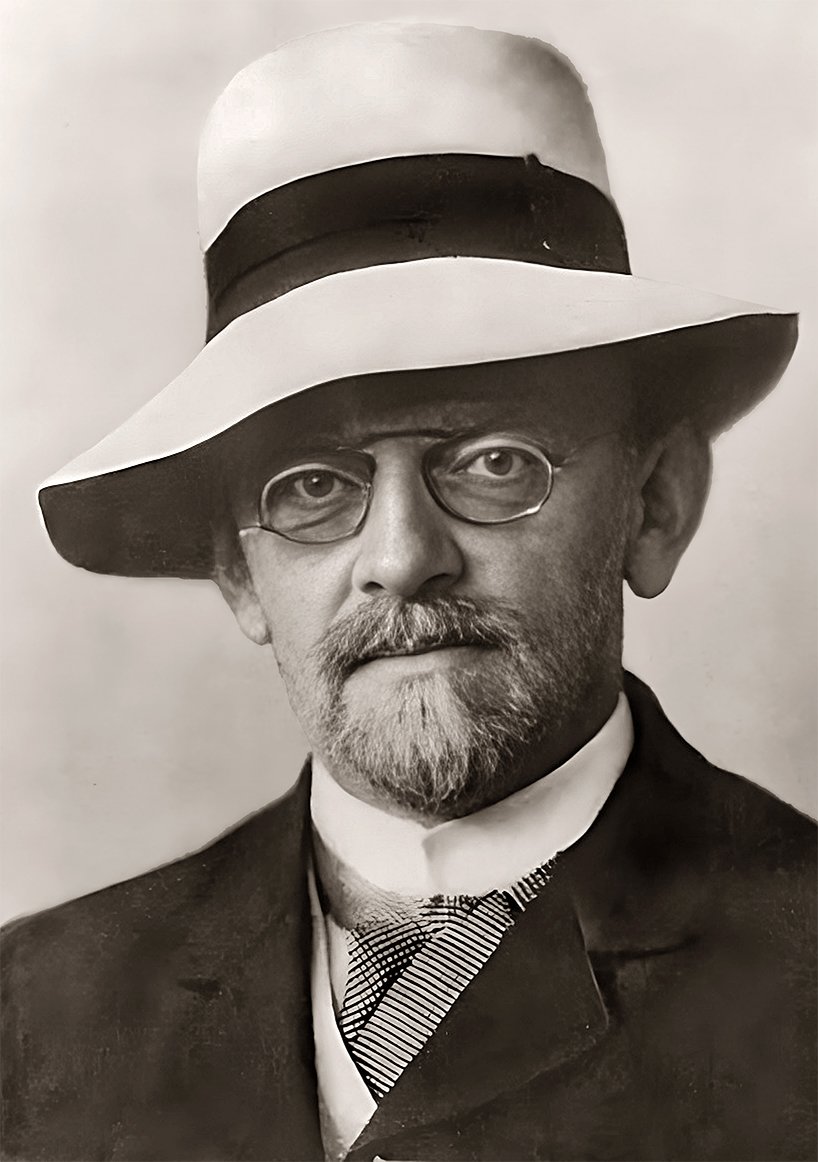
“Without mathematics, modern astronomy and physics would be impossible. The theoretical parts of these sciences almost dissolve into branches of mathematics.”
— David Hilbert, 1930
From his address 𝘕𝘢𝘵𝘶𝘳𝘦𝘳𝘬𝘦𝘯𝘯𝘦𝘯 𝘶𝘯𝘥 𝘓𝘰𝘨𝘪𝘬 (“Knowledge of Nature and Logic”)
@PhysicsArchives Poincaré really was a remarkable example of the “last universalist.” What stands out is not just how much he knew, but how deeply he understood different subjects and how naturally he connected ideas across mathematics, physics, astronomy, and philosophy.
Poincaré truly embodied the spirit of the “last universalist.” His remarkable breadth was matched by an extraordinary depth of understanding—and, perhaps most importantly, by his ability to see connections across mathematics, physics, astronomy, and philosophy. Few scientists in modern history have ranged so freely and so profoundly across different fields of knowledge.
Henri Poincaré is often remembered as “the last universalist,” but his physics alone would secure his place among the greats of the field.
Years before Einstein's 1905 paper, Poincaré was already probing the foundations of space and time. In his 1898 essay "La Mesure du Temps" ("The Measure of Time"), he argued that we have no direct intuition of simultaneity between distant events and that simultaneity must instead be established through conventions and operational procedures involving clocks and signal propagation.
In 1900, Poincaré went further. In discussing Lorentz's theory, he gave Lorentz's "local time" a physical interpretation: observers moving with the Earth could synchronize clocks using optical signals, and the time indicated by those clocks would correspond to Lorentz's local time. This transformed what had been essentially a mathematical device into a quantity with an operational interpretation—although Poincaré still interpreted it within an ether-based theory and, at this stage, the treatment was first-order in v/c.
By 1904, in his famous lecture at the International Congress of Arts and Science in St. Louis, Poincaré explicitly formulated the principle of relativity and argued that uniform motion relative to an absolute state of rest could not be detected experimentally. He increasingly regarded the invariance of physical laws under uniform motion as a fundamental principle of nature.
Then, on 5 June 1905, Poincaré communicated "Sur la dynamique de l'électron" to the French Academy of Sciences. Einstein's own paper, "On the Electrodynamics of Moving Bodies," was received by 𝘈𝘯𝘯𝘢𝘭𝘦𝘯 𝘥𝘦𝘳 𝘗𝘩𝘺𝘴𝘪𝘬 on 30 June.
In his 1905 paper, Poincaré explicitly named the Lorentz transformations, showed that they form a group together with spatial rotations, and developed a relativistic dynamics of the electron. The later extension of this symmetry to include spacetime translations became known as the Poincaré group.
The crucial difference between Poincaré's 1905 approach and Einstein's was conceptual. Poincaré remained within Lorentz's ether-based framework, interpreting local time and length contraction as physical effects within that theory. Einstein, by contrast, formulated special relativity without assigning any physical role to a preferred ether frame. Starting from the relativity principle and the constancy of the speed of light, he reconstructed the Lorentz transformation and made the relativity of simultaneity central to the theory.
This distinction helps explain why Poincaré is widely credited with anticipating and developing much of the mathematical and physical structure that became special relativity, while Einstein is credited with the decisive conceptual reformulation of space and time. The precise question of priority, however, remains a subject of historical debate.
Poincaré's physics ranged much further still. He wrote extensively on electromagnetic theory, Maxwell's equations and optics. And following the 1911 Solvay Congress, he turned to the quantum problem. On 4 December 1911 he presented a short note titled "Sur la théorie des quanta" to the Académie des Sciences, followed by an expanded memoir of the same title in the Journal de Physique the following January, showing that Planck's radiation law could not be reconciled with a completely continuous exchange of energy—a powerful mathematical argument for the necessity of energy discontinuities.
The work had a significant influence on the subsequent development and acceptance of quantum theory, including on James Jeans, whose later work on radiation was strongly influenced by Poincaré's argument. His contributions across mathematics and physics also helped shape the development of modern mathematical physics.
Poincaré died in July 1912, only months after his groundbreaking work on the quantum theory of radiation.
Henri Poincaré is often remembered as “the last universalist,” but his physics alone would secure his place among the greats of the field.
Years before Einstein's 1905 paper, Poincaré was already probing the foundations of space and time. In his 1898 essay "La Mesure du Temps" ("The Measure of Time"), he argued that we have no direct intuition of simultaneity between distant events and that simultaneity must instead be established through conventions and operational procedures involving clocks and signal propagation.
In 1900, Poincaré went further. In discussing Lorentz's theory, he gave Lorentz's "local time" a physical interpretation: observers moving with the Earth could synchronize clocks using optical signals, and the time indicated by those clocks would correspond to Lorentz's local time. This transformed what had been essentially a mathematical device into a quantity with an operational interpretation—although Poincaré still interpreted it within an ether-based theory and, at this stage, the treatment was first-order in v/c.
By 1904, in his famous lecture at the International Congress of Arts and Science in St. Louis, Poincaré explicitly formulated the principle of relativity and argued that uniform motion relative to an absolute state of rest could not be detected experimentally. He increasingly regarded the invariance of physical laws under uniform motion as a fundamental principle of nature.
Then, on 5 June 1905, Poincaré communicated "Sur la dynamique de l'électron" to the French Academy of Sciences. Einstein's own paper, "On the Electrodynamics of Moving Bodies," was received by 𝘈𝘯𝘯𝘢𝘭𝘦𝘯 𝘥𝘦𝘳 𝘗𝘩𝘺𝘴𝘪𝘬 on 30 June.
In his 1905 paper, Poincaré explicitly named the Lorentz transformations, showed that they form a group together with spatial rotations, and developed a relativistic dynamics of the electron. The later extension of this symmetry to include spacetime translations became known as the Poincaré group.
The crucial difference between Poincaré's 1905 approach and Einstein's was conceptual. Poincaré remained within Lorentz's ether-based framework, interpreting local time and length contraction as physical effects within that theory. Einstein, by contrast, formulated special relativity without assigning any physical role to a preferred ether frame. Starting from the relativity principle and the constancy of the speed of light, he reconstructed the Lorentz transformation and made the relativity of simultaneity central to the theory.
This distinction helps explain why Poincaré is widely credited with anticipating and developing much of the mathematical and physical structure that became special relativity, while Einstein is credited with the decisive conceptual reformulation of space and time. The precise question of priority, however, remains a subject of historical debate.
Poincaré's physics ranged much further still. He wrote extensively on electromagnetic theory, Maxwell's equations and optics. And following the 1911 Solvay Congress, he turned to the quantum problem. On 4 December 1911 he presented a short note titled "Sur la théorie des quanta" to the Académie des Sciences, followed by an expanded memoir of the same title in the Journal de Physique the following January, showing that Planck's radiation law could not be reconciled with a completely continuous exchange of energy—a powerful mathematical argument for the necessity of energy discontinuities.
The work had a significant influence on the subsequent development and acceptance of quantum theory, including on James Jeans, whose later work on radiation was strongly influenced by Poincaré's argument. His contributions across mathematics and physics also helped shape the development of modern mathematical physics.
Poincaré died in July 1912, only months after his groundbreaking work on the quantum theory of radiation.
On September 8, 2026, @OpenAI announced that an internal AI system had produced what it says is a proof resolving the Navier–Stokes existence and smoothness problem, one of mathematics’ seven Millennium Prize Problems. If the proof survives independent mathematical scrutiny and is ultimately accepted, it would be only the second Millennium Prize Problem to be solved, and potentially the most significant mathematical result yet publicly attributed to an AI system. The announcement also arrived in the middle of an unresolved public dispute over who deserves credit for the ideas and final steps. What follows treats the announcement itself as established fact, while treating the validity of the underlying proof and the credit dispute as open questions that the mathematical community has only just begun to examine.
The Navier–Stokes equations were developed in the first half of the nineteenth century by Claude-Louis Navier and George Gabriel Stokes, applying Newtonian mechanics to the motion of viscous fluids such as water and air. They are elegant to state and, in three dimensions, extraordinarily difficult to analyze. The central open question is one of regularity: if a fluid starts out smooth and well-behaved, does it remain smooth for all time, or can a solution develop a singularity in finite time, with quantities such as the velocity or its derivatives becoming unbounded?
A foundational breakthrough came in 1934, when Jean Leray established the global existence of weak, generalized solutions to the three-dimensional Navier–Stokes equations, without resolving whether those solutions remain smooth. Olga Ladyzhenskaya's work over the following decades made major contributions to the existence, uniqueness, and regularity theory of the equations. In 2000, the Clay Mathematics Institute named the Navier–Stokes problem one of its seven Millennium Prize Problems, each carrying a $1 million prize; Princeton's Charles Fefferman wrote the official problem description, which permits a resolution either by proving global regularity or by demonstrating finite-time breakdown under the conditions specified in the statement. Before the present episode, only one of the seven had been officially solved: the Poincaré Conjecture, proved by Grigori Perelman in 2002–2003. Perelman ultimately declined both the Fields Medal and the $1 million Millennium Prize.
Progress toward a genuine singularity in three-dimensional fluid equations came through several different lines of research. In 2013, Caltech's Thomas Hou and Guo Luo produced a groundbreaking result concerning finite-time blow-up for the three-dimensional incompressible Euler equations in a cylindrical setting, with the top and bottom halves of the cylinder spinning in opposite directions. They used computer models to simulate a scenario that might lead to blow-up and then rigorously accounted computationally for potential errors. The result became an important reference point in subsequent research on Euler and Navier–Stokes singularities.
In 2019, Tristan Buckmaster and Vladimir Vicol proved a strikingly different result: finite-energy weak solutions of the three-dimensional Navier–Stokes equations need not be unique. This did not solve the Millennium problem, but it exposed another way in which weak solutions can fail to possess the well-behaved properties mathematicians would ideally like.
A particularly important analytic line of attack was developed by Diego Córdoba of Madrid's Institute for Mathematical Sciences (ICMAT) and his doctoral student Luis Martínez-Zoroa. In his doctoral research, Martínez-Zoroa pioneered analytic techniques that did not rely on computer calculations. By 2023, Córdoba and Martínez-Zoroa had used related ideas to prove singularity formation for a version of the Euler equations with a rough, or “messy,” forcing function. Their method relied on constructing an infinite sequence of individually nonsingular layers and combining them in what Martínez-Zoroa called an “infinite cascade” to produce a singularity. The remaining challenge was to construct such a cascade while keeping the forcing function smooth enough to satisfy the Millennium Prize formulation.
That line of research became especially relevant during 2026, as increasingly capable AI systems began producing results on difficult open problems in mathematics. In July, mathematician Levent Alpöge used Anthropic's Claude Fable 5 to find an explicit counterexample to the general Jacobian conjecture, an 87-year-old problem in algebra. The result became one of the most striking recent examples of AI-assisted mathematical discovery.
Alpöge subsequently worked with Buckmaster on problems connected to the Córdoba–Martínez-Zoroa approach, using several AI systems as research tools. By August 22, they had a Lean-verified proof concerning blow-up for the three-dimensional Euler equations. Their broader September 7 release also contained results on related fluid equations, while they described a still-unverified blow-up result for a somewhat easier Navier–Stokes variant.
On September 1, according to OpenAI's account, the company learned of a rumor that a Millennium Prize–related result might be close and began directing a new, unreleased internal model toward the problem. OpenAI describes this system as significantly more capable in mathematics than its public GPT-6 Astra model. According to OpenAI, nearly 100 agents then worked for approximately 50 hours on the unforced Euler regularity problem, producing what the company describes as a disproof of global regularity. That unexpected result convinced OpenAI to redirect its resources toward Navier–Stokes. The company says roughly 10,000 coordinating agents then attacked Navier–Stokes, producing their claimed singularity result after approximately 88 hours. A further 17 hours of Lean formalization followed.
The chronology became particularly contentious on September 6. According to Buckmaster's account of two private calls with OpenAI researchers, he was told that an internal OpenAI model had produced a proof of finite-time blow-up for forced Navier–Stokes and that the internal proof was approximately 100 pages long. Buckmaster emphasized that he had not seen the proof itself. OpenAI has disputed aspects of his account and maintained that its work was independently developed. The roughly 100-page figure therefore remains a report of what Buckmaster says he was told, rather than an independently verified description of the internal manuscript.
Buckmaster and Alpöge released their own results just before midnight on September 7. Buckmaster was unusually candid about the role of AI in producing some of the material, acknowledging that one of their three papers was so rushed that he described it as “AI slop” and apologized for its presentation. He also said that, in view of the body of work, he believes Luis Martínez-Zoroa deserves a Fields Medal.
OpenAI announced its Navier–Stokes result on September 8. The company released a roughly 165-page public version of its mathematical argument accompanied by a Lean formalization. OpenAI says the construction demonstrates finite-time breakdown for a three-dimensional incompressible Navier–Stokes flow with smooth forcing while maintaining finite, bounded kinetic energy. The construction involves a vortex that contracts while its rotation intensifies, producing a singularity in finite time. OpenAI argues that this establishes one of the breakdown alternatives in Charles Fefferman's official Clay problem statement, which explicitly permits smooth external forcing in alternatives C and D. OpenAI has also said that it does not intend to claim the $1 million Millennium Prize.
The announcement was accompanied by another notable development. On September 7, Anima Anandkumar and collaborators at Caltech's TensorLab independently released a manuscript on their laboratory website describing a stable singularity for the three-dimensional, zero-viscosity Euler equations in R³ without forcing. Their approach used a physics-informed neural network to find an approximate singular profile, followed by mathematical stability analysis and formal verification. This is a substantially different AI-assisted approach from OpenAI's large-language-model-based system and concerns Euler rather than the full viscous Navier–Stokes Millennium Problem.
What followed was not simply a celebration but a public argument over credit and chronology. Buckmaster's statements raised questions about whether OpenAI's researchers or systems could have benefited from work that he and Alpöge had been developing with AI tools. At a press briefing, OpenAI mathematician Sébastien Bubeck denied that OpenAI had used their unpublished proof or research materials and maintained that OpenAI's work was independently developed. OpenAI has also said that its Navier–Stokes result was developed independently. The two sides have therefore given different accounts of the chronology and possible overlap. OpenAI has ceded priority for the 3D Euler result to Buckmaster and Alpöge while claiming the Navier–Stokes result for itself.
There is strong recognition of the intellectual importance of Córdoba and Martínez-Zoroa's earlier analytic work. Their construction provided an important mechanism for studying finite-time singularity formation, and subsequent researchers pursued related questions. Charles Fefferman of Princeton University, who wrote the Clay Institute's official description of the Navier–Stokes problem, said he was thrilled that the problem had been solved and identified Córdoba and Martínez-Zoroa as “the heroes of the story.” Buckmaster has likewise said that he believes Martínez-Zoroa deserves a Fields Medal in view of the body of work.
The Lean formalization is an important part of OpenAI's claim, but it should not be misunderstood. A theorem proved by Lean establishes the validity of the formal statement encoded in the Lean system, assuming the correctness of Lean's underlying trusted foundations. It does not by itself guarantee that every informal mathematical definition, translation, hypothesis, or connection to the original Clay problem has been formulated exactly as intended. Establishing that correspondence, and checking the mathematical argument in full, remains a task for human experts. For a result announced only days ago, that independent scrutiny is only beginning.
So, as of September 9, 2026, the most accurate description is not that the Navier–Stokes Millennium Prize Problem has already been officially accepted as solved. OpenAI has announced a claimed solution and released a formalized argument, but the Clay Mathematics Institute's official page still presents the problem as unsolved. If the proof survives independent scrutiny and is accepted by the mathematical community, it could become only the second Millennium Prize Problem to be solved.
The story is therefore less a finished mathematical triumph than the latest stage of a much longer chain of ideas: from Navier and Stokes, through Leray and Ladyzhenskaya, to Hou and Luo, Buckmaster and Vicol, Córdoba and Martínez-Zoroa, and now to AI-assisted research involving Alpöge, Buckmaster, OpenAI, Anandkumar and many others. Whether the new proof is correct, whether it fully satisfies the Clay formulation, and how credit should ultimately be divided are questions that the mathematical community has only just begun to answer.
[Sources: OpenAI, “On the Navier–Stokes Millennium Prize Problem” (https://t.co/Vr2MYmqxqG); Clay Mathematics Institute, “Navier–Stokes Equation” (https://t.co/VNCDm8h0U3); Konstantin Kakaes, “AI Has Solved One of Math’s $1 Million Millennium Prize Problems,” Quanta Magazine, Sept. 8, 2026; “OpenAI claims huge maths breakthrough on a famed ‘Millennium Problem,’” Nature, Sept. 2026; “OpenAI claims blockbuster math breakthrough amid swirl of controversy,” Scientific American, Sept. 8, 2026; “OpenAI’s historic math solution overshadowed by credit controversy,” Axios, Sept. 8, 2026; Anima Anandkumar / Caltech TensorLab, “Stable Singularity of the Euler Equations on R³ without forcing,” Sept. 7, 2026.]
(Photo: A swirling vortex featured in OpenAI’s claimed solution to the Navier–Stokes existence and smoothness problem, credit: @OpenAI.)
(📸: Kurt Gödel, c. 1925. Source: Kurt Gödel Papers, Shelby White and Leon Levy Archives Center, 𝘐𝘯𝘴𝘵𝘪𝘵𝘶𝘵𝘦 𝘧𝘰𝘳 𝘈𝘥𝘷𝘢𝘯𝘤𝘦𝘥 𝘚𝘵𝘶𝘥𝘺, Princeton. Public domain.)
On this day in 1930, 24-year-old Kurt Gödel made a brief announcement at a conference in Königsberg that would transform mathematical logic: sufficiently powerful formal systems can contain undecidable propositions. His result would become the First Incompleteness Theorem.
1/n
A quiet remark in Königsberg became one of the most consequential moments in the history of mathematics, reshaping our understanding of mathematical proof, formal systems, and the limits of formalization.
5/5
Gödel later developed the result into his famous First Incompleteness Theorem, published in 1931. It became one of the foundational results of modern mathematical logic.
4/n


![MathematicsArch's tweet photo. In November 2002, a short paper appeared on the preprint server @arXiv. Its author was a 36-year-old mathematician in Saint Petersburg, Russia, who had largely withdrawn from the mathematical mainstream and had published relatively little since his celebrated work of the mid-1990s. He was working as a researcher at the Steklov Institute, but had turned down academic positions at several leading universities. Within four years, mathematicians around the world had reached consensus that the paper and two that followed had achieved something no one had managed in a century: they had solved the Poincaré conjecture. It was the first of the seven Millennium Prize Problems to be resolved, and it remains the only one officially recognized as solved. Its author, Grigori Perelman, would then decline almost every major honor and financial award offered to him for the achievement.
The conjecture is often described as a question about the "shape" of three-dimensional space. That captures the basic idea, but not quite the mathematics. Henri Poincaré posed the problem in 1904 as a question in topology: if every loop in a closed three-dimensional manifold can be continuously shrunk to a point, must that manifold be topologically equivalent to the three-sphere, (S^3)? In modern terminology, the question asks whether every closed, simply connected 3-manifold is homeomorphic to (S^3). The corresponding higher-dimensional problems were solved in stages. Stephen Smale proved the generalized conjecture in dimensions five and higher in 1961, while Michael Freedman solved the topological four-dimensional case in 1982. The three-dimensional case remained open and became one of the most famous unsolved problems in mathematics.
Beginning in the 1970s, William Thurston transformed the subject with his geometrization program, proposing that three-dimensional manifolds could be decomposed into pieces carrying one of eight standard geometric structures. The Poincaré conjecture would follow as a special case of this much broader statement. In 1982, Richard Hamilton introduced Ricci flow, a geometric evolution equation that changes a manifold's metric according to its Ricci curvature. The basic idea can be compared, loosely, to the way heat spreads through an object: irregularities tend to smooth out over time. Hamilton hoped that Ricci flow could transform complicated three-dimensional spaces into geometrically understandable ones and thereby prove Thurston's conjecture. But there was a major obstacle. As Ricci flow evolved, curvature could become arbitrarily large in finite time, producing singularities that Hamilton could not completely control.
Grigori Perelman had been immersed in mathematics from an early age. Born in Leningrad in 1966, he attended Sergei Rukshin's famous mathematics circle and, at sixteen, represented the Soviet Union at the 1982 International Mathematical Olympiad in Budapest. He received a perfect score of 42 out of 42 and won a gold medal. Perelman went on to study at Leningrad State University and completed his doctorate in 1990 before joining the Steklov Institute. In 1993, he received a Miller Research Fellowship at the University of California, Berkeley. In 1994, he published a remarkably short proof of the soul conjecture of Cheeger and Gromoll, a significant result in Riemannian geometry. Several leading American universities subsequently offered him positions, but Perelman declined them and returned to Saint Petersburg in 1995. In 1996, he wrote to Richard Hamilton explaining that he believed he had found a way around the difficulties in the Ricci-flow program and offering to collaborate. The collaboration did not materialize, and Perelman continued working largely on his own.
His breakthrough finally appeared on arXiv. On 11 November 2002, Perelman posted "The Entropy Formula for the Ricci Flow and Its Geometric Applications". The paper did not contain a conventional announcement that the Poincaré conjecture had been solved. Instead, in Perelman's extremely compressed style, it developed new tools for Ricci flow and included a sketch of how they could be used to prove Thurston's geometrization conjecture. Two more papers followed, in March and July 2003. Together, they supplied the mathematical framework that completed Hamilton's program and established the geometrization conjecture in the form needed to settle the Poincaré problem.
Among the crucial ingredients were Perelman's no-local-collapsing theorem and his analysis of canonical neighborhoods. These results gave mathematicians the control they needed over the shapes that appear near singularities of three-dimensional Ricci flows. When a singularity developed in a controlled cylindrical region, the problematic neck could be cut out and replaced with suitable caps, after which the Ricci flow could continue. This process, known as surgery, provided the mechanism needed to carry the flow through singularities. Perelman's papers were remarkably terse, often stating sophisticated arguments with far fewer intermediate details than a conventional mathematical exposition would normally provide. Several groups therefore undertook detailed examinations of the work, including Bruce Kleiner and John Lott, Huai-Dong Cao and Xi-Ping Zhu, and John Morgan and Gang Tian. Their extensive expositions, together with the scrutiny of many other mathematicians, helped establish the consensus reached by 2006 that Perelman's arguments were correct.
The recognition that followed was extraordinary. In May 2006, the Fields Medal committee voted to award Perelman mathematics' highest distinction. Sir John Ball, then president of the International Mathematical Union, traveled to Saint Petersburg that June and spent roughly ten hours over two days trying to persuade Perelman to accept the medal. Perelman had already made up his mind. At the International Congress of Mathematicians in Madrid in August 2006, he was announced as one of the Fields Medalists, but he did not attend the ceremony and declined the medal, becoming the first person to refuse a Fields Medal. Perelman explained that he was not interested in money or fame and expressed deep dissatisfaction with aspects of the mathematical community and its standards of recognition. His rejection of major honors was not new: in 1996, he had also declined the European Mathematical Society Prize awarded to him. Later in 2006, Science magazine named the proof of the Poincaré conjecture its Breakthrough of the Year, the first time the distinction had gone to a mathematical achievement.
That same year, another controversy surrounding the proof became highly public. In August 2006, The New Yorker published Sylvia Nasar and David Gruber's article "Manifold Destiny," which described tensions surrounding the recognition of Perelman's work and the detailed proof written by Huai-Dong Cao and Xi-Ping Zhu. The article portrayed Fields Medalist Shing-Tung Yau as attempting to give greater prominence to the work of Cao and Zhu in a way that diminished Perelman's contribution. Yau strongly disputed the article's characterization and threatened legal action, although no lawsuit followed. The details and interpretations surrounding that episode remain contested. Perelman had, however, already resigned from the Steklov Institute in December 2005 and had expressed serious concerns about ethical standards and what he regarded as tolerated dishonesty within parts of the mathematical community.
The Poincaré conjecture was not immediately eligible for the Millennium Prize. The Clay Mathematics Institute's rules require a proposed solution to be published in an appropriate outlet, to have at least two years pass after publication, and to receive general acceptance from the mathematical community. On 18 March 2010, Clay formally awarded Perelman the $1 million Millennium Prize for the solution of the Poincaré conjecture. He declined it. Perelman did not attend the June 2010 Paris conference organized to celebrate the solution, and on 1 July the Russian news agency Interfax reported that he had confirmed his decision to reject the money. His explanation was more specific than simply saying that he disliked publicity: Perelman said that he considered his contribution to the solution no greater than Richard Hamilton's and that he was dissatisfied with the way the mathematical community had treated him and Hamilton. The Clay Mathematics Institute subsequently used the funds associated with the declined prize to establish the Poincaré Chair at the Institut Henri Poincaré in Paris, intended to support promising young mathematicians.
Since then, Perelman has largely disappeared from public mathematical life. He has given very few interviews and has avoided the public spotlight. Reports over the years have described him as living privately in Saint Petersburg, but his current circumstances are not publicly documented. One reported anecdote captures his attitude toward publicity particularly well: a journalist who reached him by telephone was reportedly told that Perelman could not talk because he was out picking mushrooms. There have also been occasional Russian media reports about his activities, including a 2014 report claiming that he had taken a position connected with nanotechnology in Sweden, but such reports have not been independently confirmed by Perelman.
The Poincaré conjecture remains the only one of the seven Millennium Prize Problems that the Clay Mathematics Institute has officially recognized as solved. That status is particularly relevant in September 2026, following recent attention surrounding an OpenAI research result on the Navier–Stokes problem. OpenAI has reported a result concerning a forced version of the equations and has explicitly said that it does not intend to claim the Millennium Prize for that result. The Clay Mathematics Institute has described the Navier–Stokes problem as apparently settled while emphasizing that its evaluation process is deliberately slow and that mathematical scrutiny remains necessary before the problem can be formally recognized as solved.
Perelman's story illustrates why extraordinary mathematical claims are not settled by announcements alone. They become accepted through sustained scrutiny, reconstruction, verification, and the willingness of other mathematicians to spend years trying to determine whether an argument actually works. In the end, Perelman's achievement was not simply that he solved a problem that had resisted mathematicians for a century. He completed a program begun by Hamilton, established the much broader geometrization theorem, and then walked away from the fame, medals, and million-dollar prize that followed.
[References: Grigori Perelman, Manifold Destiny, and Millennium Prize Problems (Wikipedia); Clay Mathematics Institute; Science, "Breakthrough of the Year" (Dec 2006); The New Yorker, "Manifold Destiny" by Sylvia Nasar and David Gruber (Aug 2006); Masha Gessen, Perfect Rigor (2009).]
(Photo: Grigori Perelman at Berkeley, 1993. George M. Bergman / Wikimedia Commons, CC BY-SA 4.0.)](https://pbs.twimg.com/media/HS-l5aQboAA_Tr7.jpg)

![PhysicsArchives's tweet photo. In 1945, the great mathematician and theoretical physicist Hermann Weyl prepared this remarkable assessment of leading physicists and mathematicians for Frank Aydelotte, then Director of the Institute for Advanced Study (IAS), Princeton. The memorandum evaluated potential candidates for affiliation with the Institute, and its names read like a who's who of twentieth-century science.
Weyl placed Niels Bohr, Erwin Schrödinger, Werner Heisenberg, Paul Dirac and Enrico Fermi in his top-ranked group, while George Gamow, Hans Bethe, Eugene Wigner and Wolfgang Heitler appeared in the second rank. Both Bethe and Wigner would later receive Nobel Prizes in Physics. Weyl considered the four second-ranked physicists to be of the same rank as J. Robert Oppenheimer, though several steps below Wolfgang Pauli, and described Oppenheimer as “the most inspiring for younger physicists.”
The memorandum also highlights Weyl's assessment of individual scientific achievements. He praised Dirac's relativistic quantum equation for the electron, rated Fermi's early theoretical work highly, and noted Wigner's application of group theory to quantum mechanics.
Read the full memorandum here: 🔗 https://t.co/EEtCIeB3vZ
[Credit: Hermann Weyl, "Theoretical Physicists and Mathematicians," April 19, 1945. Shelby White and Leon Levy Archives Center, Institute for Advanced Study, Princeton.]](https://pbs.twimg.com/media/HTJeYumbEAEx1XS.jpg)
![MathematicsArch's tweet photo. Bryan Birch turns 95 today.
Born on 25 September 1931 in Burton-upon-Trent, England, he is one of the most influential number theorists of the past century, and one of the two mathematicians behind one of the seven Clay Mathematics Institute Millennium Prize Problems.
Among his early major results came work on rational solutions of homogeneous forms. As a Cambridge doctoral student, supervised by J. W. S. Cassels, Birch was also influenced by Harold Davenport. Using the Hardy–Littlewood circle method, he proved important results showing that systems of homogeneous forms of odd degree have nontrivial rational zeros when they involve sufficiently many variables.
The work that defined his career began in the late 1950s and early 1960s, when he and Peter Swinnerton-Dyer used Cambridge’s EDSAC computer to study elliptic curves by calculating their numbers of points modulo primes. The patterns in their data led them to conjecture that the rank of an elliptic curve’s group of rational points equals the order of vanishing of its L-function at s = 1. The Birch and Swinnerton-Dyer conjecture has shaped arithmetic geometry ever since.
When the Clay Mathematics Institute announced its seven Millennium Prize Problems in Paris on 24 May 2000, each carrying a $1 million prize for a correct proof, the Birch and Swinnerton-Dyer conjecture was among them. It remains unsolved.
Birch continued making important contributions beyond this celebrated conjecture. Around 1971, he introduced modular symbols, a tool that Yuri Manin also developed independently. They are now important in computational number theory. Birch also worked on the Birch–Tate conjecture in algebraic K-theory.
He further helped reassess Kurt Heegner’s 1952 solution to Gauss’s class number one problem, which had gone unrecognized for years. Birch developed Heegner’s ideas and studied Heegner points on elliptic curves, helping establish the groundwork for the later Gross–Zagier theorem.
His academic career took him from Trinity and Churchill Colleges, Cambridge, to the University of Manchester, and then to Oxford. There, he became a Fellow of Brasenose College and Professor of Arithmetic, and is now Emeritus Professor of Arithmetic. He was elected a Fellow of the Royal Society in 1972 and went on to receive the Senior Whitehead Prize, the De Morgan Medal, and, in 2020, the Royal Society’s Sylvester Medal.
Among the mathematicians influenced by Birch’s work was John Cremona, who completed his doctorate under Birch at Oxford in 1981 with a thesis on modular symbols, and went on to make important contributions to computational number theory.
Happy 95th birthday to Professor Bryan Birch. More than six decades after the conjecture that bears his name emerged, it remains one of mathematics’ great open questions.
[Photo credit: William Stein / Wikimedia Commons (CC BY 3.0)]](https://pbs.twimg.com/media/HTEAt4xagAAcEDM.png)


![MathematicsArch's tweet photo. On September 8, 2026, @OpenAI announced that an internal AI system had produced what it says is a proof resolving the Navier–Stokes existence and smoothness problem, one of mathematics’ seven Millennium Prize Problems. If the proof survives independent mathematical scrutiny and is ultimately accepted, it would be only the second Millennium Prize Problem to be solved, and potentially the most significant mathematical result yet publicly attributed to an AI system. The announcement also arrived in the middle of an unresolved public dispute over who deserves credit for the ideas and final steps. What follows treats the announcement itself as established fact, while treating the validity of the underlying proof and the credit dispute as open questions that the mathematical community has only just begun to examine.
The Navier–Stokes equations were developed in the first half of the nineteenth century by Claude-Louis Navier and George Gabriel Stokes, applying Newtonian mechanics to the motion of viscous fluids such as water and air. They are elegant to state and, in three dimensions, extraordinarily difficult to analyze. The central open question is one of regularity: if a fluid starts out smooth and well-behaved, does it remain smooth for all time, or can a solution develop a singularity in finite time, with quantities such as the velocity or its derivatives becoming unbounded?
A foundational breakthrough came in 1934, when Jean Leray established the global existence of weak, generalized solutions to the three-dimensional Navier–Stokes equations, without resolving whether those solutions remain smooth. Olga Ladyzhenskaya's work over the following decades made major contributions to the existence, uniqueness, and regularity theory of the equations. In 2000, the Clay Mathematics Institute named the Navier–Stokes problem one of its seven Millennium Prize Problems, each carrying a $1 million prize; Princeton's Charles Fefferman wrote the official problem description, which permits a resolution either by proving global regularity or by demonstrating finite-time breakdown under the conditions specified in the statement. Before the present episode, only one of the seven had been officially solved: the Poincaré Conjecture, proved by Grigori Perelman in 2002–2003. Perelman ultimately declined both the Fields Medal and the $1 million Millennium Prize.
Progress toward a genuine singularity in three-dimensional fluid equations came through several different lines of research. In 2013, Caltech's Thomas Hou and Guo Luo produced a groundbreaking result concerning finite-time blow-up for the three-dimensional incompressible Euler equations in a cylindrical setting, with the top and bottom halves of the cylinder spinning in opposite directions. They used computer models to simulate a scenario that might lead to blow-up and then rigorously accounted computationally for potential errors. The result became an important reference point in subsequent research on Euler and Navier–Stokes singularities.
In 2019, Tristan Buckmaster and Vladimir Vicol proved a strikingly different result: finite-energy weak solutions of the three-dimensional Navier–Stokes equations need not be unique. This did not solve the Millennium problem, but it exposed another way in which weak solutions can fail to possess the well-behaved properties mathematicians would ideally like.
A particularly important analytic line of attack was developed by Diego Córdoba of Madrid's Institute for Mathematical Sciences (ICMAT) and his doctoral student Luis Martínez-Zoroa. In his doctoral research, Martínez-Zoroa pioneered analytic techniques that did not rely on computer calculations. By 2023, Córdoba and Martínez-Zoroa had used related ideas to prove singularity formation for a version of the Euler equations with a rough, or “messy,” forcing function. Their method relied on constructing an infinite sequence of individually nonsingular layers and combining them in what Martínez-Zoroa called an “infinite cascade” to produce a singularity. The remaining challenge was to construct such a cascade while keeping the forcing function smooth enough to satisfy the Millennium Prize formulation.
That line of research became especially relevant during 2026, as increasingly capable AI systems began producing results on difficult open problems in mathematics. In July, mathematician Levent Alpöge used Anthropic's Claude Fable 5 to find an explicit counterexample to the general Jacobian conjecture, an 87-year-old problem in algebra. The result became one of the most striking recent examples of AI-assisted mathematical discovery.
Alpöge subsequently worked with Buckmaster on problems connected to the Córdoba–Martínez-Zoroa approach, using several AI systems as research tools. By August 22, they had a Lean-verified proof concerning blow-up for the three-dimensional Euler equations. Their broader September 7 release also contained results on related fluid equations, while they described a still-unverified blow-up result for a somewhat easier Navier–Stokes variant.
On September 1, according to OpenAI's account, the company learned of a rumor that a Millennium Prize–related result might be close and began directing a new, unreleased internal model toward the problem. OpenAI describes this system as significantly more capable in mathematics than its public GPT-6 Astra model. According to OpenAI, nearly 100 agents then worked for approximately 50 hours on the unforced Euler regularity problem, producing what the company describes as a disproof of global regularity. That unexpected result convinced OpenAI to redirect its resources toward Navier–Stokes. The company says roughly 10,000 coordinating agents then attacked Navier–Stokes, producing their claimed singularity result after approximately 88 hours. A further 17 hours of Lean formalization followed.
The chronology became particularly contentious on September 6. According to Buckmaster's account of two private calls with OpenAI researchers, he was told that an internal OpenAI model had produced a proof of finite-time blow-up for forced Navier–Stokes and that the internal proof was approximately 100 pages long. Buckmaster emphasized that he had not seen the proof itself. OpenAI has disputed aspects of his account and maintained that its work was independently developed. The roughly 100-page figure therefore remains a report of what Buckmaster says he was told, rather than an independently verified description of the internal manuscript.
Buckmaster and Alpöge released their own results just before midnight on September 7. Buckmaster was unusually candid about the role of AI in producing some of the material, acknowledging that one of their three papers was so rushed that he described it as “AI slop” and apologized for its presentation. He also said that, in view of the body of work, he believes Luis Martínez-Zoroa deserves a Fields Medal.
OpenAI announced its Navier–Stokes result on September 8. The company released a roughly 165-page public version of its mathematical argument accompanied by a Lean formalization. OpenAI says the construction demonstrates finite-time breakdown for a three-dimensional incompressible Navier–Stokes flow with smooth forcing while maintaining finite, bounded kinetic energy. The construction involves a vortex that contracts while its rotation intensifies, producing a singularity in finite time. OpenAI argues that this establishes one of the breakdown alternatives in Charles Fefferman's official Clay problem statement, which explicitly permits smooth external forcing in alternatives C and D. OpenAI has also said that it does not intend to claim the $1 million Millennium Prize.
The announcement was accompanied by another notable development. On September 7, Anima Anandkumar and collaborators at Caltech's TensorLab independently released a manuscript on their laboratory website describing a stable singularity for the three-dimensional, zero-viscosity Euler equations in R³ without forcing. Their approach used a physics-informed neural network to find an approximate singular profile, followed by mathematical stability analysis and formal verification. This is a substantially different AI-assisted approach from OpenAI's large-language-model-based system and concerns Euler rather than the full viscous Navier–Stokes Millennium Problem.
What followed was not simply a celebration but a public argument over credit and chronology. Buckmaster's statements raised questions about whether OpenAI's researchers or systems could have benefited from work that he and Alpöge had been developing with AI tools. At a press briefing, OpenAI mathematician Sébastien Bubeck denied that OpenAI had used their unpublished proof or research materials and maintained that OpenAI's work was independently developed. OpenAI has also said that its Navier–Stokes result was developed independently. The two sides have therefore given different accounts of the chronology and possible overlap. OpenAI has ceded priority for the 3D Euler result to Buckmaster and Alpöge while claiming the Navier–Stokes result for itself.
There is strong recognition of the intellectual importance of Córdoba and Martínez-Zoroa's earlier analytic work. Their construction provided an important mechanism for studying finite-time singularity formation, and subsequent researchers pursued related questions. Charles Fefferman of Princeton University, who wrote the Clay Institute's official description of the Navier–Stokes problem, said he was thrilled that the problem had been solved and identified Córdoba and Martínez-Zoroa as “the heroes of the story.” Buckmaster has likewise said that he believes Martínez-Zoroa deserves a Fields Medal in view of the body of work.
The Lean formalization is an important part of OpenAI's claim, but it should not be misunderstood. A theorem proved by Lean establishes the validity of the formal statement encoded in the Lean system, assuming the correctness of Lean's underlying trusted foundations. It does not by itself guarantee that every informal mathematical definition, translation, hypothesis, or connection to the original Clay problem has been formulated exactly as intended. Establishing that correspondence, and checking the mathematical argument in full, remains a task for human experts. For a result announced only days ago, that independent scrutiny is only beginning.
So, as of September 9, 2026, the most accurate description is not that the Navier–Stokes Millennium Prize Problem has already been officially accepted as solved. OpenAI has announced a claimed solution and released a formalized argument, but the Clay Mathematics Institute's official page still presents the problem as unsolved. If the proof survives independent scrutiny and is accepted by the mathematical community, it could become only the second Millennium Prize Problem to be solved.
The story is therefore less a finished mathematical triumph than the latest stage of a much longer chain of ideas: from Navier and Stokes, through Leray and Ladyzhenskaya, to Hou and Luo, Buckmaster and Vicol, Córdoba and Martínez-Zoroa, and now to AI-assisted research involving Alpöge, Buckmaster, OpenAI, Anandkumar and many others. Whether the new proof is correct, whether it fully satisfies the Clay formulation, and how credit should ultimately be divided are questions that the mathematical community has only just begun to answer.
[Sources: OpenAI, “On the Navier–Stokes Millennium Prize Problem” (https://t.co/Vr2MYmqxqG); Clay Mathematics Institute, “Navier–Stokes Equation” (https://t.co/VNCDm8h0U3); Konstantin Kakaes, “AI Has Solved One of Math’s $1 Million Millennium Prize Problems,” Quanta Magazine, Sept. 8, 2026; “OpenAI claims huge maths breakthrough on a famed ‘Millennium Problem,’” Nature, Sept. 2026; “OpenAI claims blockbuster math breakthrough amid swirl of controversy,” Scientific American, Sept. 8, 2026; “OpenAI’s historic math solution overshadowed by credit controversy,” Axios, Sept. 8, 2026; Anima Anandkumar / Caltech TensorLab, “Stable Singularity of the Euler Equations on R³ without forcing,” Sept. 7, 2026.]
(Photo: A swirling vortex featured in OpenAI’s claimed solution to the Navier–Stokes existence and smoothness problem, credit: @OpenAI.)](https://pbs.twimg.com/media/HRwxUsHbMAAUayS.jpg)