We just released 𝗞𝗶𝗺𝗼𝗱𝗼 — our new diffusion model for generating high-quality motion for humanoids and digital humans 🏃🤖
Check out the project page for more details!👇
https://t.co/QITKwmLQf8
What is missing to bring real-time motion research into AAA games and real-world robotics?
We present MotionBricks, a step toward bridging this gap with two key components:
- a single generative latent motion backbone covering 350,000+ motion skills, running at 15,000 FPS with 2 ms latency and substantially improved quality and reliability.
- a unified smart primitive interface for locomotion, object / scene interaction, with fine-grained control over generated behaviors.
Webpage: https://t.co/aJE5skUuWD
Code: https://t.co/r56D3TJ8CW
Paper: https://t.co/CtOHXnHZMv (ACM TOG / SIGGRAPH 2026)
1/ We’re releasing the Kimodo Motion Generation Benchmark 🏃🤖
Built on BONES-SEED, it provides 22k+ test cases for evaluating text-to-motion and constraint-conditioned motion generation in a standardized and reproducible way.
4/ For text-semantic evaluation, we build on TMR and trained a version on the Rigplay dataset, released as TMR-SOMA-RP-v1.
It can also be used for text-to-motion and motion-to-text retrieval.
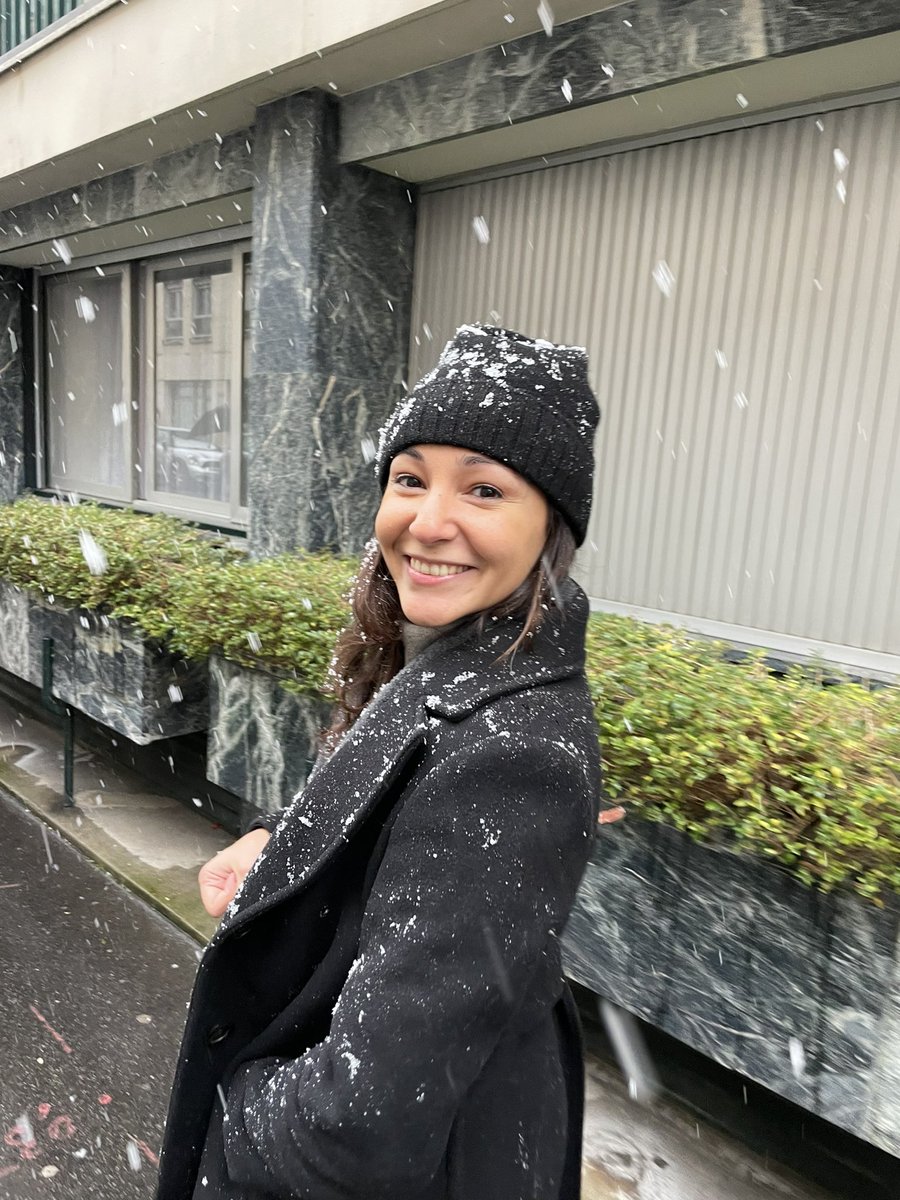
Big congratulations to @gulvarol for her successful habilitation on a snowy day in Paris. I’ve had the pleasure of collaborating with Gül over many years and highly recommend her to prospective students. She is an outstanding advisor who is technically deep and hands on.
After so much work @eccvconf is finally happening😱 Today, I will be giving talks on 3D motion editing at Expressive Encounters workshop (Suite 3, 11am) and on sign language at T-CAP (Amber 7-8, 2pm). And will be at our Artificial Social Intelligence workshop (Suite 2). #ECCV2024
Thanks to everyone who came to see our STMC work during lunch yesterday! I really appreciated the discussions.
For those who couldn't make it, the poster is now available online: https://t.co/QoYusEXmFI. If you're at #CVPR2024 and want to chat about it, feel free to reach out!
Just arrived in Seattle for #CVPR2024!😎
Catch me at the #HuMoGen workshop this Tuesday, I will be presenting my latest work "Multi-Track Timeline Control for Text-Driven 3D Human Motion Generation"🚀
https://t.co/CzuMpPT8kq
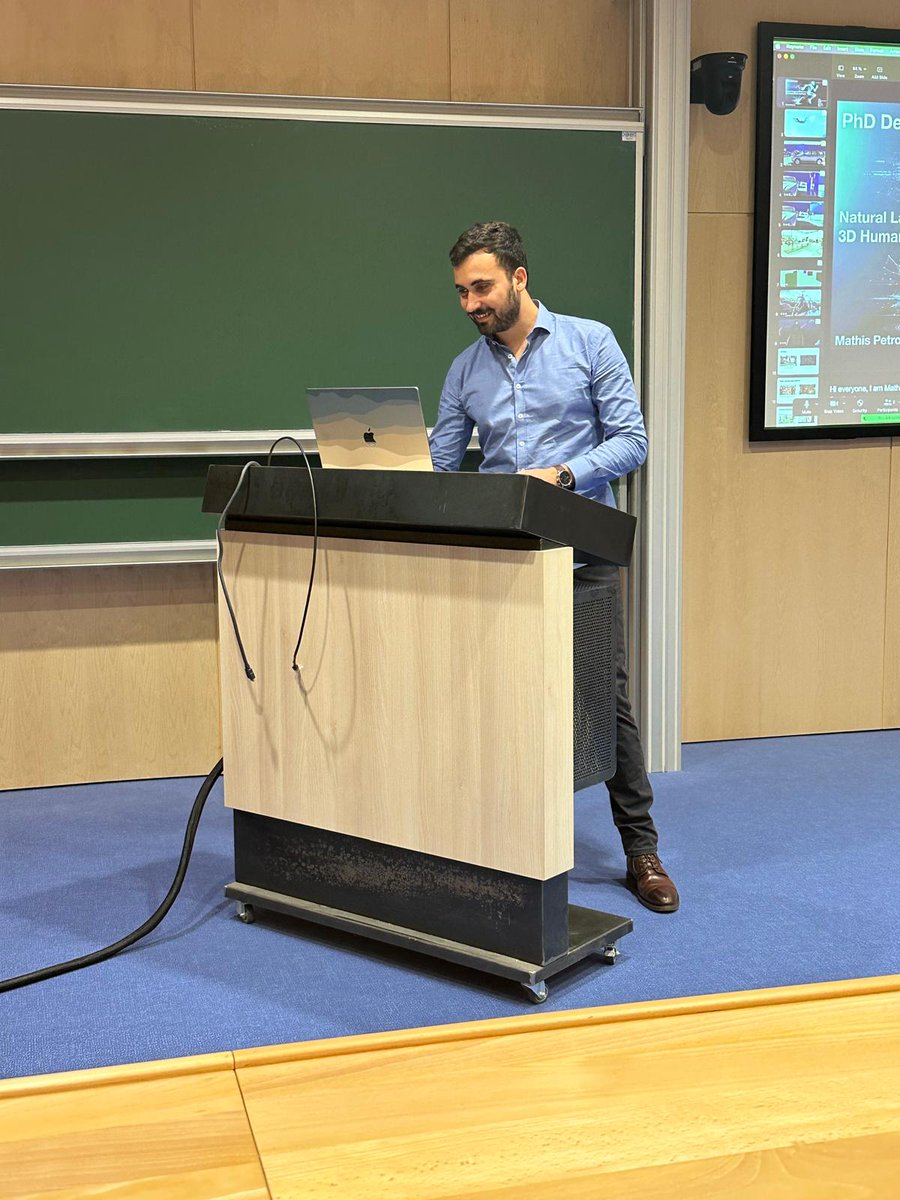
I am very proud and grateful to have successfully defended my PhD thesis last Wednesday! 🎆🎊🥳
Big thank you to @gulvarol and @Michael_J_Black for your guidance and support throughout my PhD journey. I am truly lucky to have had such people as my mentors!
It has been a real pleasure working with @MathisPetrovich. With constant positivity and great technical skills came a very productive and enjoyable PhD journey! Consider this my public recommendation, whoever hires him soon is very lucky :)
Congratulations to @MathisPetrovich on successfully defending his PhD. This work pioneered the use of transformers for modeling 3d human motion. ACTOR, TEMOS, TEACH, TMR, and more. Great work!! 🎊🥂🎉 Co-advisor: the awesome @gulvarol!
✅PhD manuscript is online!
💡Two takeaways: (i) the acquisition geometry of #3D sensors can be leveraged to accelerate data processing and improve efficiency, (ii) the use of models operating directly in input space leads to powerful and interpretable unsupervised methods.
📖👇🏻
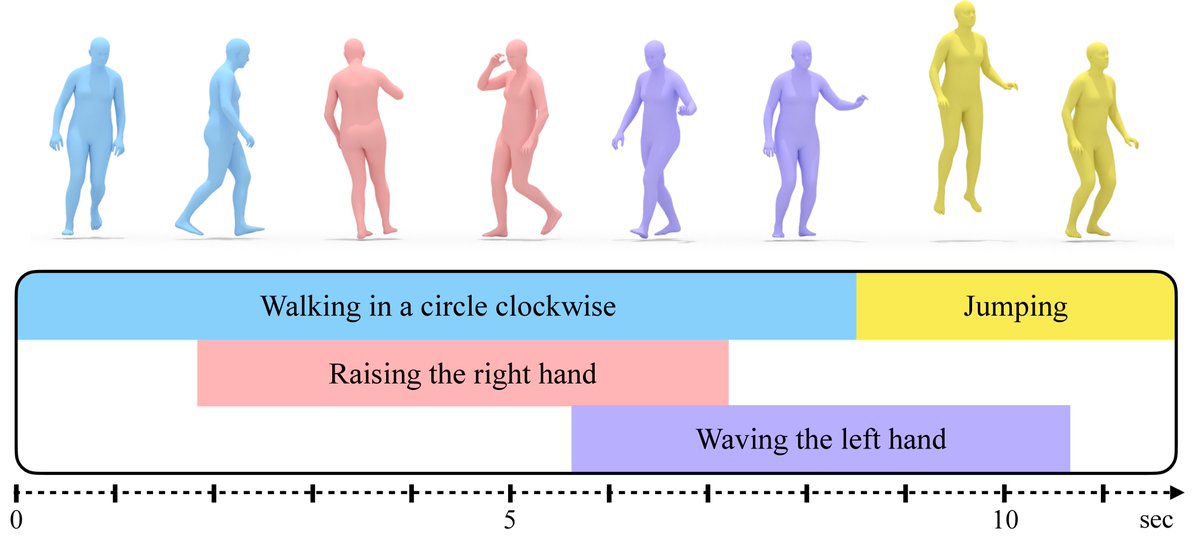
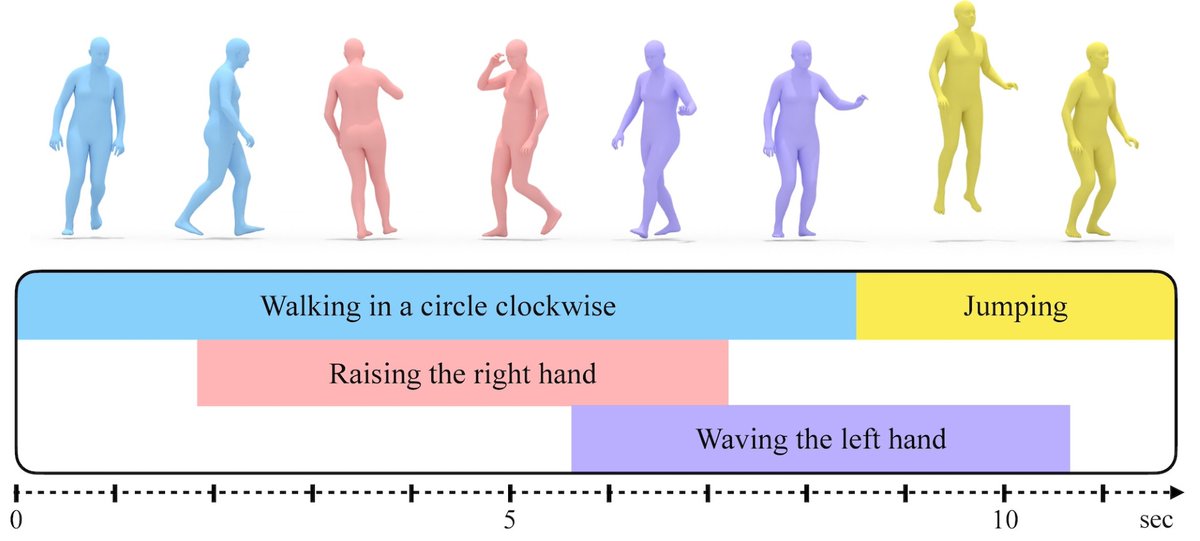
We've seen rapid progress on generating human motion from text descriptions. But to be really useful, animators need timeline control. With our new work, one can control when multiple actions occur and these actions can even overlap. Great #Nvidia internship by @MathisPetrovich.
Thank you @_akhaliq for sharing our work!😎
For those interested, please have a look at our webpage: https://t.co/g9ydbl1EbQ
There is a video with a graphical explanation of the method, and more qualitative results 🎆
I will let you know when the code/model/demo are available :)
Multi-Track Timeline Control for Text-Driven 3D Human Motion Generation
paper page: https://t.co/QYyAXoAZj6
Recent advances in generative modeling have led to promising progress on synthesizing 3D human motion from text, with methods that can generate character animations from short prompts and specified durations. However, using a single text prompt as input lacks the fine-grained control needed by animators, such as composing multiple actions and defining precise durations for parts of the motion. To address this, we introduce the new problem of timeline control for text-driven motion synthesis, which provides an intuitive, yet fine-grained, input interface for users. Instead of a single prompt, users can specify a multi-track timeline of multiple prompts organized in temporal intervals that may overlap. This enables specifying the exact timings of each action and composing multiple actions in sequence or at overlapping intervals. To generate composite animations from a multi-track timeline, we propose a new test-time denoising method. This method can be integrated with any pre-trained motion diffusion model to synthesize realistic motions that accurately reflect the timeline. At every step of denoising, our method processes each timeline interval (text prompt) individually, subsequently aggregating the predictions with consideration for the specific body parts engaged in each action. Experimental comparisons and ablations validate that our method produces realistic motions that respect the semantics and timing of given text prompts.