My co-authors and I have written a new Economic Commentary on “The (Re)Anchoring of US Firms’ Inflation Expectations.” Link: https://t.co/cMtPHzwKU4
Alex Cline, Christian Garciga, @timo_reinelt, and Rob Rich
Check out our new paper on the Smoot-Hawley Tariff. Using new evidence, we reassess its economic impact and draw lessons that remain highly relevant in today's trade policy debate
New evidence on Smoot-Hawley Tariff Act: tariff hikes cut targeted imports sharply, with costs borne mainly by US importers, reducing welfare by about 0.2 percent of GDP, from Kris James Mitchener and @mathpedemonte https://t.co/5exnUXYa5i
New CEPR Discussion Paper - DP21522
The Price of Protection: Tariff Incidence and Import Collapse under the Infamous Smoot-Hawley Tariff
Kris Mitchener @SantaClaraUniv, Mathieu Pedemonte @the_IDB
https://t.co/bAnzOFyXiE
#CEPR_EH#CEPR_ITRE
Super interesting!
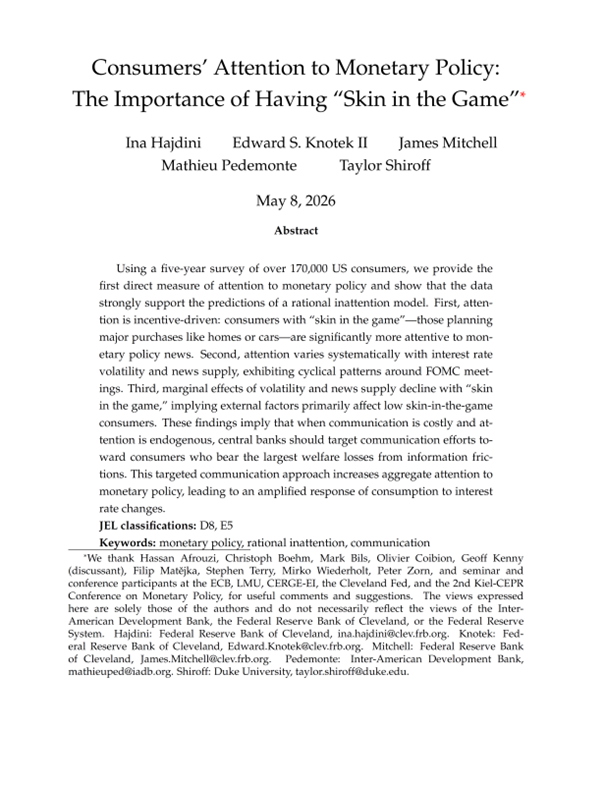
"Consumers’ Attention to Monetary Policy: The Importance of Having 'Skin in the Game' ", by Ina Hajdini, Edward S. Knotek II, James Mitchell, Mathieu Pedemonte, and Taylor Shiroff.
"Using a five-year survey of over 170,000 US consumers, we provide the first direct measure of attention to monetary policy and show that the data strongly support the predictions of a rational inattention model. First, attention is incentive-driven: consumers with “skin in the game”—those planning major purchases like homes or cars—are significantly more attentive to monetary policy news. Second, attention varies systematically with interest rate volatility and news supply, exhibiting cyclical patterns around FOMC meetings. Third, marginal effects of volatility and news supply decline with “skin in the game,” implying external factors primarily affect low skin-in-the-game consumers. These findings imply that when communication is costly and attention is endogenous, central banks should target communication efforts toward consumers who bear the largest welfare losses from information frictions. This targeted communication approach increases aggregate attention to monetary policy, leading to an amplified response of consumption to interest rate changes."
https://t.co/hUopc6jPEy
Constructing a novel measure of one-year-ahead exchange rate forecasts and nowcasts for non-financial firms, from Martha Elena Delgado Rojas, @juanherreno, @mahofste, and @mathpedemonte https://t.co/h3ciR4sES2
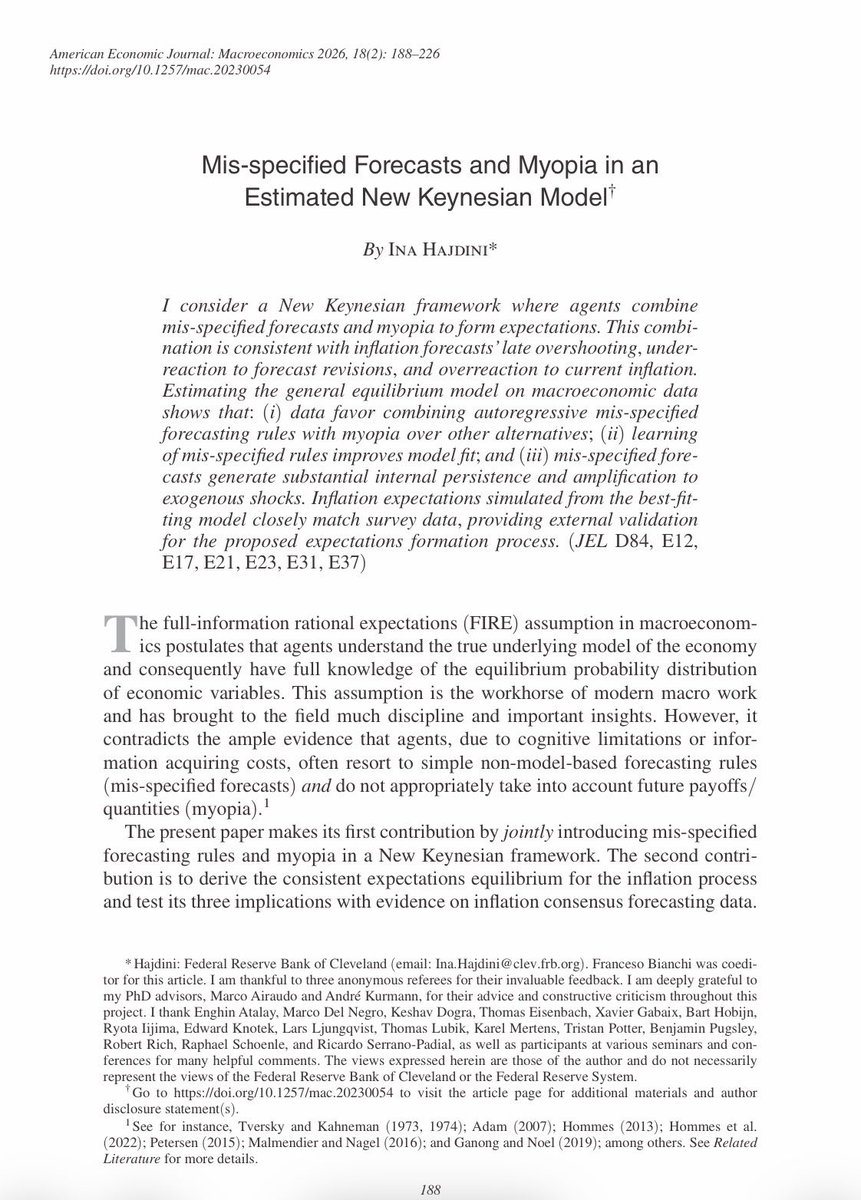
So happy to see my paper published at AEJ: Macro! It shows that simple autoregressive foresting rules and myopia, embedded in a New Keynesian framework, help the model match key features of consensus inflationexpectations and US macro data.
The International Economic Review has just published a new exciting paper by Gustavo de Souza and André Victor Luduvice on Optimal Unemployment Insurance Requirements. It is available through @WileyEconomics here: https://t.co/ZDBviqKbwu
Interested in postpandemic inflation and wage growth heterogeneity? Check out our Commentary written with Anaya Truss-Williams and C. J. Walker.
As in previous ECs, we provide a GitHub repo with annotated codes: https://t.co/4WwNXS5DVS
More links at: https://t.co/mqtylERD7Y
Monetary policy shocks affect more cities with low income per capita, both in prices and income. Just Accepted new paper by Juan Herreño Bluesky: https://t.co/1FdoXCm4xa and Mathieu Pedemonte @mathpedemonte
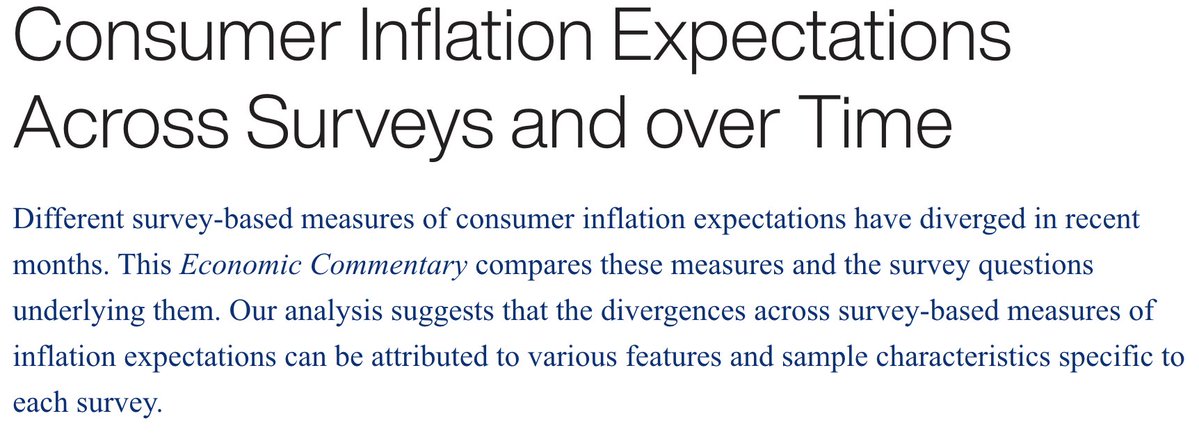
Why have different surveys of inflation expectations recently shown such different numbers for U.S. consumer inflation expectations?
In a new @ClevelandFed Economic Commentary with my co-authors @InaHajdini , Ph.D., Ed Knotek, @JohnCLeer, @mathpedemonte, Damjan Pfajfar and Taylor Shiroff, we provide one answer: part of the gap comes from the political makeup of the different survey samples. Inflation expectations differ sharply by party -- in April 2025, Democrats in the Michigan Survey of Consumers (MSC) expected inflation over 10 percentage points higher than Republicans. When we reweight surveys to also match the U.S. population’s actual party affiliation, the gaps across surveys shrink, while the average inflation expectation in the MSC is lower by about 2 percentage points for April 2025,
https://t.co/rPaaJT44G4
#inflation #inflationexpectations
New paper with @InaHajdini, Saten, Samreen, and Jordan. Using an RCT, we show that firms communicate within their IO network, influencing connected firms’ expectations, uncertainty and actions. We then illustrate the relevance for shock transmission and inflation in a NK model
Just Accepted new paper, “Multi-establishment Firms, Pricing and the Propagation of Local Shocks: Evidence from US Retail” by Ezequiel García-Lembergman https://t.co/lfRq93fspk
In a revised working paper, researchers study how #MonetaryPolicy communications associated with increasing the federal funds rate causally affect consumers' inflation expectations in real time. See their findings: https://t.co/C1cCF93wR8
Bernardo is on the market this year, and also has an excellent paper on households’ spending reaction to changes in inflation expectations, comparing the effects in high and low inflation settings, using a series of RCTs in the US https://t.co/x24GiRQ583
Happy to see our paper with Bernardo Candia out at the @JEEA_News. We use high frequency data and variation from countries that left the gold standard to estimate the cost of bilateral exchange rate appreciations in US cities
Forthcoming article by Bernardo Candia and @mathpedemonte "Export-Led Decay: The Trade Channel in the Gold Standard Era" @EEANews@OUPAcademic
https://t.co/NAjq00DKWi
In this paper, we use the 2021 General Social Survey to study drivers of individuals' preferences over taxes & redistribution. They find that these preferences are more strongly associated w/ broad measures of political preference than w/ economic status. https://t.co/DfFyHIqm7S