PhD, Associate Professor at Lund University, Senior Clinical Psychologist at CAMHS Skåne | Trying to understand what causes and maintains psychopathology
Two papers.
On the left, a non-randomized, non-crossover study showing that a one-off sauna exposure significantly decreased arterial stiffness, with implications on cardiovascular health.
On the right, a randomized, crossover (more robust) study, showing no benefits on arterial stiffness or blood flow. Note the colossal difference in Altmetric score and media attention.
The media favors sensational but flawed studies over rigorous ones, distorting public understanding. #science #media
@aidangcw Great, thanks! We’re working on a Swedish evaluation of the HiTOP SR, but the CAT-PD has some very attractive features, with the number of items being one. I need a HiTOP measure for a large longitudinal study. Should I abandon ship on HiTOP SR and go all in on CAT-PD?
@ianhussey Maybe the Positive Emotions subscale of the Well-being Profile. Three non-complicated items with high face validity and good internal consistency. Adult US norms available. However, it may be too trait-like in the context of an intervention.
❗NEW PODCAST ❗
In this Papers Podcast, @MattiCervin discusses his @TheJCPP paper ‘Efficacy & acceptability of cognitive-behavioral therapy & serotonin reuptake inhibitors for pediatric #ObsessiveCompulsiveDisorder: a network meta-analysis’.
Listen: https://t.co/V4UzTIWjrx
@Hugo_Gson Detta projekt handlar inte om det, men det är ju inte samma sak som att det inte är värdefullt eller intressant. Här är huvudfrågan om psykiatriska problem går att förebygga hos barn med extrem risk. Det undersöks bäst genom en prospektiv randomiserad kontrollerad studie.
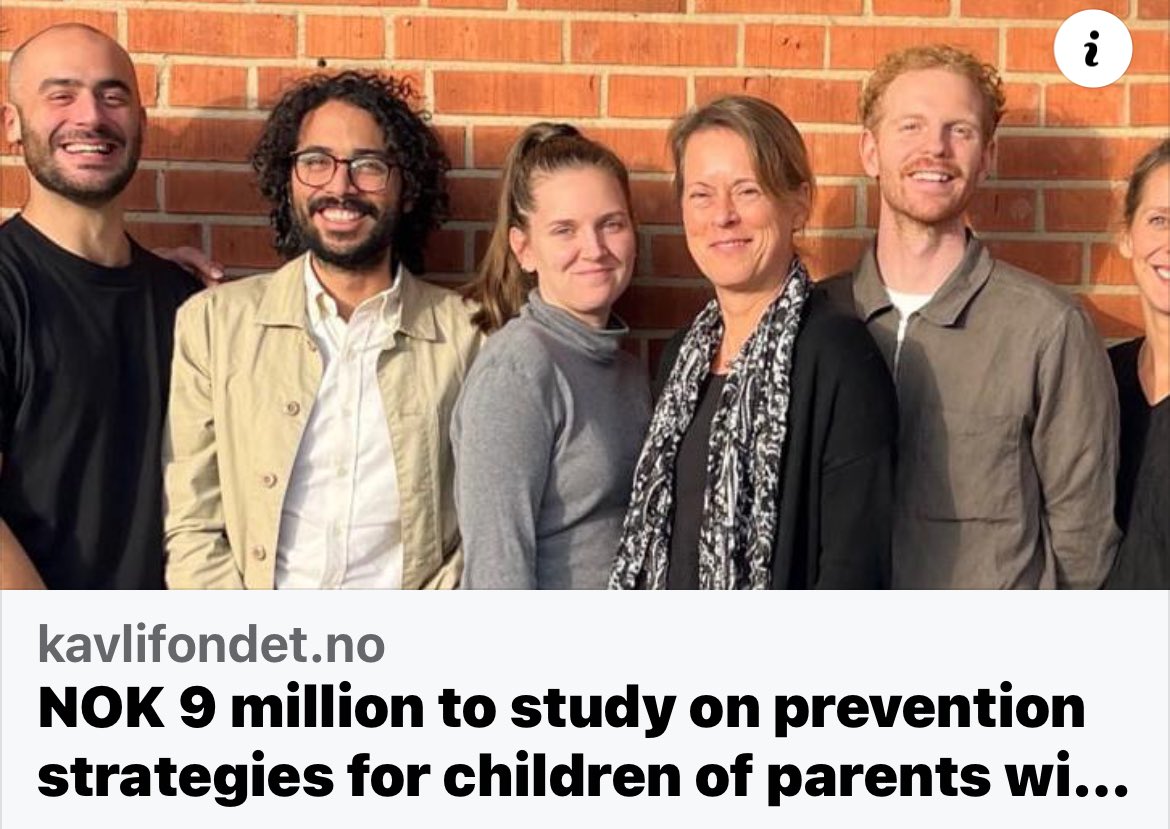
Incredibly honored for the support from the Kavli Trust, which secures completion of Phase 1 of IRMA, where 600 kids will be followed for 3 years. Half of the kids have two parents with mental illness and they will be randomized to either long-term prevention or life-as-usual.
Kavli Trust has awarded NOK 9 million to Psykiatri Skåne, Child and Adolescent Mental Health Services and IRMA, a longitudinal study where children of parents with mental illness and their peers are followed from age 8-18: https://t.co/WSbWAeDLL0
@Hugo_Gson Studien handlar inte bara om barnen, utan har också ett starkt fokus på föräldrarna. Många deltagande föräldrar har psykiatriska problem och många av dessa växte säkerligen upp med föräldrar som också hade det. Vi hoppas kunna förvalta dessa erfarenheter som del av forskningen.
@Hugo_Gson Hej Hugo! Jag tror tyvärr inte det finns några svenska studier från den perioden. Det finns en del amerikanska studier där man följt barn till föräldrar med bipolärt syndrom och schizofreni, men där har ingen insats utvärderats.
@LynnLi_S@CorteseSamuele@JAMA_current Good editorial! But my question still lingers: is this a medication effect or does it stem from whether or not a person engages in tx? As a clinician, I know it's far from random who engages in tx and stuff like attitudes and sociocultural context may confound these associations.
🚨Paper in press!🚨How does co-occurring PTSD impact intensive OCD treatment outcomes?
We combined data from the intensive OCD programs at @Rogers_BH and @McLeanHospital, two leading OCD hospitals, to see how PTSD impacted treatment for 3,000+ patients (5% w/ PTSD) 🧵/1
📣 We are happy to share our new published study, available in Open Access, where @laura_lromero@MattiCervin and colleagues applied network analysis to better understand the structure of psychopathic traits in childhood👇🏼
https://t.co/9p7wDiXoKP
Proud of this one! We synthesize all available RCT evidence regarding the effects of CBT and meds in the treatment of OCD in children and adolescents. A paper that is so much stronger now than when it was first submitted.
With @MataixCols @BCMStorchLab and other world-class folks
@f_hieronymus Where can the material be found? Looks like the GRADE approach for certainty of evidence, so the certainty ratings and the reasons for downgrading should be transparent.
The mysterious 𝑝 factor. From a talk today about whether the 𝑝 factor has utility as a predictor of long-term outcome among youth treated for psychiatric disorders.
@EikoFried Probably best to simply show a person. I agree with Nesse that it is unwise to reduce human functioning to single things, may it be brains or environments. We are fuzzy organisms navigating fuzzy environments using what we can, e.g., brains. https://t.co/dZmwgHXqWm
Only the genuinely curious and dispassionate should conduct systematic or other reviews. Rather like the Bible, selective quotation and reference from the scientific literature can be used to support just about anything.