@metoffice Disappointing - the Beta version seemed to provide less information, and be harder to navigate, than the current app. And it looks as though many others in the comments agree with me.
@metoffice The temperatures reported here as "warmest average" and "coldest average" are actually the warmest/coldest maxima, not the averages. Coldest average should be -1.8C and warmest average 6.3C.
Had a great time at the @TRANSCEND_H_eu project meeting in @UU_University last week. Thanks to @g_dibaldassarre and Elisa for the excellent organization. Learned a lot and enjoyed the mandatory fika breaks! Can't wait to continue working on this amazing project with you all. 🙌
I'm excited to be giving this webinar on Wednesday for the SEG Hydrogeophysics Group - a good chance to hear about what I've been working on the past 5 (!) years. #SanJoaquinValley#Subsidence#InSAR
"Using InSAR for Groundwater Science and Management in California’s San Joaquin Valley"
18 October, 2023. 10:00 –11:00 AM (U.S. Central). Free.
More information and registration: https://t.co/QV2sr1tN9B
#hydrogeophysics#Geophysics#inSAR#groundwater
This is very big - and very good - news for California groundwater. Deliveries directly supplant pumping. Historically, high deliveries is the only tried and tested way to raise groundwater levels.
DWR today announced a significant boost in forecasted State Water Project deliveries due to continued winter storms & a massive Sierra snowpack. DWR now expects to deliver 75% of requested water supplies, up from 35% announced in February. More➡️ https://t.co/obPPypilMf
What does recent stormy weather mean for subsidence in California’s San Joaquin Valley? Last week, I shared my thoughts in a blog post.
https://t.co/buQrFUzsTu
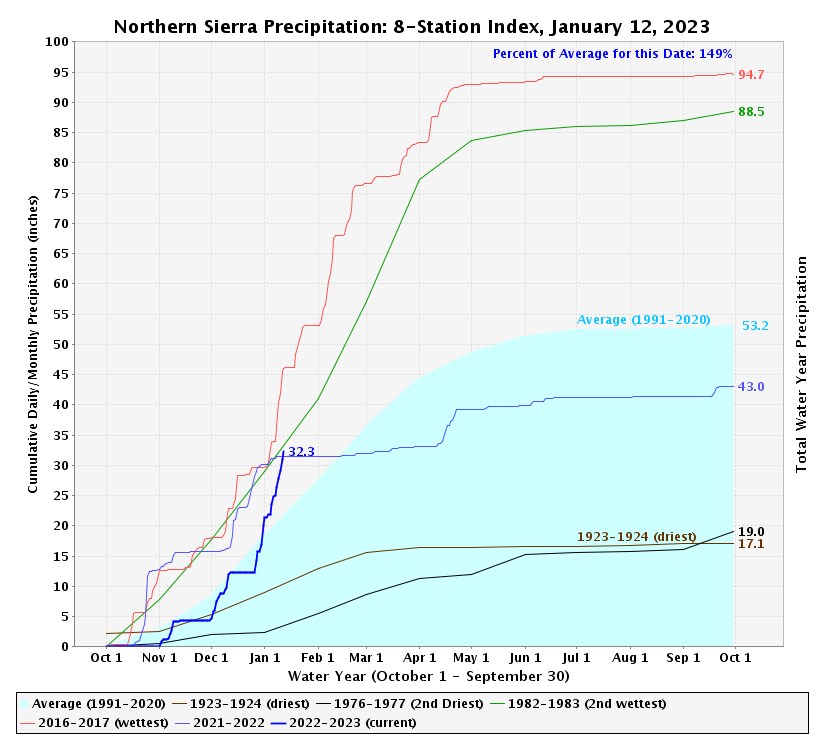
Despite this year's flooding, up until today, last year's northern California precipitation exceeded this year's precipitation. Last year became a drought year, so anything can happen. We can have drought and flood in the same year.