Everyone setting --max-old-space-size in Kubernetes is doing it wrong.
Here's why your Node.js app keeps getting OOMKilled despite your "careful" heap tuning 🧵
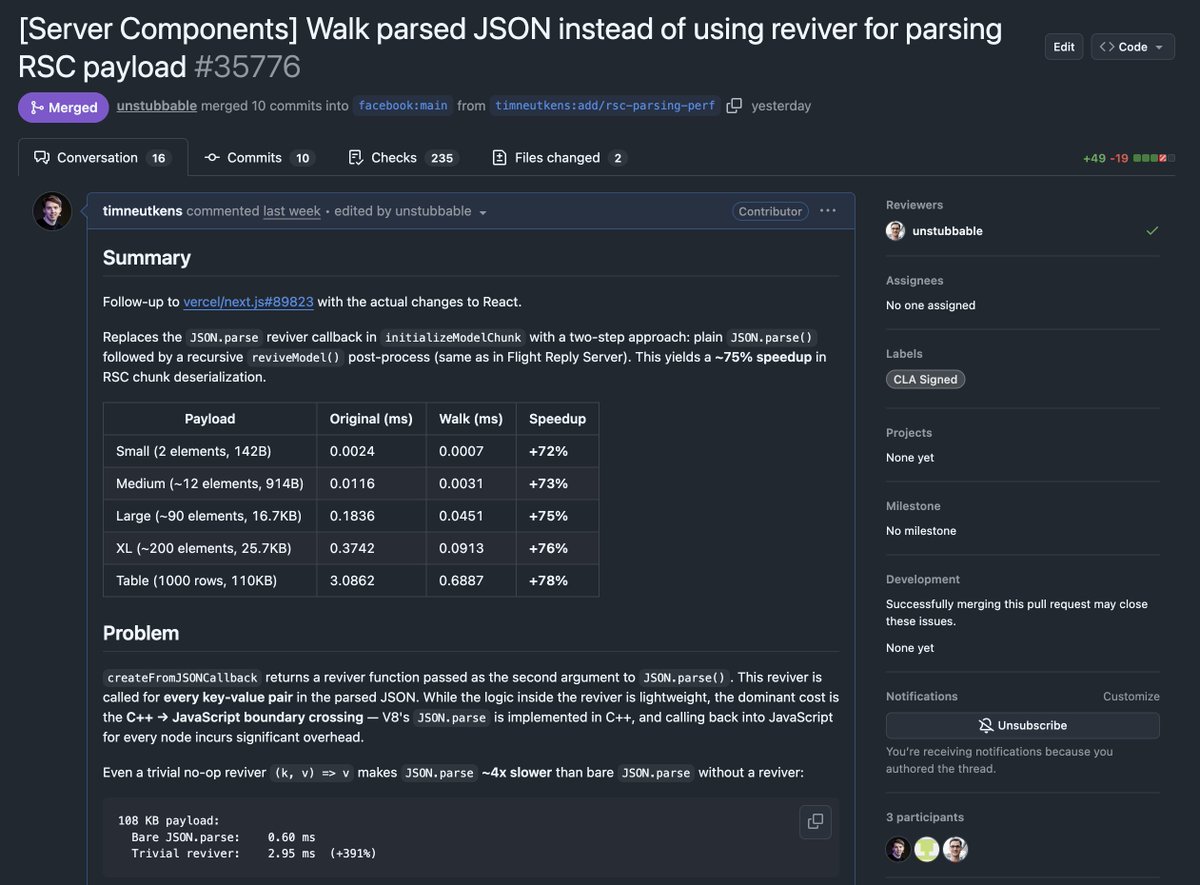
Made React ~74% faster when turning the server components payload into elements to render in the browser or during SSR/SSG.
In real-world Next.js applications this shows 15% to 30% faster rendering to HTML, depending on the RSC payload size.
This is cool & all but what are these tasks? I've decided to look deeper into it and made some plots that OpenAI folks didn't include in the paper :(
I was trying to figure out why, on GDPval, Opus beats GPT-5. My main hypothesis - which I still buy - is that the model is bigger, knows the small quirks better, and does more compute per token, so it performs better. No surprises there. The alternative idea was that it just renders visuals better: for a long time OpenAI models were weaker at working with web pages, etc.
I noticed some of the benchmark tasks could be sensitive to that—things like laying out a presentation or a PDF brochure. I wasn’t about to manually skim 220 half-page prompts, so I ran them through an LLM and had it classify them.
Prompt: "the importance of good visuals and the style in the resulting work.
For the context of this field we may consider the performer to be sloppy but very smart, or messy but highly intelligent.
They don't care about the visuals, and the result will be slapdash.
How significant will the effect on the result be in this case?"
In 58% of tasks, according to GPT-5-high, there’s no effect or it’s negligible. In 8% of tasks, it’s very important. In theory that could explain the benchmark gap, but I wouldn’t call it compelling evidence.
More findings in the thread 👇
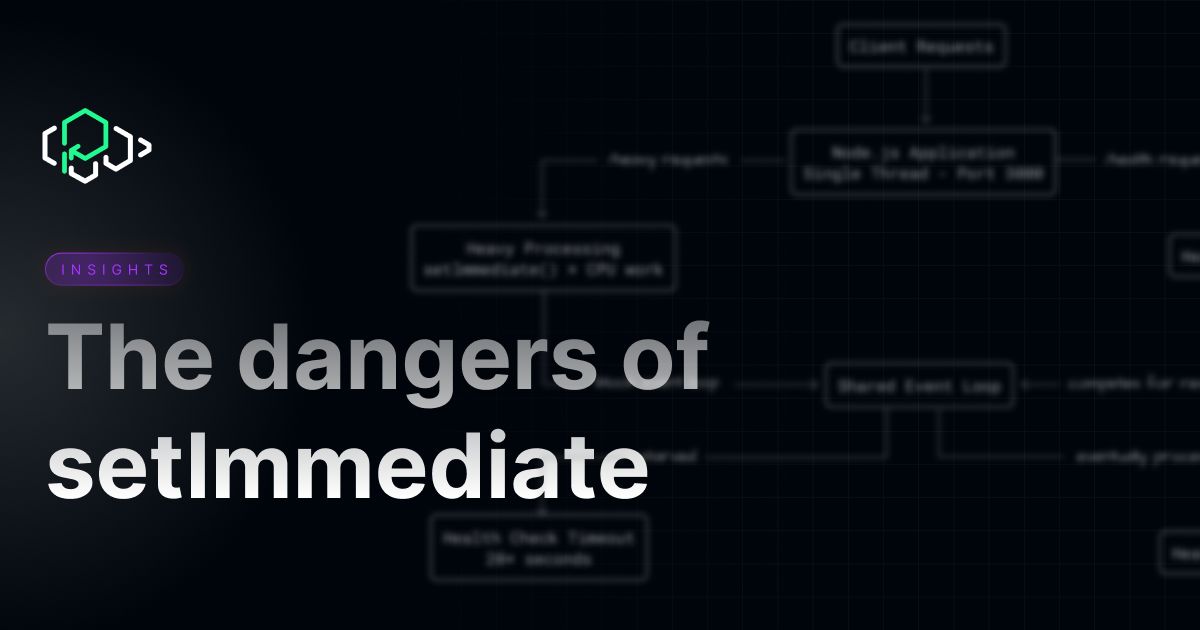
🧵⚠️ PSA for @nodejs developers: be careful with setImmediate() for CPU-intensive work.
A minor libuv optimization exposed how many apps accidentally depended on implicit timing behaviors they didn't even know existed.
Here's why this is a crucial lesson 👇
In Next.js 15.4 we've added the first devtool for Next.js: The route segment explorer
It allows you to view the segments that make up the current route you're viewing.
It also allows for triggering not found, loading, and error states. So you no longer have to manually trigger them in your code while developing these.
More devtools coming soon! Excited about the work the team is doing here.
CPUpro 0.7.0 also brings an enhanced All Call Frames table!
Get a bird’s-eye view of every function — with hotness, code states, deopt counts, and inline expansion for source + states.
No more jumping between source and back — everything at your fingertips.
Can I say something without everyone getting mad?
This isn't about any single library, but the JavaScript ecosystem as a whole. And I think we could learn a lot from the PHP ecosystem.
JavaScript can sometimes lead you to "analysis paralysis". There's many packages that do the same thing.
Let me give you an example. You want to do localization. As a beginner, what should you do? One thing Laravel (and Rails) do well is provide built-in solutions for a broad range of problems.
Here's Laravel's support: https://t.co/iOdha8J0Pb. It's obvious this is where you should start.
Now let me ask you a question. If the built-in support is perfect, why does this package exist? https://t.co/JX0z8pr0Kh
Answer: different apps have different requirements. Maybe the built-in support gets you far, but doesn't do exactly what you need. Maybe you just prefer this alternative community API. You get to choose.
The blessing and curse of the JS ecosystem is that there's so many different options, and it's not always clear who are the winners.
Even tools like Prettier and ESLint which have been the most stable set of tools over the past 7-10 years are now starting to see new versions gain traction (Biome). While I love the innovation, this also doesn't mean that everyone must move to the new shiny object.
My challenge to folks in the JS ecosystem is: consider whether you need to pull for a package right away. Challenge the status quo.
Sometimes you still might use a library, because you're trying to ship something fast, but "dependency minimalism" can help make your applications more maintainable long term.
"Copy paste is better than the wrong abstraction".
Let me give you an example – here's how you "roll your own auth" with Next.js using boring ol' cookies and sessions: https://t.co/uF4SaiFGUp.
I have a lot of respect for the surface area of problems that are solved by Laravel packages. Okay, that's my TED talk.
Выскажу непопулярное мнение:
Удаленка выгоднее для компаний!
Компании которые это не понимают - воруют у самих себя и у них хуевые менеджеры!
Во первых - работники на удаленке обычно работают больше часов и перерабатывают (Исследования ниже)
Во вторых - работники на удаленке берут меньше больничных - при небольших симптомах простуды ты можешь с комфортом работать из дома завернувшись в плед, в то время как ты скорее всего в случае работы из офиса:
1. В лучшем случае - не пойдешь на работу и возьмешь sick-day
2. Пойдешь в офис и заразишь там еще несколько человек и компания понесет убытки по принципу домино. По пути на работу заразишь еще несколько человек и нанесешь вред всей экономике.
В третьих - я уверен что работники на удаленке более продуктивны. Они живут более сбалансированную жизнь так как на коммьют уходит меньше времени, у них есть время заниматься спортом и порешать свои вопросы не в ущерб компании.
Исследования о продолжительности рабочего времени:
https://t.co/chtLGTeLqx’s Work Trend Index (2021): This report found that the average workday for Microsoft Teams users increased by 13%, or 46 minutes, during the early months of the pandemic when remote work became widespread. Additionally, after-hours work increased by 28%.
2.Harvard Business School Study (2020): This study revealed that the average workday increased by 8.2% (about 48.5 minutes) for employees working remotely during the early stages of the COVID-19 pandemic. There was also an increase in the number of meetings and emails sent.
3.National Bureau of Economic Research (2020): A paper published by the NBER found similar results, indicating that the workday lengthened by nearly 49 minutes during the pandemic, with an increase in meetings and email activity.
4.Buffer’s State of Remote Work Report (2022): In this survey, 22% of remote workers reported struggling with unplugging after work. Many respondents indicated that the boundary between work and personal life had blurred, leading to longer working hours.
Исследования о продуктивности на удаленке:
1.Stanford Study (2015): One of the most cited studies on remote work productivity was conducted by Stanford University, where they tracked 16,000 employees over a 9-month period. The study found that remote workers were 13% more productive than their in-office counterparts. The increase in productivity was attributed to fewer breaks, fewer sick days, and a more comfortable working environment at home.
2.Prodoscore Research (2020): Prodoscore, a company that tracks employee productivity, analyzed data from March and April 2020, when many employees were forced to work from home due to the COVID-19 pandemic. They found a 47% increase in worker productivity compared to the same period in 2019. This increase was largely attributed to remote work.
3.Harvard Business Review (2020): A report published in HBR suggested that remote workers can be more productive, but this productivity boost is contingent on good remote work practices. The report emphasized that clear communication, proper tools, and a supportive culture are critical for maintaining high productivity levels.
4.Great Place to Work Survey (2020): This survey looked at productivity data from 800,000 employees from March to August 2020. It found that 87% of employees felt as productive or more productive while working remotely compared to before the pandemic.
5.Owl Labs’ State of Remote Work Report (2021): According to this report, 90% of employees who worked remotely during the pandemic reported that they were at least as productive working remotely as they were in the office, with many reporting even higher productivity.
@TkDodo good news re Suspense, just met w/ @rickyfm@en_JS@acdlite
* we care a lot about SPAs, team misjudged how many people rely on this today
* still recommend preloading but recognize not always practical
* we plan to hold the 19.0 release until we find a good fix
more to come
Big news! Today INP (Interaction to Next Paint) officially became a Core Web Vital, replacing FID (First Input Delay). It's a much better input responsiveness metric.
In this little benchmark rendering 16k squares using the DOM goes at 10fps, and rendering 1M squares using raw WebGL goes at 120fps.
I understand the DOM does a lot more here, but surely with enormous effort a faster web renderer that destroys Blink is physically implementable?
My friend gets 18.3M visits on his site and earns $3M from it (with only 4 employees)
He revealed his SEO playbook and I'm gonna share it with you.
This works for ANY kind of website.
The strategies, tools, and hacks to reach millions🧵