@Bharath70424554@AnimaAnandkumar We are effectively learning the diagonalization of the KS potential and calculating the exchange-correlation analytically from the output density. So the FNO is not learning the correlation
@PinChoALTA@AnimaAnandkumar An attractive basin is essential for a learned SCF map. The pretrained model lacks one for the 80k-electron Mg cells, while fine-tuning restores it. This makes convergence a promising signal for out-of-distribution behavior, though not proof of uniform contraction
@tomhihihihihi We use a final NSCF on the converged density to obtain forces/energies and properties (band gaps, DOS, etc.); see Fig. 4 for an example on Sr3SnO
@gmseabra@AnimaAnandkumar It reproduces our specific PBE/SG15 Quantum ESPRESSO setup, including the plane-wave cutoffs, k-point sampling, and smearing. However, the potential-to-density map is not tied to the PBE functional, as shown by transferring a PBE-trained model to PBEsol without retraining
@MattChallacombe@AnimaAnandkumar We calculated energies from the converged FNO densities using fixed-density NSCF calculations in QE. We typically found agreement within a few meV per atom with reference plane-wave PBE. The example reported in the paper is Sr₃SnO, with a difference of 2.29 meV per atom
Tackling a 60-year-old challenge in quantum chemistry: making density functional theory scale nearly linearly with system size.
This has huge implications for opening the door to realistic systems that have traditionally been too expensive to simulate.
AI has attempted to accelerate these calculations, but models generally struggle to extrapolate, particularly to systems larger than those seen during training. Unlike text or images, quantum-mechanical training data is extremely expensive to generate.
We present a single unified AI model that performs quantum-mechanical simulations of both molecules and materials in quasi-linear time.
Using a novel Fourier neural operator variant, we learn the underlying Kohn–Sham equation map to produce physics-informed, self-consistent answers.
Unlike prior AI approaches that directly predict chemical properties, our model works through intermediate steps to improve difficult predictions, resembling inference-time reasoning in large language models.
To demonstrate its scalability, we run a self-consistent calculation of a magnesium dislocation with about 80k electrons on a single GPU, which previously required about 7k GPUs.
https://t.co/5DG12E04Rh
@DanishK42@Caltech
2025 was a whirlwind of activity in AI+science. Our team’s seminal contributions to the field were well recognized and we deepened those foundations. You can read the year end summary here https://t.co/VdEqkG0zov
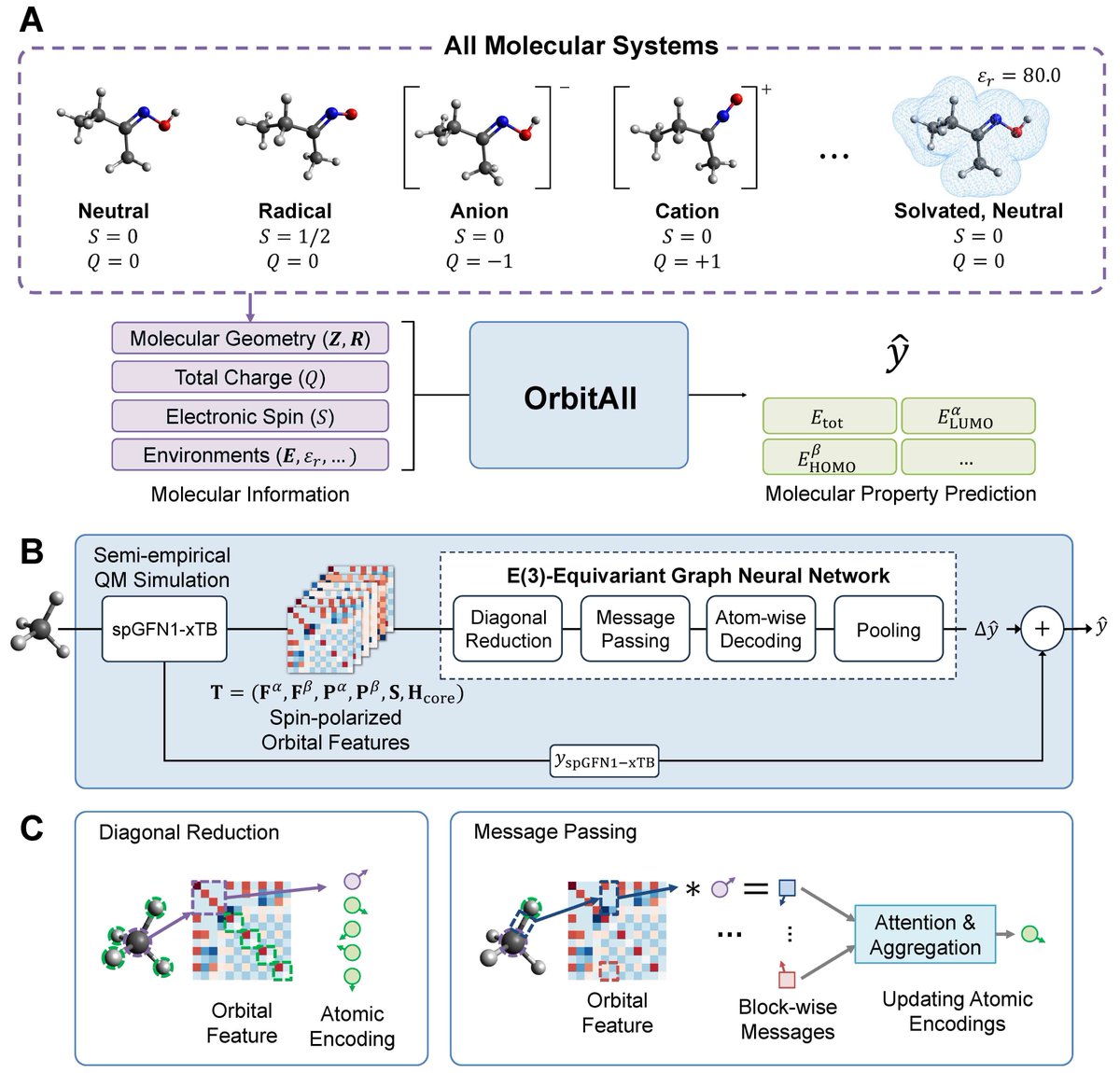
OrbitAll: A Unified Quantum Mechanical Representation Deep Learning Framework for All Molecular Systems
Accurately modeling chemical systems across diverse charges, spin states, and environments remains a central challenge in molecular machine learning. No existing machine learning–based methods can simultaneously handle molecules with varying charges, spins, and environments. A few recently developed approaches address one or two of these factors individually by designing task-specific architectures, but this limits their applicability to broader chemical scenarios.
OrbitAll is the first deep learning-based method that can simultaneously incorporate spin, charge, and environmental information using consistent and physically grounded quantum mechanical features. It has superior accuracy, generalization, and data efficiency on diverse chemical systems.
We introduce a unified quantum mechanical representation that naturally incorporates spin, charge, and environmental effects within a single, physics-informed framework. Specifically, OrbitAll utilizes spin-polarized orbital features from the underlying quantum mechanical method, and combines it with graph neural networks satisfying SE(3)-equivariance.
This enables our model, OrbitAll, to achieve accurate, robust, and data-efficient predictions across a wide range of chemical systems–including charged and open-shell species, as well as solvated molecules–without the need for domain-specific tuning.
OrbitAll achieves chemical accuracy using 10 times fewer training data than competing AI models, with a speedup of more than thousand times compared to density functional theory. It can extrapolate to molecules more than 10times larger than those in training data. This universality distinguishes our approach from current deep learning models.
https://t.co/u7fmFAWBsP @Caltech