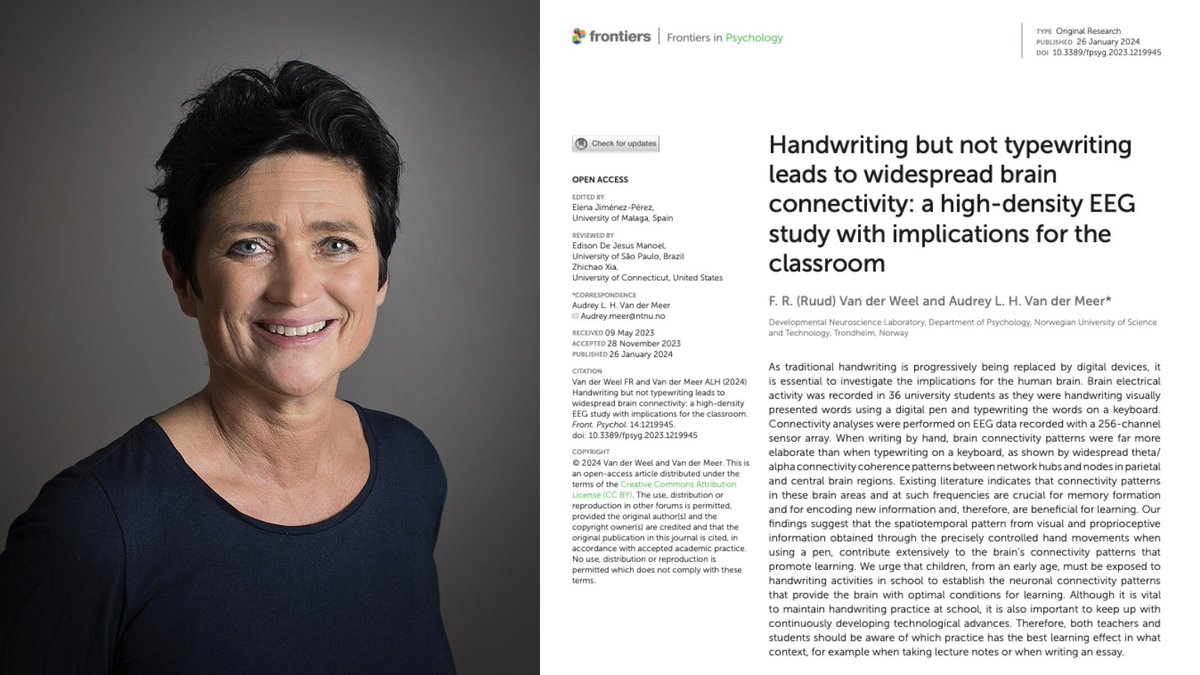
A Norwegian neuroscientist spent 20 years proving that the act of writing by hand changes the human brain in ways typing physically cannot, and almost nobody outside her field has read the paper.
Her name is Audrey van der Meer.
She runs a brain research lab in Trondheim, and the paper that closed the argument was published in 2024 in a journal called Frontiers in Psychology. The finding is brutal enough that it should have changed every classroom on Earth.
The experiment was simple. She recruited 36 university students and put each one in a cap with 256 sensors pressed against their scalp to record brain activity. Words flashed on a screen one at a time.
Sometimes the students wrote the word by hand on a touchscreen using a digital pen, and sometimes they typed the same word on a keyboard. Every neural response was recorded for the full five seconds the word stayed on screen.
Then her team looked at the part of the data most researchers had ignored for years, which is how different parts of the brain were communicating with each other during the task.
When the students wrote by hand, the brain lit up everywhere at once.
The regions responsible for memory, sensory integration, and the encoding of new information were all firing together in a coordinated pattern that spread across the entire cortex. The whole network was awake and connected.
When the same students typed the same word, that pattern collapsed almost completely.
Most of the brain went quiet, and the connections between regions that had been alive seconds earlier were nowhere to be found on the EEG.
Same word, same brain, same person, and two completely different neurological events.
The reason turned out to be something nobody had really paid attention to before her work. Writing by hand is not one motion but a sequence of thousands of tiny micro-movements coordinated with your eyes in real time, where each letter is a different shape that requires the brain to solve a slightly different spatial problem.
Your fingers, wrist, vision, and the parts of your brain that track position in space are all working together to produce one letter, then the next, then the next.
Typing throws all of that away. Every key on a keyboard requires the exact same finger motion regardless of which letter you are pressing, which means the brain has almost nothing to integrate and almost no problem to solve.
Van der Meer said it plainly in her interviews.
Pressing the same key with the same finger over and over does not stimulate the brain in any meaningful way, and she pointed out something that should scare every parent who handed their kid an iPad.
Children who learn to read and write on tablets often cannot tell letters like b and d apart, because they have never physically felt with their bodies what it takes to actually produce those letters on a page.
A decade before her, two researchers at Princeton ran the same fight using a completely different method and ended up at the same answer. Pam Mueller and Daniel Oppenheimer tested 327 students across three experiments, where half took notes on laptops with the internet disabled and half took notes by hand, before testing everyone on what they actually understood from the lectures they had watched.
The handwriting group won by a wide margin on every question that required real understanding rather than surface recall.
The reason was hiding in the transcripts of what the two groups had actually written down.
The laptop students typed almost word for word, capturing more total content but processing almost none of it as they went, while the handwriting students physically could not write fast enough to transcribe a lecture in real time, which forced them to listen carefully, decide what actually mattered, and put it in their own words on the page.
That single act of choosing what to keep was the learning itself, and the keyboard had quietly skipped the choosing and skipped the learning along with it.
Two studies. Two countries. Same answer.
Handwriting makes the brain work. Typing lets it coast.
Every note you have ever typed instead of written went into your brain through a thinner pipe. Every meeting, every book highlight, every idea you captured on your phone instead of on paper was processed at half depth.
You did not forget those things because your memory is bad. You forgot them because typing never woke the part of the brain that would have made them stick.
The fix is the thing your grandmother already knew.
Pick up a pen. Write the thing down. The slower road is the faster one.
*IMPORTANT*
Please read & share, it could save you or a loved one from a lifetime of chronic system-wide illness. 🙏❤️
Today I was diagnosed with Lyme Disease.😔
I was bitten by 4 ticks 30 days ago & had a red rash come up around one of the bites, that soon started spreading.
As there was no 'bullseye', I didn't think it was Lyme, I assumed it was just a reaction, especially as the rash wasn't painful or itchy..(see photo)
It WAS Lyme!
Any rash around a tick bite is diagnostic.
I didn't know this. 😕
I was bitten at Shapwick Heath on the Somerset Levels.
I've since learnt some areas of the UK have a higher risk of Lyme, and the Somerset Levels is one of them.
If you go out in the countryside, take care... stick to paths and try to avoid brushing up against vegetation, that's how the ticks get on you.
Always check yourself over for ticks when you get home. The longer a tick is attached to you, the higher the chance of infection.
If you find a tick, don't panic, remove it carefully with a tick removal tool or tweezers, being careful not to squeeze the tick.
Keep an eye on the bite for the next month... if a rash starts to develop at the site of the bite in that time, go to your doctor ASAP!
Explain that you were bitten by the tick, and have now developed a rash at the site... they will prescribe antibiotics, usually Doxycycline, for at least 3 weeks.
You may be asked to have a blood test too, but these aren't reliable in the early stages of Lyme, insist on starting the antibiotics immediately.
Sometimes, you don't even get a rash. In these cases, if you get flu-like symptoms in the 30 days after a tick bite, go and see a doctor, it's probably Lyme Disease and you'll need antibiotics.
Many people with debilitating advanced Lyme Disease didn't see the signs, or they just ignored them.
Lyme Disease is usually curable in the early stages, but can become a chronic lifelong illness affecting every system in your body, if left untreated! 😔
I'm not posting this to scare anybody, but because I was ignorant to the rash, and if it hadn't been for my youngest daughter badgering me to get it checked out, I'd not be sat here taking antibiotics for Lyme Disease... I wouldn't even know I had it, and many of the later symptoms are confused with other illnesses!
A case in point is the fabulous musician @Renmakesmusic, who was only diagnosed with Lyme Disease 6 years after being infected! 😯
He really suffered in those years, spending much of it in bed, too ill to get up, but not having a clue what he was suffering with.
I'm obviously no medical expert, all I've written here has come from my own research & experience, so in case there are some inaccuracies, learn more from @UKLyme 🙏
However, you get the picture... if this post prevents just one person getting advanced Lyme Disease, I'd be delighted!
Prevention is better than cure, so please be careful out there!
Don't be ignorant to the dangers of ticks, rashes and Lyme Disease.. don't be like me! 🙏❤️
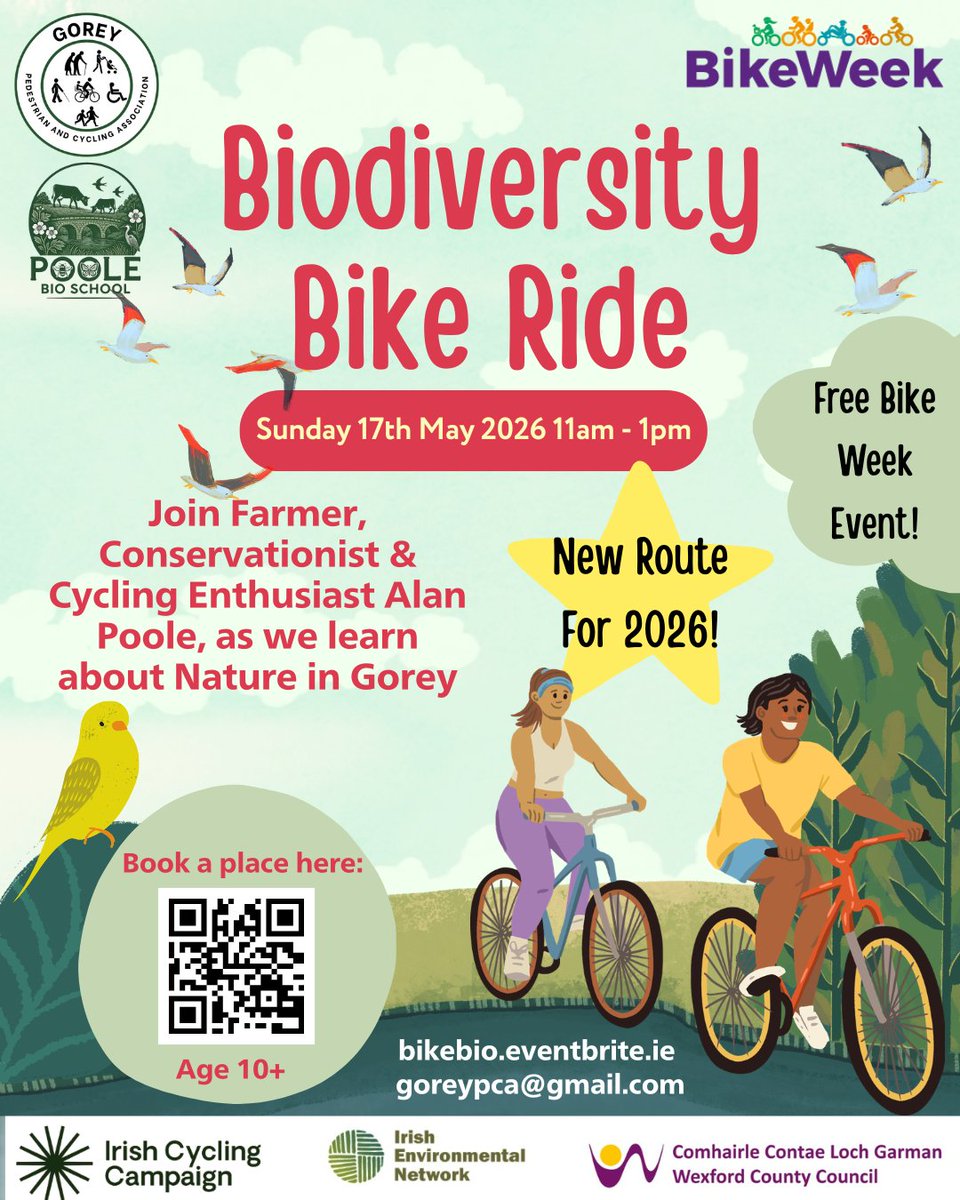
🌿🚲 Biodiversity Bike Ride – Gorey Town
To celebrate the crossover between Bike Week and Biodiversity Week, Gorey Pedestrian and Cycling Association invites you to join a guided Biodiversity Bike Ride through Gorey Town.
🆕 Featuring a new route for 2026, the ride will be led by Alan Poole, a Co. Wexford dairy farmer with a passion for nature and the environment. Along the way, we’ll stop at key biodiversity sites and explore how we can both appreciate and protect the nature around us.
📅 Sunday 17th May
🕚 11am – 1pm
📍 Meeting point: Gorey Orchard (next to the fire station)
🏁 Finish: The Park — enjoy a complimentary drink from the Coffee Pod ☕
🚴 Suitable for competent cyclists aged 10+
⚙️ Difficulty: Easy to Moderate
Grab your bike, bring your curiosity, and let’s ride toward a greener, more sustainable future.
@Mick_Finnegan What an inspiring story you continue to weave Mick Very well done you I hope that the powers that be will do something eventually and I so admire your tenacity in continuing to remind them and calling them out on their lack of action for you and all survivors of abuse ❤️👏
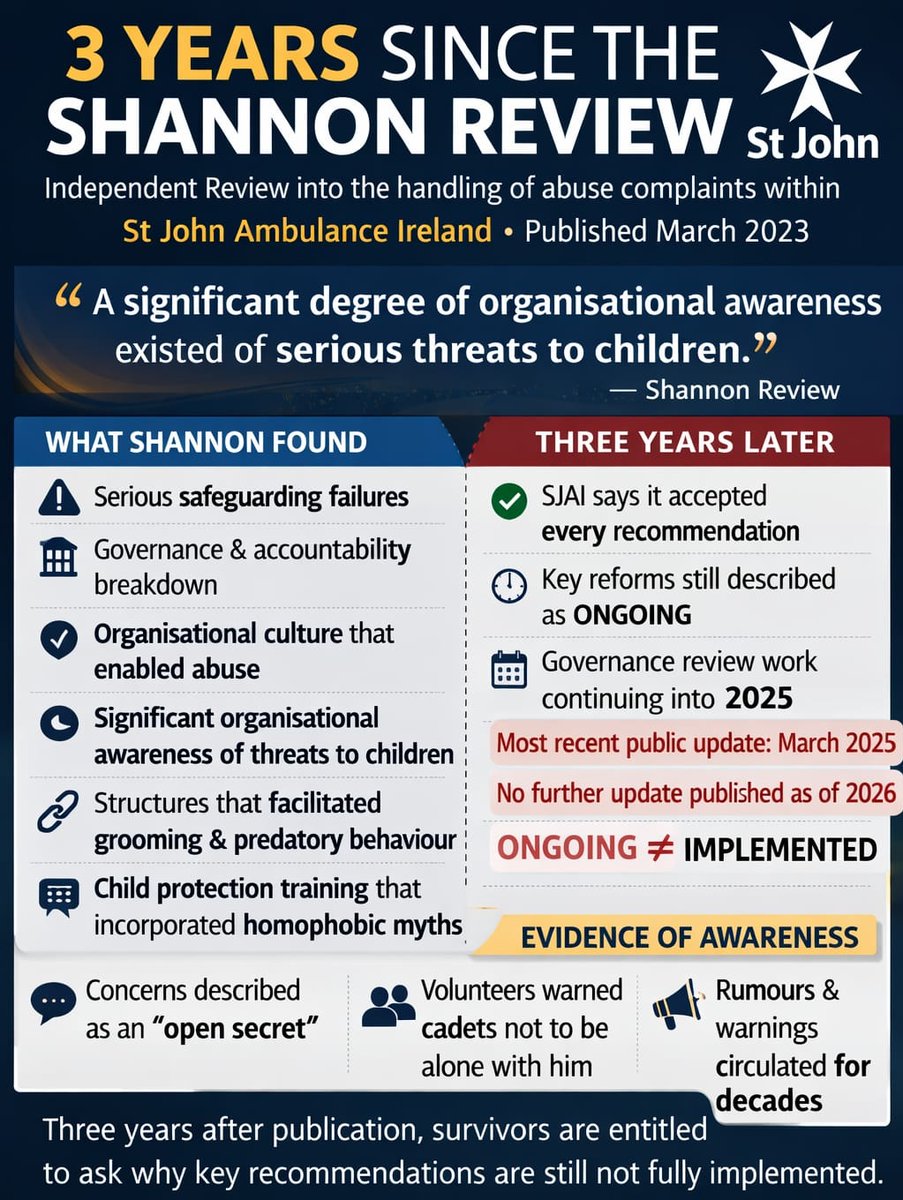
Today’s Sunday Independent article shares part of my story. It’s not easy to keep talking about this, what happened to me should never have been allowed to happen, and there are still serious questions to answer.
I’m focused now on rebuilding my life and training to help others.
Some progress has been made, but “ongoing” is not the same as done. Not when children were failed. Not when lives were changed forever. This isn’t about process or timelines. Its about accountability. Its about ensuring no child is ever put at risk again
https://t.co/0lt5ARWjnL
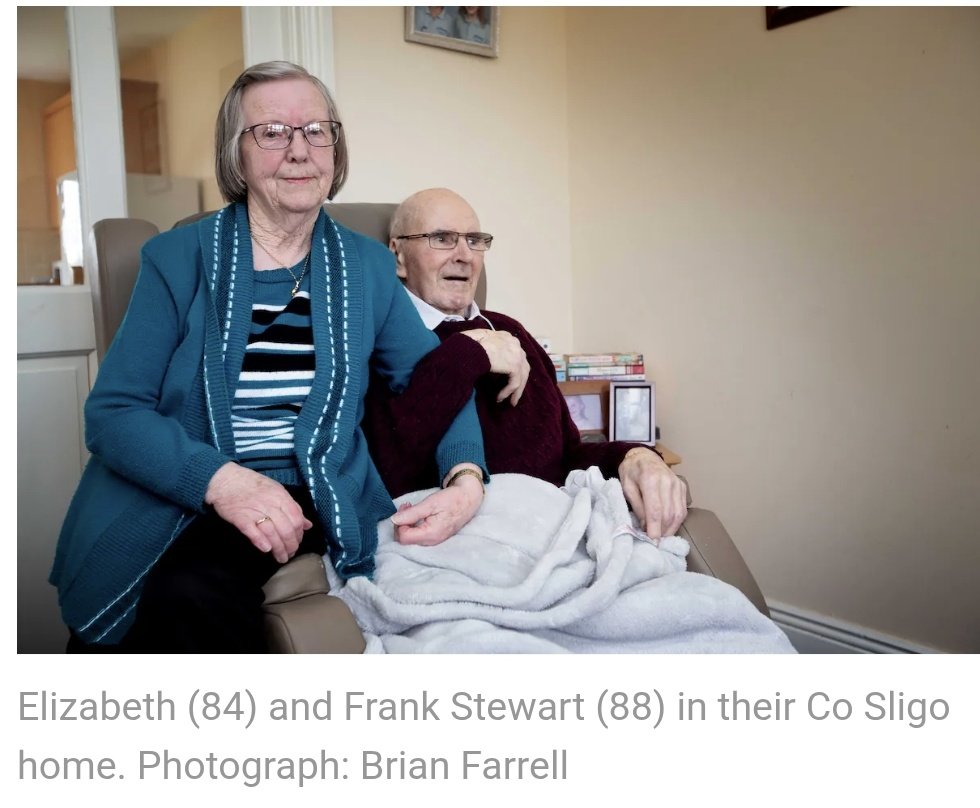
Heartbreaking to see what is happening to the residents of the former Sonas Retirement Village in Enniscrone.
Imagine being in your 80s, having sold your family home for the security of a retirement village, only to be told you must leave by June 5th because the building was sold to a private company.
This is an absolute failure to protect our older people. With rental availability at an all-time low, never mind suitable accommodation, where are they supposed to go?
#Sligo #Enniscrone #HousingCrisis #Safeguarding #ProfitOverCare
https://t.co/D644ckU4lX
Three years ago today the Shannon Review into historical child sexual abuse within St John Ambulance Ireland was published. The review exposed serious safeguarding failures, and three years on survivors continue to call for the full implementation of its recommendations.