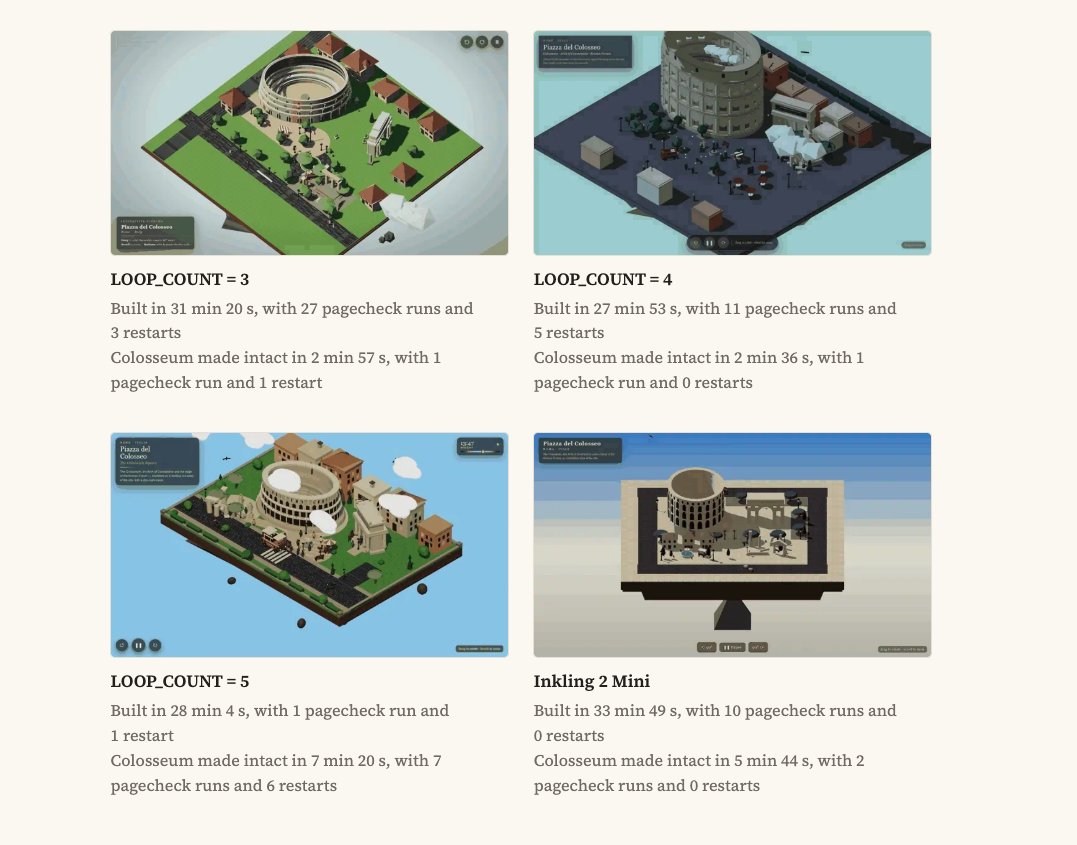
All six, same prompt, one run each. You can rotate them and pause the clock:
LOOP_COUNT = 1: https://t.co/CUI8VvhQu7
LOOP_COUNT = 2: https://t.co/gQ4voBMhZ8
LOOP_COUNT = 3: https://t.co/q2g9eOjIxd
LOOP_COUNT = 4: https://t.co/gnYm4BT8I8
LOOP_COUNT = 5: https://t.co/4mWdc8Pma8
Inkling 2 Mini: https://t.co/xHg9sG0nC8
Prompt, times and how they were built: https://t.co/AUQNgB7ALK
How vLLM runs a looped model: https://t.co/O8dl96rIC9
A month ago this streamer flipped his whole options account from calls to $470,000 of Moderna puts, 90 minutes before a trial-data leak sent Moderna into a trading halt. His own screenshots had the account at $915,000 by that afternoon.
Then he made the exact same flip on the S&P 500, right into the morning Nvidia brought Jensen back.
Look at the right side of his screen. 400 contracts of the SPX 6,900 put and 40 of the 7,000, both stamped 11/23. Those expire at Monday's 4pm close.
The date on those puts is the only real difference between the trade that made him and the one in this clip. His Moderna puts ran out anywhere from Oct 30 to Dec 18, so even if the stock had ripped first, he had weeks for it to come back. An option's price is two pieces stacked together. One is what it's worth if it expired this second. The other is whatever people will pay for the chance that things change before it really does. On expiration morning that second piece is close to zero, and a same-day put becomes a bet on one number, where the S&P prints at 4pm.
Monday's number got rewritten overnight. Nvidia reinstated Jensen less than two weeks after he resigned, and Nasdaq futures ran straight into CME's 7% overnight limit and got halted. Nvidia closed up 31.5%, its best day since 2003, and the S&P finished up 4.7%.
SPX options carry a 100x multiplier. On 400 contracts, every $1 that 6,900 put gives back pulls $40,000 out of his account. Keep your eye on the number in the top left.
He has plenty of company in this product. Same-day contracts hit a record 66% of all SPX options volume this July, and Cboe has estimated retail traders at more than half of that flow.
The caption running along the bottom of his own stream says DO NOT GAMBLE YOU WILL LOSE. On Monday it was the most accurate trade call on the screen.
Introducing Matrix BioTech
It's what Theranos should've always been
Measures your hormones, disease markers, etc
But it was built by 2 college kids in a dorm room
& they promised me it works
BJP will be a chapter in India’s history books as a Dehati uprising against the educated meritocratic upper class led by dehati leaders which lasts for 15-20 years creating a class of freeloader blue virus which delays India’s mental development by 50 years
Every product and engineering team in India should read how Zerodha built Blobasaur.
It is the best case study of the build or buy decision.
Let me explain.
Kite is Zerodha's trading app with 2 crore customers. Traders set up their screens in very personal ways.
Multiple chart layouts. Saved indicator settings. Lines they draw on charts. And now the new Terminal mode, where you drag widgets around.
All of this gets saved. Each saved item is a "blob". That is basically a chunk of data the app stores and fetches as one piece. It is mostly JSON, from a few KB to several MB.
Now, Zerodha had a system for this already. It first used CouchDB, then a database called SSDB, which ran well for years.
Then SSDB stopped being maintained. So nobody was fixing bugs or security issues in it anymore.
Since it was written in C++, it wasn't part of Zerodha's stack, so taking it over wasn't an option either.
SSDB also ran on only one machine. Large blobs slowed it down. So Zerodha had to cap every saved item at 1 MB.
So they went shopping first. They looked at ScyllaDB, PostgreSQL, YugabyteDB, RocksDB, Ceph, SeaweedFS, S3 and MinIO, and even plain files on disk.
For one reason or another, none of them fit this one job well. SeaweedFS came closest, but had blockers.
Only then did they build Blobasaur.
Blobasaur is written in Rust. It stores data in SQLite, a small database that lives inside a single file. Each machine holds many SQLite files, called shards, so many writes can happen at the same time.
The smartest part is that it speaks the Redis protocol. Redis is a very popular tool for fast storage, and almost every app already knows how to talk to it.
So Kite's services kept using the same commands. The only change was switching to a Redis Cluster client.
It also compresses everything before saving. Zerodha say that the average saved item comes in at 63.6 KB and is stored as 5.5 KB. About 11 times smaller.
Say 1 crore layouts of 64 KB each. That is about 640 GB of raw data. At 11 times compression, you store roughly 58 GB.
The results were amazing.
In production, Blobasaur runs on three machines. Each has 4 vCPUs and 8 GB of RAM. Very ordinary server.
Over a full trading day, from 9 am to 3:30 pm, 99% of requests finish in about 2 milliseconds. Half finish in under 0.6 milliseconds.
Now there is no copy of the data on a second machine yet. If a machine goes down, there is no automatic failover.
Zerodha's answer is that this store holds screen settings, not money or trades. So while losing a chart layout is annoying, losing a trade record would be a disaster.
That is why they kept this design so simple.
If you are a founder or a tech head, build only after you have tried to buy.
Keep what you build small and narrow. Blobasaur does one job. Also make it plug into tools your apps already use.
For Zerodha, the next thing to watch is replication and failover. If more of Kite users starts depending on Blobasaur, those gaps become more important.
And for the wider Indian tech scene, they've open-sourced it. It is out on GitHub under the AGPLv3 licence.
Anyone can now study and use it.