Today, we share a breakthrough on the planar unit distance problem, a famous open question first posed by Paul Erdős in 1946.
For nearly 80 years, mathematicians believed the best possible solutions looked roughly like square grids.
An OpenAI model has now disproved that belief, discovering an entirely new family of constructions that performs better.
This marks the first time AI has autonomously solved a prominent open problem central to a field of mathematics.
Ecco allora il punto: regolare l’AI non significa soltanto contenere un rischio. Significa decidere se, nel futuro che andiamo costruendo, la persona resterà il fine dell’ordine giuridico e politico, oppure verrà silenziosamente degradata a sua variabile dipendente.
Si continua a discutere di AI soffermandosi quasi sempre su ciò che le macchine sapranno fare. Il punto più delicato, tuttavia, è più a monte: quale idea di uomo prende forma in una società che affida a sistemi artificiali quote crescenti di decisione, selezione, classificazione?
Stando così le cose il rischio non consiste unicamente in una cattiva regolazione dell’AI. Consiste, più radicalmente, nell’assuefazione ad una società che finisce per guardare l’essere umano alla luce di ciò che è misurabile, prevedibile, processabile.
Vi è un tratto del presente che si tende ancora troppo spesso a sottovalutare: il fatto che molte delle categorie con cui continuiamo a raccontarlo appaiano, ormai, sempre meno capaci di contenerlo davvero.
Tecnica, economia, nuovi poteri privati, rarefazione del politico: tutto
Ancora una volta Israele ci mostra come la retorica "aggressore e aggredito" sia un dispositivo retorico ad uso della propaganda.
Chi ha la forza la usa e il suo limite è la forza di un altro.
🚨🚨🚨🪖🇪🇺🇺🇸🇮🇱🇮🇷 Von der Leyen annuncia di aver convocato per lunedì un apposito Collegio di Sicurezza con gli altri commissari UE.
Per lunedì.
Mentre il Medio Oriente è in fiamme. Con potenziali ricadute per la sicurezza anche per l'Europa.
Scusate, ma poi non lamentiamoci se gli altri ci prendono a pesci in faccia.
In der USA sind die meisten Menschen enthusiastisch.
In Europa werde ich beschimpft, Leute schreien REGULIERUNG und VERANTWORTUNG.
Und wenn ich wirklich hier eine Firma baue dann kann ich mich mit Themen wie Investitionsschutzgesetz, Mitarbeiterbeteiligung und lähmenden Arbeitsregulierungen abkämpfen. Bei OAI arbeiten die meisten Leute 6-7 Tage die Woche und werden depentsprechend bezahlt. Be uns ist das illegal.
Avete fatto caso come negli ultimi anni la cd “alta velocità” sia sempre più lenta?
Modena-Milano senza cambi 2 ore: farei prima in auto.
@Frecciarossa_IT che ne dite?
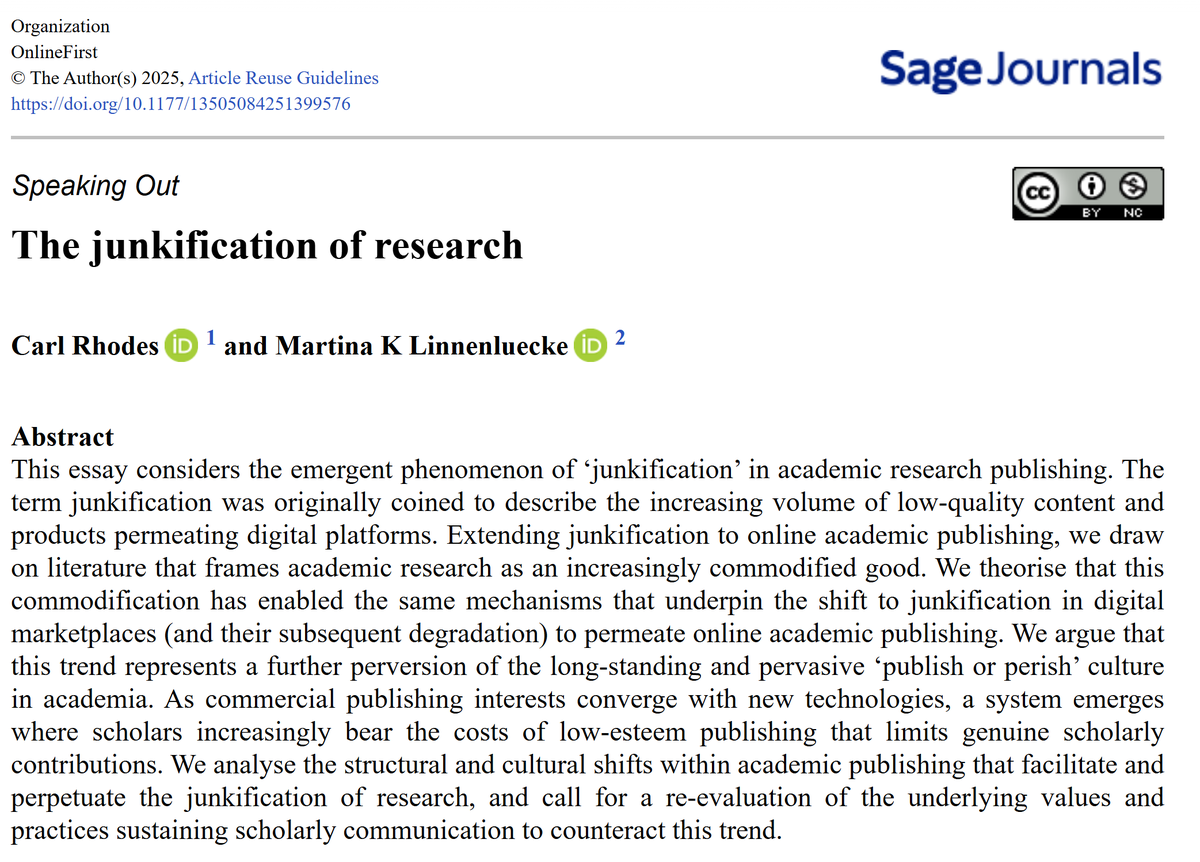
Two business school professors from the University of Technology in Sydney have sounded the alarm on the declining quality of academic literature in a new publication titled “The junkification of research”.
Drawing parallels to the “enshittification” of online platforms, they argue that similar forces are now overwhelming scholarly publishing. The key drivers are threefold: 1) relentless “publish or perish” pressures in academia, 2) scientific publisher’s incentive to publish more to make more money, and 3) AI making paper production faster and easier. Taken together, they say, these drivers are a recipe for disaster. The authors call for a shift to not-for-profit models of scientific publishing and better evaluation systems.
I strongly doubt either is going to happen.
The problem is of course not new, and you all know that I have been drawing attention to this trend for more than a decade. It is interesting to see, however, that the awareness for the issue is increasing.
Paper: Rhodes, C., & Linnenluecke, M. K., “The junkification of research” Organization (2025).